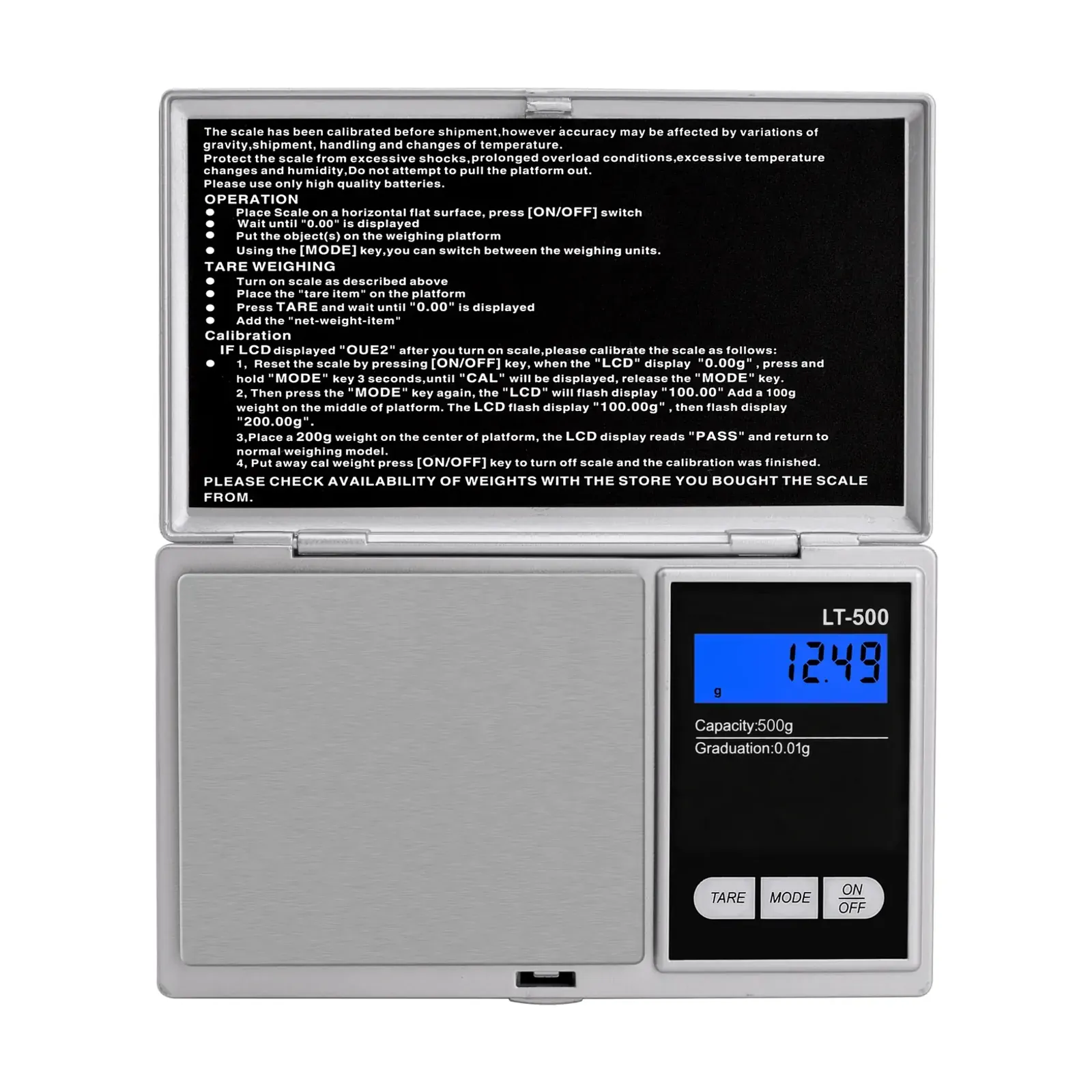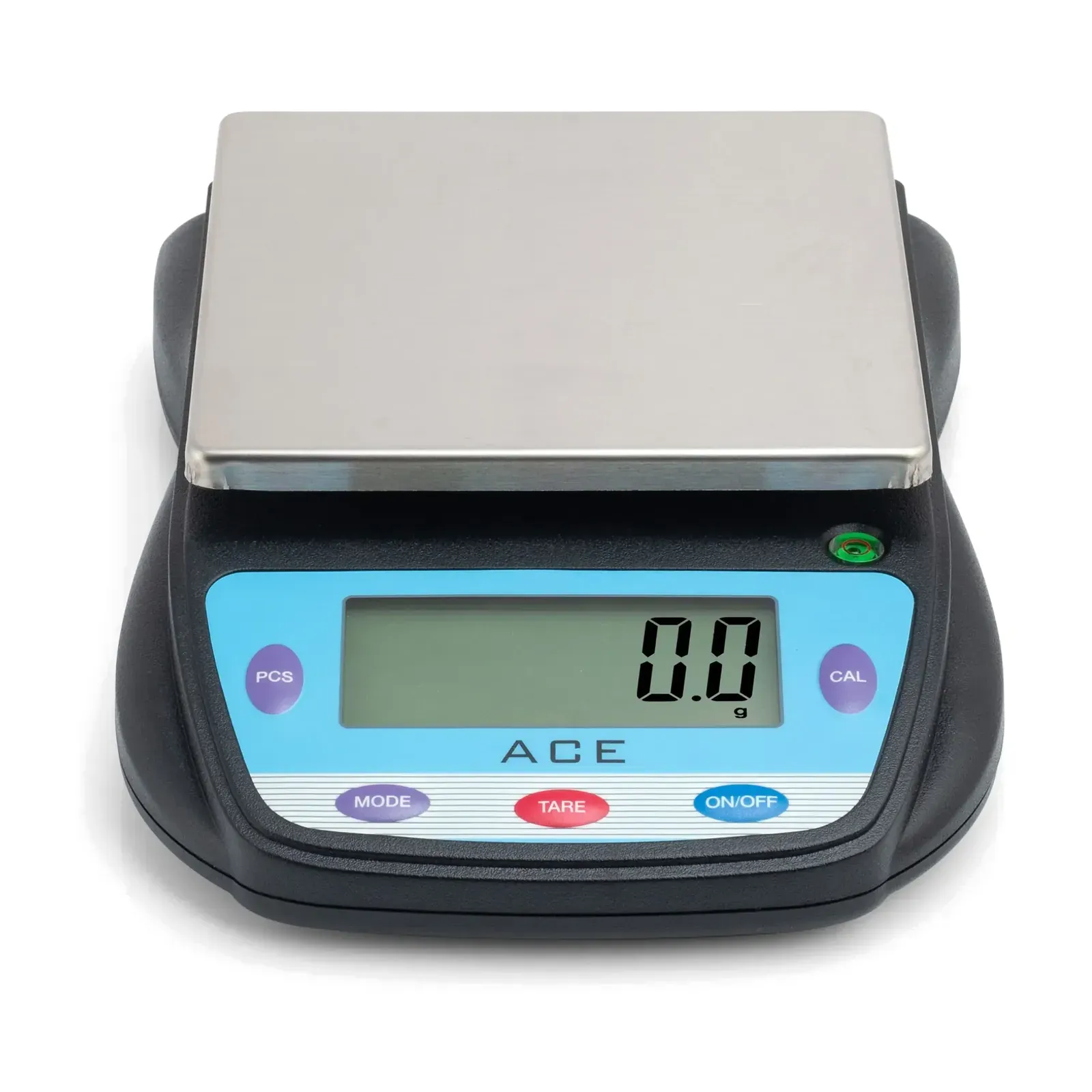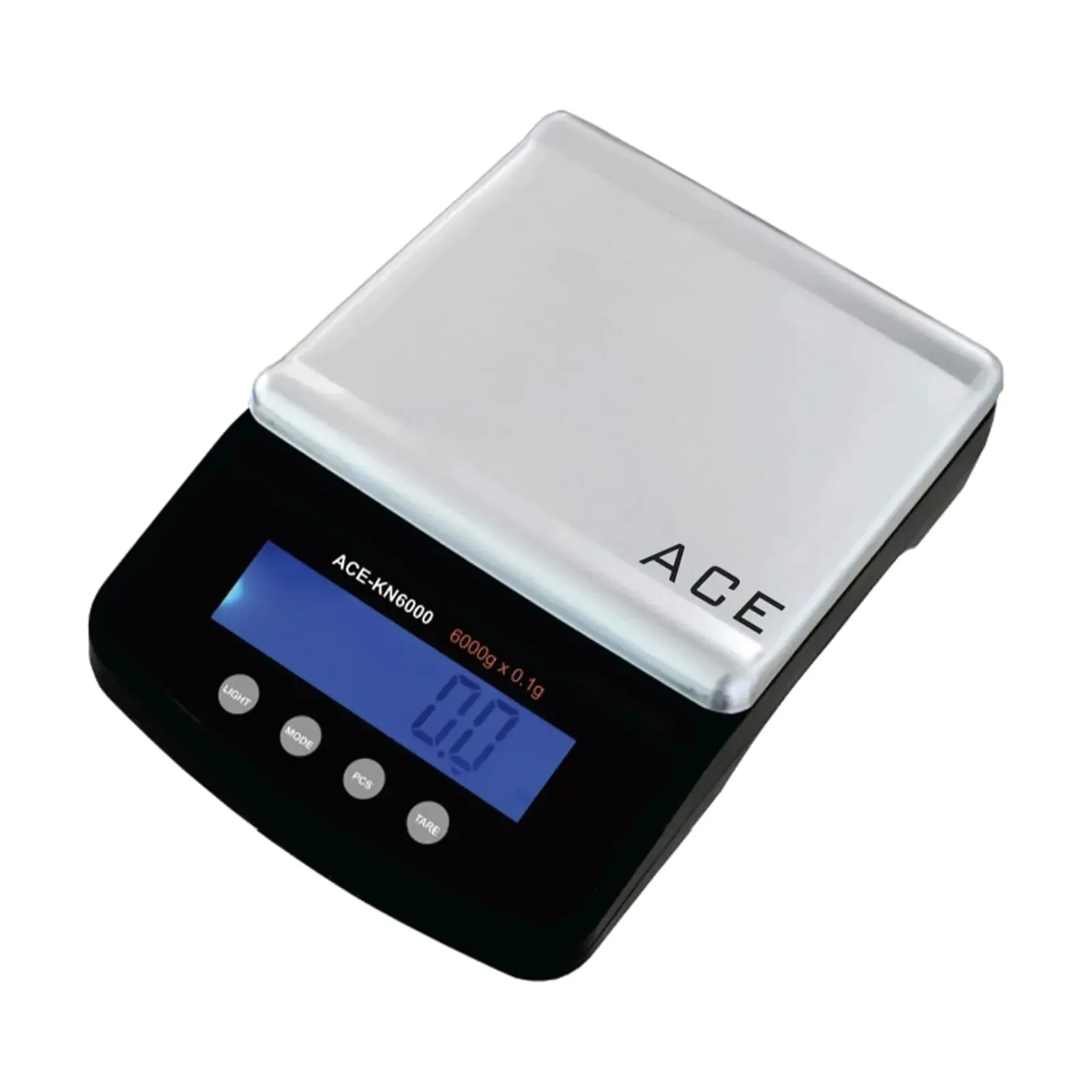
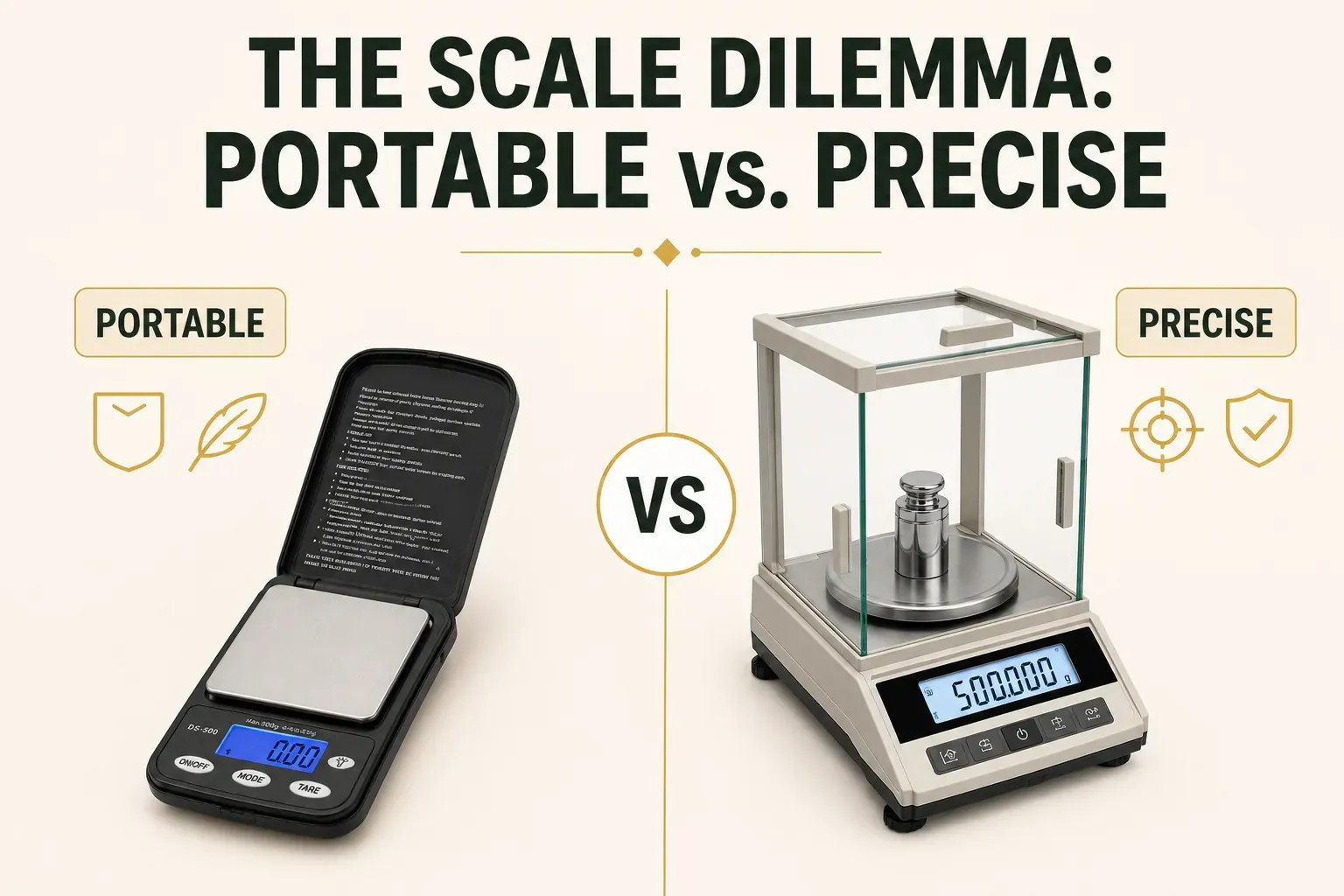
Choose a pocket scale for small items up to 500 g on the move, and a bench scale for 600 g to 35 kg on a fixed counter. The Ace LT-500 pocket scale weighs 500 g in 0.01 g steps and weighs about 150 g itself. The Ace KB-6000 bench scale weighs 6 kg in 0.1 g steps on a 130 x 130 mm steel pan.
A pocket scale is a battery-powered digital scale about the size of a phone, built to weigh small items in 0.01 g or 0.001 g steps. A bench scale stays on a counter or workbench, has a larger pan, and weighs from 600 g up to 35 kg in Omace's Ace range.
Pocket and bench scales compared side by side
The table compares two Ace scales sold today, so every figure is a product specification.
| Feature | Pocket scale: Ace LT-500 | Bench scale: Ace KB-6000 |
|---|---|---|
| Capacity | 500 g | 6 kg |
| Reads in | 0.01 g steps | 0.1 g steps |
| Pan | Stainless steel, 60 x 75 mm | Stainless steel, 130 x 130 mm |
| Power | 2 AAA batteries | AAA batteries or adapter |
| Size and weight | 12.8 x 7.7 x 1.9 cm closed, about 150 g | 8.2 x 6.2 inch, 650 g |
| Price (October 2026) | ₹1,099 | ₹2,599 |
The LT-500 reads in grams, carats and tola, and one tola is 11.6638 g. The KB-6000 adds ounces, grains, pennyweights and troy ounces, seven units in all. Both have tare, an overload sign and auto off.
How a pocket scale works, and what upsets it
A digital pocket scale weighs with a load cell. The pan rests on a small metal beam fitted with strain gauges, and the beam bends very slightly under a load. The gauges turn that bend into an electrical signal, which the scale's chip shows as grams.
At 0.01 g, the surroundings matter as much as the scale. NIST's guide to factors affecting weighing lists balance drift, air currents, temperature differences, magnetic or electrostatic fields and handling as sources of error. It advises keeping balances away from heating and cooling vents. It also warns that relative humidity well below 40% can cause static discharge and erratic readings.
A 0.001 g scale works at the edge of what can be checked. OIML R 76, the international standard for non-automatic weighing instruments, notes that verifying a scale to an interval below 1 mg is not normally feasible. Test loads that small carry too much uncertainty.
Readability is not the same as accuracy. A scale that displays 0.01 g reads true to that level only when it is level, calibrated and out of a draught.
Bench scales with 0.1 g readability
A bench scale with 0.1 g readability weighs a few kilograms in steps fine enough for silver articles, herbs, parcels and kitchen batches. Omace's Ace range has two:
- The Ace KB-6000 6 kg weighing scale weighs 6 kg in 0.1 g steps on a 130 x 130 mm stainless steel pan for ₹2,599.
- The Ace KN 10 kg weighing scale comes as 6 kg in 0.1 g steps or 10 kg in 0.5 g steps for ₹3,999. It adds piece counting, a level indicator and a 160 x 160 mm pan.
Capacity and step move together. The same KB body reads 0.01 g steps when its capacity drops to 600 g (KB-600, ₹4,699). The Ace PS-30 reads 1 g steps up to 30 kg for ₹1,799. For 0.01 g on a counter, the Ace KS-600 weighs 600 g for ₹2,999, and the Ace JS-6002 adds green LED displays on the front and back for ₹9,999. All of them sit in Omace's jewellery weighing scale range.
When a pocket scale is the right choice
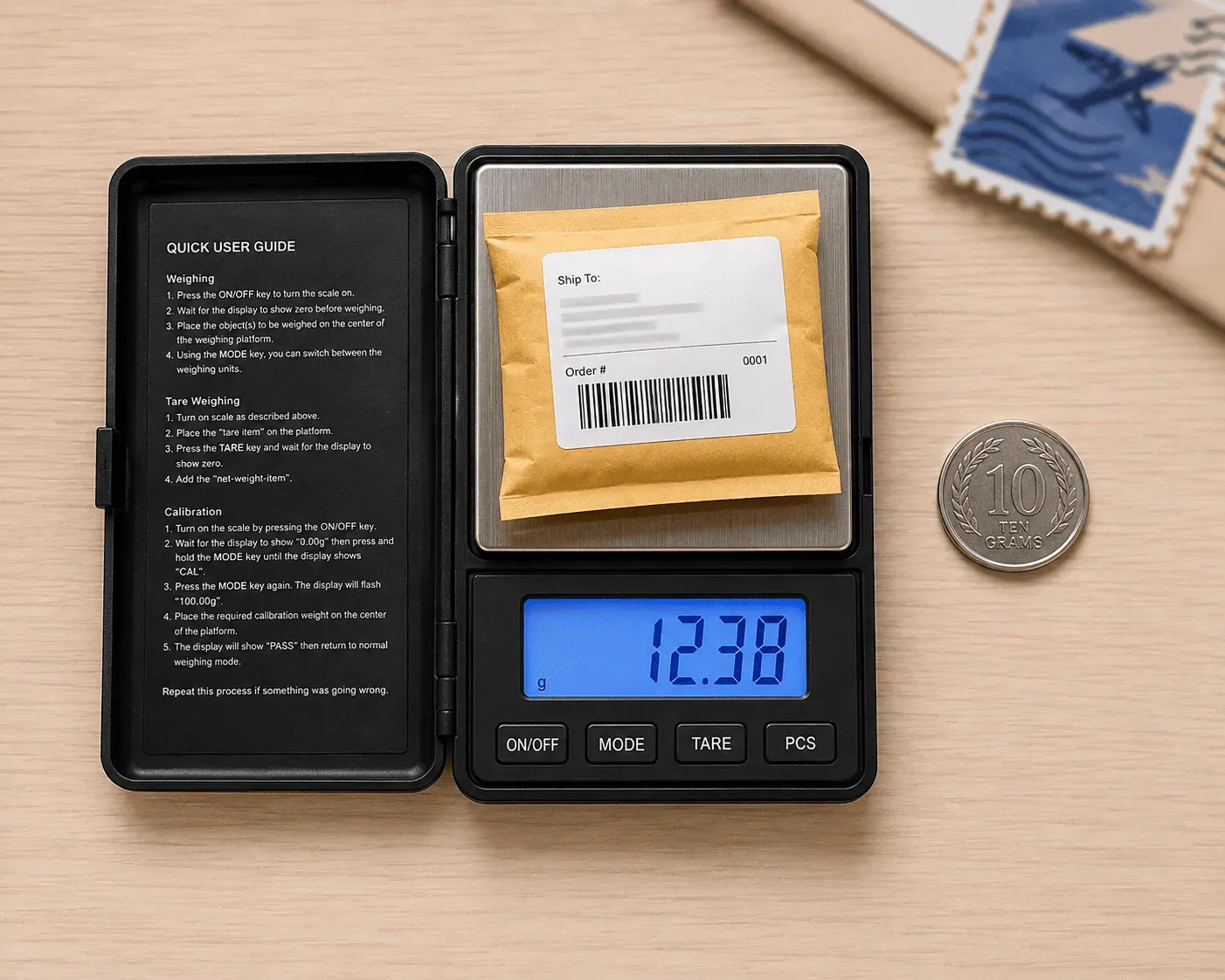
- You weigh on the move. The Ace LT-500 digital pocket scale is about the size of a phone and runs on 2 AAA batteries. Its flip cover closes over the pan and keys, so nothing presses on the sensor in a bag.
- Your items weigh under 500 g. Gold rings, coins, spices, saffron, tea, herbal powders and medicine all fit on its 60 x 75 mm pan.
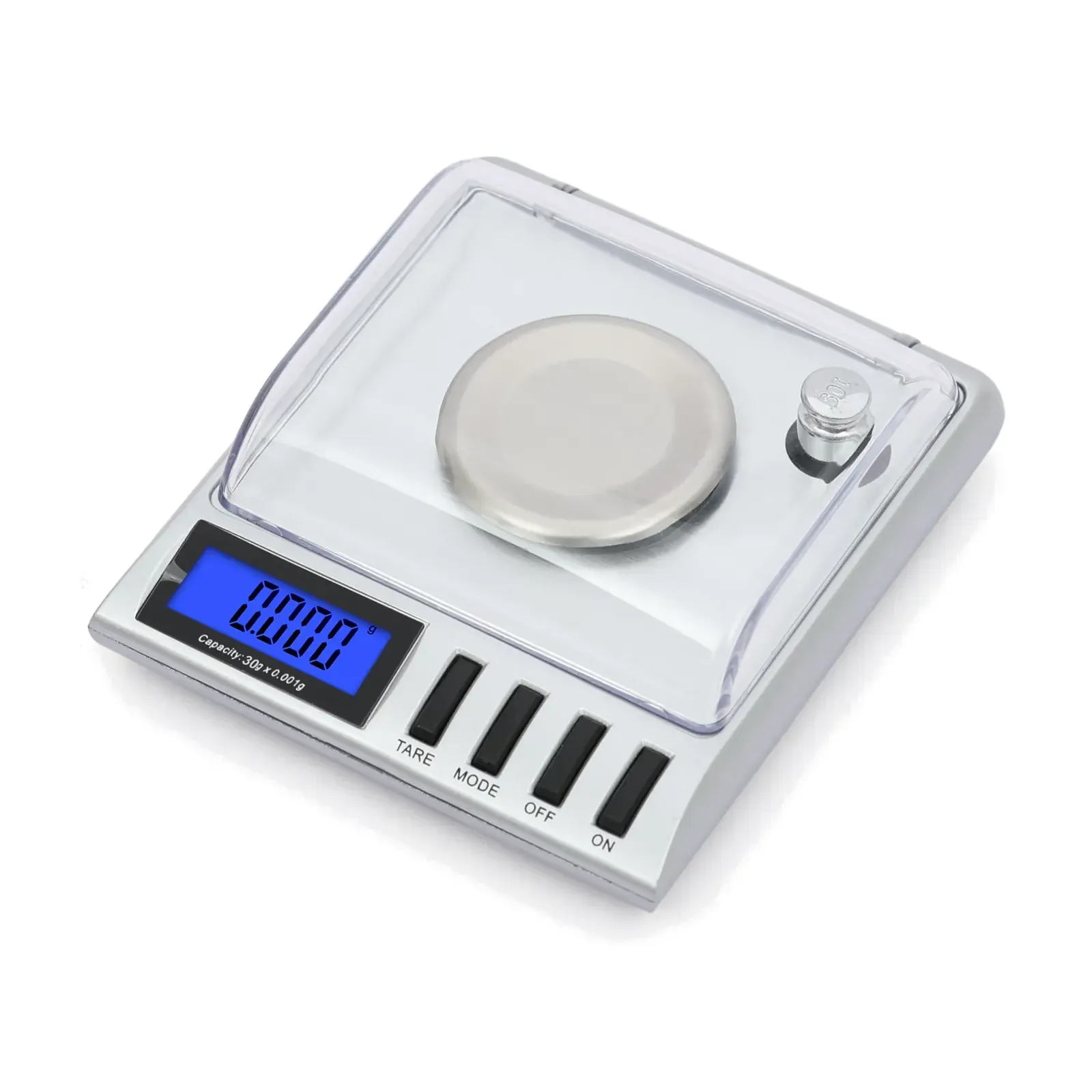
- You weigh gemstones. One metric carat equals 200 mg, according to NIST, so a 0.01 g scale reads in 0.05 carat steps and a 0.001 g scale in 0.005 carat steps. For small stones, the Ace GM-50 carat scale weighs 50 g in 0.001 g steps and comes with a windshield, tweezer and calibration weights for ₹2,599.
- You want a spare. A pocket scale at ₹799–₹1,099 is a low-cost backup for a workshop bench scale.
Omace's pocket scale range costs ₹799–₹2,499 for 0.01 g models and ₹1,999–₹4,499 for 0.001 g models (October 2026). For suitcases, the portable choice is a 50 kg luggage scale such as the Hoffen HO-L-8 at ₹349.
When a bench scale is the better buy
- Your loads go past 500 g. Silver articles, parcels, parts and bakery batches need the 6–10 kg of a bench scale.
- The scale stays in one place. A bench scale on a fixed counter stays level, and the KB and KN run on an adapter as well as AAA batteries.
- You count pieces. The KN works out the weight of one piece from a sample, then counts coins, parts or packets.
- You need a bigger pan. Pans of 130 x 130 mm and 160 x 160 mm take trays and containers that would overhang a pocket scale.
A jeweller who visits clients can keep both: a bench scale at the counter and a pocket scale in the bag.
Which scale can be used for trade
Any scale used to buy or sell by weight must be verified before use, whatever its size. Section 24 of the Legal Metrology Act, 2009 applies to every weight or measure used in a transaction. State Legal Metrology officers carry out the verification, according to the Department of Consumer Affairs.
Before you use a pocket or bench scale at a shop counter, check that the model has Legal Metrology approval and get the scale stamped. A stamped scale is sealed, and only a registered repairer may recalibrate it. Section 11 of the same Act bars stating a price or quantity in a transaction in anything other than standard units. Bill in grams, even if your scale also shows tola. Goldsmiths choosing a counter scale can read the jewellery scale buying guide.
How to get a steady reading on either scale
- Put the scale on a flat, steady table away from fans, AC vents and open windows.
- Switch it on with the pan empty and wait for zero.
- If you use a bowl or paper, put it on the pan and press TARE.
- Place the item gently in the middle of the pan and read it once the number stops changing.
NIST advises handling small test weights with forceps or clean gloves rather than bare fingers, and letting objects reach the same temperature as the balance. The same habits help with gold and gemstones. If you move a bench scale to a new table, recheck it with a known weight. To calibrate the LT-500, switch it fully off once and back on, then press and hold the TARE key for about 5 seconds. It asks for 50 g, then 100 g, then 500 g. The full steps are in how to calibrate a pocket scale.
Ace pocket and bench scales from Omace
Ace is Omace's brand for jewellery, pocket and laboratory scales. Omace Brands Private Limited has made and supplied weighing scales in India since 1994, from Bagru, Jaipur. Every scale is checked before dispatch. Omace scales are made in India. As a manufacturer, Omace Brands Private Limited holds ISO 9001:2015, ISO 13485:2016 and EU MDR quality certificates, and CE and US FDA compliance certificates; each is listed with its certificate number on the Omace certificates page.
Scales bought on the Omace store carry a 2-year warranty on manufacturing defects, excluding batteries and physical damage. Omace delivers PAN India.