Poultry farming in India means raising chickens and other birds for eggs and meat. The country produced 149.11 billion eggs in 2024-25, according to the Department of Animal Husbandry and Dairying. Commercial farms laid 84.49% of them. A new farmer chooses broilers or layers first, because housing, feed and cash flow all follow that choice.
What a poultry farm is, and the size of the trade in India
A poultry farm keeps domestic birds for eggs, meat or breeding stock. The Hindi name is murgi palan, which points to the chicken, though India's 20th Livestock Census also counted ducks, emus, turkeys and quail. That 2019 census found 851.81 million poultry birds: 534.74 million on commercial farms and 317.07 million in backyards. The Department's 2025 year-end review said fieldwork for the 21st census had finished and its report was being finalised.
India ranks second in the world for eggs and fourth for meat, according to the same review, which cites FAOSTAT 2023 data. The Basic Animal Husbandry Statistics 2025 put poultry at 5.18 million tonnes of the 10.50 million tonnes of meat produced in 2024-25, about half. Each Indian had 106 eggs available that year, against 62 in 2014-15. Andhra Pradesh led with 18.37% of eggs, followed by Tamil Nadu at 15.63% and Telangana at 12.98%.
Types of poultry farm
Four kinds of farm cover almost everyone starting out. They differ in how soon money comes in and how much of the work is fixed by others.
Broiler farm
A broiler is a young chicken raised for meat. A 2025 study of 348 commercial batches in Tamil Nadu says the desirable market age is almost standardised around 42 days, and it recorded market weights of 2.20–2.33 kg. Many growers work on contract, and the study notes the integrator fixes the lifting age from daily market demand. IS 1374, the Indian Standard for poultry feeds, records that the broiler cycle has come down from eight weeks to six.
Layer farm
Layers are hens kept for table eggs. The NABARD model scheme for a 20,000-bird unit assumes 8.5 kg of feed per bird up to 20 weeks, then 40 kg over 52 weeks of laying, for 310 eggs per bird. Income starts late: the IS 1374 performance table has production at 5% in week 19, reaching 97% around week 30. Tamil Nadu Agricultural University puts an economical layer unit at about 2,000 birds.
Backyard poultry
Backyard flocks forage by day and shelter at night. ICAR-Directorate of Poultry Research suggests 10–20 birds per household, moved to free range at six weeks once they weigh 650–750 g. Its Vanaraja lays 100–110 eggs a year in a backyard and its Gramapriya 160–180. The Indian chicken breeds and varieties guide compares them. Backyard birds still laid 15.51% of India's eggs in 2024-25.
Breeder farm and hatchery
A breeder farm keeps parent birds and sells hatching eggs or day-old chicks. It needs more skill and capital than a grow-out shed, and it is the type the main central subsidy is written for, as the support section below explains.
Broiler, layer and backyard: quick reference
| Measure | Broiler | Layer | Improved backyard |
|---|---|---|---|
| Main product | Meat | Table eggs | Eggs and meat |
| First income | About 42 days | About 19 weeks | About 3 months for males |
| Output | 2.20–2.33 kg per bird | 310 eggs per bird in the NABARD model | 100–180 eggs a year |
| Feed | FCR of 1.58–1.70 | 8.5 kg to week 20, then 40 kg over 52 weeks | Forage plus 20–30 g grain each evening |
| Housing | Deep litter, up to 0.9 sq ft by week 7 | Cage, 0.6–0.85 sq ft per bird | Night shelter |
Poultry housing: space, litter and site rules
Deep litter and cages are the two main systems. Tamil Nadu Agricultural University says litter starts at 5 cm before chicks arrive and builds to 15 cm by adding about 2 cm a week. It should be turned at least twice a week in cold or rainy weather and once a week in hot weather, and kept dry. Its space table gives chicks 0.2 sq ft in week 1, 0.4 sq ft in week 4 and 0.9 sq ft in week 7.
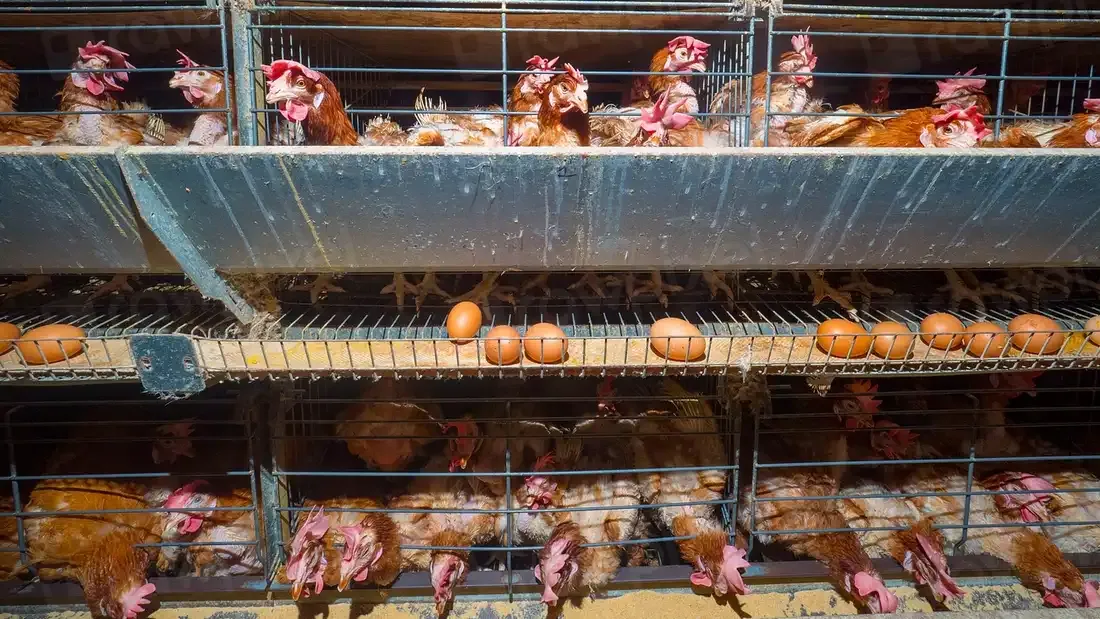
Cages for layers take 0.6–0.75 sq ft per bird in the university's figures, and the NABARD model uses 0.85 sq ft, with 1 sq ft on deep litter during rearing. Chicks need heat at first: the university gives 35 °C in the first week, falling to 23 °C by week five.
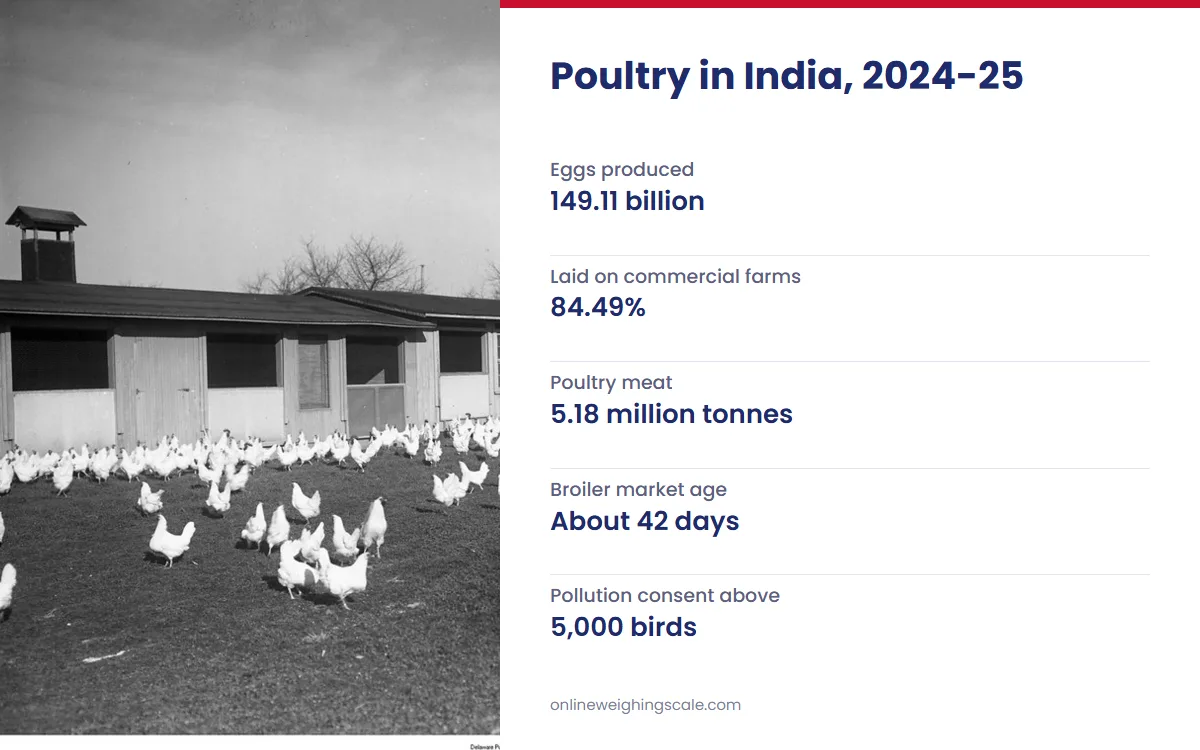
Site rules come next. The Central Pollution Control Board's Environmental Guidelines for Poultry Farms sort farms into small at 5,000–25,000 birds, medium up to 1 lakh and large above that. Following a National Green Tribunal order, farms above 5,000 birds at one location need consent to establish and consent to operate from the state board, from 1 January 2023. Poultry is a green category activity, with consent valid for 15 years.
- Homes: new farms should preferably stand 500 m from a residential zone.
- Water: 100 m from rivers, lakes, canals and drinking water sources.
- Roads: 100 m from a national highway, 50 m from a state highway and 10–15 m from rural roads.
- Boundary: sheds at least 10 m inside the farm boundary for cross ventilation.
Poultry feed and feed conversion ratio
Feed is sold by stage, and IS 1374 sets a minimum energy level for each. Broiler pre-starter runs from day 1 to 7, starter from day 8 to 21 and finisher from day 22. Layers move through chick, grower and two laying phases, and the standard advises 4–5 g of shell grit or limestone per bird per day during lay.
| Feed | When | Minimum energy, kcal/kg |
|---|---|---|
| Broiler pre-starter | Days 1–7 | 3,000 |
| Broiler starter | Days 8–21 | 3,100 |
| Broiler finisher | Day 22 onward | 3,200 |
| Layer chick | Weeks 0–8 | 2,800 |
| Layer grower | Weeks 9–20 | 2,500 |
| Layer Phase I | Weeks 21–45 | 2,600 |
| Layer Phase II | Weeks 46–72 | 2,400 |
Feed conversion ratio, or FCR, is the farm's report card. The Tamil Nadu study works it by dividing total feed intake of a batch by its total live weight output. Its batches averaged 1.58 in monsoon, 1.60 in winter and 1.70 in summer, and the authors blame heat stress for the summer result. A flock that eats 18,000 kg of feed and weighs 11,250 kg at sale has an FCR of 1.60. ICAR-DPR lists 2.0 for its slower-growing, coloured Krishibro, so judge a bird against its own type.
Poultry health and biosecurity
ICAR-DPR's pamphlet gives this vaccination schedule for rural chicken varieties. Commercial flocks follow their own, so let your veterinarian set the final plan.
| Age | Vaccine |
|---|---|
| 1 day | Marek's disease |
| 5–7 days | Newcastle disease (Lasota) |
| 14 and 24 days | Infectious bursal disease |
| 30 days | Newcastle disease (Lasota) |
| 6 weeks | Fowl pox |
| 9 weeks | Newcastle disease (R2B) |
Biosecurity is mostly about what enters the shed. Limit visitors and outside vehicles, keep separate footwear for each shed, and rear one age group per shed where you can. Keep rodents and wild birds out, clean drinkers daily and report sudden deaths to the government veterinary officer. The pollution board's guidelines say dead birds must be collected promptly and disposed of by the prescribed methods, because carcasses attract disease, insects and predators.
Antibiotics have a legal limit too. A Health Ministry notification of 19 July 2019 banned the manufacture, sale and distribution of colistin and its formulations for food producing animals, poultry, aqua farming and animal feed supplements.
Government support for poultry farmers
These terms were checked November 2026, and schemes change, so confirm with your district animal husbandry office. The National Livestock Mission's entrepreneurship programme gives a 50% capital subsidy of up to ₹25 lakh for rural poultry breed development ventures, and it approved 208 poultry projects between 2021-22 and 2025-26. A parliament reply sets the unit at 1,000 parent layers plus 100 males for a parent farm, hatchery or brooder cum mother unit. Individuals, farmer producer organisations, self-help groups, joint liability groups, cooperatives and Section 8 companies can apply. A plain broiler shed does not match that description.
The Animal Husbandry Infrastructure Development Fund offers a 3% interest subvention with loans of up to 90%, according to the year-end review, and it covers animal feed plants and breed multiplication farms. For ordinary sheds, the usual route is a bank loan with NABARD refinance. NABARD's note puts borrower margin at 10% to 25%, and it says birds, sheds and equipment may be insured.
Writing a poultry farm business plan
A bank will want more than a bird count and a profit guess. NABARD's list works as a ready outline for a poultry farm business proposal.
- Technical: land, farm size, sheds, equipment, housing system, chick strain and source, feed source, water and power, veterinary aid, expected FCR and mortality, and a flock projection chart.
- Financial: capital and running costs, loan and margin, income and expenditure, cash flow, and repayment schedule.
- Marketing: where you will sell eggs, birds and manure, and whether payment is by kilo or by number.
The prices in older model schemes are out of date, so use your own quotes. Broiler rates and chick prices change daily by market, which is why this post quotes neither; take today's rate from your local buyer or integrator.
Weighing birds and feed on a poultry farm
FCR rests on two weights, so a wrong scale gives a wrong answer about your flock. In the example above, a scale reading 1% low would show 11,138 kg of birds and turn an FCR of 1.60 into 1.62. Weigh a sample of birds from different parts of the shed at the same time each week, check feed bags as they arrive, and weigh crates at sale.
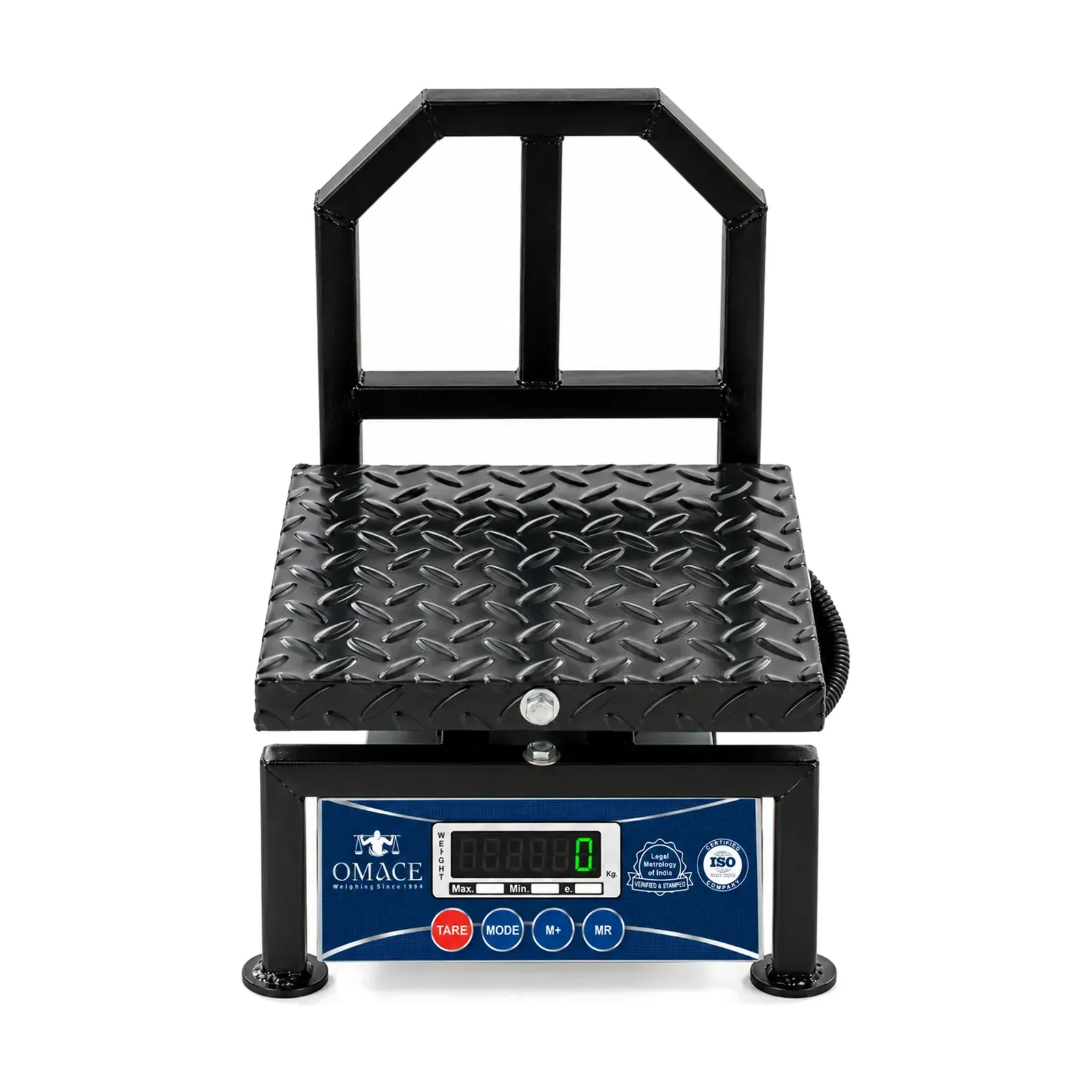
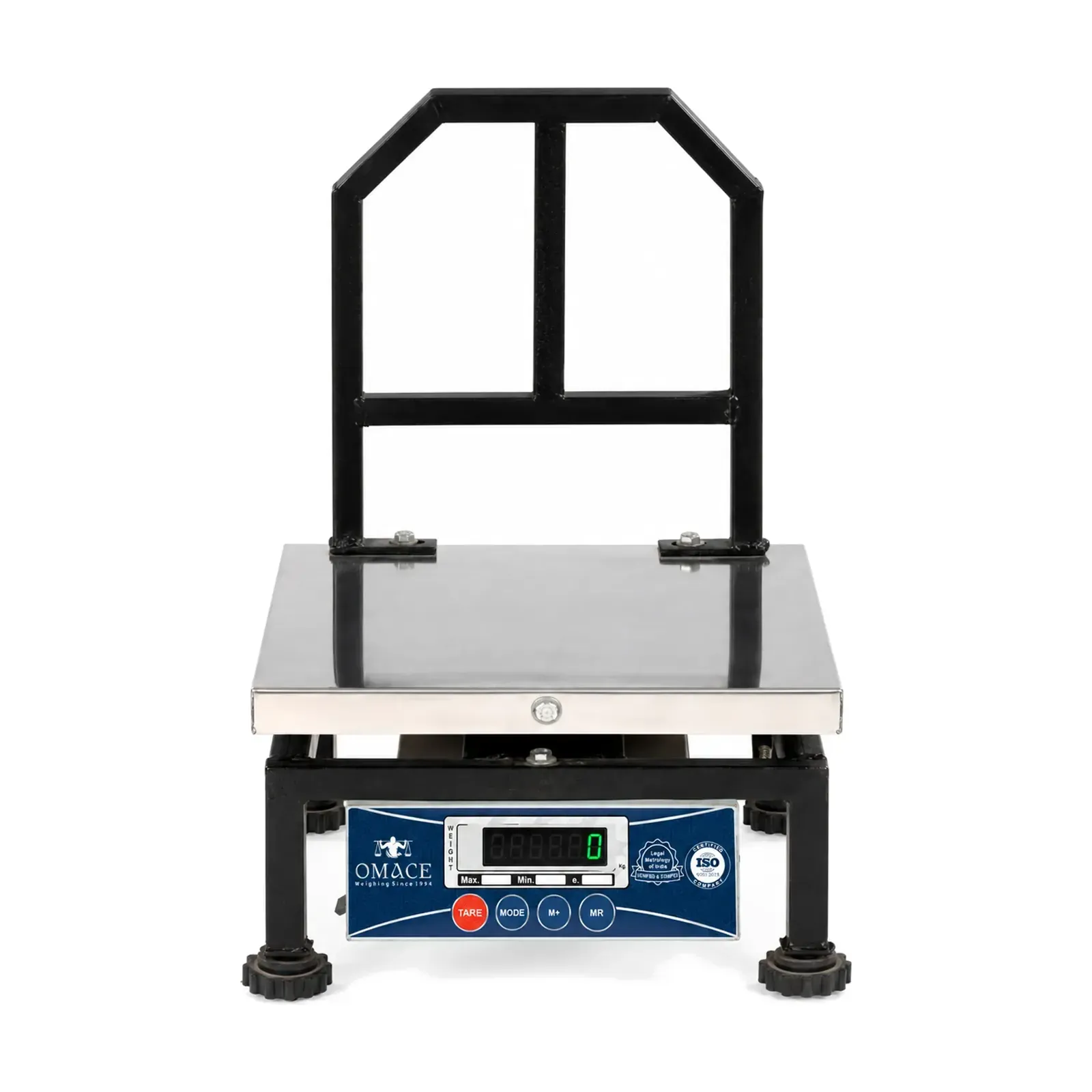
A bird scale used for selling must be verified and stamped. Omace shop and chicken scales leave Bagru verified and stamped by Legal Metrology. The Om-CK-MS chicken weighing scale has a mild steel platform, and the Om-CK-SS poultry weighing scale has stainless steel for sheds that are washed often. Both run from 60 kg to 300 kg, and the mild steel model reads in 5 g steps at 60 kg.
Starting small and staying within the rules
A first batch teaches more when it is small and the loan behind it is small too. Visit a working farm in your district, speak to the veterinary officer and ask your state pollution board what your bird count requires before you build. Keep daily records of feed, deaths and weights from the first batch, since those records tell you sooner than the bank statement whether the shed is working.