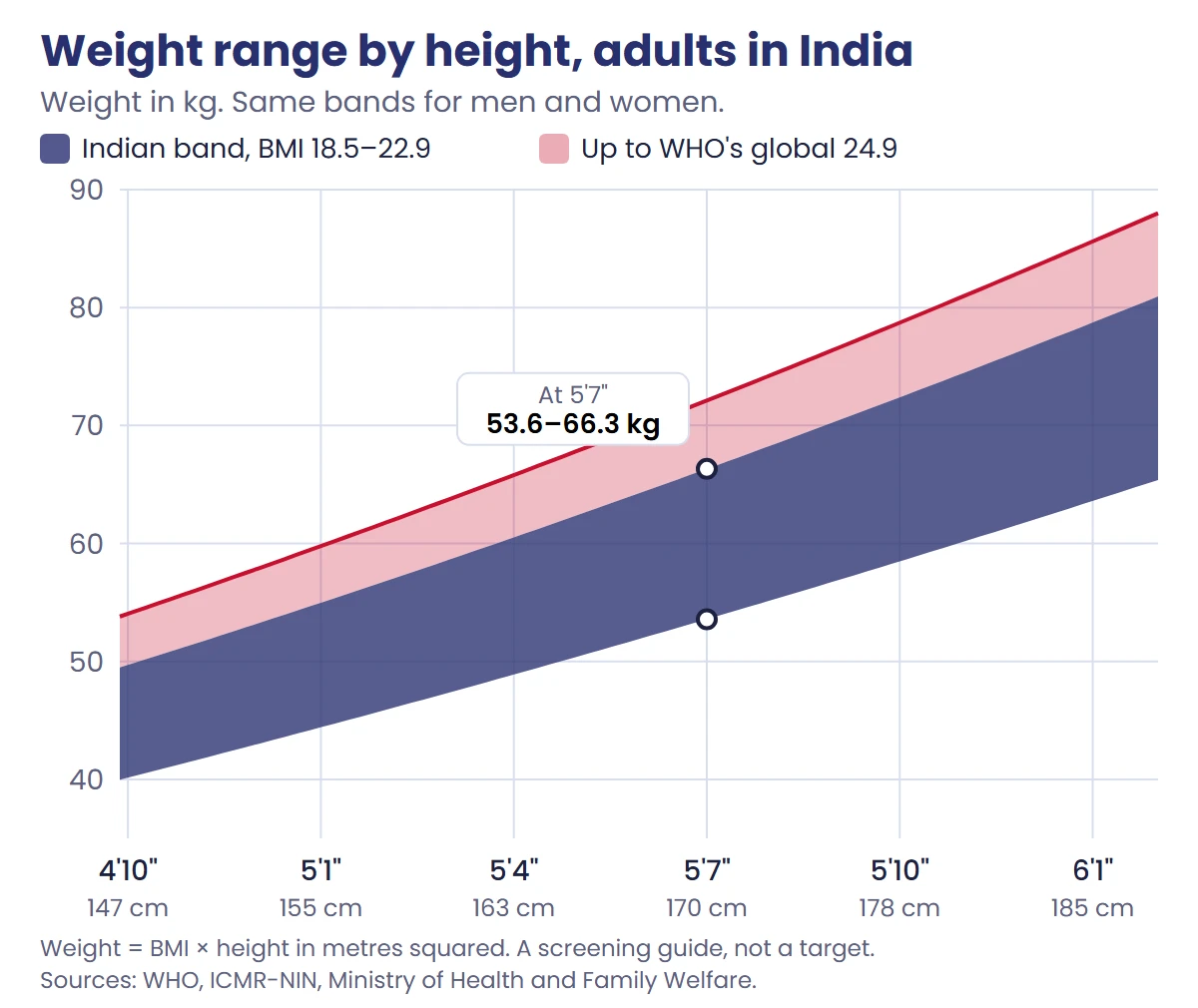
A height and weight chart for Indian adults turns BMI into a weight range, and at 5'7" (170.2 cm) that range is 53.6–66.3 kg. Men and women share one chart, because WHO's BMI bands are the same for both sexes. ICMR-NIN puts the healthy band for Indians at BMI 18.5 to 23, below WHO's global 24.9. Read it as a screening guide.
Weight for each height, in kg
The third column uses the Indian band of BMI 18.5 to 22.9, from the Ministry of Health's 2016 guideline. The fourth uses WHO's global band of 18.5 to 24.9. Each row is plain arithmetic, so anyone can check it.
| Height | In cm | Indian band (BMI 18.5–22.9) | WHO global band (BMI 18.5–24.9) |
|---|---|---|---|
| 4'10" | 147.3 cm | 40.2–49.7 kg | 40.2–54.0 kg |
| 4'11" | 149.9 cm | 41.5–51.4 kg | 41.5–55.9 kg |
| 5'0" | 152.4 cm | 43.0–53.2 kg | 43.0–57.8 kg |
| 5'1" | 154.9 cm | 44.4–55.0 kg | 44.4–59.8 kg |
| 5'2" | 157.5 cm | 45.9–56.8 kg | 45.9–61.8 kg |
| 5'3" | 160.0 cm | 47.4–58.6 kg | 47.4–63.8 kg |
| 5'4" | 162.6 cm | 48.9–60.5 kg | 48.9–65.8 kg |
| 5'5" | 165.1 cm | 50.4–62.4 kg | 50.4–67.9 kg |
| 5'6" | 167.6 cm | 52.0–64.4 kg | 52.0–70.0 kg |
| 5'7" | 170.2 cm | 53.6–66.3 kg | 53.6–72.1 kg |
| 5'8" | 172.7 cm | 55.2–68.3 kg | 55.2–74.3 kg |
| 5'9" | 175.3 cm | 56.8–70.3 kg | 56.8–76.5 kg |
| 5'10" | 177.8 cm | 58.5–72.4 kg | 58.5–78.7 kg |
| 5'11" | 180.3 cm | 60.2–74.5 kg | 60.2–81.0 kg |
| 6'0" | 182.9 cm | 61.9–76.6 kg | 61.9–83.3 kg |
| 6'1" | 185.4 cm | 63.6–78.7 kg | 63.6–85.6 kg |
| 6'2" | 188.0 cm | 65.4–80.9 kg | 65.4–88.0 kg |
For example, a height of 170.2 cm is 1.702 m, and 1.702 squared is 2.897. Multiply 2.897 by 18.5 and you get 53.6 kg. Multiply it by 22.9 and you get 66.3 kg. Our BMI calculator does the same sum for any height and weight, and the height and weight converter switches between cm, feet, kg and pounds.
One height and weight table for men and women
WHO states that its adult BMI values are the same for both sexes and do not change with age. So a men's chart and a women's chart built on BMI give identical rows.
Many separate charts for men and for women online name no source. One common row gives men at 170 cm a top weight of 73.9 kg. Worked backwards, that is BMI 25.6, above even WHO's overweight line of 25.
ICMR-NIN does publish separate figures, for another job. Its 2020 nutrient tables use a reference man of 65 kg and a reference woman of 55 kg. They help set national nutrient requirements, and they are not personal goals.
Why Indian charts use a lower BMI line
ICMR-NIN's Dietary Guidelines for Indians, 2024, say Asians tend to carry more body fat at a given BMI, so the healthy band should stop at 23. Indian sources agree on that top line, but they differ on where obesity starts.
| Source | Healthy BMI | Overweight | Obesity |
|---|---|---|---|
| WHO, global | 18.5–24.9 | 25 and above | 30 and above |
| ICMR-NIN, 2024 | 18.5–23 | Over 23, up to 27.5 | Over 27.5 |
| Ministry of Health, 2016 | 18.5–22.9 | 23–24.9 | 25 and above |
| NHS, UK, South Asian adults | Below 23 | 23–27.4 | 27.5 and above |
WHO itself did not set an Asian cut-off. Its 2004 expert consultation kept 25 and 30 as the international lines and named 23 and 27.5 as possible action points for public health. The Ministry of Health's 2016 guideline sets the Indian lines in its third row, and the NHS uses the lines in its fourth for South Asian adults.
What a height and weight chart can't tell you
BMI is a screening number, and it can't see what the weight is made of. The NHS notes that a BMI calculator cannot tell muscle from fat, so a muscular adult can land in a higher band. WHO adds that the same BMI may not mean the same fatness in different populations.
Waist size adds a second check. ICMR-NIN links a waist above 90 cm in men and above 80 cm in women with higher risk of chronic disease. The NHS advises keeping your waist under half your height.
A 2025 paper from the India Obesity Commission goes further and proposes that Indian definitions should combine BMI, waist and health signs. A doctor reads all of these together, and one number on a chart diagnoses nothing.
Weight also moves from day to day with water and food. One long study of a single healthy man, weighed each morning for 9,521 days, found daily changes of about 0.4 kg at a body weight of 75 kg. So look at the trend across weeks.
How to measure your height and weight
A chart is only as good as the two numbers you bring to it. WHO's STEPS survey manual and an NHS England leaflet give these steps:
- Weigh at the same time of day, preferably in the morning.
- Put the scale on a firm, level floor, never on carpet or a slope.
- Wear little or no clothing, take off shoes and socks, and empty your pockets.
- Stand still, face forward, and wait until the number stops moving.
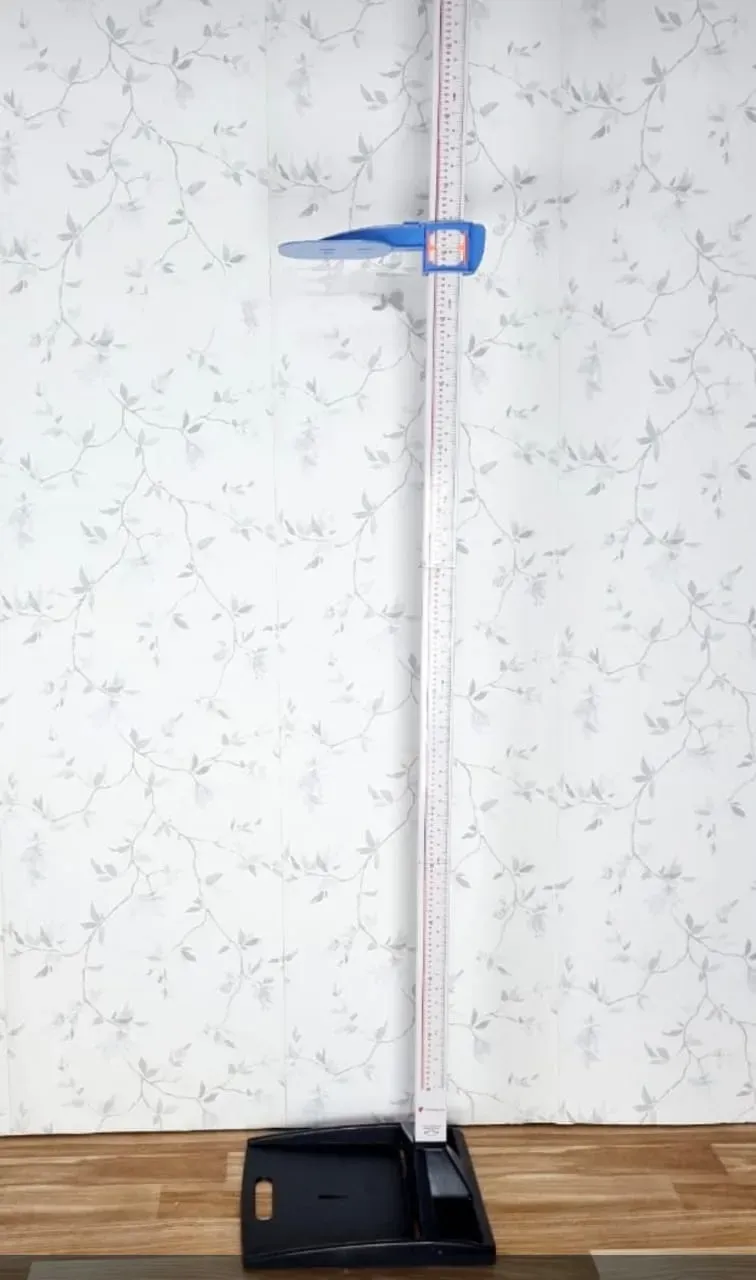
- For height, take off footwear and head gear and stand with heels back and knees straight.
- Look straight ahead, breathe in, stand tall, and read to the nearest millimetre.
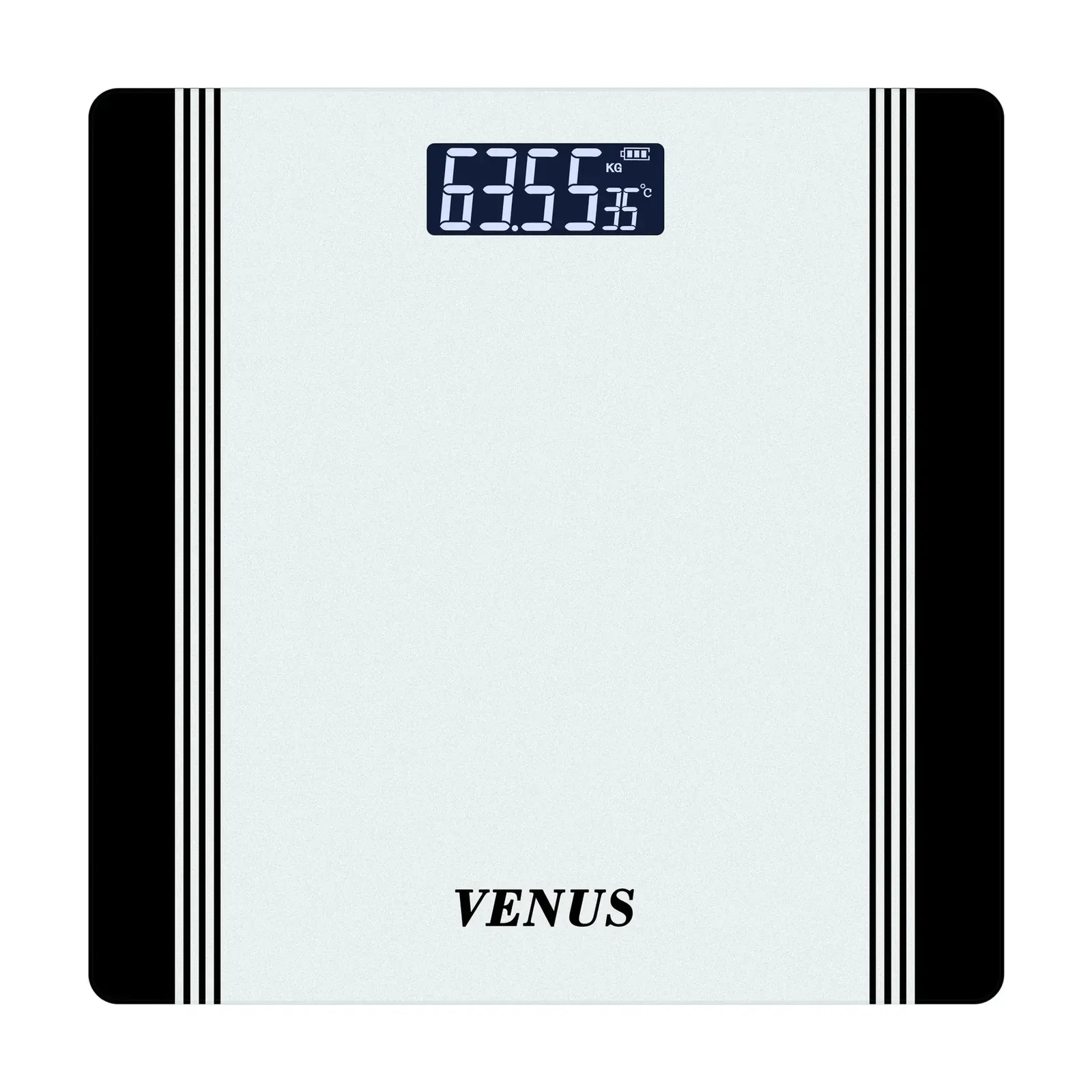
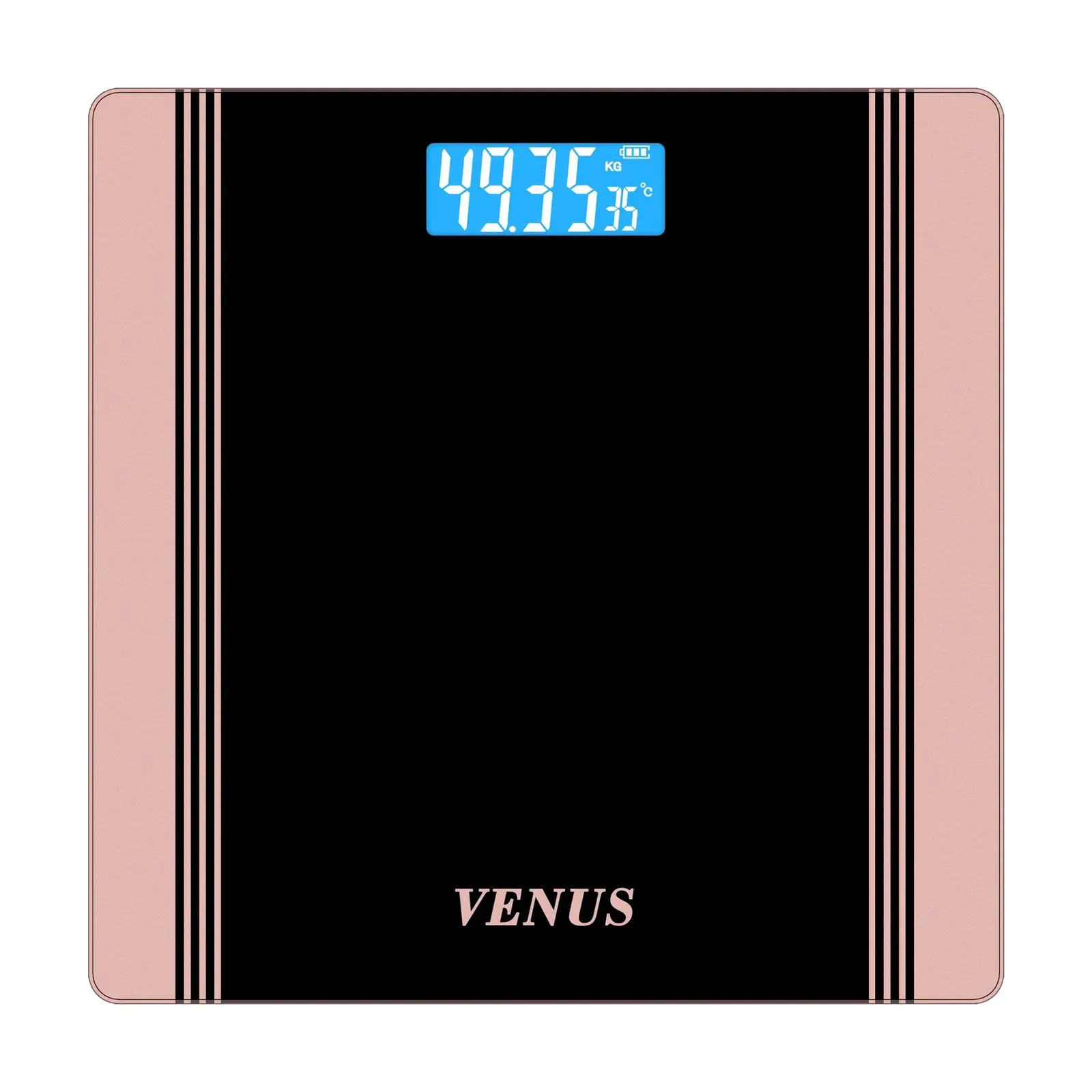
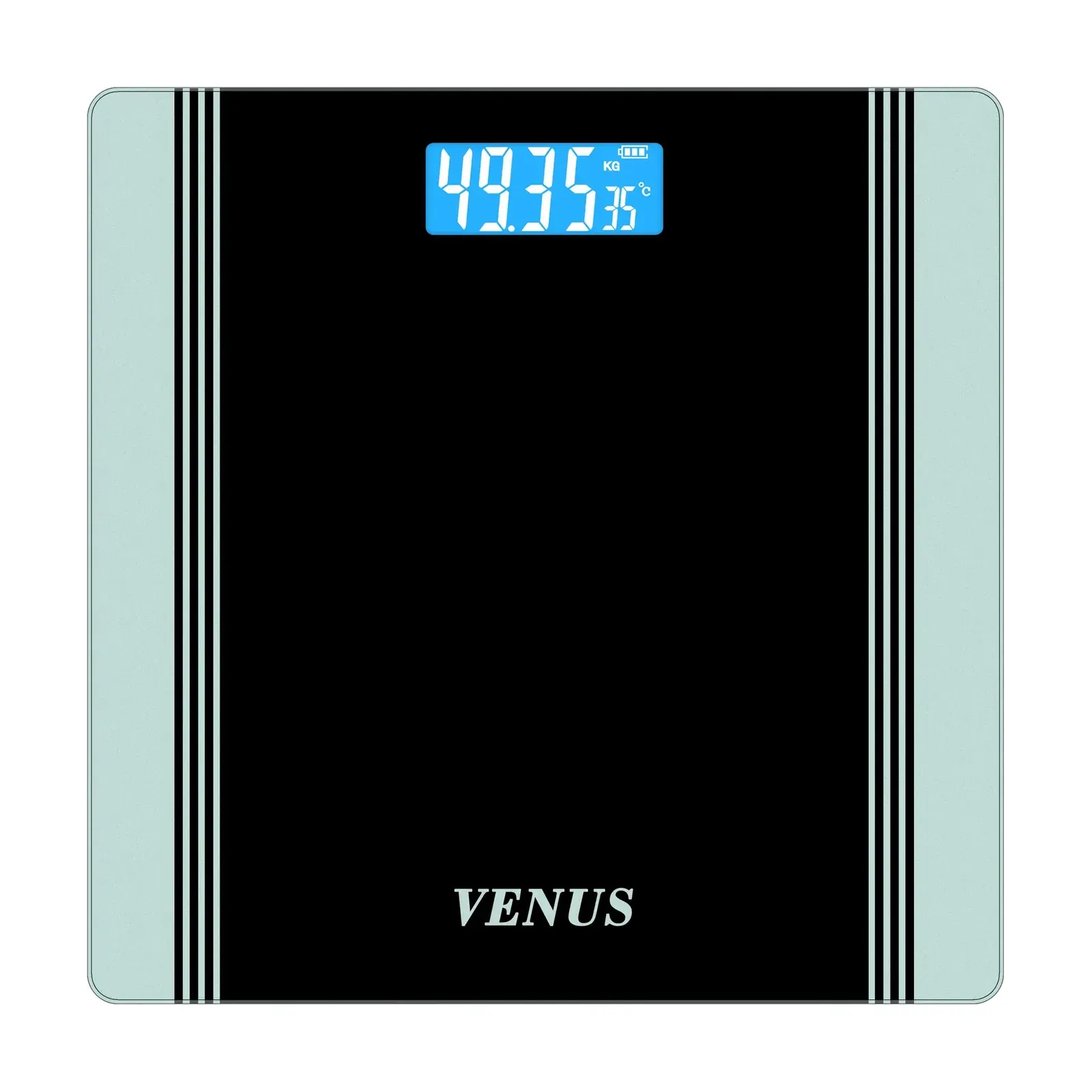
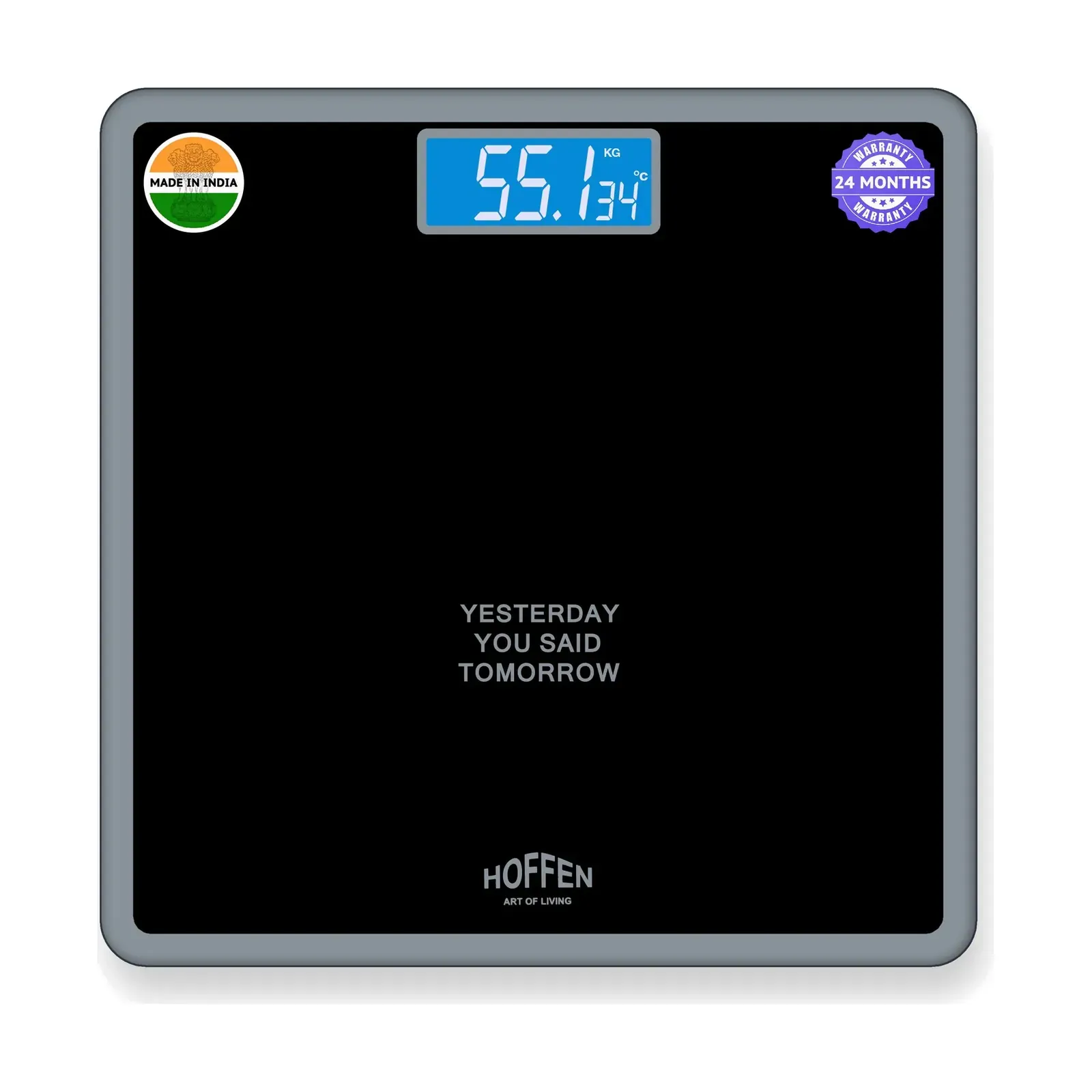
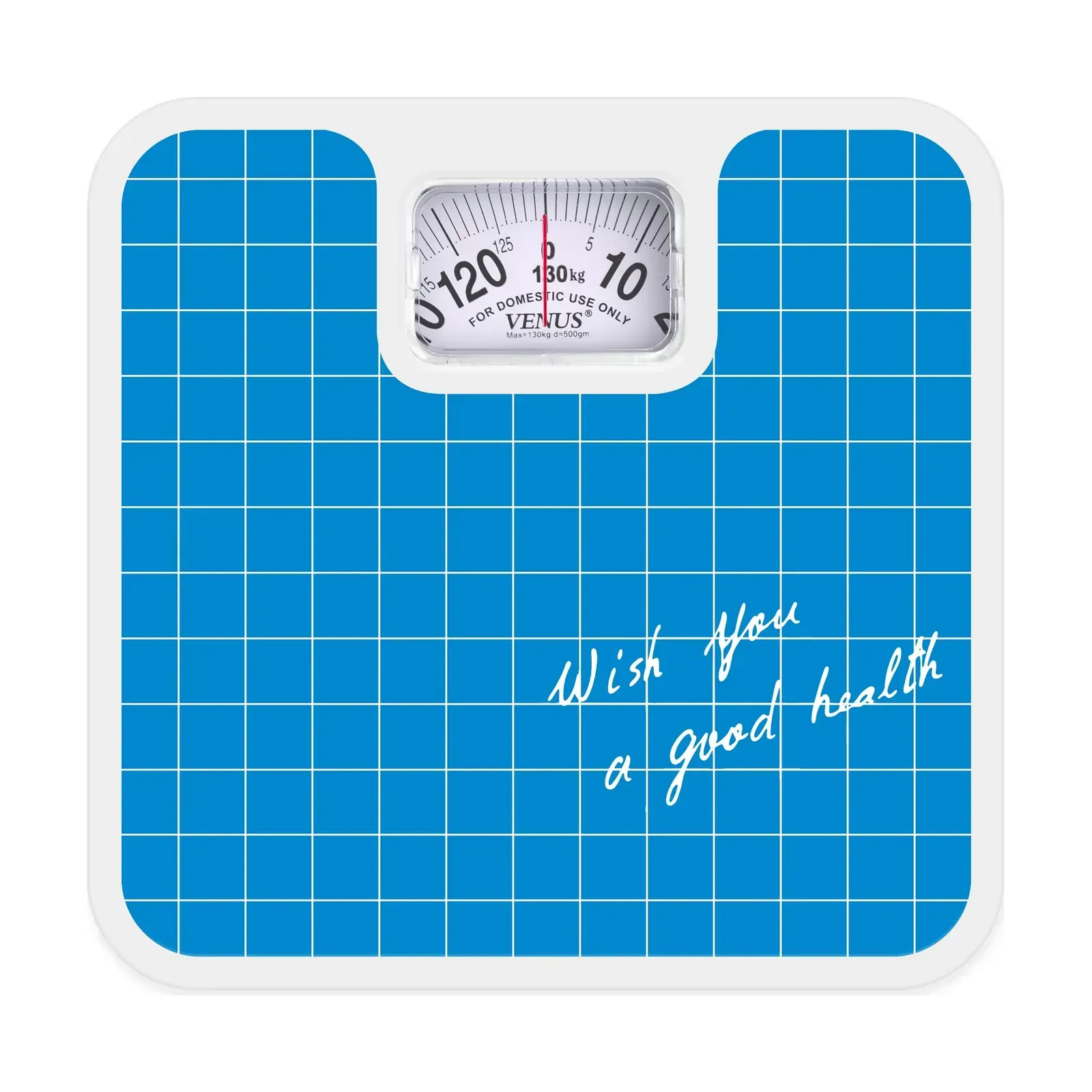
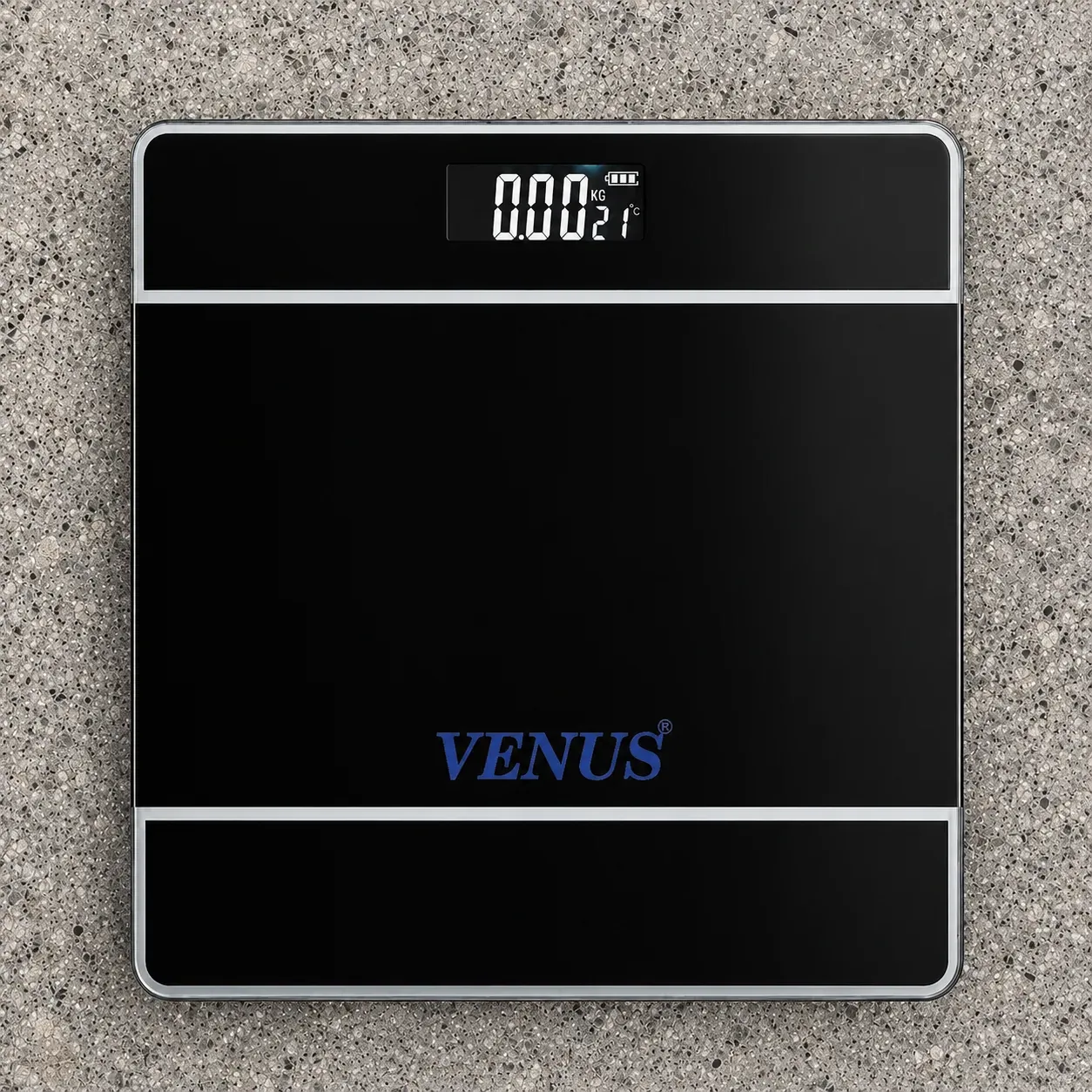
For weight at home, the Venus EPS-1199 weight machine for home weighs up to 180 kg for ₹579, and the Hoffen HO-18 weighing scale for human use does the same for ₹679 (November 2026). Omace lists both with its other personal weighing scales. For height, the ICDS-SDM stadiometer costs ₹1,569, and our guide covers how to measure height accurately.
No scale at hand? Our post on how to check weight without a weight machine gives seven ways to get close. If your scale seems off, see how to calibrate a bathroom scale.
Who makes these scales
Omace Brands Private Limited has made and supplied weighing scales in India since 1994, and every scale is calibrated and checked before dispatch. More about Omace. Omace scales are made in India. As a manufacturer, Omace Brands Private Limited holds ISO 9001:2015, ISO 13485:2016 and EU MDR quality certificates, and CE and US FDA compliance certificates, each listed on the Omace certificates page. Scales bought from the Omace store carry a 2-year warranty on manufacturing defects.