


Most of us step on a scale, glance at the number, and either feel relieved or slightly annoyed. But have you ever stopped to think about what that number actually represents, how it was measured, or whether you can trust it? This guide breaks down the real bathroom scale meaning, covers different types of scales, explains how they work, and helps you pick the right one for your goals. This guide is for anyone who wants to understand what their bathroom scale readings mean, whether you're tracking weight for health, fitness, or general curiosity.
Bathroom scale meaning – quick answer
A bathroom scale is a home weighing device you keep in your bathroom to track body weight regularly. A bathroom scale measures body weight by detecting the force your body exerts on its platform, then converting that force into a readable number.
The bathroom scale meaning today goes well beyond a single weight reading. While traditional mechanical scales show only kilograms or pounds, advanced digital bathroom scales now deliver a range of body composition metrics, including BMI, estimated body fat, muscle mass, water percentage, and even visceral fat levels.
Omace Brands Private Limited, an actual manufacturer based in India (not a trading intermediary like many others), produces both digital and mechanical bathroom scales under its Hoffen and Venus brands for home and professional use.
Here is what a modern bathroom scale can measure:
-
Body weight in kg, lb, or stones
-
BMI (Body Mass Index), calculated from weight and height inputs
-
Body fat percentage via bioelectrical impedance
-
Muscle mass and body water percentage
-
Bone mass and visceral fat estimates (on premium models)
What is a bathroom scale? (definition and basic purpose)
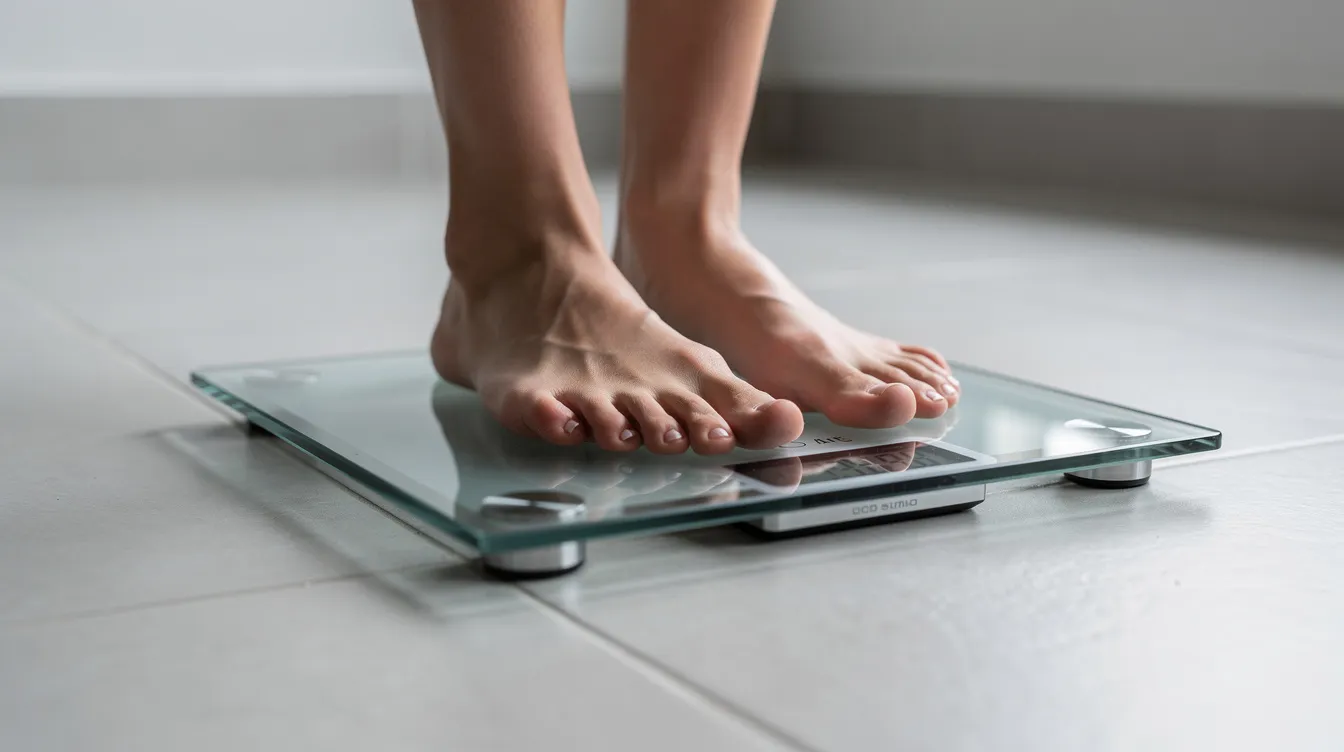
A bathroom scale is a compact domestic weighing instrument designed to monitor personal body weight at home. Typical weight limits for adult bathroom scales range between 120 kg and 180 kg (roughly 260 to 400 lb), though some heavy-duty models go higher. Bathroom scales are primarily used in home settings and are distinct from other devices like a digital kitchen scale (used for food portions), luggage scales, or laboratory precision balances.
What sets a bathroom scale apart is its floor-standing platform, which is wide enough to stand on comfortably, and its capacity, which is built to weigh an entire human body. Bathroom scales are affordable and widely accessible, and they provide straightforward functionality with minimal setup. Common designs in the 2020s feature tempered safety glass platforms, ABS or stainless-steel casings, anti-slip rubber pads, and either a digital display with backlight or a classic analog dial. Most basic bathroom scales measure weight only, lacking body composition insights. However, premium models from Omace, Hoffen, and Venus brands add BMI calculation and body composition estimates for users who want deeper health data.
Different types of bathroom scales
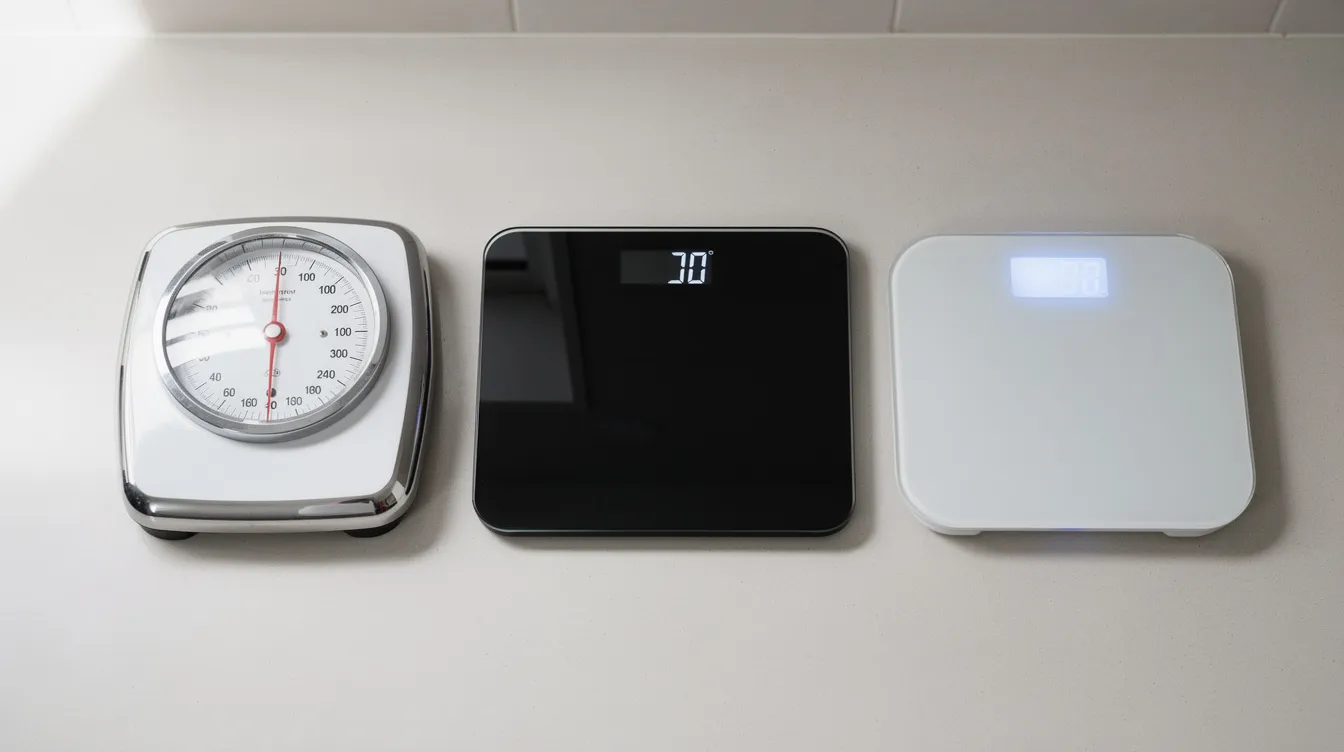
The bathroom scale meaning you get depends heavily on which type you own. There are three main families, and each offers a different level of detail.
Mechanical scales use internal springs and levers. When you step on, the spring compresses and moves a pointer on an analog dial. They require no batteries, making them durable and low-maintenance. The trade-off is lower precision, often ±0.5 to 1.0 kg error under everyday conditions, and readings that drift as springs age. If simplicity is your priority, you can explore Mechanical Bathroom Scales & Analog Weight Machines from Omace's range.
Basic digital bathroom scales rely on strain gauges and load cells under the platform. These components deform under pressure and convert force into an electrical signal, which a microcontroller processes and shows on a backlit LCD screen. Digital scales typically display weight on an LCD screen with 100 g (0.1 kg) or 0.2 lb resolution, and most feature step-on activation and low-battery warnings. Digital bathroom scales can handle weights up to 440 pounds on higher-capacity models. Browse 180kg Digital Bathroom Scales for popular options.
Smart body composition scales add Bluetooth or Wi-Fi connectivity, app integration, and bioelectrical impedance analysis (BIA). They estimate body fat percentage, muscle mass, water percentage, and bone mass. Many digital scales connect to smartphones for tracking, making trend analysis effortless. Omace manufactures Smart Bluetooth Body Fat & Composition Analyzers under both the Hoffen and Venus labels, with OEM and private-label options for retailers.
How bathroom scales work (mechanical vs digital scale)
Both mechanical and digital scales measure the force your body exerts on the platform due to earth's gravity. The difference lies in how they convert and display that force.
In a mechanical scale, stepping on the platform compresses an internal spring. The displacement of that spring, governed by Hooke's law, is transferred through a lever system to rotate an analog dial. Over time, spring fatigue, temperature shifts, and the lack of an auto-zero function cause readings to drift. A study comparing dial versus digital bathroom scales found that analog models had significantly higher imprecision, sometimes deviating by 1 kg or more at higher loads.
A digital scale uses multiple load cells containing strain gauges. When force is applied, the strain gauges deform slightly, changing their electrical resistance. This change produces an electrical signal that a microcontroller reads, compensates for temperature and zero offset, and renders on a digital display. Digital bathroom scales display weight on a digital screen with precise measurements, and digital bathroom scales typically display weight in 0.2 lb increments. Omace, Hoffen, and Venus digital models are calibrated at the factory and, where applicable, comply with Legal Metrology of India standards.
Here is a quick comparison:
-
Mechanical: no batteries needed, simple and robust, but larger error (±500–1000 g in real home use) and readings drift over time
-
Digital: higher accuracy (±100–200 g), clearer readability, thinner profile, but requires batteries or USB charging
-
Smart digital: all digital benefits plus body composition metrics, app sync, and trend tracking, but costlier and more complex
-
Calibration: digital models hold calibration longer; mechanical scales may need manual re-zeroing
Bathroom scales vs body composition scales: what's the real difference in body composition metrics?
A bathroom scale measures body weight, while a body composition scale estimates additional metrics such as body fat percentage and muscle mass. Most bathroom scales only measure weight, lacking body composition insights.
Traditional bathroom scales measure weight only. Body composition scales go further and estimate fat, muscle, water, and more. The difference matters because bathroom scales may mislead users about body composition changes. For instance, you could lose fat and gain muscle without the number on a basic scale changing at all.
A body composition scale is a type of weighing device that, in addition to measuring body weight, uses technologies such as bioelectrical impedance analysis (BIA) to estimate body fat percentage, muscle mass, water percentage, and sometimes bone mass. These scales provide a broader picture of your health by offering insights into the makeup of your body beyond just total weight.
Body composition scales use bioelectrical impedance analysis for measurements. In simple terms, a weak electrical current runs through your body from foot to foot. Because muscle tissue has high water content and fat tissue does not, resistance to that current varies. The device measures this resistance and, combined with your height, age, and sex, uses algorithms to estimate body composition. They can calculate BMI and muscle mass using sensors built into the platform. Digital bathroom scales can measure body fat percentage when equipped with BIA electrodes.
Here is how the data sets compare and how to assess which device suits you:
-
Basic bathroom scale data: weight in kg or lb only
-
Body composition scale data: weight, BMI, body fat percentage, muscle mass, water %, visceral fat, bone mass
-
Cost: bathroom scales are generally more affordable than body composition scales
-
Ease of use: simple scales require no setup; body composition models need user profiles (age, height, sex)
-
Insight depth: body composition scales let you determine whether you are losing fat or gaining muscle, which matters for weight loss and fitness progress
-
Accuracy caveat: BIA results are affected by several factors including hydration status, recent exercise, food intake, and body temperature, so they estimate rather than define
-
Best for athletes: body composition models provide richer data to assess training outcomes
-
Best for simplicity: a standard bathroom scale is suitable for anyone who just wants to track weight trends
Omace's Venus and Hoffen smart scales cover the body composition segment, while their basic digital and mechanical lines serve users who prefer simplicity.
Bathroom scales vs mechanical balances and industrial scales
Bathroom scales are force-measuring devices designed for domestic health tracking. They are not the same as precision lab balances or industrial scales, even though all these instruments weigh things. The iconic image of lady justice holding a balance is perhaps the oldest symbol of weighing, and beam balances with two pans remain in use in laboratories and jewellery shops today.
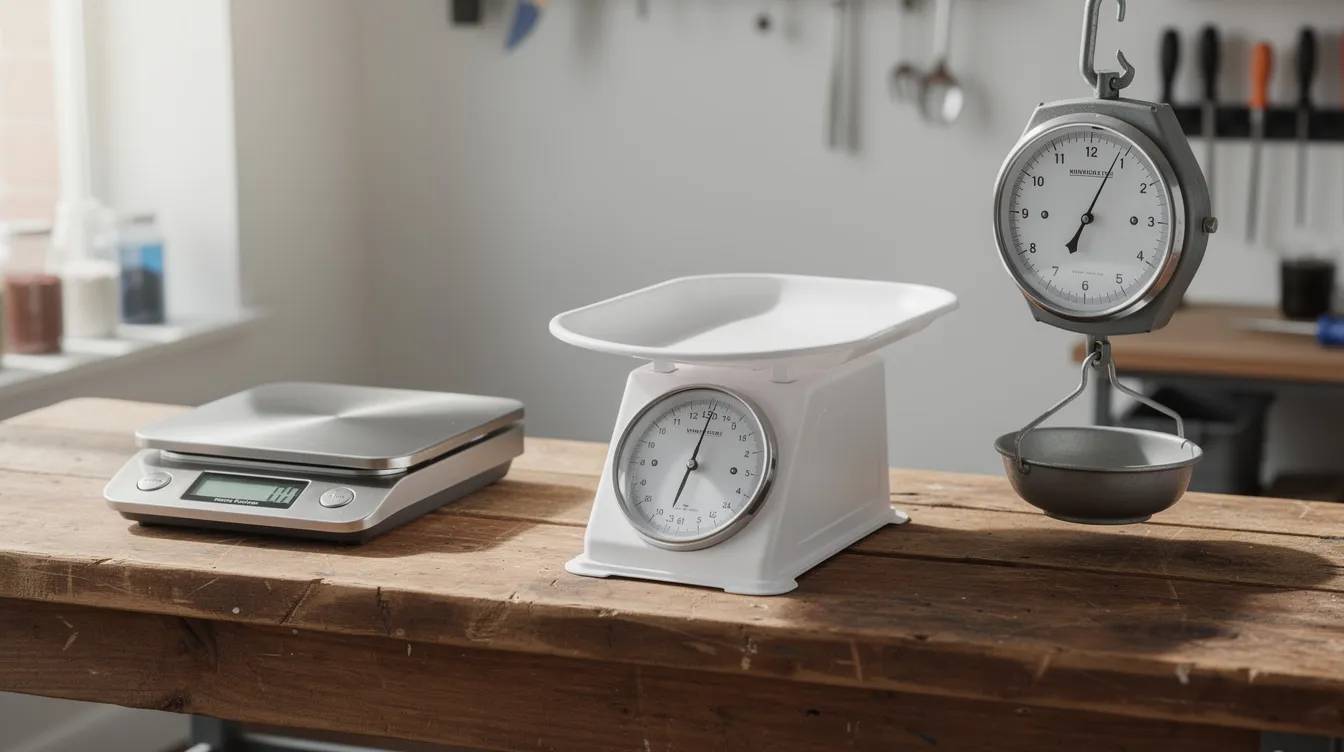
Mechanical balances, also called precision balances or balance beam instruments, measures mass by comparing an unknown object against calibrated reference masses. They often include draft shields to block air currents that could affect readings. Industrial weighing scales, on the other hand, include platform scales, hanging scales, and weighbridges used across various industries for logistics, inventory management, and manufacturing.
-
A bathroom scale is enough for health tracking at home and to monitor body weight trends
-
For legal-for-trade applications (shops, markets), government-stamped and calibrated scales are required
-
For laboratory or jewellery work, precision balances with milligram resolution are necessary
-
Omace Brands also manufactures jewellery precision scales, baby weighing scales, and hanging and platform scales for B2B buyers in India and for export
-
This broader weighing instrument expertise feeds directly into the quality of their bathroom scale engineering
Common units and readings on bathroom scales
Bathroom scales typically measure weight in pounds or kilograms, and some models sold for UK markets also display stones. Most Omace, Hoffen, and Venus digital scales include unit toggle buttons so you can switch between kg and lb based on your regional habits. India uses kg, while the US uses lb.
Key conversions and tips:
-
1 kg ≈ 2.205 lb
-
For example, 70 kg ≈ 154.3 lb; 80 kg ≈ 176.4 lb; 100 kg ≈ 220.5 lb
-
To convert pounds to kg, divide by 2.205
-
Domestic bathroom scales show "weight-equivalent mass" under standard gravity; the difference caused by altitude or latitude on earth is negligible for home use (less than 0.5%)
-
If your scale offers units in stones, 1 stone = 14 lb ≈ 6.35 kg
-
Always confirm which units your scale is set to before comparing readings over time
How to use a bathroom scale correctly for consistent results
The bathroom scale meaning also depends on how and when you use it. Method affects the numbers you see, and consistency in measuring conditions helps track weight changes effectively. They can contribute to an unhealthy obsession with weight if you react to every single reading, so focus on trends instead.
Follow these tips for reliable, comparable readings:
-
Place on a hard, flat surface: bathroom scales should be placed on a hard, flat surface for accurate readings. Tile or concrete works best. Carpets, bathmats, and uneven floors absorb force and produce inaccurate results.
-
Weigh at the same time daily: morning, after using the toilet and before breakfast, gives the most consistent baseline. Your diet, fluid intake, and activity throughout the day cause fluctuations of 0.5 to 2 kg.
-
Wear minimal clothing: or the same clothing each time so that fabric weight does not vary.
-
Stand still with feet centered: standing still with both feet evenly distributed is important while weighing. Wait for the digital scale to stabilize or the dial to settle before reading.
-
Understand normal fluctuations: water retention, salt intake, hormonal cycles, and meal timing all affect your reading. These shifts are normal and do not reflect real fat or muscle changes.
-
Track weekly averages: instead of obsessing over a single number, record daily weights and calculate a weekly average. This reveals the real trend.
-
Use app sync when available: Omace smart models under the Hoffen and Venus brands can store data and sync trends via companion apps, making progress tracking visual and motivating.
The most accurate scale in the world is useless if you weigh yourself under different conditions every time. Aim for similar conditions each session.
Accuracy, calibration, and legal metrology for bathroom scales
Accuracy for a bathroom scale means the difference between the displayed weight and the true weight. But for home users, absolute accuracy matters less than consistency and stability over time. If your scale reads 0.3 kg high every time, that offset cancels out when you track trends.
You can run simple at-home checks using known reference masses. For instance, a 5 kg bag of flour or a 10 kg dumbbell placed on the scale should read within the device's specified tolerance (±0.1 kg for most digital models). If your readings are consistently off, recalibrate or replace the scale. For guidance on calibration techniques, see How to Calibrate a Kitchen Scale Without Weights, which covers principles applicable to bathroom models too.
Omace, Hoffen, and Venus bathroom scales are produced in ISO 9001-certified facilities in India and follow Legal Metrology of India guidelines where applicable.
-
Standard home bathroom scales are "not legal for trade" and are not stamped for commercial transactions
-
Government-stamped kata used in shops and markets must be verified and certified under the Legal Metrology Act, 2009
-
Omace can supply Legal Metrology of India certified, government-stamped kata at competitive rates, including 5 kg kata from India for retailers and government tenders
-
Calibration includes verifying labeling, maximum permissible error, and ensuring the weighing instrument meets its accuracy class
-
For most cases, a well-maintained digital bathroom scale stays accurate enough for personal health tracking without professional recalibration
Choosing the right bathroom scale for your needs
Choosing a scale depends on individual health and fitness goals. Whether your aim is weight loss, fitness tracking, clinical monitoring, or equipping a family bathroom, the right scale varies by what you need it to tell you. Most bathroom scales are affordable and easy to use, so the decision often comes down to features versus budget.
Key factors to consider:
-
Capacity: ensure the scale supports your weight comfortably. Common capacity ranges from 150 to 200 kg. Compared to mechanical scales, digital models often offer higher maximums.
-
Readability: 100 g (0.1 kg) resolution is standard for digital; mechanical dials are less precise.
-
Platform and safety: tempered glass, anti-slip pads, and a platform large enough to stand on securely. Check the display for large, backlit digits.
-
Features: unit toggle (kg/lb), auto on/off, overload and low-battery warnings, memory for multiple users, app connectivity for smart scales.
-
Who should pick what: beginners or budget users do well with a basic digital or analog scale. Fitness enthusiasts benefit from body composition models that track health metrics like fat and muscle over time. Families benefit from multi-user memory on smart scales.
-
B2B buyers: gyms, hospitals, wellness clinics, and retail chains should look for certified, high-capacity models. Omace Brands Private Limited offers OEM and private-label bathroom scales with custom logos, packaging, and branding, a service that sets them apart from traders who merely resell.
Explore the full range of Different Types of Weighing Scales to compare options side by side.
Beyond bathroom scales: other home and professional scales from Omace
Omace Brands Private Limited is a made-in-India manufacturer and exporter with in-house engineering, tooling, and quality control. Unlike many competitors in the Indian market who operate as traders, Omace designs and builds its products, giving it direct control over quality and the ability to produce custom solutions.
-
Smart body composition scales: advanced BIA models under Hoffen and Venus brands with app connectivity
-
Digital kitchen scales: designed for portion control, cooking, and baking precision. See Digital Kitchen Weighing Scales for the full lineup.
-
Baby weighing scales: both mechanical suspension and digital models, including the Venus Mother & Child Scale with tare function
-
Jewellery precision scales and hanging/platform scales: serving lab professionals, jewellers, and industrial buyers
-
Government e-Marketplace (GeM) approved seller: Omace can supply bulk orders for institutions, hospitals, and corporate wellness programs
-
B2B readers, whether retail chains, wellness brands, or hospitality clients, can explore OEM/private-label options with custom branding and packaging
Key takeaways on bathroom scale meaning
A bathroom scale is a simple but powerful tool for personal health tracking, and its meaning has expanded significantly from a single weight number to a suite of body composition data. Here is what to remember:
-
Bathroom scales are domestic weight-measuring devices; the "meaning" now spans simple mechanical scales to smart digital body analyzers
-
Digital bathroom scales offer better accuracy and readability than older mechanical scales, but both have a role depending on your budget and preferences
-
Consistent use, correct placement on hard surfaces, and realistic expectations about daily fluctuations are essential to interpreting readings correctly
-
Body composition scales add valuable insight but are not a substitute for clinical measurements; use them to track your own trend over time
-
For weight loss, fitness, or general health monitoring, pick the scale type that matches your goals and stick with similar conditions each time you weigh
Omace Brands Private Limited, with its Hoffen and Venus brands, offers reliable, India-manufactured bathroom scales and weighing solutions for both households and businesses. Whether you need a single scale for your home or a bulk OEM order with custom branding, Omace has the manufacturing capability and certifications to deliver.


