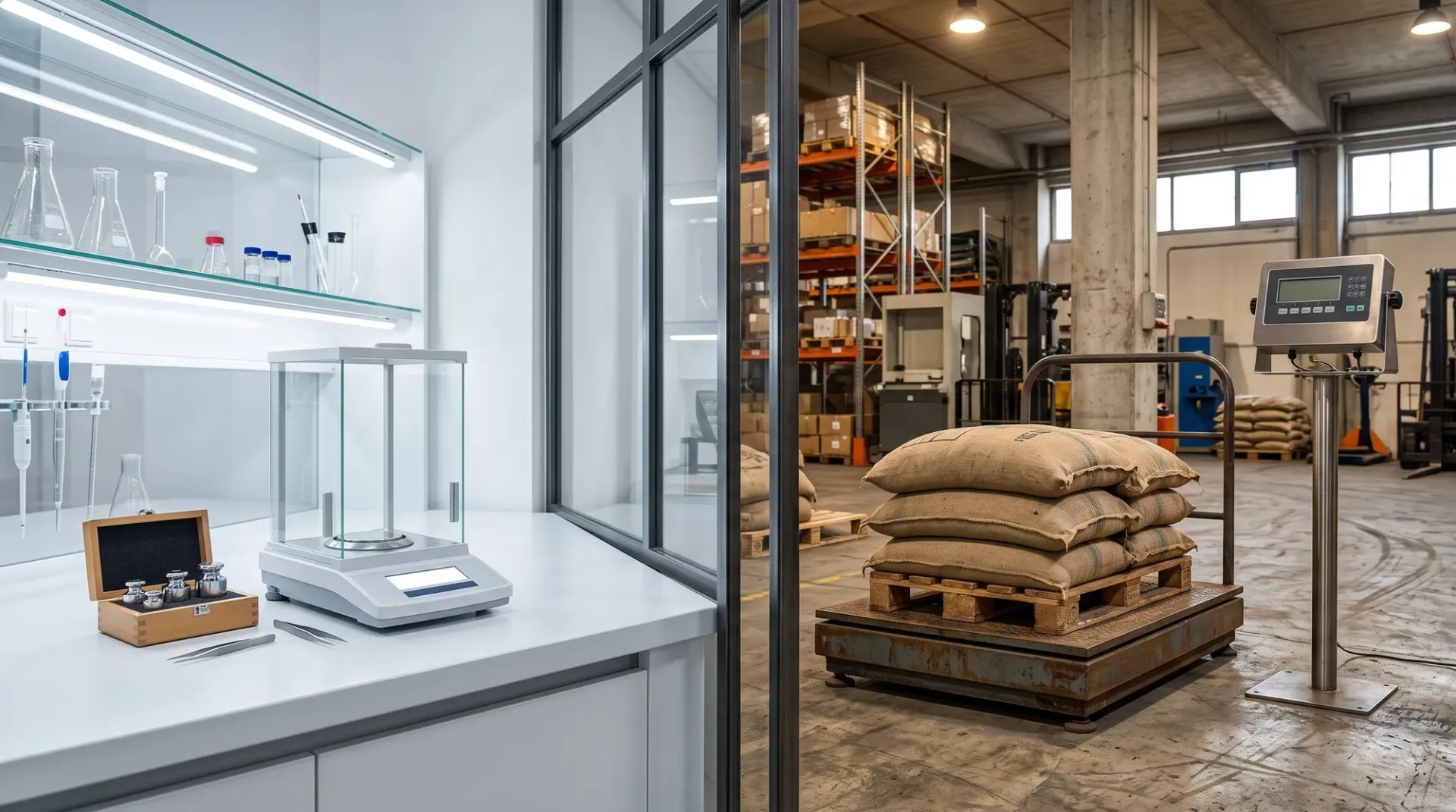
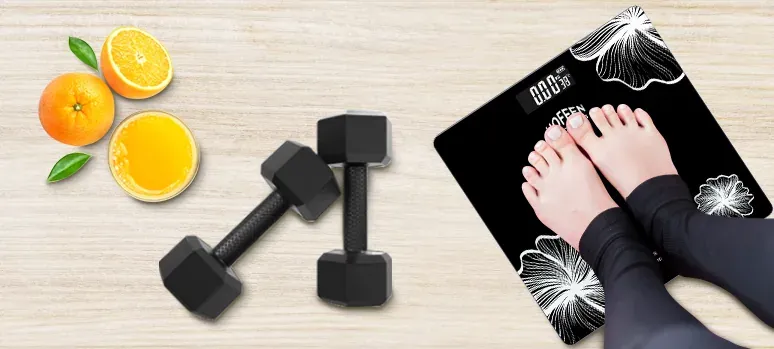
Weighing scales come in three working kinds (spring, lever balance and electronic load cell) and in about 14 everyday types named for what they weigh, from bathroom and kitchen scales to platform and crane scales. Pick by load and step size: a bathroom scale reads up to 180 kg in 100 g steps, while a gold scale reads 600 g in 0.01 g steps.
What a weighing scale is and how it works
A weighing scale is an instrument that measures how heavy something is and shows the result as a mass in grams or kilograms. Gravity pulls on every object with a force, its weight, and the scale turns that force into a mass reading. The NIST Guide to the SI notes that in commercial and everyday use, "weight" usually means mass, measured in kilograms.
Every scale works on one of three principles:
- Spring scales measure how far a spring stretches or compresses under the load, and a gear turns that movement into a needle reading on a dial. Analog bathroom scales and hand-held spring balances work this way and need no battery.
- Lever balances set the load against known weights on a beam until it sits level. The sum of the weights is the mass of the load. Read weighing scale vs balance for how the two compare.
- Electronic load cell scales rest the load on metal sensors fitted with strain gauges. The metal bends very slightly, the gauges change their electrical resistance, and a chip turns that signal into a number on an LCD or LED display.
Electronic scales also hold their zero better than spring dials. In a BMC Public Health study of 61 home bathroom scales, every digital scale read 0 kg before use, while the dial scales read an average of 0.95 kg before they were zeroed. The analog vs digital weighing machine comparison covers the trade-offs in detail.
Weighing scales for home and health
Home scales weigh people, food and luggage. Their steps run from 0.1 g on a coffee scale to 500 g on an analog bathroom scale.
Bathroom and personal scales
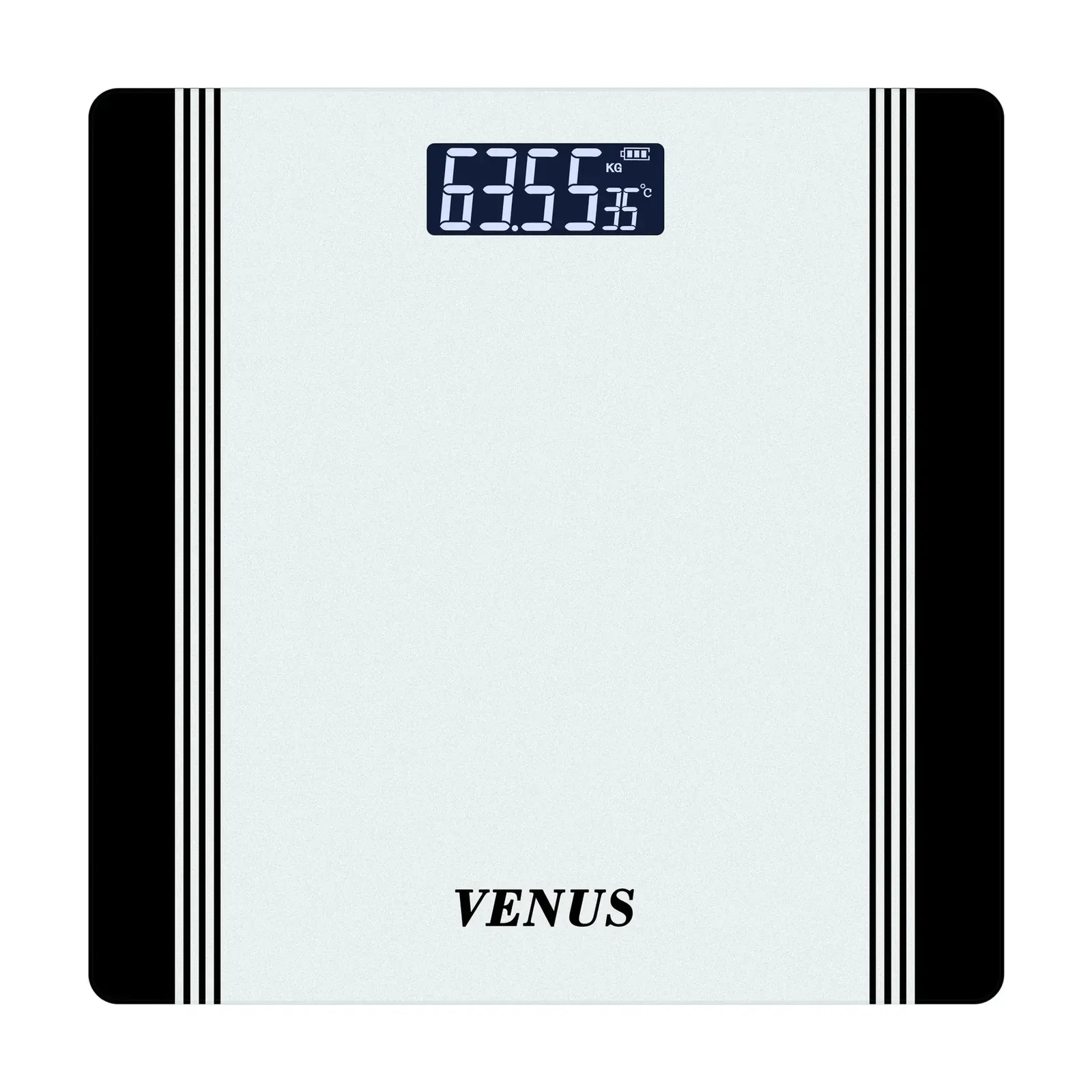
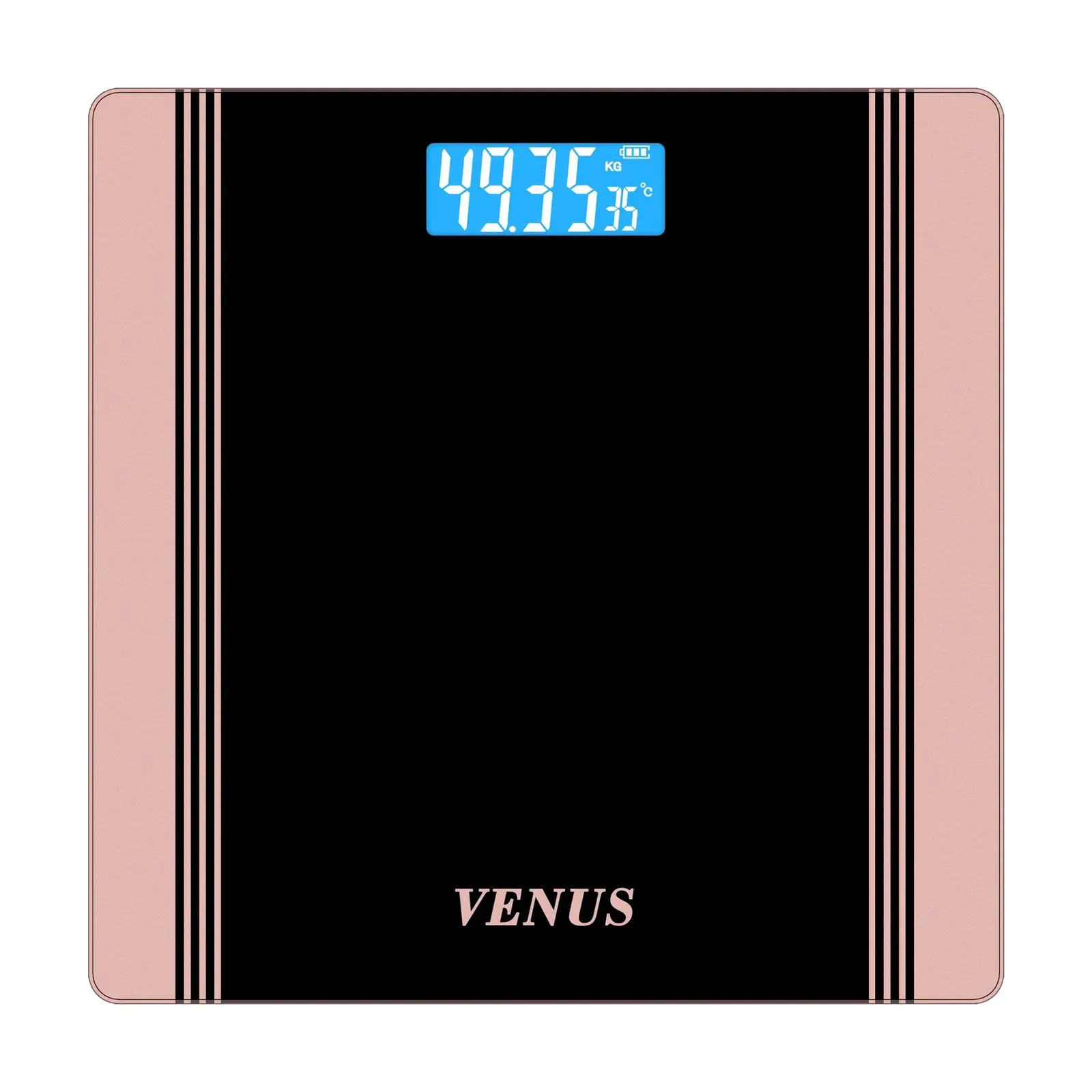
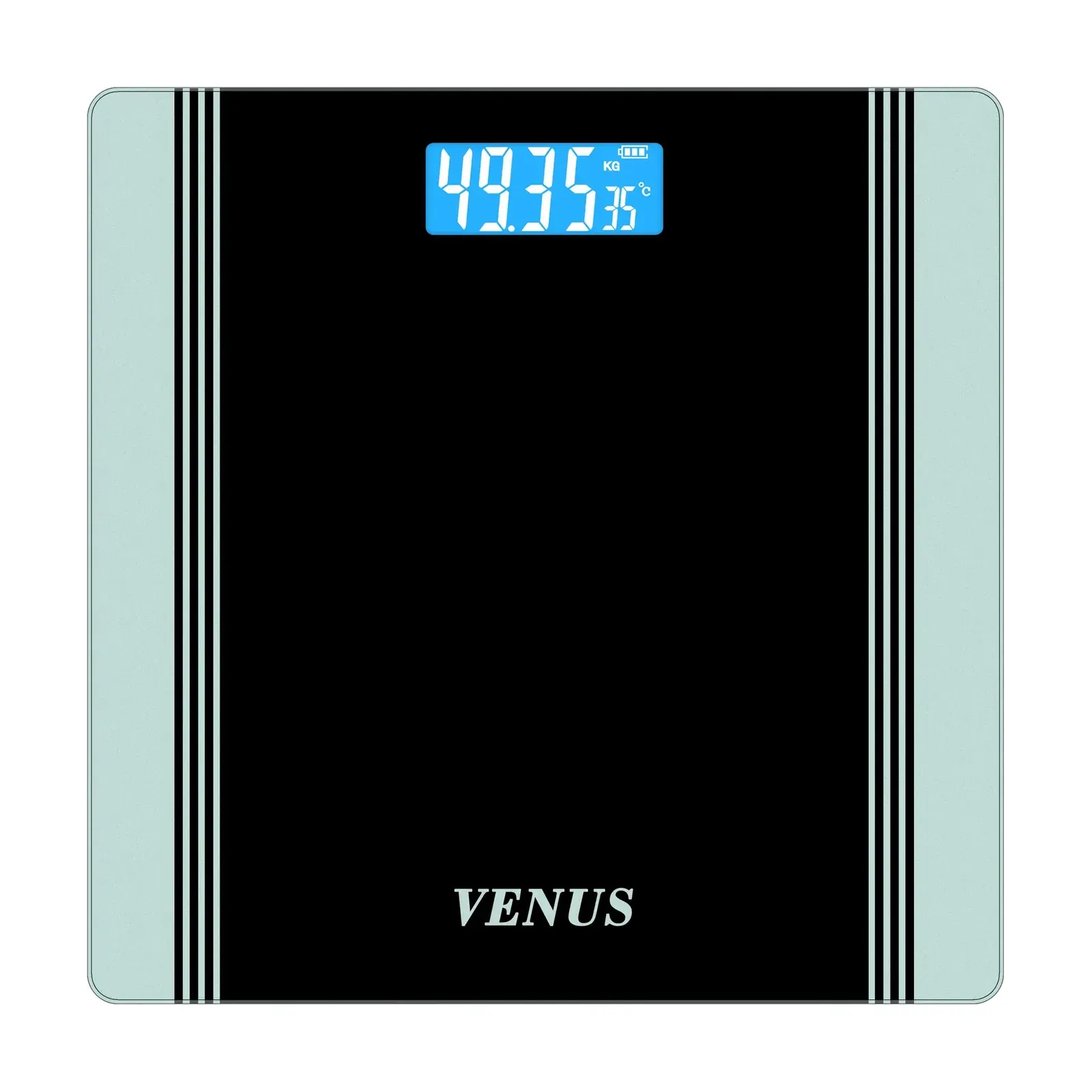
A personal scale stands on the floor and weighs one person at a time. The Venus EPS-1199 weight machine for home reads up to 180 kg in 100 g steps on a tempered glass top and costs ₹549 including GST (October 2026). The analog Venus BS-9701 works on a spring with no battery and reads up to 130 kg in 500 g steps. Omace's digital personal weighing scale models cost ₹520–₹1,099, and Omace calibrates its bathroom scales at the factory before dispatch. For what happens inside the platform, read how a bathroom scale works.
Smart body composition scales
A smart scale weighs you and also estimates body fat, muscle and water by passing a small current between metal pads under your feet. Omace's smart weighing scale range runs from the Hoffen HO-9 at ₹699 to the Hoffen HO-45 at ₹2,499, which adds heart rate and, like the Hoffen HO-36, reads in 50 g steps. Treat the body figures as estimates: a 2021 study of three smart scales in JMIR mHealth and uHealth found their weights within a kilogram of a DEXA scan but body fat underestimated on all three. Omace's product pages also say not to use the body-fat function with a pacemaker or other implanted electronic device, or during pregnancy; weight-only use is fine. The guide to how a smart scale measures body fat explains the method.
Baby weighing scales
A baby scale holds an infant in a curved tray and reads in grams, because a baby's gain from week to week is small. The Venus EBS-KS-9090 infant weighing scale reads up to 20 kg in 5 g steps and costs ₹2,499. Omace's baby weighing scale range costs ₹399–₹14,999 and includes mother-and-baby and 3-in-1 baby and adult models. For weighing children at home, the US Centers for Disease Control and Prevention advises a digital scale on a firm floor and no spring-loaded bathroom scales. The guide to choosing a baby weighing scale compares the formats.
Kitchen scales
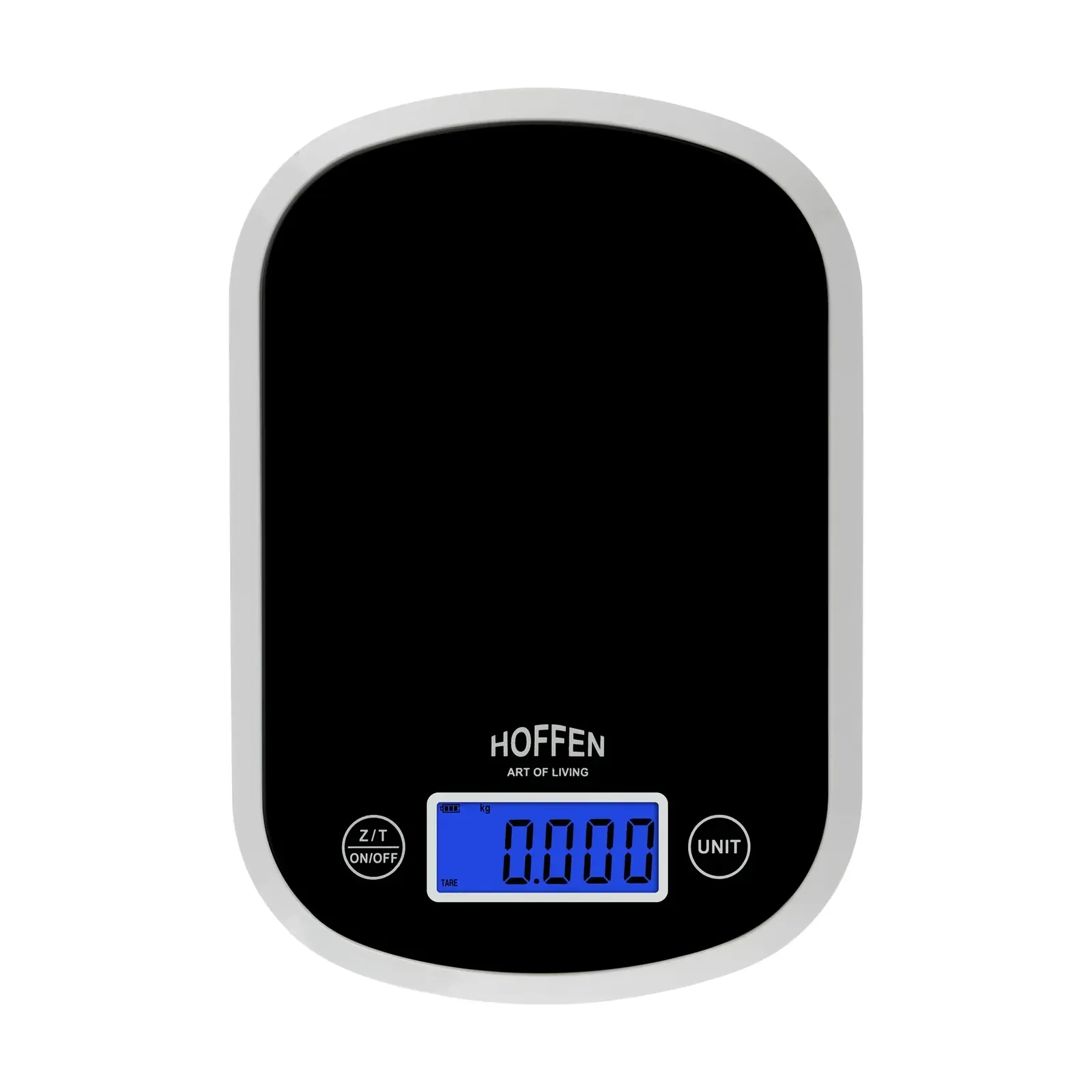
A kitchen scale weighs ingredients, usually up to 5–10 kg in 1 g steps, and its tare key subtracts the weight of the bowl. The Hoffen KS-601 digital kitchen scale reads up to 5 kg in 1 g steps, switches between nine units and costs ₹599. The Hoffen KS-201 smart kitchen scale with app weighs up to 5 kg in 0.1 g steps and connects to a Bluetooth app for ₹699. Omace's kitchen weighing scale models cost ₹279–₹1,099. Capacity, units and tare are covered in how to choose a kitchen scale.
Coffee scales
A coffee scale reads in 0.1 g steps, so the few grams of a single cup show clearly. The Hoffen KS-301 and KS-303 add a brew timer and weigh up to 3 kg in 0.1 g steps for ₹1,500–₹1,700; both are in Omace's coffee scale range. The KS-201 kitchen scale also reads in 0.1 g steps, so it works for coffee too, and coffee scale calibration explains how to check one.
Luggage scales
A luggage scale hangs a suitcase from a hook or strap and shows its weight before you reach the airport. Every Omace luggage scale weighs up to 50 kg and costs ₹349–₹599, and the Hoffen HO-L-18 luggage measuring scale adds a tape for checking bag size. Each airline sets its own allowance, but IATA notes that international guidelines recommend no checked bag over 23 kg, and 32 kg is the maximum for a single bag in many regions. Luggage scale calibration shows how to check one before a trip.
Precision scales for gold, gems and labs
Precision scales weigh small, valuable items in 0.01 g or 0.001 g steps. At 1 mg steps moving air shifts the reading, so Omace's milligram models weigh inside a glass windshield.
Pocket scales
A pocket scale is a phone-sized digital scale for small items. Omace's pocket scales hold 200–500 g in 0.01 g steps, or 30–50 g in 0.001 g steps on models with a windshield. The Ace LT-500 digital pocket scale reads up to 500 g in 0.01 g steps for ₹1,099, and the full pocket scale range costs ₹799–₹4,499. The pocket scale vs bench scale comparison helps choose between a pocket model and a counter model.
Jewellery and gold scales
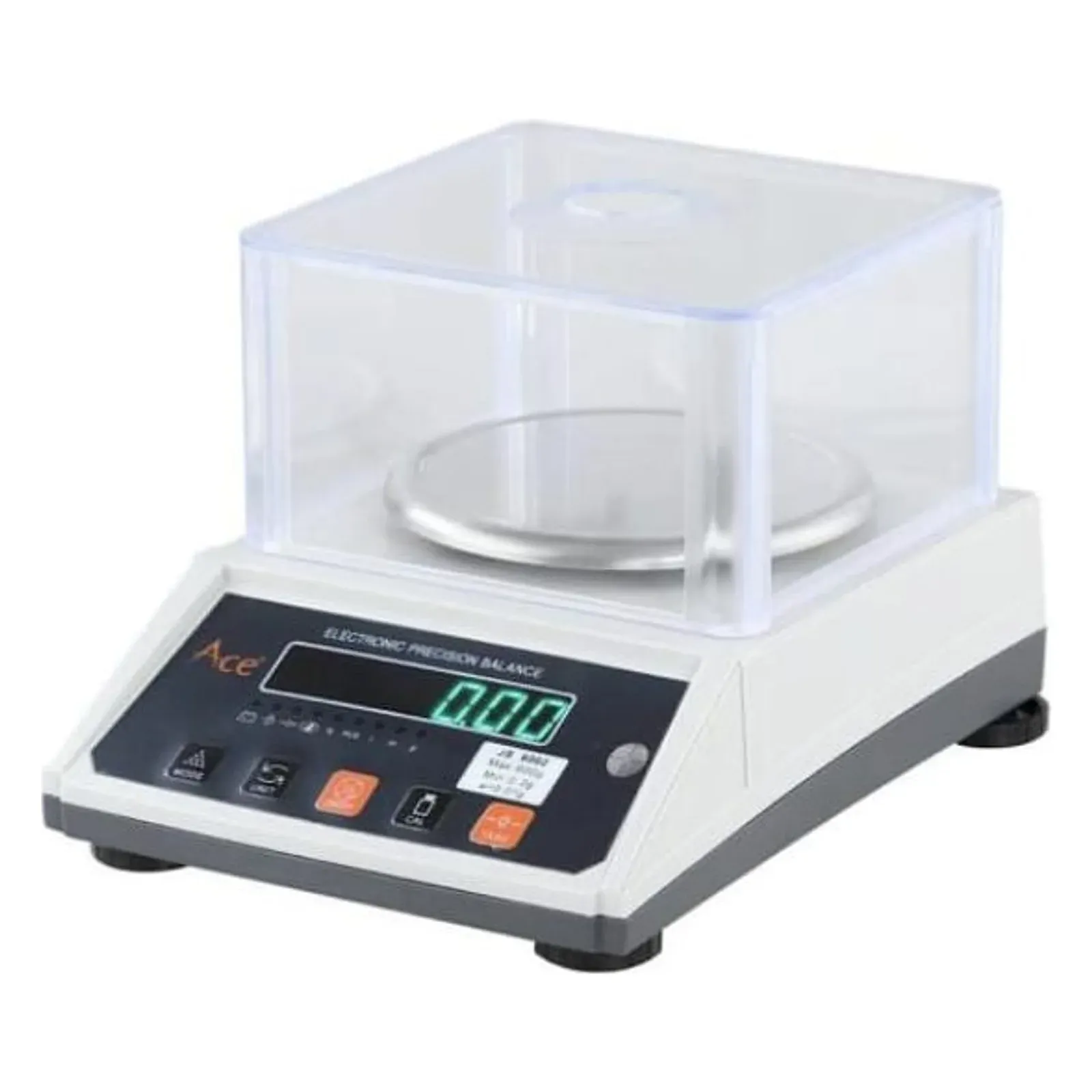
A jewellery scale sits on the counter and weighs gold, silver and stones. Most of Omace's gold scales weigh up to 600 g in 0.01 g steps, with displays facing both the jeweller and the customer. The Ace JS-6002 gold weighing scale reads up to 600 g in 0.01 g steps on green LED displays at the front and back for ₹9,999. Omace's jewellery weighing scale range costs ₹1,299–₹27,999 and includes silver scales up to 35 kg. The jewellery scale buying guide covers what a goldsmith needs.
Laboratory balances
A laboratory balance reads to the milligram and weighs powders, reagents and stones inside a glass windshield. The Ace JS-3003 precision weighing balance reads up to 300 g in 0.001 g (1 mg) steps, ships with a 200 g calibration weight and costs ₹22,499. Omace's 1 mg balances cost ₹22,499–₹27,999; balances with finer steps are used in chemistry labs, but 1 mg is the finest step Omace sells.
Scales for shops, warehouses and industry
Trade scales weigh goods that are sold, bought or shipped by weight. They range from 10 kg counter scales to 1,000 kg platforms and crane scales rated in tonnes.
Tabletop shop scales
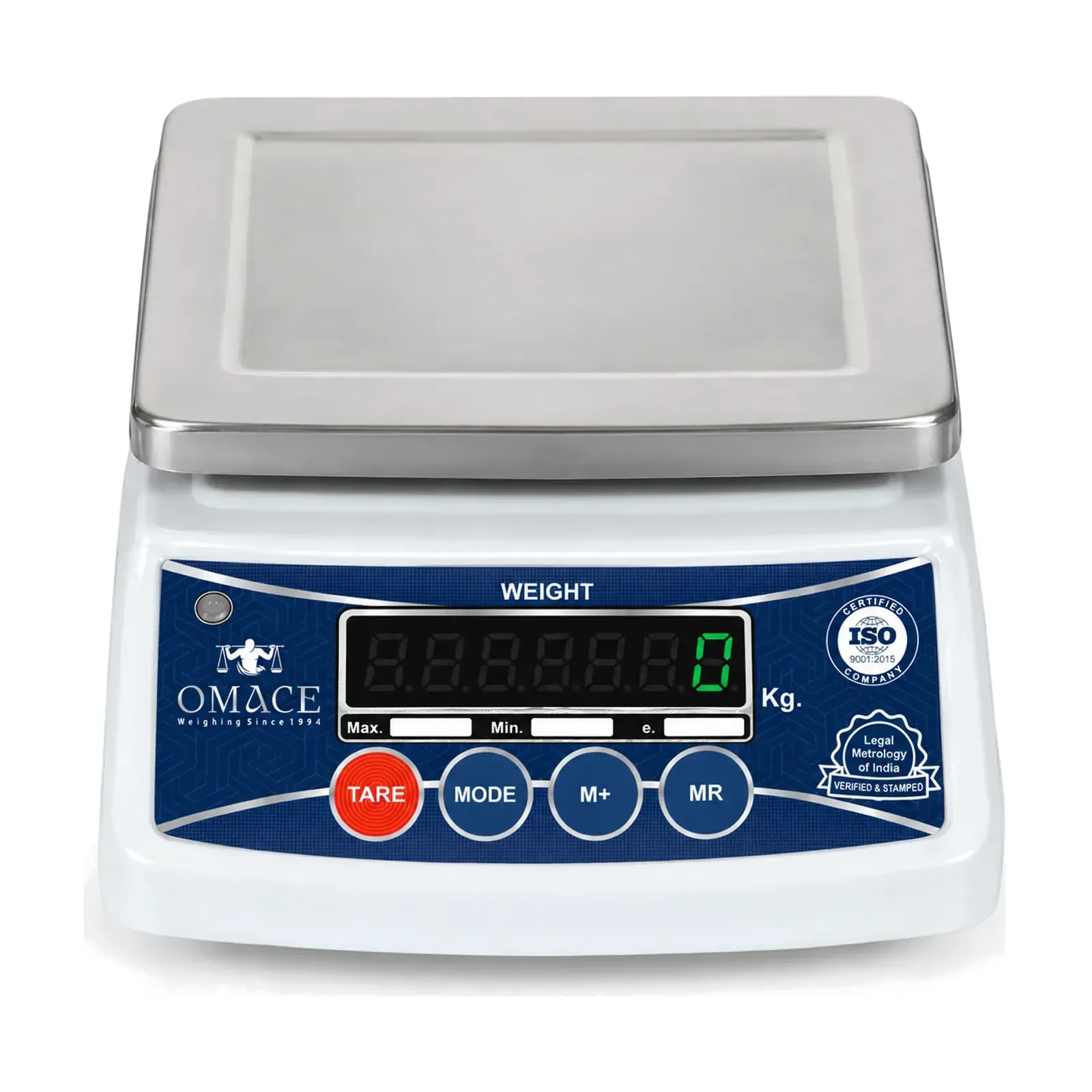
A tabletop shop scale sits on the counter of a kirana, sweet or vegetable shop, with displays for both shopkeeper and customer. The Omace Om-TT-ECO kirana weighing machine weighs 10 kg in 1 g steps or 20 kg in 2 g steps, keeps working for about 2 days on its built-in battery and costs ₹2,200. Omace's counter models in the weighing scale for shop range weigh up to 30 kg and cost ₹1,900–₹3,100. The Om-TT series is a Legal Metrology approved model in accuracy class III, and every unit leaves the Bagru factory verified and stamped. Shop-by-shop picks are in the best weighing scale for small business guide.
Bench, chicken and platform scales
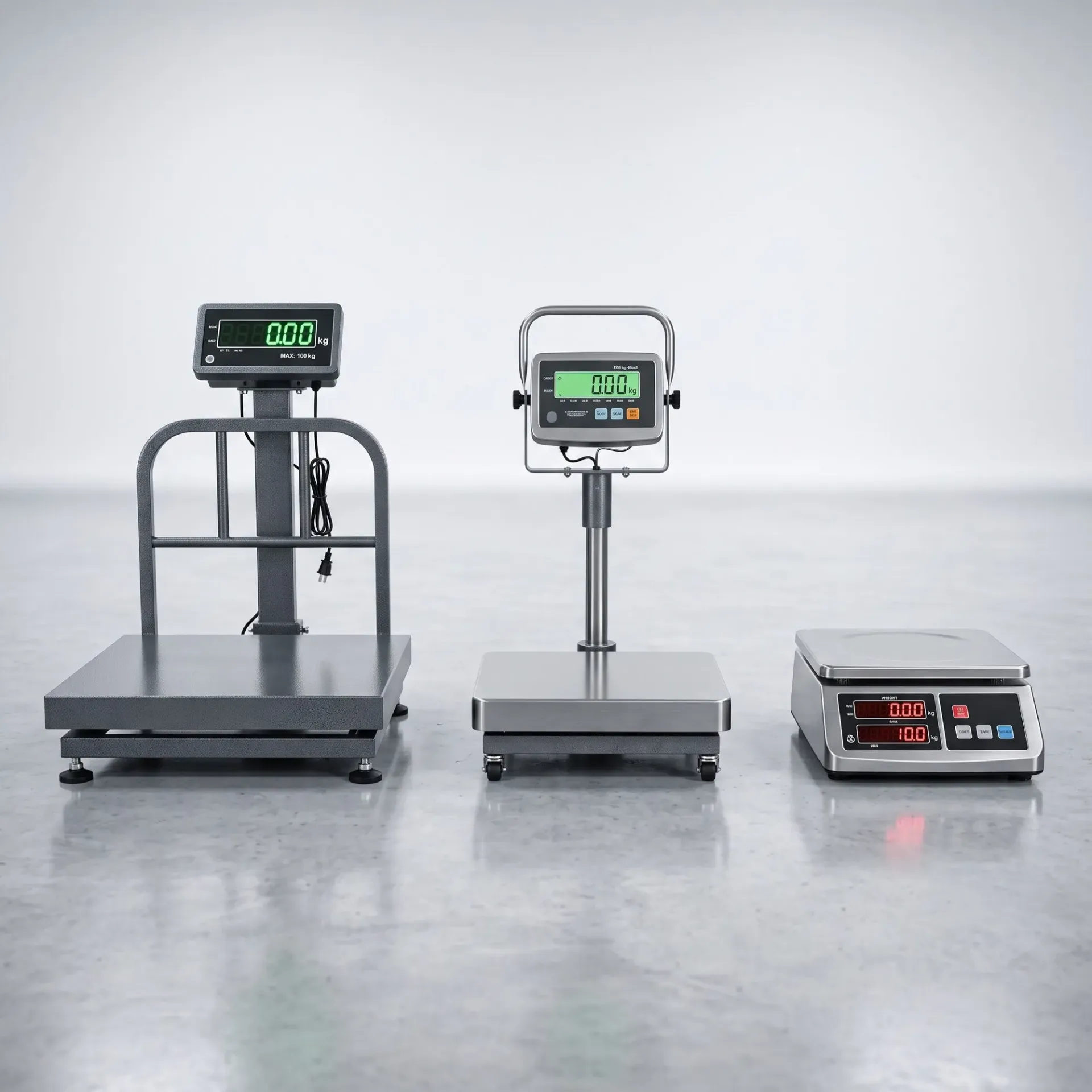
A platform scale has a flat steel deck near the floor for sacks, cartons and drums, with the reading on a separate indicator. The Omace Om-PS-MS platform kanta comes in sizes from 100 kg to 1,000 kg and costs ₹6,000–₹29,999. Chicken scales are low bench scales with a chequered mild steel or stainless steel platform for meat and poultry shops; Omace's weigh 60–300 kg and cost ₹3,900–₹8,000, the same for mild steel and stainless steel. Omace's Om-PS platform and Om-CK chicken scales are Legal Metrology approved models in accuracy class III and leave the factory stamped. The full platform weighing scale range is listed by capacity, and the industrial weighing scale guide explains how to choose one.
Hanging and spring scales
A hanging scale weighs a load that hangs from its hook, which suits sacks, produce and gas cylinders. The Venus tubular spring balance weighs 5 kg or 25 kg with no battery for ₹249–₹349, and the Venus CHS dial scale reads 25–200 kg for ₹899–₹999. Both are Legal Metrology approved models in accuracy class IIII. Omace's hanging weighing scale range also includes the OM-CS-A-09 cylinder weight machine, a 50 kg digital scale for ₹1,999. Capacities and hooks are explained in the guide to choosing a hanging scale.
Crane scales
A crane scale is a heavy-duty hanging scale that hangs from a crane or hoist hook and reads loads up to many tonnes. Omace's crane scale range runs from a 50 kg digital hanging scale to scales rated in tonnes; the lowest-priced are the 200 kg and 300 kg digital crane scales at ₹2,799–₹3,299. The Omace OCS crane scale is sold from 1 tonne to 50 tonnes with a remote control for ₹10,999–₹2,52,999 and is rated IP65 or better. The OM-CS crane scale series is a Legal Metrology approved model in accuracy class III for capacities up to 30 tonnes. Checks for these are covered in crane scale calibration.
Weighbridges
A weighbridge is a platform scale large enough to weigh a whole road vehicle, built on a foundation or pit. OIML R 76, the international recommendation for non-automatic weighing instruments, covers weighbridges that determine the total mass of a road vehicle. Weighbridges are not in the Omace catalogue, but Omace supplies them on request on 8690277199; weighbridge calibration explains how they are checked.
Weighing scale types compared
Both tables list Omace models sold today, so every capacity, step and price is a real store specification. Prices include GST.
| Home scale | Capacity | Reads in | Used for | Omace price |
|---|---|---|---|---|
| Digital personal | 180 kg | 100 g | Body weight at home | ₹520–₹1,099 |
| Analog personal | 130 kg | 500 g | Body weight, no battery | ₹799 |
| Smart body | 180 kg | 50–100 g | Weight plus body estimates | ₹699–₹2,499 |
| Infant | 20 kg | 5 g | Baby weight checks | ₹2,499 |
| Kitchen | 5–10 kg | 1 g | Cooking and diet | ₹279–₹1,099 |
| Coffee | 3–5 kg | 0.1 g | Beans and brewing | ₹699–₹1,700 |
| Trade or precision scale | Capacity | Reads in | Used for | Omace price |
|---|---|---|---|---|
| 30–500 g | 0.001–0.01 g | Small items | ₹799–₹4,499 | |
| Jewellery | 600 g | 0.01 g | Gold and silver billing | ₹2,999–₹9,999 |
| Laboratory balance | 200–500 g | 0.001 g | Powders and samples | ₹22,499–₹27,999 |
| Tabletop shop | 10–30 kg | 1–5 g | Shop counters | ₹1,900–₹3,100 |
| Platform | 100–1,000 kg | 10–100 g | Sacks and cartons | ₹6,000–₹29,999 |
| Crane | 50 kg–50 t | 10 g at 50 kg, 100 g at 1 t | Loads on a hook | ₹2,799–₹2,52,999 |
For model picks for a home, see the best weight machine guide, and for prices across capacities, the weight machine price guide.
Accuracy classes and Legal Metrology in India
Scales are graded by accuracy class. OIML R 76, the international recommendation for non-automatic weighing instruments, sets four classes: special (I), high (II), medium (III) and ordinary (IIII).
The class follows the job. OIML R 111, the recommendation for test weights, pairs class F2 weights with high-accuracy class II instruments for precious metals and stones. It pairs class M2 weights with medium-accuracy class III instruments for general commercial transactions.
The display step is not the same as the tested accuracy. OIML R 76 separates the scale interval d, the step the display shows, from the verification scale interval e used in testing; its own example shows an instrument displaying 1 mg steps with e = 10 mg.
In India, the Department of Consumer Affairs administers the Legal Metrology Act, 2009, in force since 1 April 2011. Manufacturers and importers of weighing instruments must take Government of India model approval before they make or import a model. State Legal Metrology officers periodically verify the scales used by traders, industries and hospitals. Omace's own shop, platform, chicken and crane scale series are Legal Metrology approved models in accuracy class III, and its dial hanging scales, tubular spring balances and BS-9701 dial bathroom scale are approved in class IIII.
Every verification traces back to one kilogram. CSIR-National Physical Laboratory keeps India's national prototype kilogram, copy No. 57, and passes its value to weights from 1 mg to 2,000 kg. What "legal for trade" means at the counter is explained in legal for trade weighing scale rules, and home checks are in how to calibrate a digital weighing scale.
How to choose the right scale
- Name what you are weighing. A body needs a personal scale, an ingredient a kitchen or coffee scale, a ring a jewellery scale, and a sack a platform or hanging scale.
- Leave headroom on capacity. Choose a maximum above your heaviest load, but no larger than needed: the 10 kg Om-TT-ECO reads in 1 g steps, the 20 kg version in 2 g steps.
- Match the step to the stakes. Gold needs 0.01 g, baking needs 1 g and body weight needs 100 g; a finer step than the job needs adds cost, not value.
- Check the rules when money changes hands. A scale that sets a price in a shop, a jewellery counter or a freight office falls under Legal Metrology approval and verification.
- Give it a firm, level base. Omace's bathroom scale instructions ask for tiles or stone, not a carpet or mat, and its balances carry a level bubble for the same reason.
- Pick the power source. Spring scales need none, bathroom and kitchen scales use AAA cells, and shop scales run on mains with a built-in battery for power cuts.
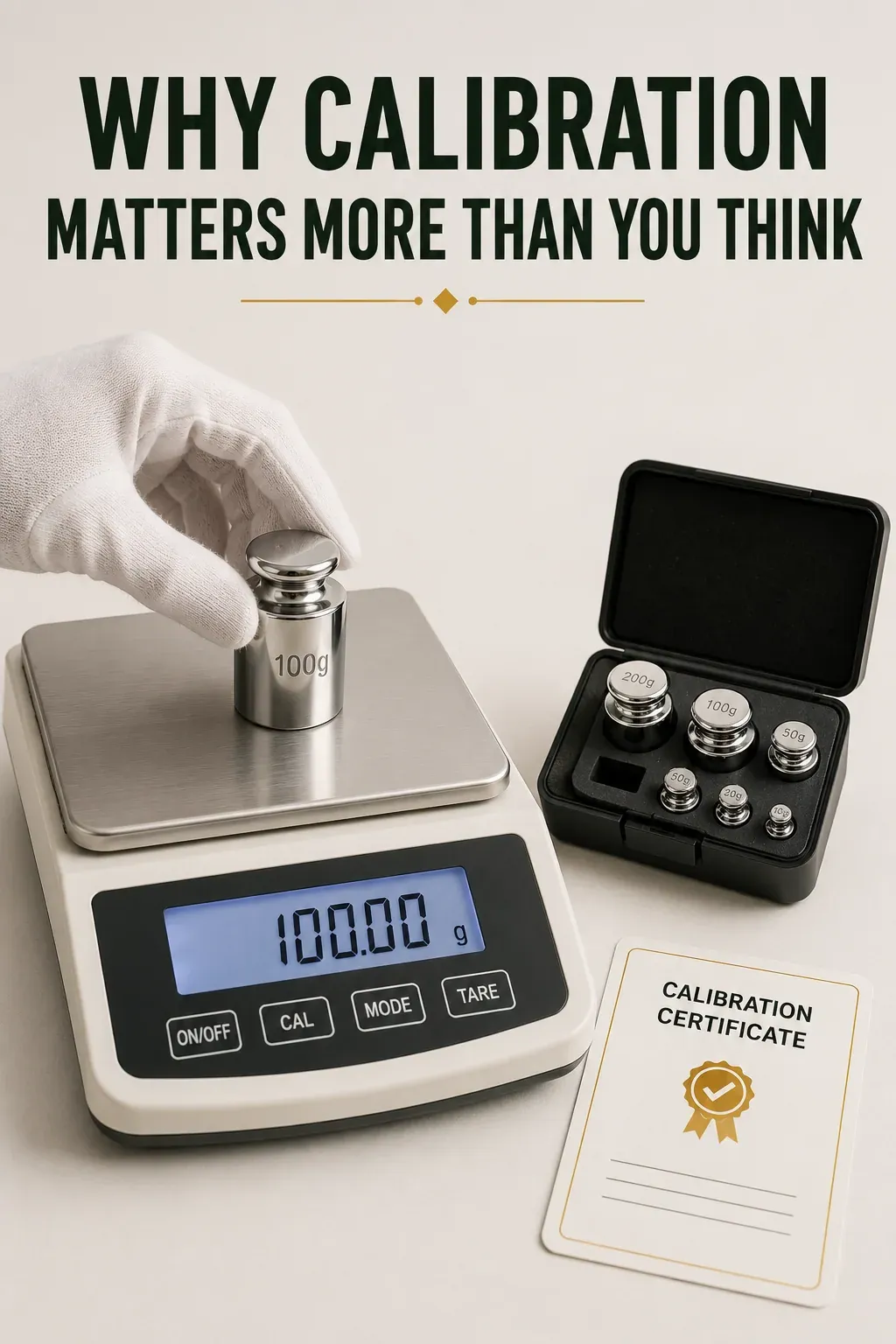
- Test a used scale before you trust it. Place a known weight on it, such as a test weight or an item already weighed on a verified scale, and compare the reading.
Who makes Omace weighing scales
Omace Brands Private Limited has made and supplied weighing scales in India since 1994, from Bagru, Jaipur. Ace carries its jewellery, pocket and laboratory scales, Venus its personal, kitchen, baby and hanging scales, and Hoffen its personal, smart, kitchen, coffee and luggage scales (see the Hoffen weighing machine brand guide); shop, platform and crane scales carry the Omace name. Every scale is checked before dispatch, and scales bought from the Omace store carry a 2-year warranty on manufacturing defects with PAN India delivery. Omace scales are made in India. As a manufacturer, Omace Brands Private Limited holds ISO 9001:2015, ISO 13485:2016 and EU MDR quality certificates, and CE and US FDA compliance certificates; each is listed with its certificate number on the Omace certificates page. Omace shop, platform, chicken and crane scales leave the Bagru factory verified and stamped by Legal Metrology.
All 14 types above are listed on the Omace online weighing scale store. Brands can sell scales under their own name through private label manufacturing. More about Omace.