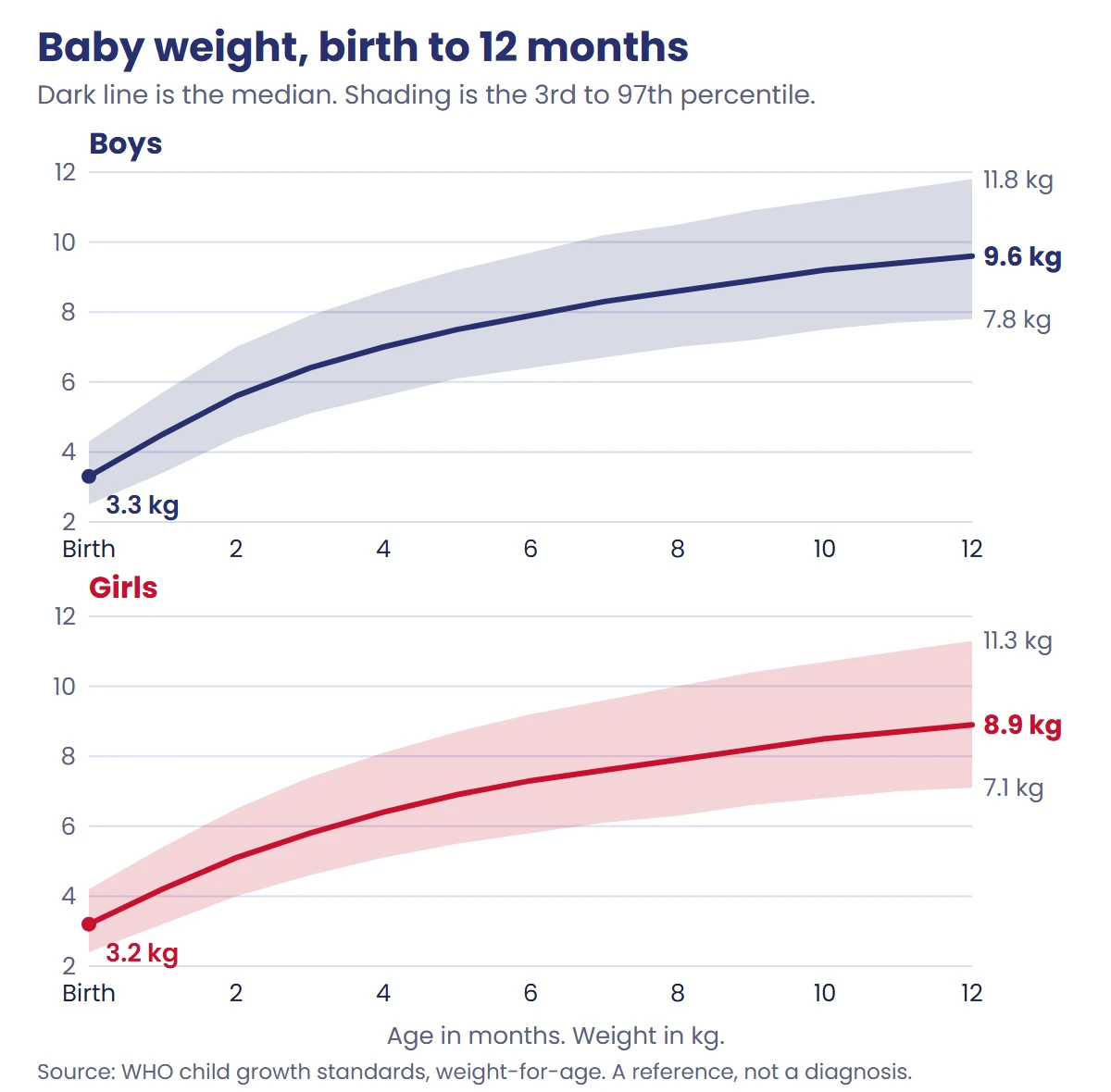
A newborn weight chart shows that most healthy babies weigh 2.4 to 4.3 kg at birth, and the WHO child growth standards put the median at 3.3 kg for boys and 3.2 kg for girls. By 12 months the median reaches 9.6 kg for boys and 8.9 kg for girls. A doctor reads the trend across several weighings.
Baby boy weight by month, in kg
This table copies WHO's weight-for-age percentiles for boys. The 50th column is the median baby, and 94 of every 100 babies in WHO's reference group sit between the 3rd and 97th columns.
| Age | 3rd | 15th | 50th (median) | 85th | 97th |
|---|---|---|---|---|---|
| Birth | 2.5 kg | 2.9 kg | 3.3 kg | 3.9 kg | 4.3 kg |
| 1 month | 3.4 kg | 3.9 kg | 4.5 kg | 5.1 kg | 5.7 kg |
| 2 months | 4.4 kg | 4.9 kg | 5.6 kg | 6.3 kg | 7.0 kg |
| 3 months | 5.1 kg | 5.6 kg | 6.4 kg | 7.2 kg | 7.9 kg |
| 4 months | 5.6 kg | 6.2 kg | 7.0 kg | 7.9 kg | 8.6 kg |
| 5 months | 6.1 kg | 6.7 kg | 7.5 kg | 8.4 kg | 9.2 kg |
| 6 months | 6.4 kg | 7.1 kg | 7.9 kg | 8.9 kg | 9.7 kg |
| 7 months | 6.7 kg | 7.4 kg | 8.3 kg | 9.3 kg | 10.2 kg |
| 8 months | 7.0 kg | 7.7 kg | 8.6 kg | 9.6 kg | 10.5 kg |
| 9 months | 7.2 kg | 7.9 kg | 8.9 kg | 10.0 kg | 10.9 kg |
| 10 months | 7.5 kg | 8.2 kg | 9.2 kg | 10.3 kg | 11.2 kg |
| 11 months | 7.7 kg | 8.4 kg | 9.4 kg | 10.5 kg | 11.5 kg |
| 12 months | 7.8 kg | 8.6 kg | 9.6 kg | 10.8 kg | 11.8 kg |
The median boy gains 1.2 kg in his first month and 0.2 kg in his twelfth. He passes twice his birth median between 3 and 4 months.
Baby girl weight by month, in kg
This table copies WHO's weight-for-age percentiles for girls. Boys and girls have separate tables because the median girl is lighter, by 0.1 kg at birth and by 0.7 kg at 12 months.
| Age | 3rd | 15th | 50th (median) | 85th | 97th |
|---|---|---|---|---|---|
| Birth | 2.4 kg | 2.8 kg | 3.2 kg | 3.7 kg | 4.2 kg |
| 1 month | 3.2 kg | 3.6 kg | 4.2 kg | 4.8 kg | 5.4 kg |
| 2 months | 4.0 kg | 4.5 kg | 5.1 kg | 5.9 kg | 6.5 kg |
| 3 months | 4.6 kg | 5.1 kg | 5.8 kg | 6.7 kg | 7.4 kg |
| 4 months | 5.1 kg | 5.6 kg | 6.4 kg | 7.3 kg | 8.1 kg |
| 5 months | 5.5 kg | 6.1 kg | 6.9 kg | 7.8 kg | 8.7 kg |
| 6 months | 5.8 kg | 6.4 kg | 7.3 kg | 8.3 kg | 9.2 kg |
| 7 months | 6.1 kg | 6.7 kg | 7.6 kg | 8.7 kg | 9.6 kg |
| 8 months | 6.3 kg | 7.0 kg | 7.9 kg | 9.0 kg | 10.0 kg |
| 9 months | 6.6 kg | 7.3 kg | 8.2 kg | 9.3 kg | 10.4 kg |
| 10 months | 6.8 kg | 7.5 kg | 8.5 kg | 9.6 kg | 10.7 kg |
| 11 months | 7.0 kg | 7.7 kg | 8.7 kg | 9.9 kg | 11.0 kg |
| 12 months | 7.1 kg | 7.9 kg | 8.9 kg | 10.2 kg | 11.3 kg |
The median girl gains 1.0 kg in her first month and 0.2 kg in her twelfth. She reaches twice her birth median at 4 months. For the gain in grams, see how much weight a baby should gain.
Normal weight of a newborn in kg
WHO defines low birth weight as under 2,500 g. A baby at exactly 2.5 kg is therefore just above that line. In India, the NFHS-5 survey (2019–21) found that 18.2% of babies with a reported weight were born under 2.5 kg. Those weights came from records and mothers' memory, so the report itself urges caution in reading them.
The WHO medians are a reference, and they aren't the average weight of Indian babies. WHO built them from healthy, breastfed children in six countries, India among them, to show how children should grow when conditions are good.
Why newborns lose weight in the first days
A newborn's weight dips before it climbs, and the birth row of the chart doesn't show this. The American Academy of Pediatrics says all newborns lose weight in their first 7 days, as they shed extra body fluid. Steady gain should start at about 5 days. Babies are usually back at birth weight by about 2 weeks, and almost all by 3 weeks.
One study of 937 full-term babies in Scotland put numbers on the dip. Breastfed babies lost a median of 6.6% of birth weight and formula-fed babies 3.5%, with the lowest point at about day 2.7. For a 3.2 kg baby, a 6.6% dip is about 210 g. Median return to birth weight took 8.3 days for breastfed babies and 6.5 days for formula-fed babies. These were Scottish babies, so treat the figures as a guide for Indian newborns.
How this infant weight chart compares with India's MCP card
India's Mother and Child Protection card uses the same source. The National Health Mission guidebook says the card's growth charts follow the WHO Child Growth Standards of 2006, with pink-bordered charts for girls and blue-bordered charts for boys.
The card draws different lines from the percentile tables above. It prints the median and two lower lines, known as the 2nd and 3rd z-score lines. A child above the 2nd line is in the green band. Between the 2nd and 3rd is yellow, and below the 3rd is orange.
The guidebook says the direction of the growth curve matters more than the weight at any one point. WHO's regional growth monitoring guide agrees that a single plotted point can't support a diagnosis. So a line that keeps rising along its own track tells you more than one reading.
How to weigh a newborn correctly
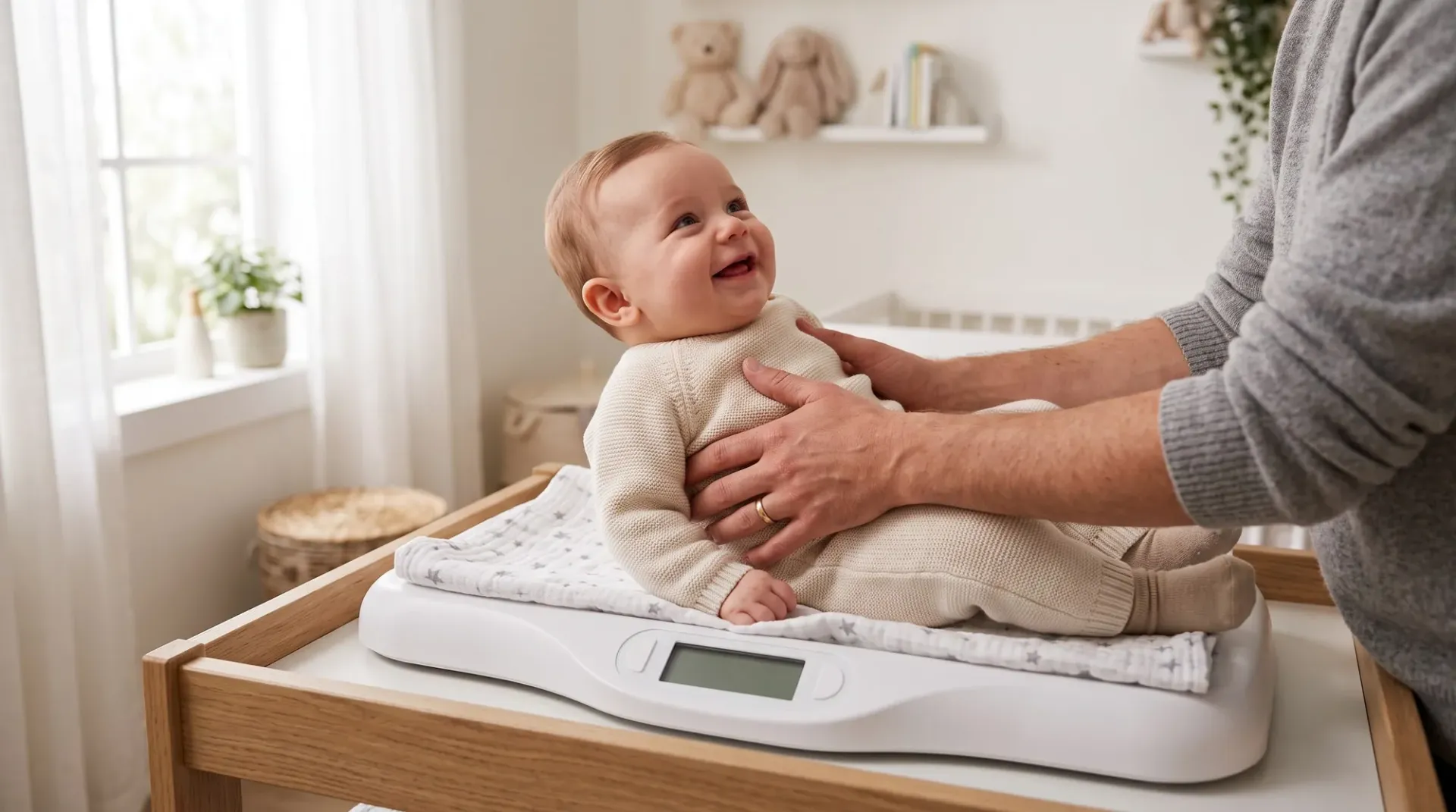
WHO's regional guide and the National Health Mission guidebook give these steps:
- Put a digital scale with a tare key on a firm, flat surface.
- Lay a light towel or blanket on the tray and press tare, so the scale shows 0.
- Undress the baby, or keep a clean nappy on and subtract a similar nappy.
- Lay the baby on the back and keep a hand close the whole time.
- Write down the reading with the date. WHO's guide records to the nearest gram, and India's card is read to the nearest 100 g.
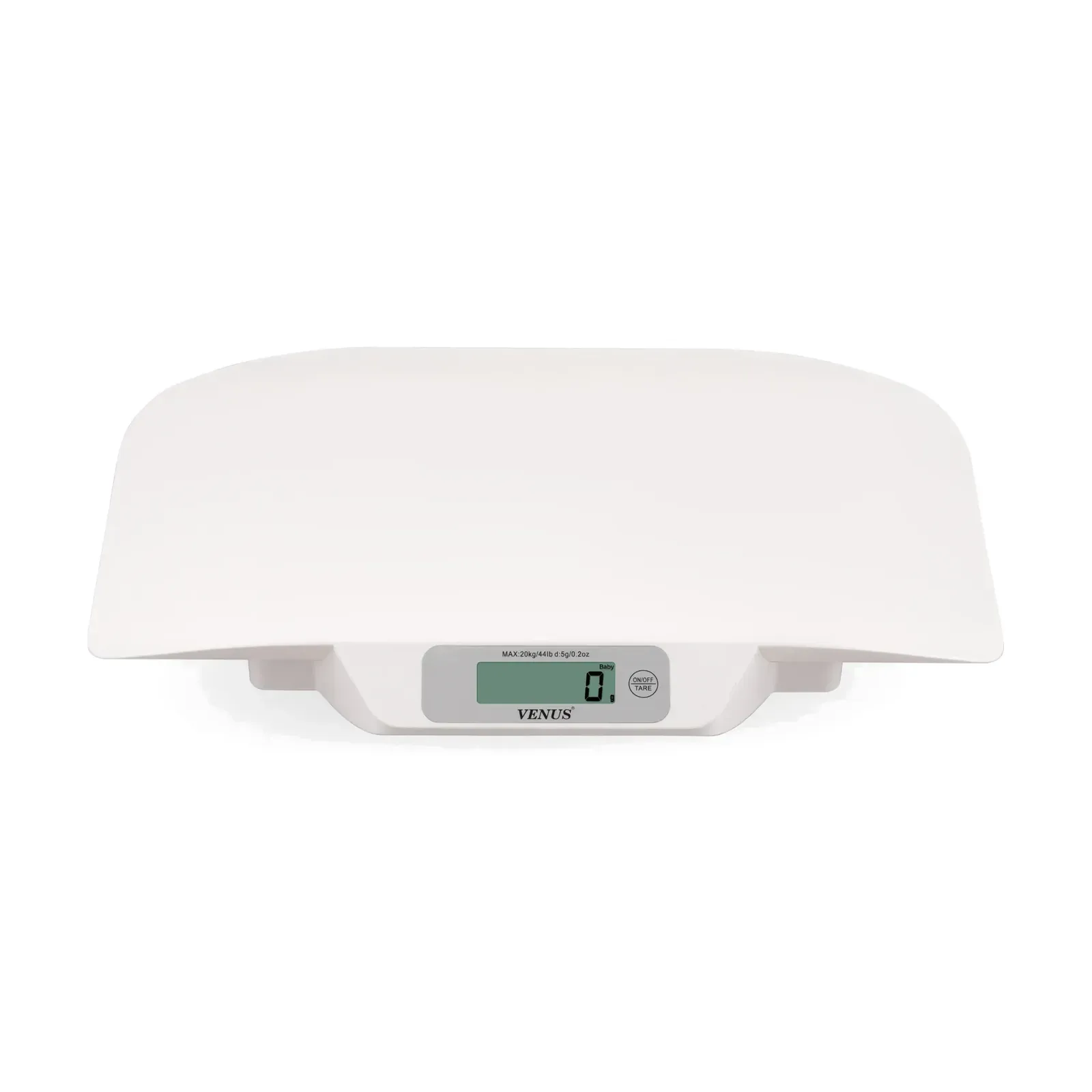
A baby scale in Omace's range reads finer than the card needs. The Venus EBS-KS-9090 infant weighing scale reads in 5 g steps up to 20 kg for ₹2,619. The Venus EBS-KS-811 rechargeable baby weighing scale reads in 5 g steps up to 30 kg, also for ₹2,619. The ICDS-MBS-KS-810 digital baby weighing scale reads in 10 g steps for ₹3,459. With no power at all, the Venus HSTB-5 spring balance for newborn babies reads in 100 g steps for ₹419. These are November 2026 prices, and our baby weighing scale range lists them all.
Home readings help you note a trend between check-ups, and the clinic's weighing still counts. After the first 2 weeks, NHS guidance suggests weighing no more than once a month up to 6 months, and no more than once every 2 months from 6 to 12 months.
When to ask a doctor
A chart raises a question, and a doctor answers it. Ask your doctor to look at the numbers if:
- your baby hasn't regained birth weight by about 2 weeks;
- a reading falls below the 3rd or above the 97th column;
- the line stays flat or falls across two or more check-ups;
- feeding or energy has changed.
For later ages, see our boys growth chart up to 5 years.
Omace Brands Private Limited has made and supplied weighing scales in India since 1994, and every scale is calibrated and checked before dispatch. More about Omace. Omace scales are made in India. As a manufacturer, Omace Brands Private Limited holds ISO 13485:2016, ISO 9001:2015 and EU MDR quality certificates, and CE and US FDA compliance certificates, each listed on the Omace certificates page. Scales bought from the Omace store carry a 2-year warranty on manufacturing defects.