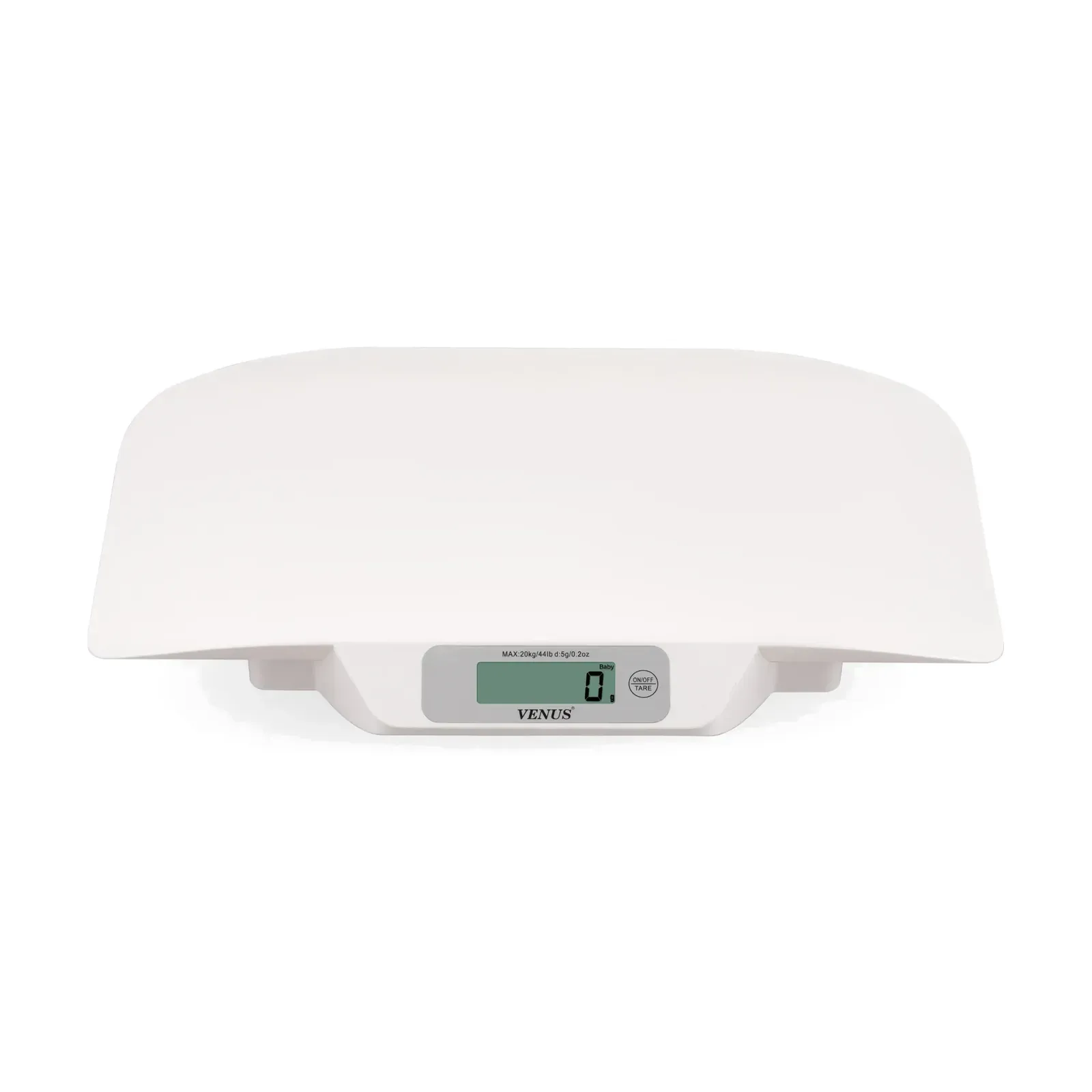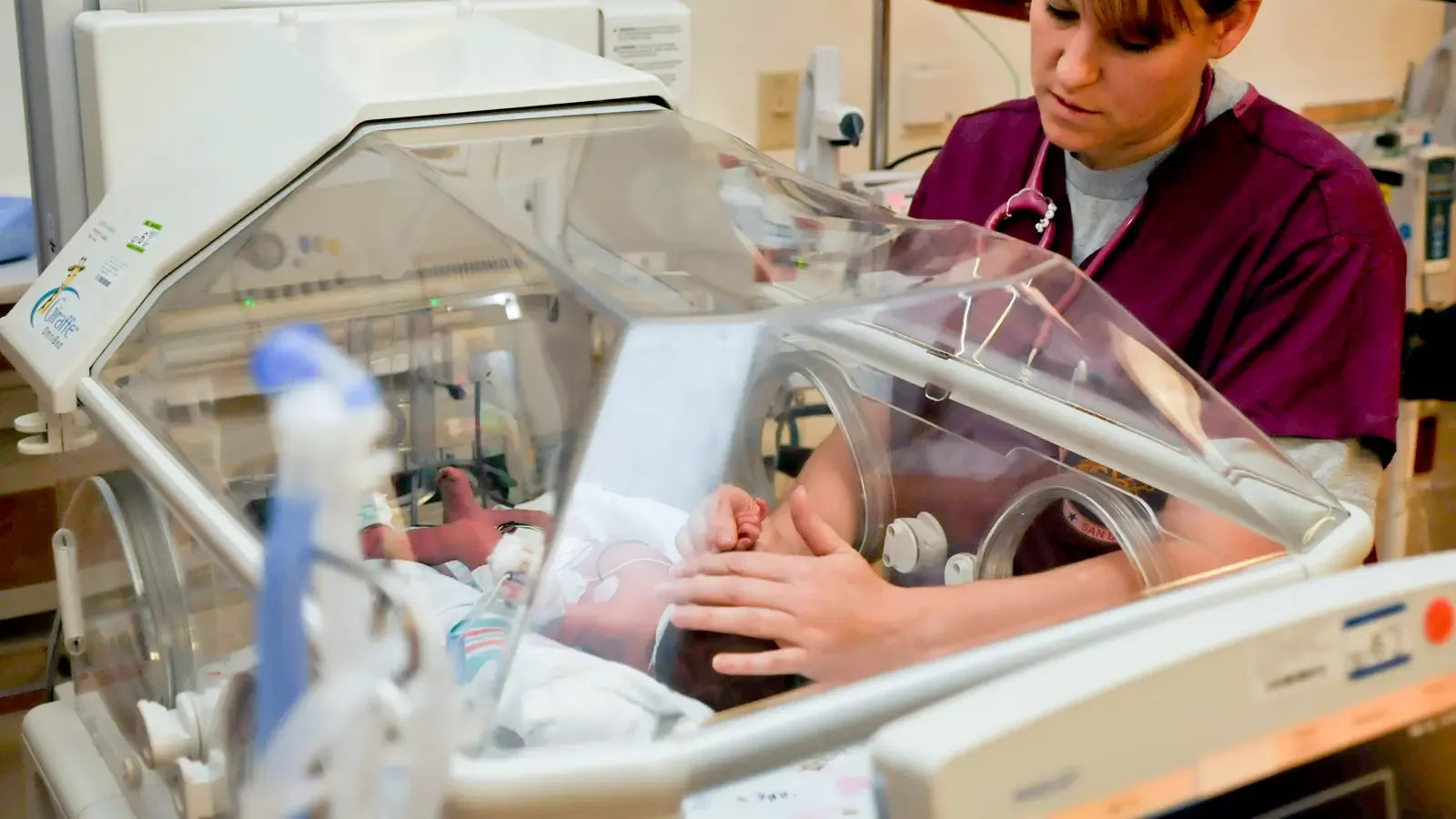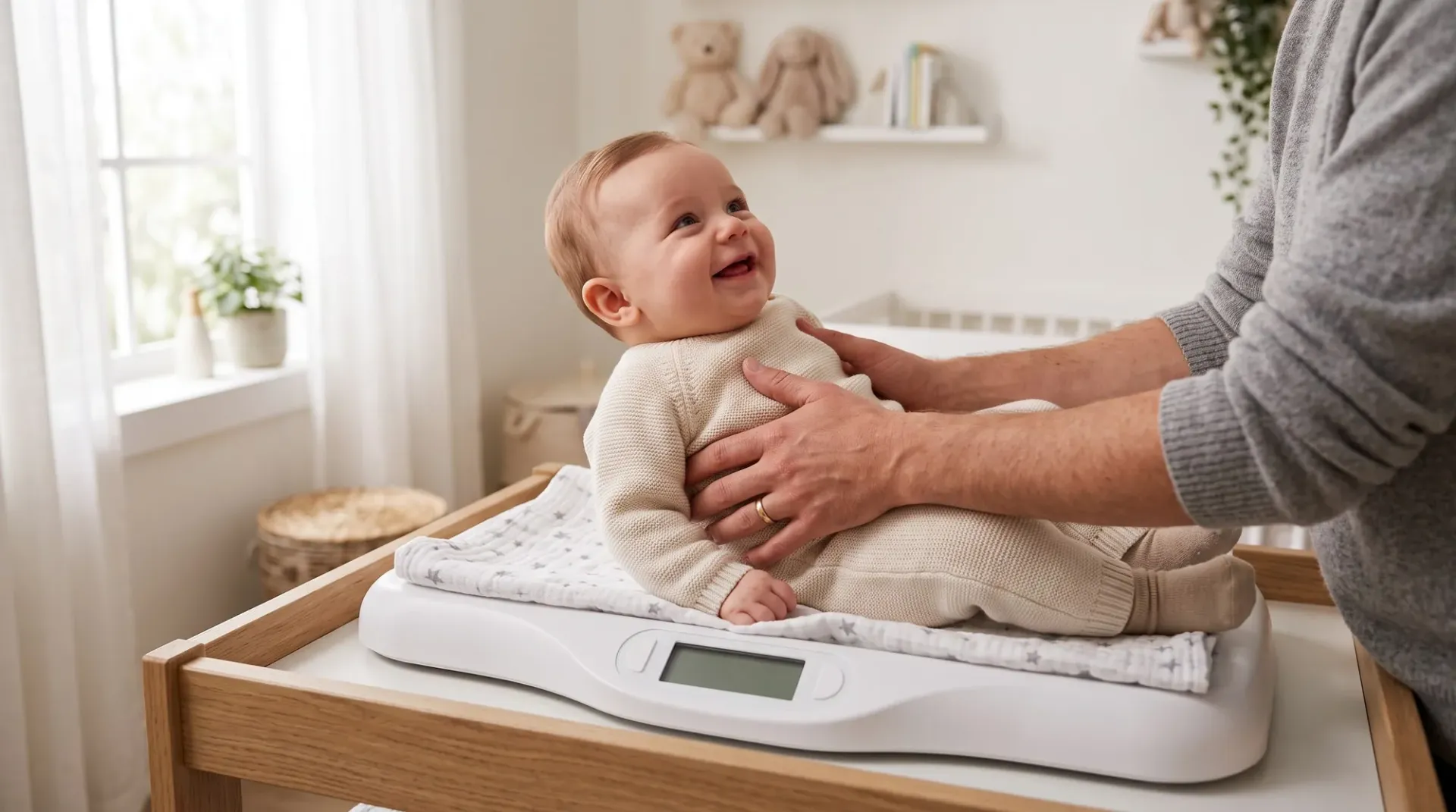
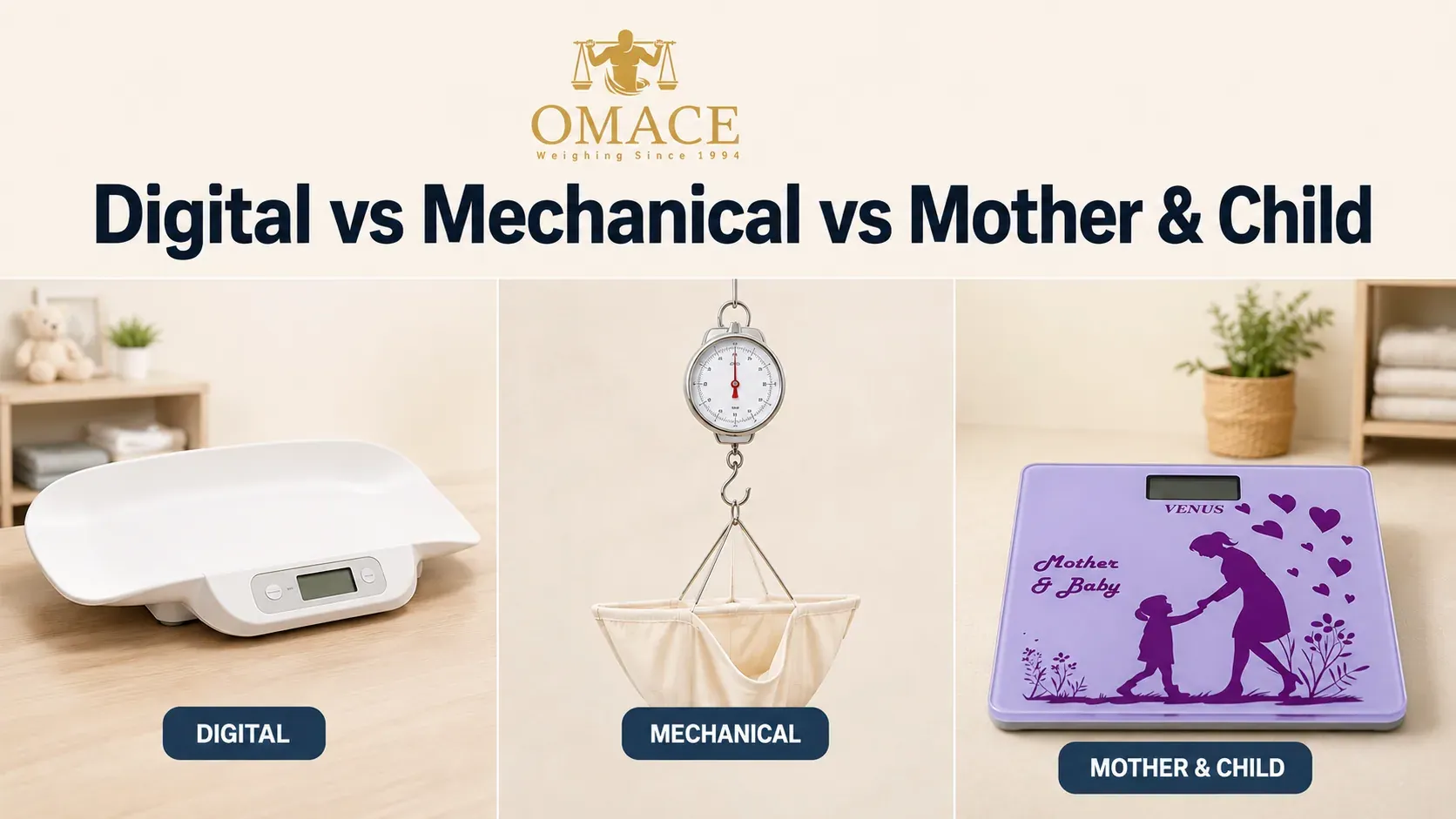
Choose a baby weighing scale by where you will use it and how small a weight change you need to see. Clinical guidance from WA Health asks for a digital infant scale that reads in steps of 10 g or finer and holds at least 20 kg; the Venus EBS-KS-9090 reads in 5 g steps up to 20 kg. For home checks, a mother and child scale with auto tare works, and for field visits without power, a hanging scale with a sling.
Five types of baby weighing scale
Omace sells five kinds of baby weighing scale under its Ace, Venus and Omace names. Each suits a different place and budget.
Digital infant scale with a curved tray
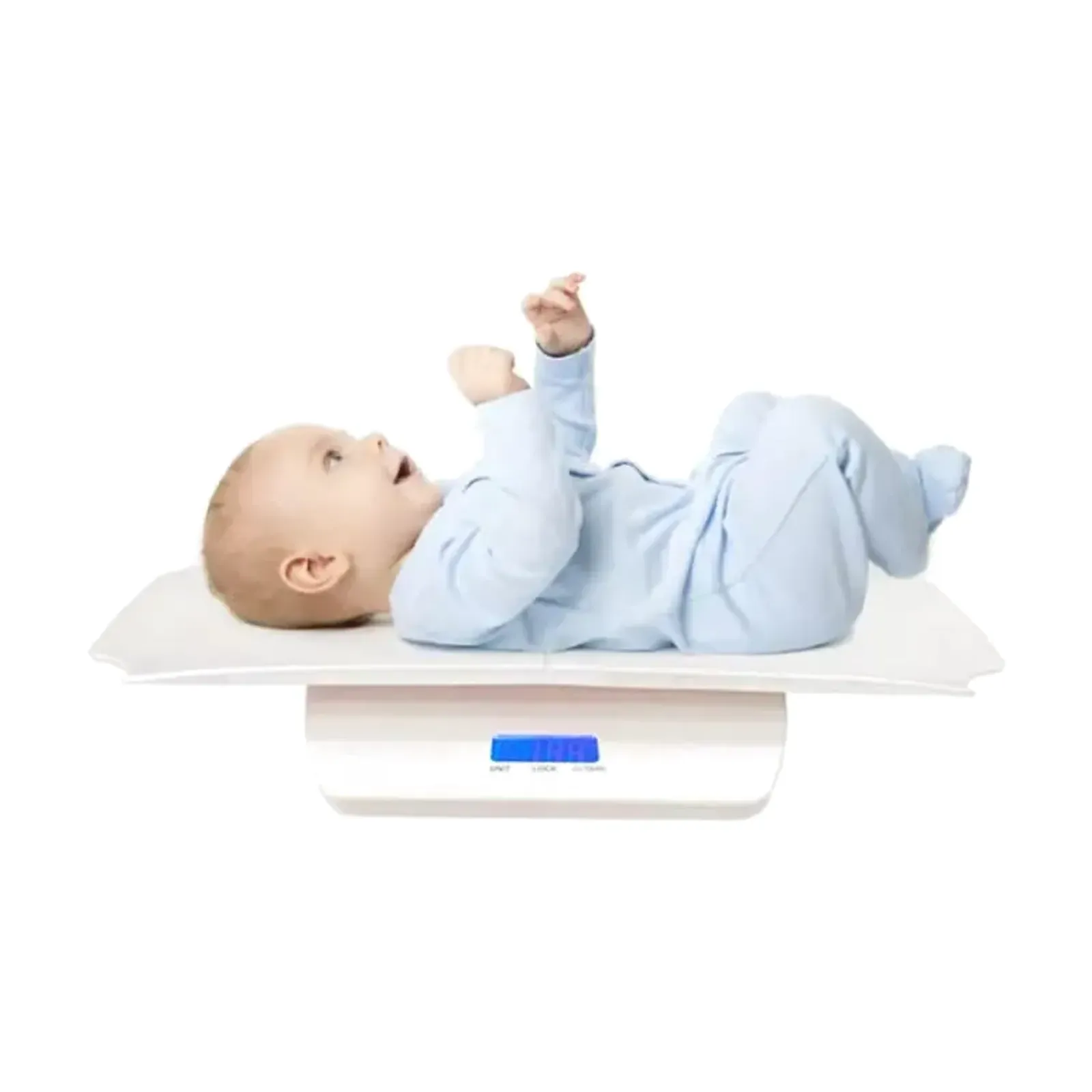
A tray scale, often called a newborn weight machine, is the easiest type to use at home. The Venus EBS-KS-9090 infant weighing scale reads in 5 g steps up to 20 kg and switches between g, kg and lb. Its curved 540 × 300 mm tray keeps the baby centred, and it has tare, an overload warning and auto-off. It runs on 3 AAA batteries and weighs 1.5 kg, so it moves easily between home and clinic. The Venus EBS baby scale series is a Legal Metrology approved model in accuracy class III; the approved 30 kg model has a minimum load (Min) of 100 g and a verification interval (e) of 5 g.
Mother and baby 2-in-1 scale
A 2-in-1 scale weighs the baby on a tray, then weighs the mother once the tray is lifted off. The Ace ICDS-MBS-KS-810 digital baby weighing scale reads in 10 g steps and holds up to 100 kg. A hold function locks the reading when the baby moves, and a 600 mm tape on the tray measures the baby's length. It runs on 2 AAA batteries and shows kg, lb or oz.
Mother and child scale with auto tare
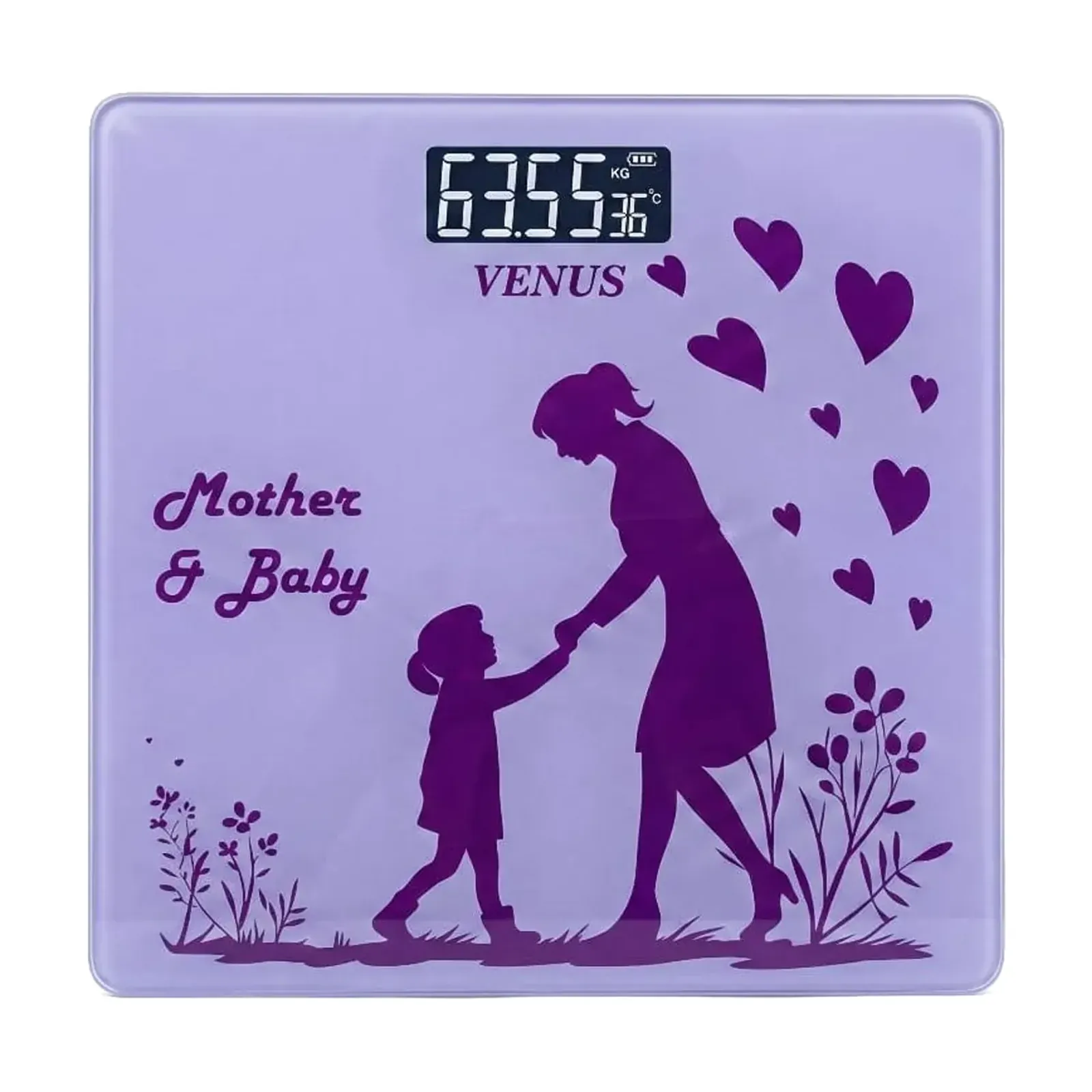
This looks like a bathroom scale but works out the baby's weight for you. The WHO growth-assessment course describes the method as tared weighing: the mother is weighed, the scale is reset to zero with her still on it, and when she holds the baby the scale shows the baby's weight alone. The Venus EPS-05 mother and child weighing scale does this automatically in mother-and-child mode. The mother weighs herself, steps off, picks up the baby and steps on again, and the scale shows the baby's weight. It is quick and needs no separate baby scale. The EPS-05 reads in 100 g steps up to 180 kg, and the Venus EPS-09 (M) works the same way on a steel platform.
The same WHO course does not recommend ordinary bathroom scales for weighing children, because they tend to be unreliable. A built-in tare mode avoids the error of subtracting two readings by hand, but a 100 g step is coarse for a newborn.
Hanging scale with a sling
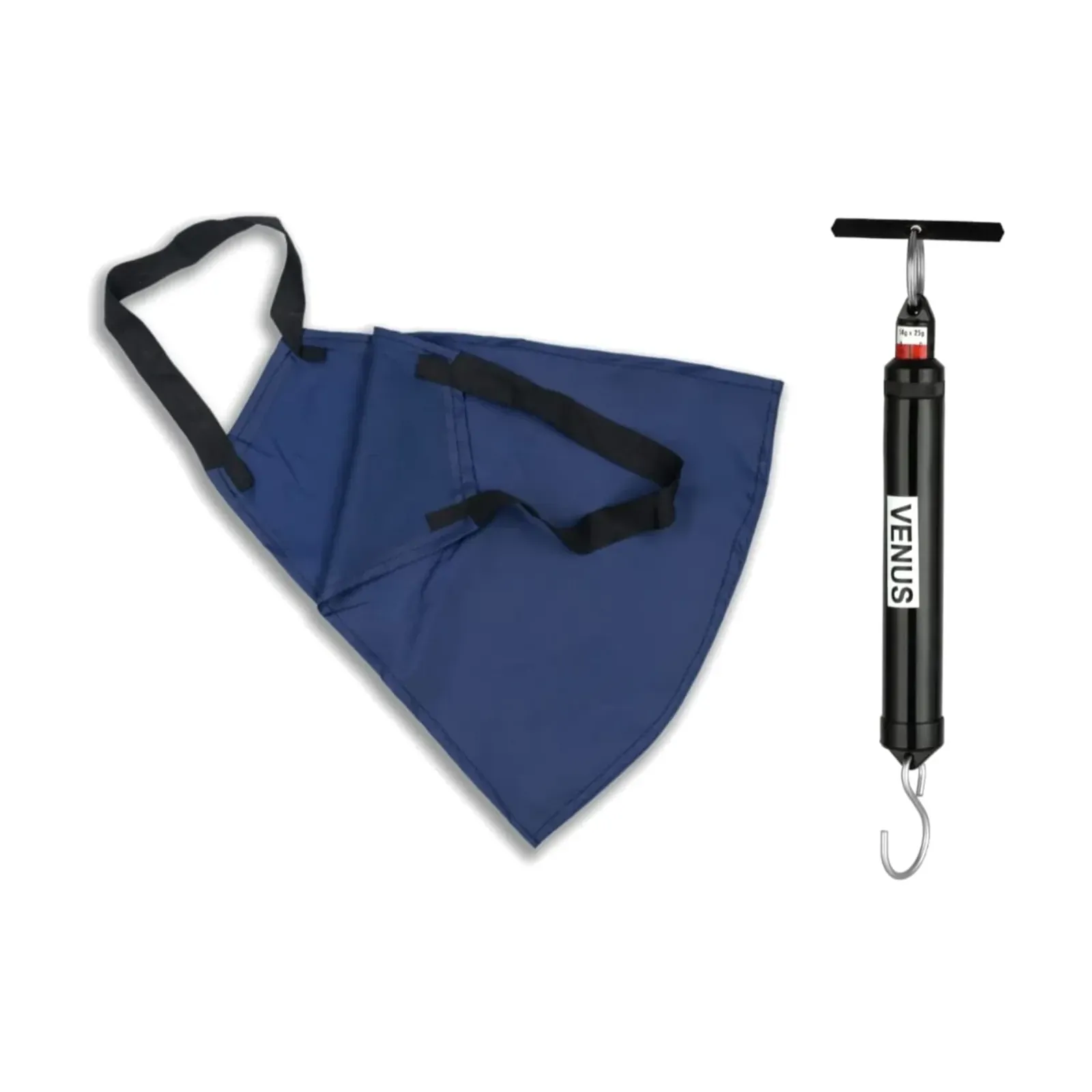
A hanging scale needs no power and fits in a kit bag, so it suits field visits. The Venus HSTB-5 spring balance for newborns is the 5 kg tricolour Anganwadi scale. It weighs up to 5 kg in 100 g steps, has tricolour weight bands and a zero adjust, and weighs only 140 g. The Venus CHS-25 baby hanging scale has a round dial, weighs up to 25 kg in 100 g steps and comes with a sling and S-hook. A knob on top sets the needle to 0 with the empty sling hanging, and the dial is marked class IIII, Max 25 kg and Min 1 kg. The Venus CHS and HSTB series are Legal Metrology approved models in accuracy class IIII. The WHO course warns that hanging scales are not reliable when a baby is agitated, so they work best with a calm baby and a steady hook. ASHA workers weigh newborns at home on a similar tricolour sling scale, as the newborn essentials checklist explains.
Baby and adult hospital scale
A baby and adult scale weighs newborns, mothers and adults on one machine. The Omace OM-PS-200 has a raised curved baby tray (250 × 550 mm) on a 400 × 500 mm stainless steel platform. It reads in 10 g steps up to 200 kg, runs on mains power with a 2-day backup and rolls on castor wheels. Hospitals can ask for it to be supplied stamped by Legal Metrology; the buyer pays the state's verification fee.
Baby weighing scales compared
| Type | Omace model | Capacity and steps | Best for | Price |
|---|---|---|---|---|
| Digital infant tray scale | Venus EBS-KS-9090 | 20 kg × 5 g | Newborns at home and in clinics | ₹2,499 |
| Mother and baby 2-in-1 | Ace ICDS-MBS-KS-810 | 100 kg × 10 g | Families and clinics weighing baby and mother | ₹3,299 |
| Mother and child, auto tare | Venus EPS-05 / EPS-09 (M) | 180 kg × 100 g | Monthly checks at home on a budget | ₹699–₹990 |
| Hanging scale with sling | Venus HSTB-5 / CHS-25 | 5 kg or 25 kg × 100 g | Field visits without power | ₹399–₹1,299 |
| Baby and adult hospital scale | Omace OM-PS-200 | 200 kg × 10 g | Hospitals, maternity wards, OPDs | ₹14,999 |
Prices are from the Omace store in October 2026.
What to look for before you buy
- Readability. WA Health asks for steps of 10 g or finer. On the WHO weight velocity tables, the median baby gains about 1 kg a month in the first two months but only about 240 g a month by 11 to 12 months, roughly 55 g a week. A 5 g or 10 g scale shows a week's gain; a 100 g scale shows a month's.
- Capacity. WA Health asks for at least 20 kg. On the WHO weight-for-age tables, a 2-year-old boy at the 97th percentile weighs 15.1 kg, so a 20 kg tray scale lasts through the tray years.
- Tare and hold. Tare zeroes a cloth or towel on the tray. A hold or weight-lock function, as on the KS-810, keeps the reading on screen when the baby wriggles.
- Tray and stability. A curved tray keeps the baby centred. The scale must stand on a flat, stable surface, and a parent stays close throughout.
- Power. Battery scales switch on anywhere; the OM-PS-200 runs on mains with a backup; hanging scales need no power at all.
- Cleaning. WA Health cleans the scale before and after each use. A smooth plastic tray wipes clean with a mild disinfectant; do not put the scale in water.
Which scale suits home, clinic or field
- Home, with a newborn: a digital infant tray scale such as the EBS-KS-9090.
- Home, weighing mother and baby: the KS-810, or the EPS-05 for monthly checks on a smaller budget.
- Anganwadi or field visits without power: the HSTB-5 or CHS-25 hanging scale, used with a calm baby.
- Hospital ward or OPD: the OM-PS-200 baby and adult scale, or the KS-810 where space is short.
Haryana's Anganwadi kits pair two scale types. In Haryana, the Women and Child Development department reports 25,962 growth monitoring sets supplied to Anganwadi centres, each with a mother and child weighing scale and an infant weighing scale, plus an infantometer and a stadiometer.
How to weigh a baby accurately
On a tray scale, following the WA Health procedure and the Omace product instructions:
- Place the scale on a firm, flat table or floor, never on a bed or sofa.
- Switch it on and wait for 0. If you use a thin cloth, lay it on the tray and press tare.
- Take off the baby's clothes and nappy.
- Lay the baby in the centre of the tray and keep one hand close.
- Wait for the reading to settle, then note it to the nearest 10 g, or 5 g on a 5 g scale.
- Write down the date and time, and weigh at the same time of day, before a feed, next time.
On a mother and child scale, the parent steps on alone and waits for the weight to lock, steps off, picks up the baby and steps on again; the screen then shows the baby's weight. The calibration guide explains how to read a baby scale and check that it is accurate.
How often to weigh, and checking the scale
After the first two weeks, NHS guidance weighs a baby no more than once a month up to 6 months, once every 2 months from 6 to 12 months, and once every 3 months after the first birthday, unless there is a concern. A home scale does not need more use than that to show the trend.
Clinics check their scales often. The WHO course checks scales at least once a week with known weights of 3, 5, 10 and 20 kg, and tests tare by weighing 20 kg, taring, then adding 3 kg, which should read 3 kg. A scale that is off by a varying amount is replaced.
A scale gives the number; a doctor or paediatrician decides whether the baby is growing well. For the monthly WHO figures, see how much weight should a baby gain. Length is measured lying down on a length board; the guide on how to use an infantometer shows the steps.
Buying a baby scale from Omace
Omace Brands Private Limited, based in Bagru, Jaipur, has made and supplied weighing scales in India since 1994. Every scale is checked before dispatch, and Omace delivers PAN India. Baby scales bought from the Omace store carry a 2-year warranty on manufacturing defects; batteries and physical damage are not covered. Hospitals, ICDS projects and distributors can order in bulk through the dealer and bulk order page. More about Omace. Omace scales, baby scales included, are made in India. As a manufacturer, Omace Brands Private Limited holds ISO 9001:2015, ISO 13485:2016 and EU MDR quality certificates, and CE and US FDA compliance certificates; each is listed with its certificate number on the Omace certificates page.