Roasting coffee means heating green coffee beans until they turn brown, crack and build the aroma that ends up in the cup. In a 2017 study in Phytochemical Analysis, beans finished at 199–230 °C and lost 12.9–19.2% of their weight between light and dark roasts. Light roasts keep more of the bean's own character, and dark roasts taste more of the roast.
What happens when coffee beans are roasted
Green coffee is hard, pale and smells more of hay than of coffee. Heat makes it brittle and fragrant through overlapping chemical changes. A 2023 review in the International Journal of Environmental Research and Public Health names the main ones as pyrolysis, the Maillard reaction and caramelization. The same review gives a usual roasting range of 180–240 °C for 5 to 15 minutes, with the time and temperature set by the roast wanted.
- Pyrolysis and drying: water leaves first, the beans lose mass and they begin to turn yellow.
- Maillard reaction: sugars and amino acids form many new compounds that give coffee its colour and aroma, and some of these join into dark brown melanoidins.
- Caramelization: sugars break down further, and in darker roasts the bean's oils move to its surface.
The review also notes that acrylamide forms from reducing sugars and the amino acid asparagine during roasting. Its formation peaks in the middle of the roast, and temperatures above 180 °C break it down, so lighter roasts carry more of it than dark ones.
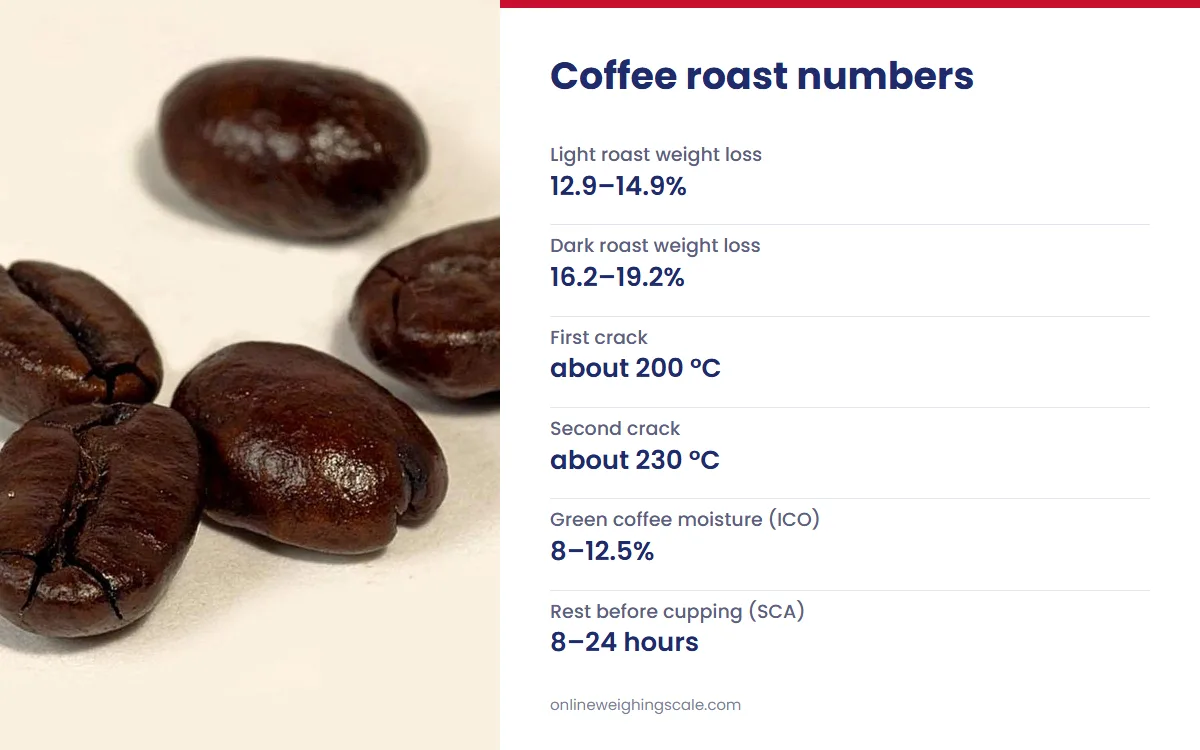
Water is the first thing to go. The International Coffee Organization's Resolution 420 asks exporting countries not to ship Arabica or Robusta with moisture below 8% or above 12.5%, measured by the ISO 6673 method. Driving off that water accounts for part of the weight a bean loses in the roaster; gases and compounds broken down by the reactions above account for the rest.
The stages of a coffee roast
As the coffee beans roast, they pass through the same stages in every machine. The timing of each stage changes with batch size, heat and the bean itself.
- Drying: the beans warm through, give off steam and fade from green to pale yellow.
- Browning: Maillard reactions take over, the colour moves through tan to light brown, and the smell turns from grass to toasted bread.
- First crack: the beans pop audibly as steam and gas break their structure. A 2018 Euronoise conference paper from the University of Pavia places first crack at about 200 °C and says it lasts 1–2 minutes.
- Development: the time after first crack, when the roaster decides how far to take the beans.
- Second crack: a quieter, quicker crackle at around 230 °C, caused by more gas escaping, according to the same paper. Past this point a few seconds separate a dark roast from a burnt one.
The Pavia paper notes that roasters judge the end point from bean colour, chamber temperature and the sound of the cracks together. Thermometer readings vary with the probe and the machine, so at home the cracks and the colour are the steadier guides.
Types of coffee roast: light, medium and dark
Roast level describes how far the beans were taken. Laboratories measure it as colour: the Specialty Coffee Association's sample preparation standard, SCA-102, defines its cupping roast as medium, with a ground-coffee lightness (L*) of 26–29 on the CIELAB colour scale. Shops also use names such as city, full city, Vienna, French and Italian roast, and these vary from one roaster to the next.
Light roast
A light roast ends at or soon after first crack. In the 2017 study, light Arabica finished at 200–204 °C and lost 14.0–14.9% of its weight, while light Robusta finished at 199–213 °C and lost 12.9–14.7%. The cup is brighter and more acidic, with fruit and floral notes, and the dense beans are harder to grind.
Medium roast
Medium roast coffee goes further into development but stops short of second crack. Medium Arabica finished at 208–215 °C with a 15.9–16.8% weight loss, and medium Robusta at 208–222 °C with 14.5–16.8%. Medium roasted coffee balances the bean's own character against caramel and chocolate notes, and it is the level the SCA uses for cupping.
Dark roast
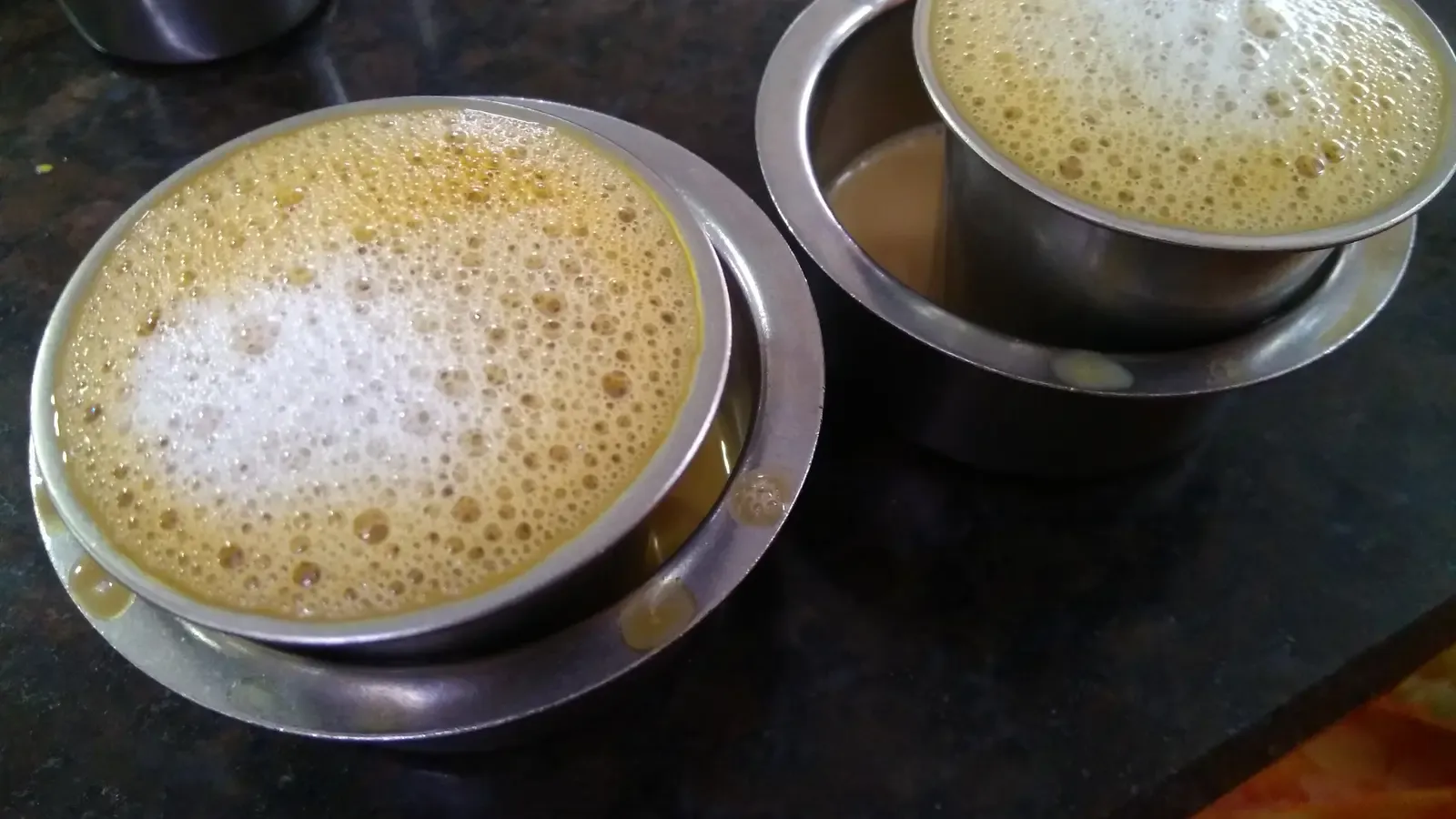
A dark roast reaches or passes second crack, and the bean's surface turns oily. Dark Arabica finished at 217–227 °C and lost 17.6–19.2%, and dark Robusta finished at 217–230 °C and lost 16.2–18.5%. The taste is bittersweet and smoky, and the roast covers much of the origin. The powders used for South Indian filter coffee are usually dark roasts, often blended with chicory.
Roasts of coffee compared
The figures below come from the 2017 Phytochemical Analysis study, which roasted Arabica from Costa Rica and Robusta from Vietnam at four speeds, from about 5 to 18 minutes. Temperatures read differently on different roasters, so treat them as a guide.
| Roast level | Where it ends | Final bean temperature | Weight lost | Look and taste |
|---|---|---|---|---|
| Green coffee | Before roasting | Room temperature | None; 8–12.5% moisture for export | Pale green, very hard, grassy smell |
| Light | At or just after first crack | 199–213 °C | 12.9–14.9% | Light brown, dry surface, bright and fruity |
| Medium | Between first and second crack | 208–222 °C | 14.5–16.8% | Mid brown, dry surface, caramel and chocolate |
| Dark | At or past second crack | 217–230 °C | 16.2–19.2% | Dark brown, oily surface, bittersweet and smoky |
Roasting coffee in India
India grows both Arabica and Robusta, and most of its crop is Robusta, as the guide to types of coffee beans sets out with Coffee Board figures. Robusta behaves a little differently in the roaster: in 9 of the 12 runs in the 2017 study, it lost less weight than Arabica roasted to the same level at the same speed.
Before the roasting of coffee beans can start, Indian coffee is hulled and graded at curing works. The Coffee Board of India issues coffee curing licences, and its 2026 support scheme for curing units lists machines such as hullers, graders, gravity separators and colour sorters. These steps turn dried cherry and parchment into the graded green coffee that roasters buy.
India also produces a coffee that breaks the usual moisture rule. ICO Resolution 420 allows exceptions to its 12.5% maximum for speciality coffees that traditionally hold more moisture, and it names Indian Monsooned coffees as the example. Those swollen beans bring more water into the roaster, which has to be driven off before browning begins.
For anyone who wants to learn the craft formally, the Coffee Board runs Kaapi Shastra, a five-day training programme in coffee roasting, brewing and retailing at its Bengaluru head office. The course fee is ₹15,000 plus 18% GST per participant, and the next batch listed runs from 30 November to 4 December 2026 (checked November 2026).
How to roast coffee beans at home
Choosing coffee beans for roasting
Buy green beans from an estate, a curing works or a roaster that sells them unroasted. Look for even size and colour, few broken or black beans, and no musty smell. If the seller states the moisture, a figure between 8% and 12.5% matches the ICO export range. Keep green beans in a cool, dry place away from strong smells, and start with batches of 100–200 g so they move freely and you can watch them.
Pan, oven and hot-air methods
- Heavy pan or kadai on the stove: the cheapest method. Stir without stopping, because beans resting on hot metal scorch on one side.
- Oven on a perforated tray: hands-free but less even, so turn the beans every few minutes.
- Hot-air roaster: a stream of hot air keeps the beans moving, roasts them evenly and blows the chaff away.
- Small drum roaster: a rotating drum over a heat source, the home version of a commercial machine.
- Weigh the green beans and write the figure down.
- Heat the pan, oven or roaster before the beans go in.
- Keep the beans moving and watch the colour go from green to yellow to brown.
- Listen for first crack, then decide how much longer to go.
- Tip the beans into a metal colander and cool them with moving air while stirring. SCA-102 air-cools its samples without water quenching.
- Shake off the papery chaff, let the beans reach room temperature and weigh them again.
Safety when roasting at home
Home bean roasting gives off smoke and gas. A 2022 study by NIOSH researchers in Frontiers in Public Health notes that roasted coffee emits volatile organic compounds, carbon monoxide and carbon dioxide. Roast beside an open window, under a working exhaust hood or outdoors. Never leave a roast unattended, since dry chaff is light and can catch fire near a flame, and keep children away from the hot pan and beans.
Resting, degassing and storing roasted coffee
Roasted beans keep releasing gas after they leave the roaster, including carbon dioxide formed during roasting. In the same NIOSH study, the emission rates of two flavour compounds, diacetyl and 2,3-pentanedione, were lowest from whole beans and rose as the coffee was ground finer.
SCA-102 rests coffee for 8 to 24 hours after roasting, then keeps it in airtight containers or non-permeable bags in a cool, dark place. At home that becomes a simple routine:
- Leave the beans loosely covered for the first night so gas can escape.
- Move them to an airtight, opaque container at room temperature after that.
- Roast only as much as you will brew in the next couple of weeks.
- Grind just before brewing; SCA-102 grinds each sample as close to cupping time as practical.
Weigh coffee beans before and after roasting
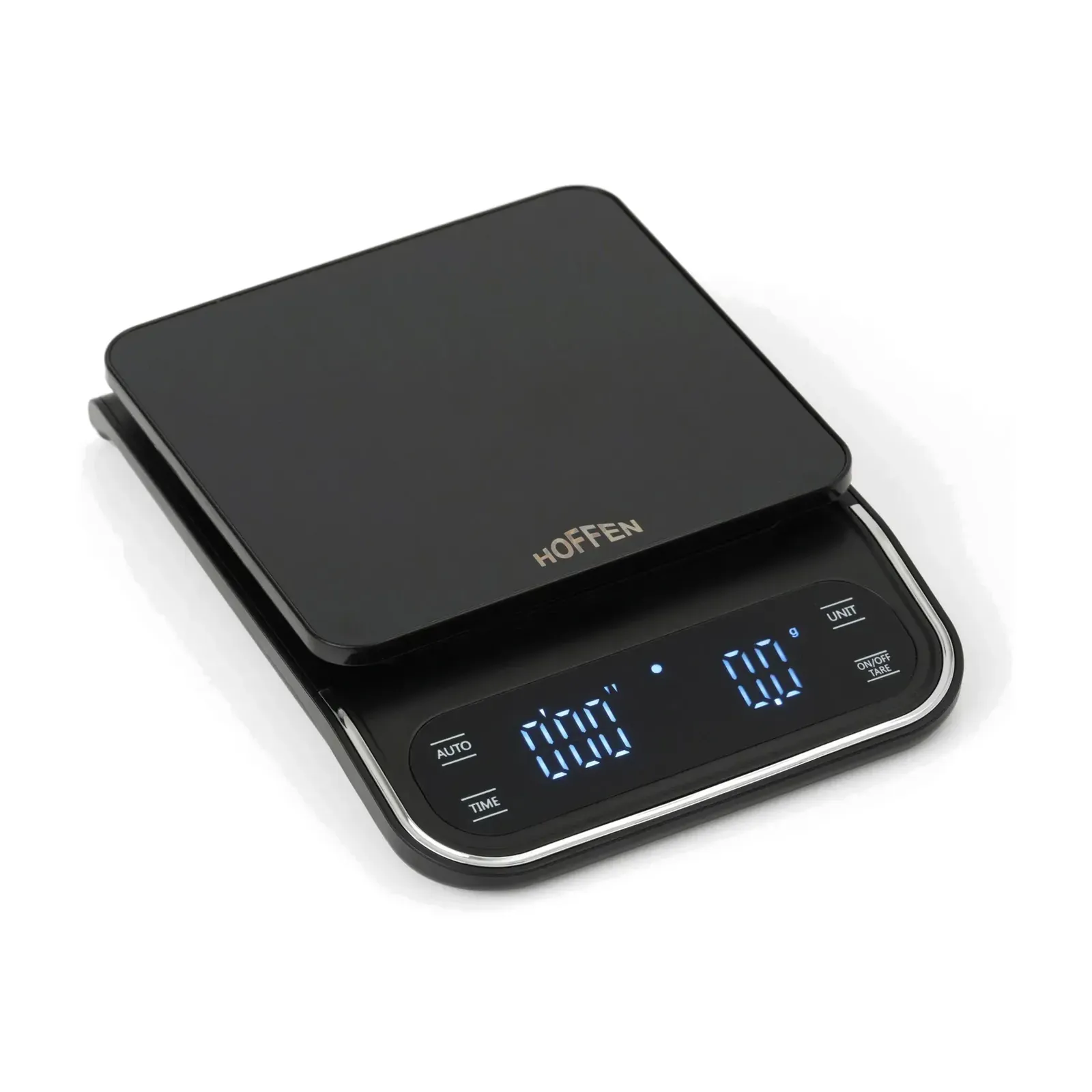
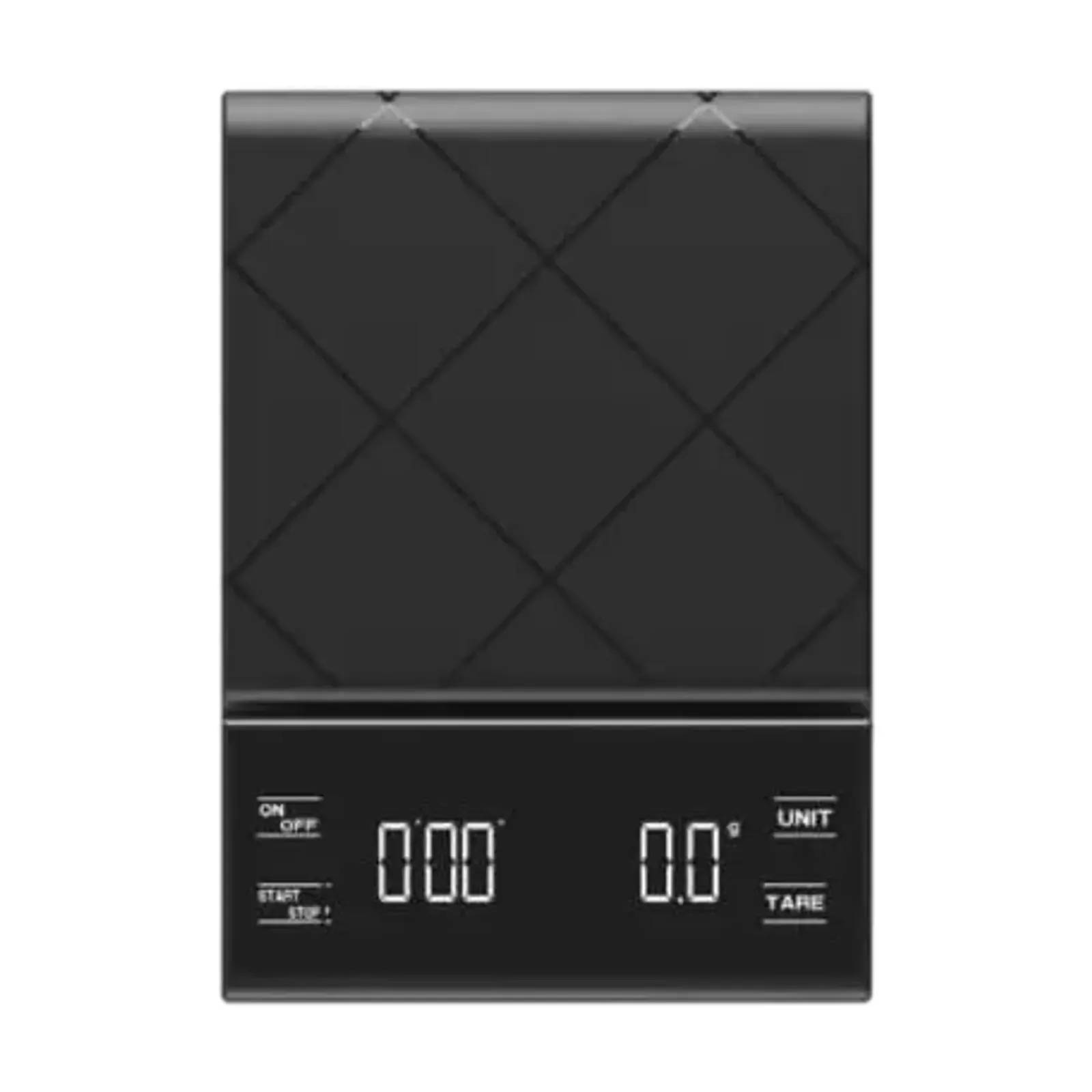
A scale turns the colour of a roast into a number. Weigh the green beans, roast and cool them, then weigh again. Roast loss is the difference divided by the green weight: 250 g of green Arabica that comes out at 209 g has lost 41 g, or 16.4%. That sits inside the 15.9–16.8% the 2017 study measured for medium Arabica. The same arithmetic gives your yield, since 1 kg of green coffee becomes roughly 810–860 g roasted at a 14–19% loss. SCA-102 lists dry matter loss among the accepted ways to control roast level, once it has been matched to colour readings, and it weighs each cupping dose on a scale reading 0.1 g or finer. A coffee scale with 0.1 g steps handles both jobs: it records the roast loss batch after batch and measures the dose when you brew.
Try one bean at three roast levels
The quickest way to learn is to take one green coffee to light, medium and dark on three separate days. Weigh each batch before and after, note the time of first crack, and brew all three the same way after a night's rest. Once you have tasted the three side by side, the weight loss figure becomes a reliable way to repeat the roast you liked best.