
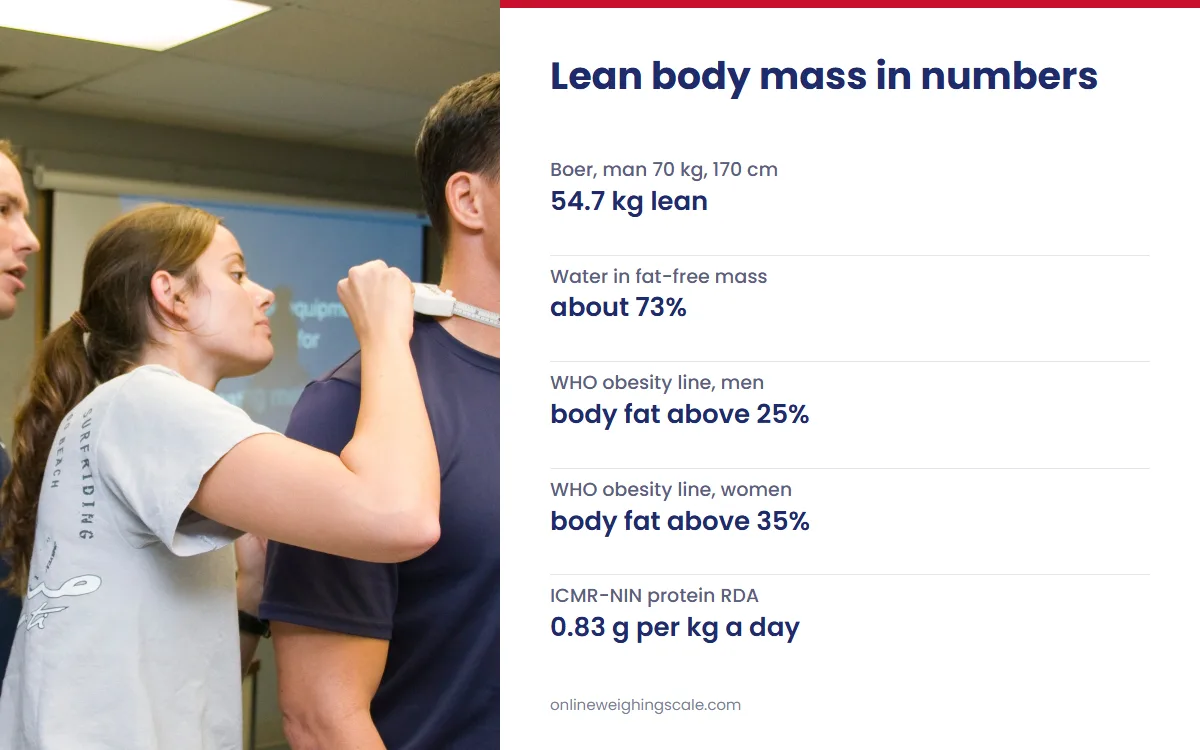
Lean body mass is your body weight minus your fat mass: muscle, bone, organs, skin and body water together. A man weighing 70 kg at 170 cm has about 54.7 kg of lean body mass by the Boer formula, which leaves roughly 22% body fat. Formulas and home scales give estimates, and a DXA scan in a hospital measures it more closely.
What lean body mass means
Body composition science splits your weight into parts. The simplest split, the two-compartment model described in a review in the Indian Journal of Medical Research, divides body weight into fat mass and fat-free mass. Lean body mass, often shortened to LBM, is the everyday name for the fat-free part, and this guide uses the two terms for the same thing. Fat mass, the charbi of everyday Hindi, is everything else.
Water is the largest share of lean mass. The two-compartment model assumes fat-free mass is 73.72% water, the review explains. Researchers who convert total body water into fat-free mass use a hydration factor of 73%, and a study of south Indian adults measured it at 71%. Because lean tissue is mostly water, anything that shifts body water, such as a hard workout in the heat or a day of drinking little, can move a lean mass estimate without any change in muscle.
Lean body mass vs muscle mass
Muscle is one part of lean body mass. The rest is bone, organs, skin, blood and the water held in all of them. This is why smart scale apps show muscle mass, skeletal muscle, bone mass and body water as separate lines, and why the muscle figure is always smaller than the lean figure.
Lean muscle mass is a phrase from gyms. It usually means skeletal muscle, the muscle attached to bones that you train with weights. All muscle tissue is lean, so in a lab report the extra word adds nothing.
Survey averages show how much of an adult is lean. In a study of 13,601 US adults measured with bioelectrical impedance, men averaged 60.0 kg of lean mass and women 44.0 kg. Men in the study weighed 80.6 kg on average and women 71.2 kg. Lean mass therefore made up about three quarters of the average man and about three fifths of the average woman.
How to calculate lean body mass
Three published formulas estimate lean mass from weight in kilograms (W) and height in centimetres (H). Each was fitted to measured groups of adults, so each gives a slightly different answer for the same person.
| Formula | Men | Women |
|---|---|---|
| Boer (1984) | 0.407 × W + 0.267 × H − 19.2 | 0.252 × W + 0.473 × H − 48.3 |
| James (1976) | 1.10 × W − 128 × (W ÷ H)² | 1.07 × W − 148 × (W ÷ H)² |
| Hume (1966) | 0.32810 × W + 0.33929 × H − 29.5336 | 0.29569 × W + 0.41813 × H − 43.2933 |
The Boer and James versions are printed in a 2018 study that compared them for dosing CT contrast dye. The James and Hume versions, with their years, appear in Table 2 of a 2012 PET imaging study. Hospitals use lean mass in this way because some drugs and dyes spread through the non-fat tissues of the body.
Here is what the three formulas give for three adults. Body fat percentage then follows in one step: subtract lean mass from weight, divide by weight and multiply by 100.
| Person | Boer | James | Hume |
|---|---|---|---|
| Man, 70 kg, 170 cm | 54.7 kg | 55.3 kg | 51.1 kg |
| Woman, 58 kg, 155 cm | 39.6 kg | 41.3 kg | 38.7 kg |
| Man, 140 kg, 170 cm | 83.2 kg | 67.2 kg | 74.1 kg |
For the 70 kg man, (70 − 54.7) ÷ 70 × 100 gives about 22% body fat by Boer and 27% by Hume. A lean body mass calculator online runs one of these formulas, and it knows only the numbers you type into it.
The James formula breaks down in heavy people. Its result stops rising at a BMI of about 37 in women and 43 in men, the contrast study notes. Above that point the formula returns less lean mass as weight goes up, which is why the 140 kg man scores lower on James than on Boer or Hume.
No formula can see what your weight is made of. Two men of 70 kg and 170 cm get the same answer whether one trains with weights five days a week or never exercises at all. Telling them apart takes a measurement of the body itself.
Body fat percentage chart: what the numbers mean
The same US study used the World Health Organization reference standard for obesity: body fat above 25% in men and above 35% in women. The table below gives that survey's average body fat and lean mass by age. These are averages for one population, measured by impedance, and they describe people rather than set goals.
| Age | Men, body fat | Women, body fat | Men, lean mass | Women, lean mass |
|---|---|---|---|---|
| 20–29 | 23.2% | 34.0% | 58.4 kg | 42.6 kg |
| 30–39 | 24.3% | 36.5% | 61.0 kg | 45.0 kg |
| 40–49 | 25.3% | 37.9% | 61.8 kg | 45.3 kg |
| 50–59 | 25.6% | 38.5% | 61.9 kg | 45.3 kg |
| 60–69 | 26.1% | 38.3% | 60.0 kg | 43.4 kg |
| 70–79 | 25.3% | 36.8% | 57.4 kg | 42.3 kg |
Half the men and 62% of the women in the survey were above the WHO body fat line, yet only 21% and 31% had a BMI of 30 or more. A BMI of 30 picked up 36% of the men and 49% of the women whose body fat was high. BMI also rose with lean mass about as strongly as with fat. A muscular person can therefore read overweight on a BMI chart, while a slim-looking person may carry more fat than the chart suggests.
The gap is wider in India. Indians, both within and outside Asia, are more adipose for a given BMI than other ethnic groups, the IJMR review states. It describes South Asians as having a "thin yet fat" phenotype, with relatively more fat and less lean mass at the same BMI. The Indian Consensus Group, the review adds, classes adults as overweight from a BMI of 23 and obese from 25. You can work out your BMI on the Omace BMI calculator, and see where fat sits with the waist and hip measures in body shape types.
How body fat percentage is measured
Every method estimates body fat from something it can actually measure: density, X-ray absorption, body water or electrical resistance. The four-compartment model, which measures water, protein, mineral and fat separately, is the criterion method the IJMR review uses to judge the others. It needs several instruments and a lab, so it stays in research.
| Method | What it measures | Where it is done | What the review notes |
|---|---|---|---|
| DXA (DEXA) scan | Two X-ray energies passing through fat, lean tissue and bone | Hospitals and diagnostic centres | Quick, with a low radiation dose |
| Air displacement | Body volume inside a sealed pod | Research labs | Body fat within 5% of the reference in Indian adults |
| Underwater weighing | Body density from weight under water | Research labs | Muscle and bone sink, fat floats |
| Deuterium dilution | Total body water from a labelled water dose | Research labs | Body water to within 1–2% |
| Skinfold callipers | Fat under the skin at fixed sites | Clinics and gyms | Fat off by 6.6 kg on average in south Indian adults, against the four-compartment model |
| Bioelectrical impedance | Resistance to a small current through the body | Smart scales and clinic analysers | Shifts with hydration, activity, meals and ovulation |
Skinfold results depend on what they are checked against. Against underwater weighing they were accurate in Indian adults, the review reports, while the four-compartment comparison above found a much larger error.
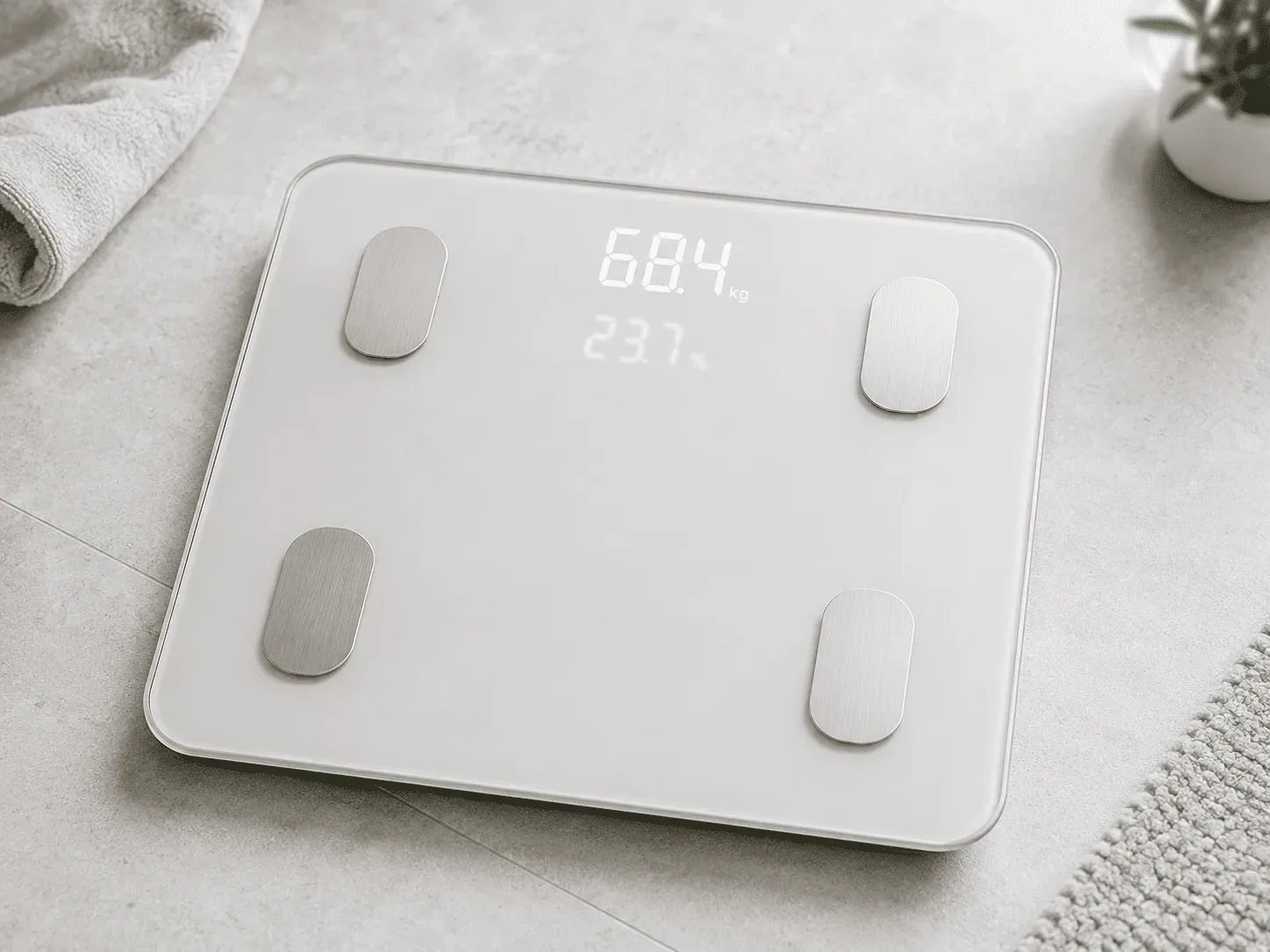
Smart scales use bioelectrical impedance. The review lists limb length, physical activity, nutrition status, hydration, blood chemistry, ovulation and electrode placement as sources of error. How a scale turns a small current into a body fat figure is covered in how a smart scale measures body fat.
How to find your body fat percentage at home
At home you can get a fair estimate and, more usefully, a trend. A measured figure needs a clinic.
- Weigh under the same conditions. Use a hard, flat floor, the same time of day and similar clothing, ideally in the morning after the toilet and before food or tea.
- Run a formula. Put your weight and height into the Boer formula above, subtract the result from your weight, and divide by your weight. This gives a rough body fat figure from your size alone.
- Step on a body composition scale barefoot. Metal foot pads pass a small current through the legs. Keep your feet clean and dry, and skip the reading straight after exercise, a bath or a large meal. Are smart scales accurate explains which numbers to trust.
- Measure your waist. Wrap a tape that does not stretch around the midpoint between your lowest rib and the top of your hip bone, after breathing out normally. It shows where fat sits, which no scale can.
- Compare weeks, not days. Average a week of readings before deciding that anything has changed.
- Ask a doctor about a DXA scan if you need a measured figure for a health reason.
Why lean mass matters as you age
Lean mass falls with age. The ICMR-National Institute of Nutrition dietary guidelines state that lean (muscle) mass decreases as age advances, and that inactivity makes muscle waste faster. The same guidelines say that keeping higher muscle mass improves insulin sensitivity.
The guidelines set out how to keep it:
- Adults aged 19 to 60 should do muscle-strengthening exercises that work all muscle groups on at least 2 days a week.
- Adults over 60 should add activities for strength and balance on 3 or more days a week.
- The recommended dietary allowance for protein is 0.83 g per kg of body weight a day, about 54 g a day for a 65 kg adult.
- Good-quality protein comes from food combinations such as cereals with pulses, milk, eggs, fish or meat. Guideline 8 advises against protein supplements for building muscle mass.
More protein does not keep adding muscle. Intakes above about 1.6 g per kg a day add nothing further to the muscle gained from resistance training, the guidelines note. Weight machines, free weights, elastic bands and push-ups all count as strength work, and types of gym machines and what each trains covers the equipment side.
Who makes Omace body composition scales
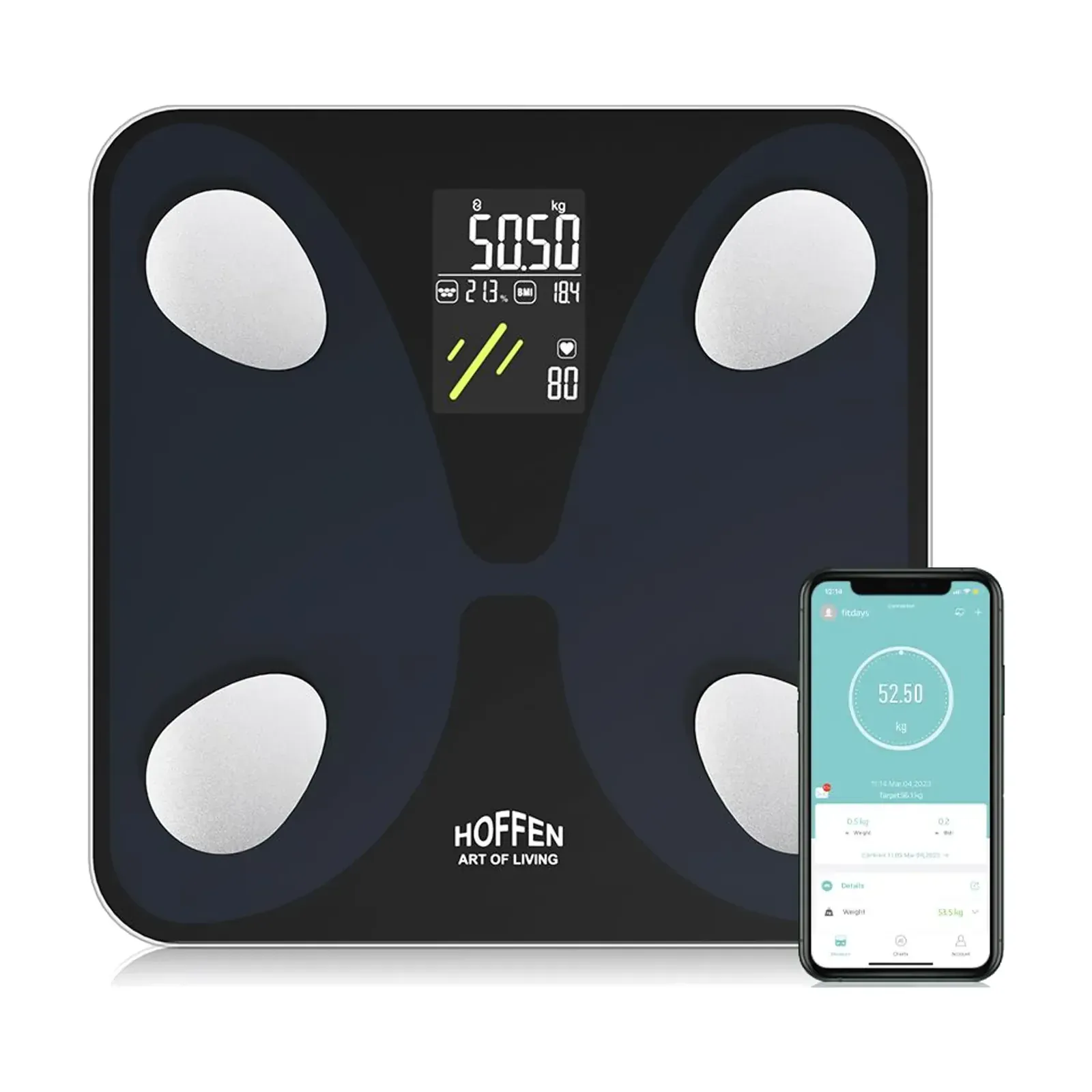
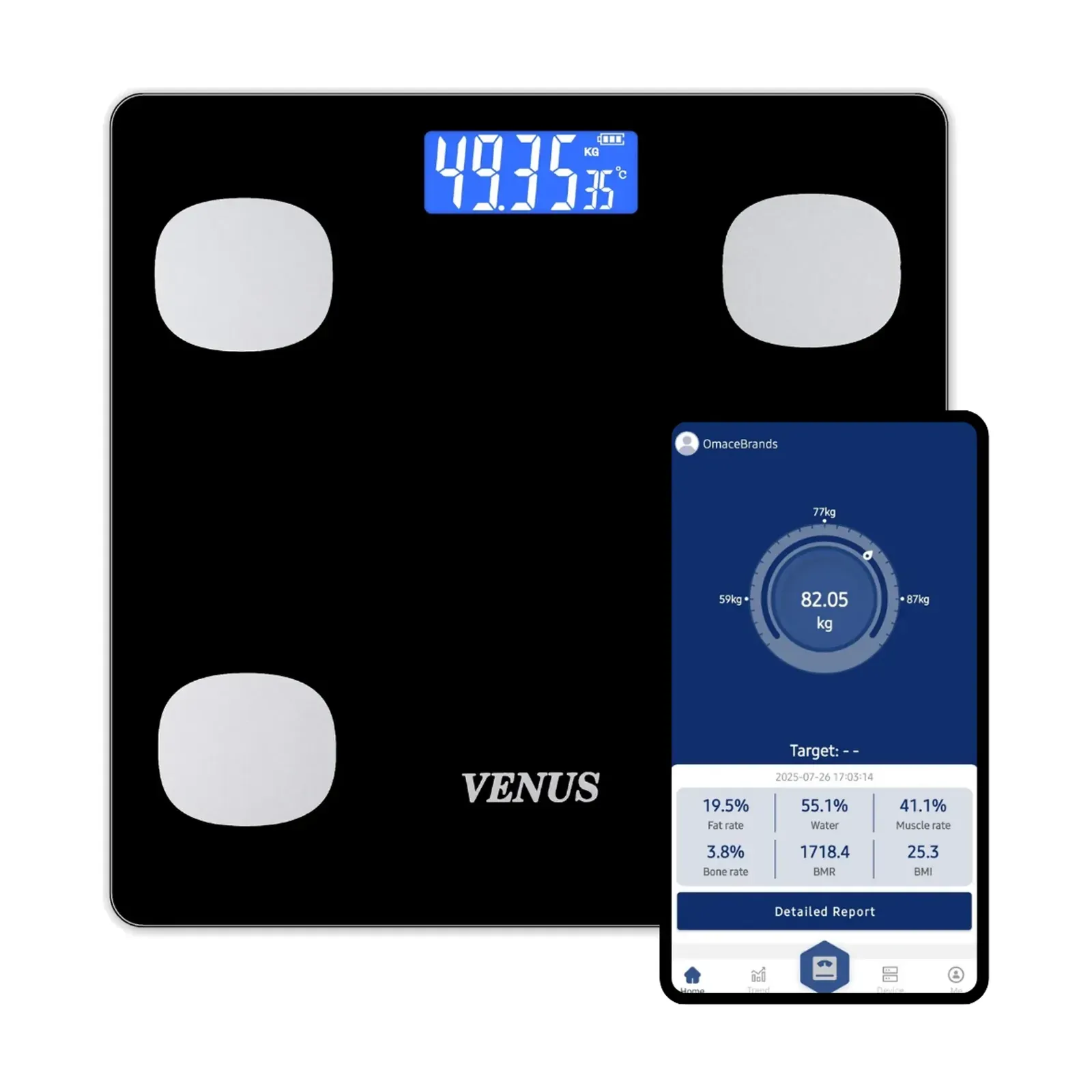
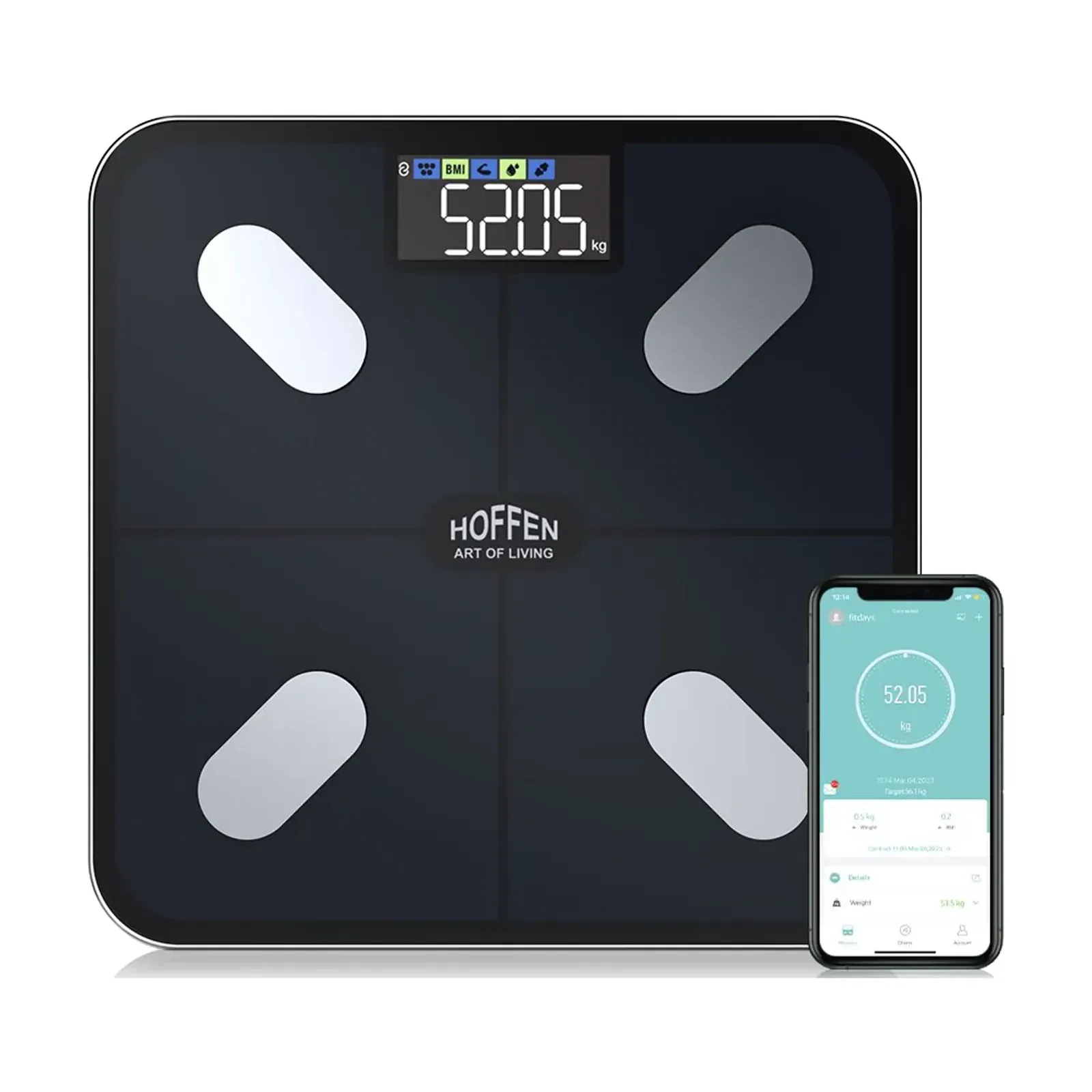
Omace Brands Private Limited manufactures scales at G-29 RIICO Industrial Area, Bagru, Jaipur. The company has been in the weighing trade since 1994. The Hoffen HO-45 smart body composition scale shows fat-free weight among its 16 readings and costs ₹2,619. The Venus EPS-6399 body fat weighing machine costs ₹729. It has no metal foot pads, so its app works the body values out from your weight and profile, much as the formulas above do.
As a manufacturer, Omace Brands Private Limited holds ISO 9001:2015 and ISO 13485:2016 certificates, an EU MDR quality certificate, a CE certificate of compliance and a US FDA compliance certificate, all listed on its certificates page. Every scale is checked with certified test weights before dispatch. Every Omace digital scale opens calibration mode when TARE is held for about 5 seconds. Scales bought from the Omace store carry a 2-year warranty on manufacturing defects, and Omace products are made in India. The other models sit in smart body scales.
Reading lean mass numbers sensibly
Lean body mass is most useful when you compare it with your own earlier readings, taken the same way. Formulas and home scales give estimates, a DXA scan measures more closely, and one reading on any of them says little. A slow rise in lean mass while fat mass holds steady or falls, over months, is the pattern regular strength training tends to produce. This is general information. Ask your doctor about your own readings.