
Body shape types describe how the bust or chest, waist and hips compare, and the five common types are apple, pear, hourglass, rectangle and inverted triangle. Three tape measurements are enough to find yours. The label describes proportions and diagnoses nothing, and a study of 1,679 body scans found tape placement alone changed the label in up to 40% of cases.
What body shape means
A body shape is the outline made by your shoulders, bust or chest, waist and hips. Bone width sets part of that outline, muscle sets some of it, and the places where the body stores fat set the rest. It tells you about proportions, which is useful when you buy clothes, and it tells nobody whether you are fit or well. No shape is better than another, and none is a goal.
Biology explains why the outlines differ. A World Health Organization expert report says men have a relatively greater central distribution of fat, while women have a more peripheral distribution in early adulthood. The same report traces these differences mainly to sex hormones, which take effect strongly during puberty. Doctors have their own words for the two patterns: a 2025 paper on obesity in Asian Indians uses android for fat held around the abdomen and gynoid for fat spread more evenly and towards the limbs.
The five body shape types
Most charts use five names, and they compare the same three measurements. Women's charts are the most common, yet the outlines apply to men too, usually with chest in place of bust.
Apple or oval shape
An apple shape has a waist close to, or wider than, the bust and hips. Weight tends to sit around the middle, with slimmer arms and legs. This is the android pattern in medical writing. It is common in men, and in women it often becomes more visible with age. Clothes usually fit best when you start from the waist measurement, since that is the largest number. Because central fat has a known link with metabolic health, this is the shape where the ratios further down are most worth knowing, as a talking point with a doctor.
Pear or triangle shape
A pear shape has hips clearly wider than the bust, with a defined waist. Fat tends to settle on the hips and thighs, which is the gynoid pattern. A dress in a single size often pulls at the hips and hangs loose on top, so separates in two sizes can fit better. Pear body shape measurements vary a great deal in actual centimetres. The defining feature is the difference between hips and bust, and it appears at any height or weight.
Hourglass shape
An hourglass shape has a bust and hips of about the same size, with a clearly narrower waist. Fat and muscle sit fairly evenly above and below the waist. Clothes that follow the waist suit this outline, and straight cuts can feel boxy. A national body scan study places hourglass among the four most common shapes for Indian women, which the India section below explains.
Rectangle or straight shape
A rectangle shape has bust, waist and hips within a close range, so the waist shows little curve. Many lean people and many athletes have this outline, and so do plenty of people at higher weights. Straight kurtas and shirts usually fit without much tailoring. The same Indian study lists rectangle among the most common groups too.
Inverted triangle shape
An inverted triangle has shoulders or a bust clearly wider than the hips. In men this is often called a V shape. Tops decide the size here, and bottoms may need taking in. One caution applies: the research system most often used for sorting shapes, the Female Figure Identification Technique or FFIT, leaves out shoulder measurements. A calculator based on bust alone can therefore miss broad shoulders.
Other labels you may see
Research systems go beyond the popular five, with names such as bottom hourglass and trapezoid. These usually split one of the five into finer groups, and they matter more to clothing makers than to anyone choosing an outfit.
Body shape types in India
India now has its own measurements, and they do not match Western charts neatly. INDIAsize, led by the National Institute of Fashion Technology under the Ministry of Textiles, scanned 26,324 people aged 15 and above in 3D. It produced 14 size charts for men and 13 for women, available on its portal from 2 January 2026.
A national study by Tiwari and Anand scanned 13,045 women aged 15 to 70 across India's six regions and kept 12,492 valid scans. The four most common shapes were hourglass, rectangle, trapezoid and bottom hourglass. The same four groups appeared in every region, and their share varied from region to region. The published page gives no percentages, so any figure you see for Indian shape shares needs its own source.
Health data adds the waist and hip side. NFHS-5 (2019-21) measured waist and hip for the first time and found 57% of women and 48% of men aged 15 to 49 above the WHO waist-to-hip line. The share rises with age, from 46% of women aged 15 to 19 to 65% of those aged 40 to 49, and from 28% to 60% among men. Urban adults sit a little higher than rural adults. By state, the women's figure runs from 40% in Madhya Pradesh to 88% in Jammu and Kashmir.
The WHO report also notes that South Asian men and women carry more visceral fat at a given waist size than Europeans. That is why Indian guidance uses a lower waist line for men, shown in the ratios section.
Body shape comparison: quick reference
| Shape | Bust or chest against hips | Waist | Where fat often settles | Also called |
|---|---|---|---|---|
| Apple | Similar, or bust larger | Close to or wider than both | Around the middle | Oval, android |
| Pear | Hips clearly wider | Narrower than hips | Hips and thighs | Triangle, gynoid |
| Hourglass | About equal | Clearly narrower than both | Evenly above and below the waist | Figure of eight |
| Rectangle | About equal | Close to both | Evenly through the trunk | Straight, banana |
| Inverted triangle | Bust or shoulders clearly wider | Narrower than chest | Upper body | V shape |
How to measure bust, waist and hips
A soft tape, a mirror and two minutes are enough. The WHO STEPS survey manual gives the method for waist and hips, and the bust follows the same habits.
- Stand with your feet together and your arms relaxed at your sides, over bare skin or light clothing.
- For the bust or chest, wrap the tape around the fullest part, keeping it level across your back.
- For the waist, find your last rib and the top of your hip bone, then place the tape at the midpoint. Read it at the end of a normal breath.
- For the hips, wrap the tape around the widest part of your buttocks.
- Keep the tape snug without pressing the skin, and read each number to the nearest 0.1 cm.
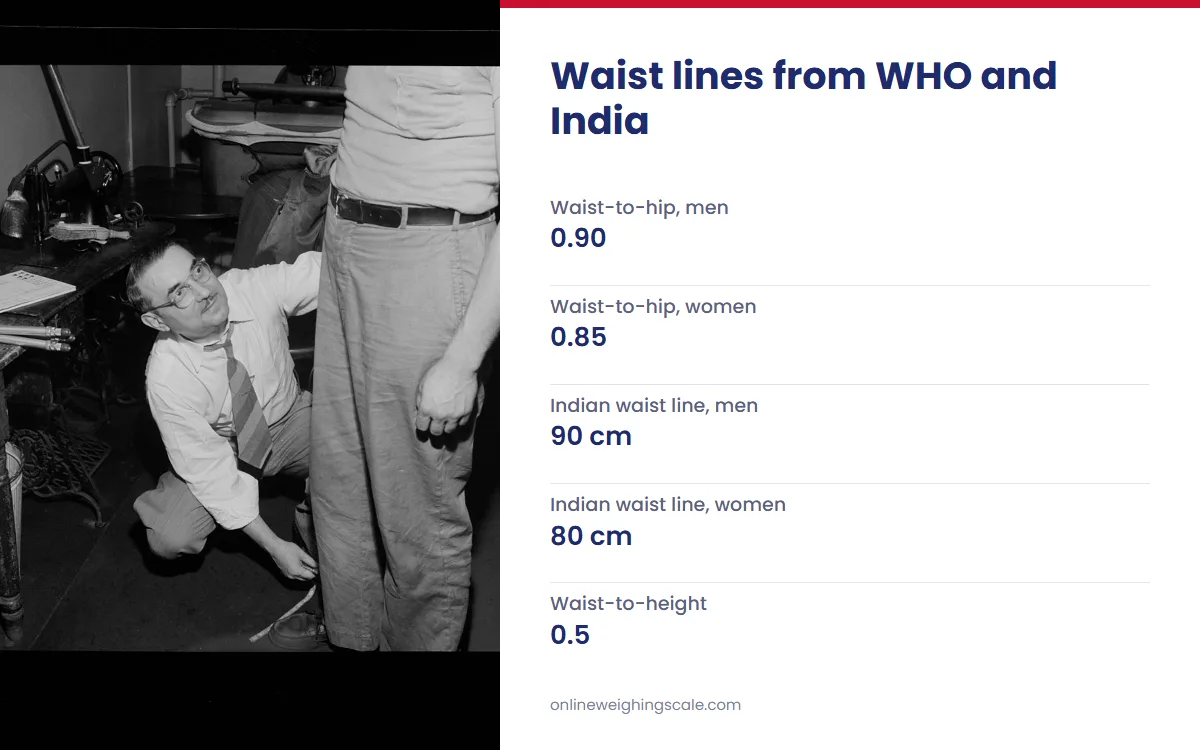
Tailors often measure the waist at its narrowest point, and health surveys use the rib-to-hip midpoint. The two give different numbers. Use the tailor's point for choosing clothes and the survey point for the health ratios, and note which one you took.
How to work out your shape from three numbers
- Compare bust and hips. If hips are clearly larger, you lean towards pear. If bust or shoulders are clearly larger, you lean towards inverted triangle.
- If bust and hips are about equal, look at the waist. A clearly narrower waist points to hourglass, and a waist close to both points to rectangle.
- If the waist matches or passes both other numbers, the outline is apple.
Online body shape calculators do the same comparison with fixed cut-offs, and each site sets its own, so two sites can name two shapes. The FFIT study shows why a borderline answer should not bother you: its authors found the same body could move between shapes depending only on where the tape was placed. If you sit between two shapes, both descriptions can be useful.
Waist-to-hip and waist-to-height ratios
These two ratios come from health research, and they measure fat distribution in a way a shape name cannot. The formulas are short.
- Waist-to-hip ratio = waist ÷ hips, both in the same unit.
- Waist-to-height ratio = waist ÷ height, both in the same unit.
| Measure | Men | Women | What the source says |
|---|---|---|---|
| Waist-to-hip ratio, WHO | 0.90 | 0.85 | Above this: substantially increased risk of metabolic complications |
| Waist size, WHO | 94 cm | 80 cm | Above this: increased risk |
| Waist size, WHO | 102 cm | 88 cm | Above this: substantially increased risk |
| Waist size, Indian guidance | 90 cm | 80 cm | At or above this: abdominal obesity |
| Waist-to-height ratio | 0.5 | 0.5 | Keep waist under half of height |
The WHO figures come from the cut-off table in its expert report, and NFHS-5 uses the same waist-to-hip lines. The Indian waist figures and a waist-to-height line above 0.5 come from the 2025 Asian Indian paper, which prefers waist-to-height over waist-to-hip. The NHS gives the same advice in plain words: try to keep your waist size to less than half your height.
Two worked examples show the arithmetic. A woman with a 74 cm waist, 96 cm hips and a height of 155 cm has a waist-to-hip ratio of 0.77 and a waist-to-height ratio of 0.48. A man with an 88 cm waist, 96 cm hips and a height of 165 cm has ratios of 0.92 and 0.53.
A number over a line is a reason to speak with a doctor, who will read it alongside blood pressure, blood sugar and family history. The NHS says its waist-to-height tool should not be used to diagnose conditions. It also advises against using the tool in pregnancy, with an eating disorder, with a growth disorder, with a BMI over 35, or for a child under five. These lines are no target for anyone to chase. This is general information. Ask your doctor about your own readings.
How body shape changes through life
Shape moves with age and life events, and these changes are ordinary. The WHO report says sex differences in fat placement become much more pronounced during puberty. It also describes data from 16,325 women showing that those who had given birth had less lower body fat and a greater waist size, even after allowing for age and BMI.
Menopause is less clear than many people assume. The report notes that menopause is linked with fat moving towards the abdomen, and it is unclear whether hormones or ageing drive this. One study of 3,064 women found no independent effect of menopause, and it recorded a mean waist gain of 2.2 cm over three years that could be attributed to age and activity. If your measurements shift over the years, that alone says little about your health.
Body shape and body type are different things
Body type quizzes usually mean something else: somatotypes. An INFLIBNET chapter on human growth explains that William Sheldon introduced the idea in 1940 with three components. Endomorphy describes soft, rounded tissue, mesomorphy describes muscle and bone, and ectomorphy describes a long, linear build.
So a somatotype rates overall build, and a shape name describes an outline. The chapter also records the main criticisms of Sheldon's method: it was subjective, it ignored body size, and somatotypes were found to change over time although he treated them as fixed. A quiz result is a loose description at best.
What a weighing scale cannot tell you about shape
A weighing scale reads total weight, so two people with the same vajan can have quite different waist and hip numbers. Omace Brands Private Limited manufactures scales at Bagru, Jaipur, and none of them reads body shape. A tape gives you the outline, and a scale gives you a separate number that is useful beside it.
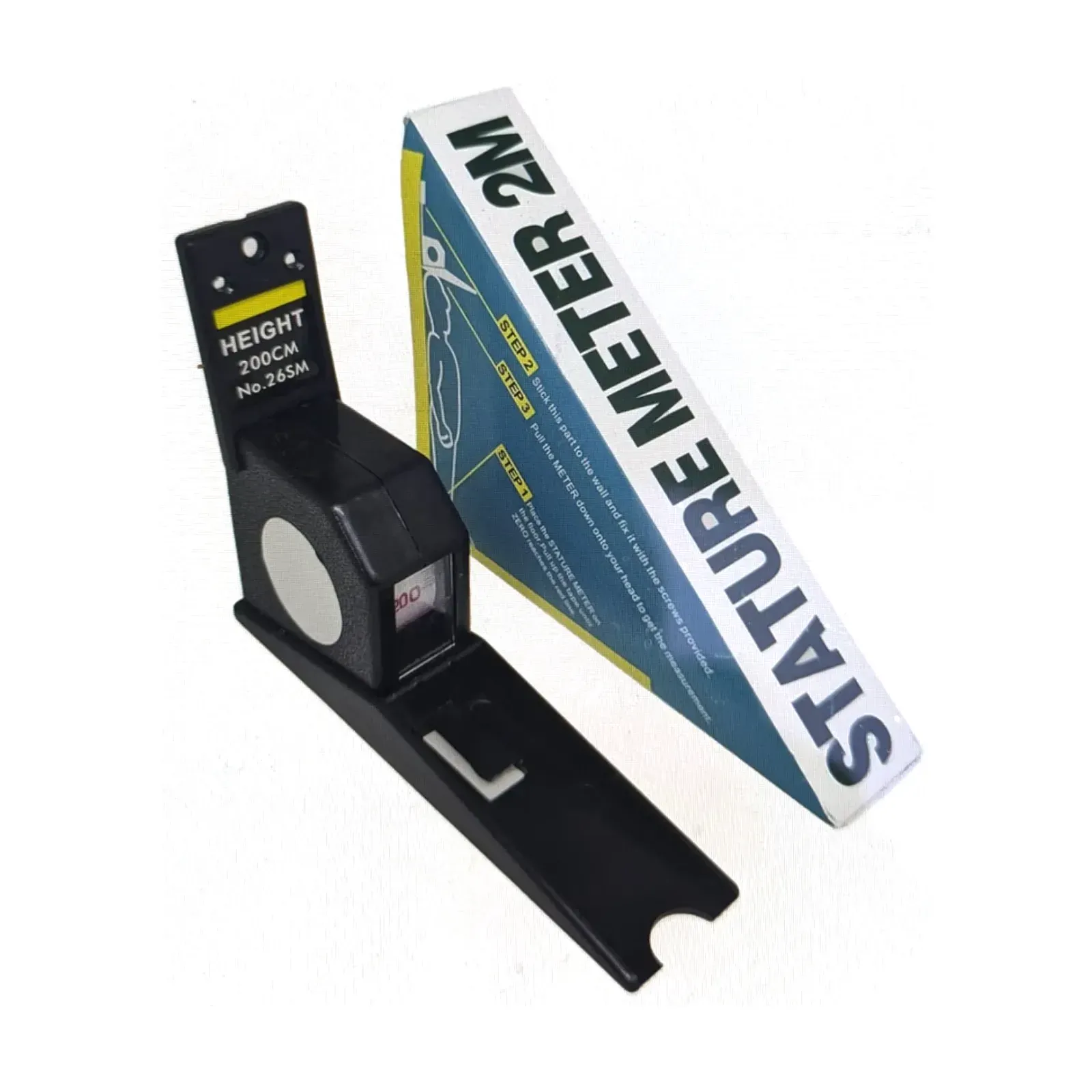
Height is the third piece, since the waist-to-height ratio depends on it. A wall-mounted stature meter reads height from 0 to 200 cm, and the BMI calculator puts weight and height together. What the weight is made of is a further question, which the guide to lean mass and body fat covers.
Keeping the label in proportion
A body shape name is a handy shorthand for a tailor's counter or a shopping trip, and it has done its job once the clothes fit. The waist ratios serve a different purpose and belong in a conversation with your doctor. Both are descriptions of a body at one moment, and bodies change. Measure the same way each time, keep the numbers somewhere you can find them, and let them inform you without letting them judge you.