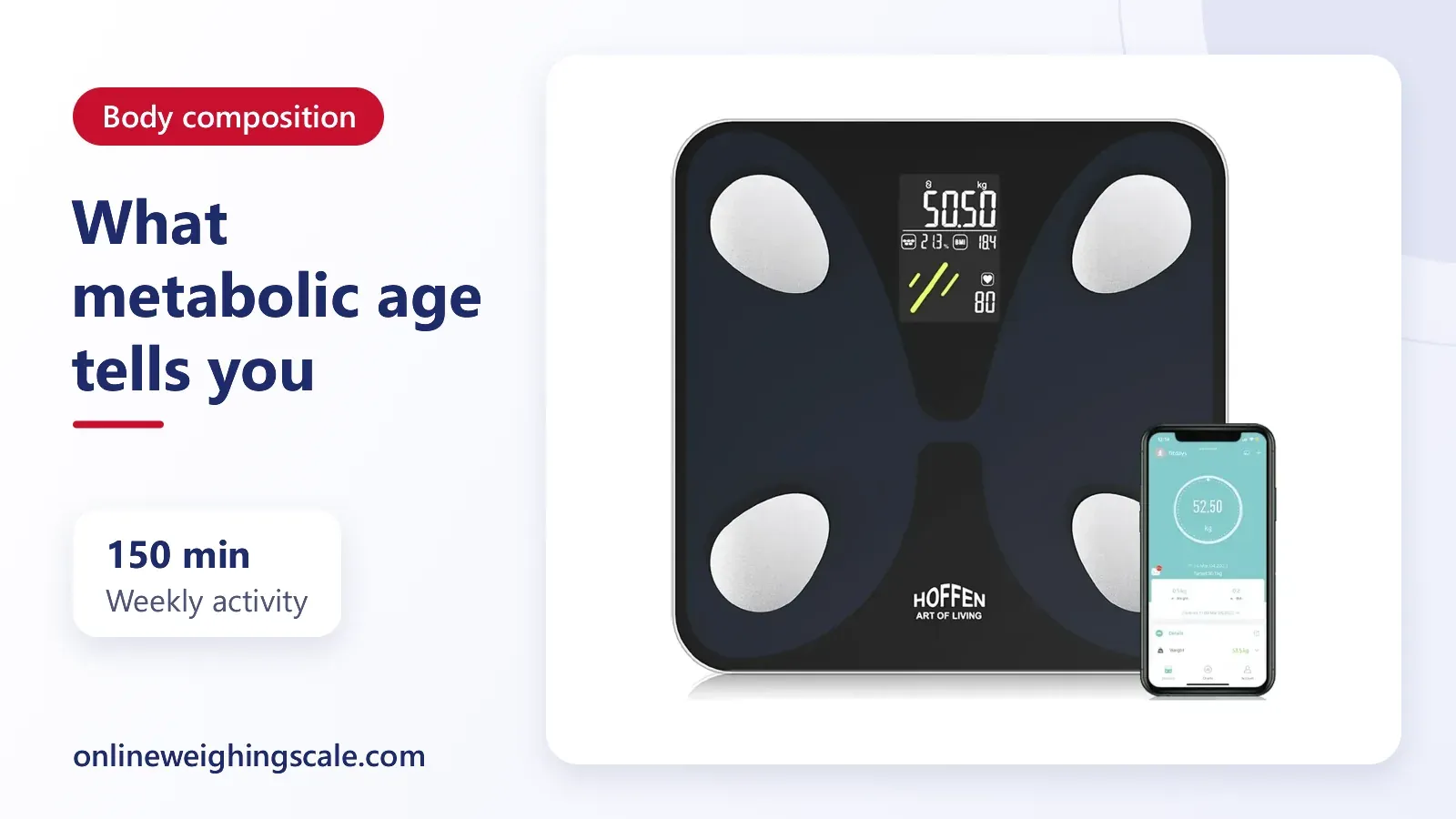
Metabolic age is a number on some smart scales that compares your estimated resting calorie burn with the average for each age and reports the age that matches. A 40-year-old can be told "metabolic age 34" or "metabolic age 47" from the same body, depending on whose table the scale uses. It is a maker-defined score, so treat it as a rough marker and not a medical result.
Many people first meet the number on a smart scale in India, usually as "body age", next to weight, body fat and BMI. This guide explains what sits behind it, why two scales can disagree, and which measures carry real evidence.
What metabolic age means
Your body burns energy even when you lie still. That resting figure is the basal metabolic rate, or BMR, and it covers breathing, circulation, temperature control and the other jobs your body does all day. Omace Brands Private Limited has a separate guide to basal metabolic rate for the full picture.
Metabolic age takes that BMR estimate and asks a simple question: at what age is the average person's BMR equal to yours? If your estimated BMR matches the average of a 32-year-old, the scale says "metabolic age 32", whatever your birth certificate says. When the number is lower than your real age, the app usually shows it in a happy colour. When it is higher, the app shows a warning colour.
The comparison table that turns a BMR into an age belongs to the maker of the scale or its app. That is the first thing to know about the term. The WHO and CDC pages used for this guide, on physical activity and on BMI, do not use the phrase "metabolic age" anywhere, and no health body that Omace Brands Private Limited read for this post defines it. It is a product feature, not a clinical measure.
How metabolic age is calculated
There are two steps, and both involve estimates.
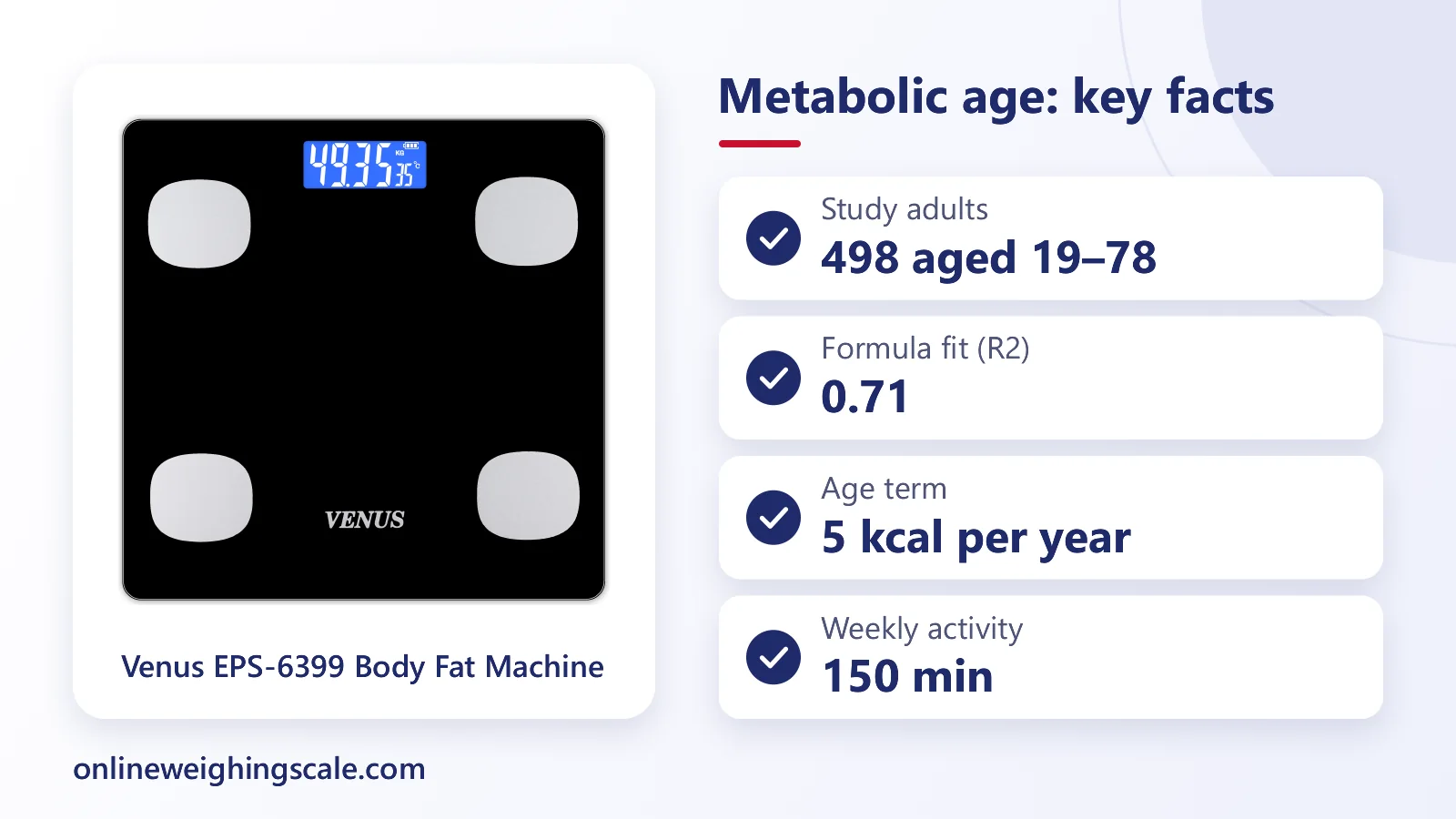
The first step is to estimate your BMR. Most formulas start from weight, height, age and sex. A well known one is the Mifflin-St Jeor equation, published in 1990 in the American Journal of Clinical Nutrition. The authors measured resting energy expenditure in 498 healthy adults aged 19 to 78 by indirect calorimetry and fitted an equation. For men it is 10 x weight in kg + 6.25 x height in cm - 5 x age in years + 5. For women the last term is -161. The same paper found that the older Harris-Benedict equations of 1919 overestimated measured resting expenditure by 5 percent.
The same study found that fat-free mass was the best single predictor of resting expenditure, ahead of body weight. That is one reason some scales add a body composition estimate to the formula, and why a scale with a body fat reading may give a different BMR from a plain weight scale for the same person.
The second step is the lookup. The scale compares your BMR with a table of average values by age and reports the age whose average is closest. Nothing about this step is standardised across brands.
A worked example with the formula
Take a man who is 40 years old, 70 kg and 170 cm tall. The Mifflin-St Jeor equation gives 700 + 1,062.5 - 200 + 5, which is about 1,568 kcal per day. Keep every other number the same and make him 30, and the answer is about 1,618 kcal. One year of age is worth 5 kcal in this equation.
A woman who is 35 years old, 60 kg and 160 cm tall works out to 600 + 1,000 - 175 - 161, about 1,264 kcal per day. These are population estimates from one formula. A real person can sit well above or below them, and the equation explained about 71 percent of the variation in the original study, which leaves the rest unexplained.
| Person | Mifflin-St Jeor working | Estimated BMR |
|---|---|---|
| Man, 40 y, 70 kg, 170 cm | 700 + 1,062.5 - 200 + 5 | about 1,568 kcal a day |
| Same man at 30 y | 700 + 1,062.5 - 150 + 5 | about 1,618 kcal a day |
| Woman, 35 y, 60 kg, 160 cm | 600 + 1,000 - 175 - 161 | about 1,264 kcal a day |
The example shows something useful about the metabolic age number. Because age is a direct input to the formula, the scale already knows how old you are before it calculates anything. Changing the age you enter in the app changes the result.
Why two scales give two different ages
Several things can move the number, and none of them has anything to do with your health.
- The formula behind the BMR estimate. Different equations give different kcal values for the same person.
- The reference table of averages. Each maker builds or buys its own, so "average at age 35" differs.
- The body composition estimate, if the scale uses one. A bioelectrical impedance review in Clinical Nutrition states that the method can determine fat-free mass and total body water in people without significant fluid or electrolyte abnormalities, when suitable equations and procedures are used, and that it lacks a standardised method and quality control. A 2019 perspective in the European Journal of Clinical Nutrition argues that impedance errors are not very different from those of so-called gold standard methods, and also asks for better standard protocols.
- Your state on the day. Hydration, a meal, a workout or the time of day can change a body composition reading, and so the age the app reports.
- The profile you entered. A wrong height or birth year moves the result straight away.
The practical result is that the same body can be "35" on one app and "41" on another. Neither is wrong, because neither is measuring a fixed biological quantity called metabolic age.
Is a lower metabolic age better?
A lower number feels like praise and a higher number like a warning. The sources read for this post do not support reading it that way. They give no link between a scale's metabolic age and health outcomes, the way waist size and physical activity have been studied. A high result does not diagnose a slow metabolism, and a low one does not mean your heart or sugar levels are fine.
The number also hides the cause. The Mifflin-St Jeor paper found fat-free mass to be a stronger predictor of resting energy use than weight alone, so a scale that estimates more muscle may report a younger age. The score reacts to weight, height, age and the estimate of body composition, so it tells you little that those inputs did not already tell you.
In a home where several people share one scale, the age column also tends to get compared between members. That comparison has no meaning, because each profile uses a different age input.
What has real evidence instead
Three measures carry more weight than a body age.
- BMR and daily energy need. It is a real quantity, measurable in a lab by indirect calorimetry. A formula estimate is useful for planning meals and is explained in the BMR guide.
- Waist size. The WHO held an expert consultation on waist circumference and waist-hip ratio. The report reviews how well these measures predict heart disease, diabetes and death compared with BMI. A tape measure, read with your doctor, is worth more than a body age.
- Physical activity. The WHO physical activity fact sheet advises adults to do at least 150 minutes of moderate-intensity activity a week. It adds that muscle strengthening benefits everyone and lists lower risk of heart disease, type 2 diabetes and high blood pressure among the gains.
BMI is a screening number as well. The CDC notes that BMI does not distinguish between fat, muscle and bone mass, a fair reminder that any single number from a bathroom scale has limits. You can check yours with the BMI calculator.
How to use the number sensibly
If your scale shows a body age, treat it as a trend line on one device and nothing more. Weigh at the same time of day, on the same hard floor, with the same profile, and look at the direction over weeks. Do not compare it with a friend's scale or with a second app.
For the body fat, muscle and water readings that sit beside it, read how a smart scale estimates body fat in this explainer, and why they are estimates in are smart scales accurate. The lean body mass guide covers the muscle side.
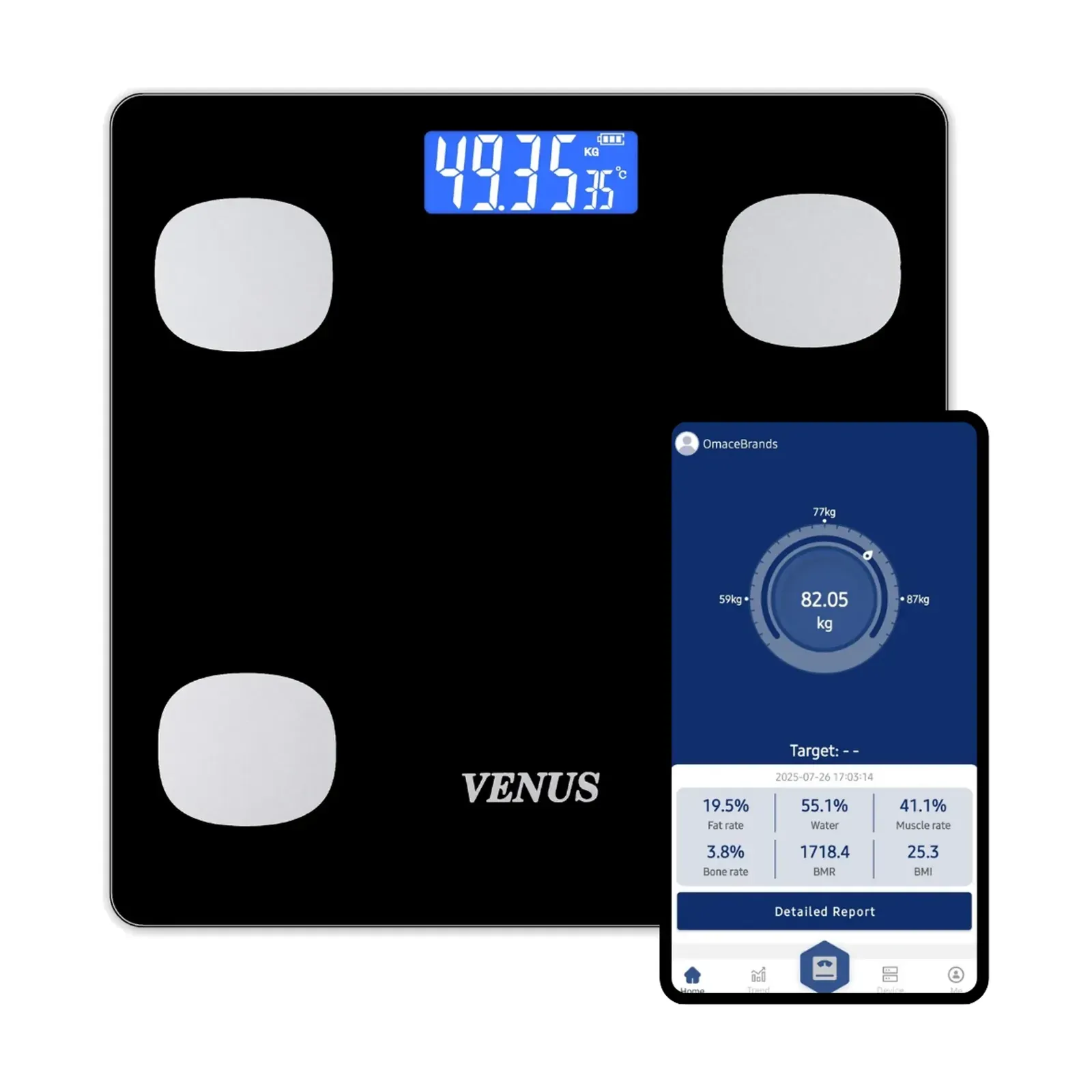
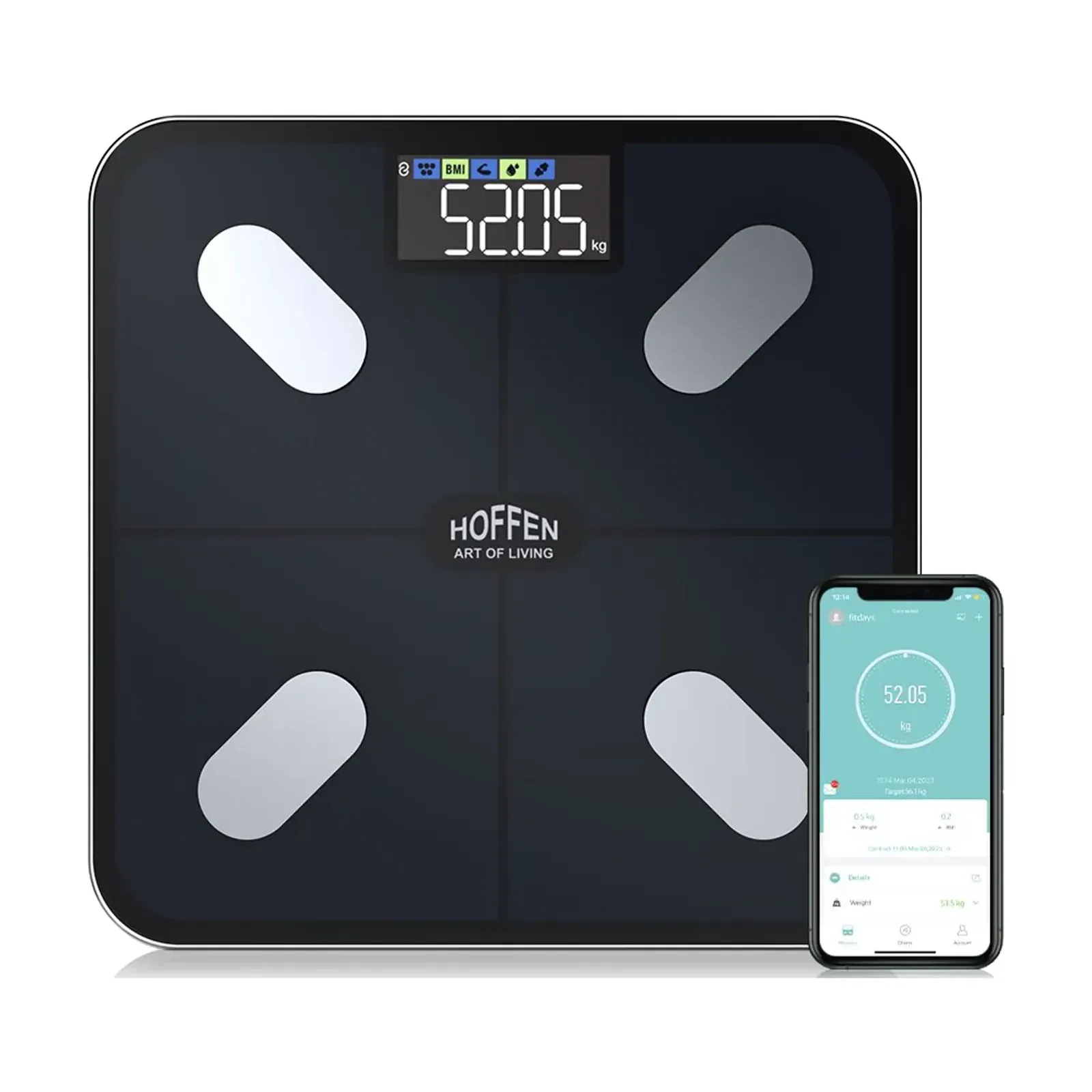
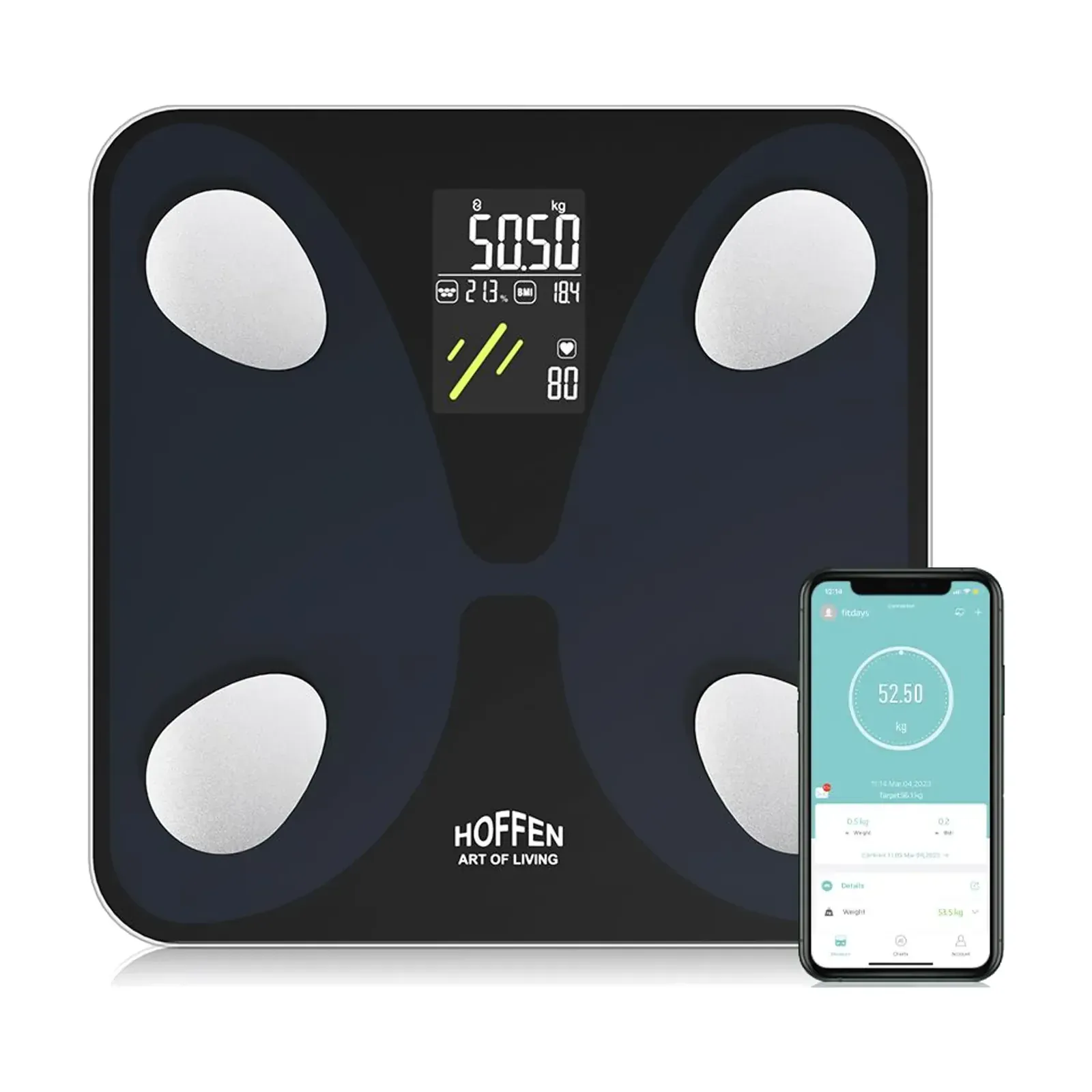
Omace Brands Private Limited makes smart body scales in Bagru, Jaipur, and has been in the weighing trade since 1994. Check a model's product page for the exact readings it lists before you buy one for a specific number. The Venus EPS-6399 body fat weighing machine and the Hoffen HO-36 body fat analyzer scale both list BMR and body age, and the Hoffen HO-45 smart body composition scale lists 16 body measurements. Treat every one of these numbers as an estimate.
This is general information. Ask your doctor about your own readings. A scale does not diagnose anything, and every body composition figure on it is an estimate.
What to remember about your body age
Metabolic age is a BMR estimate translated into an age by a table that the maker controls. It can help you see a trend on one scale. It cannot say whether you are healthy, and a doctor, your waist and your activity say far more.