Basal metabolic rate (BMR) is the energy your body burns in a day just to stay alive at complete rest. The FAO/WHO/UNU expert report on human energy requirements puts BMR at 45 to 70 percent of total daily energy use, depending on age and lifestyle. The number is measured in kilocalories per day and differs from one person to the next. It depends mainly on body size, body composition, age and sex.
Omace Brands Private Limited makes body scales in Bagru, Jaipur, and many buyers ask what the BMR figure on their scale display means. This post explains the term, the difference between BMR and resting metabolic rate, the equations used to estimate it, and how much weight to give the number on a scale.
What is BMR?
BMR is the minimum energy the body needs to keep the heart beating, lungs working, brain active and body temperature steady. The FAO/WHO/UNU report defines it as the minimal rate of energy expenditure compatible with life. Walking, cooking, working and digesting food all cost extra energy on top of it.
Most of what you burn in a day is therefore spent while doing nothing visible. A peer-reviewed study of body composition and resting metabolism describes resting rate as the main contributor to daily energy expenditure for most people, at 60 to 80 percent of the total. That range is wider than the FAO figure because researchers define and measure the resting state in slightly different ways.
BMR vs RMR: what is the difference?
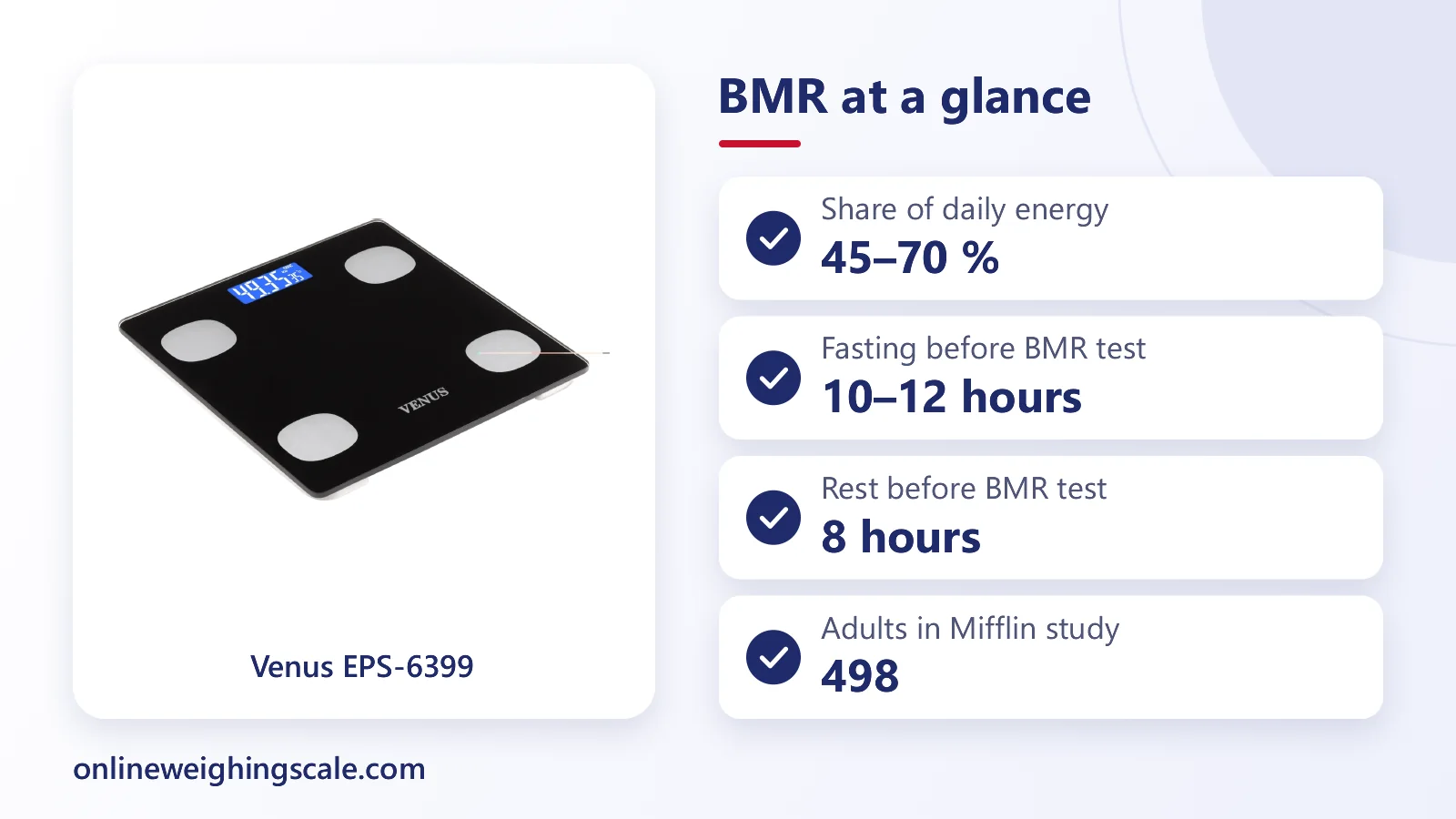
BMR is the strictest version of the measurement, and resting metabolic rate (RMR) is the practical version. The FAO/WHO/UNU report describes the BMR test: the person lies awake and still, after 10 to 12 hours without food and eight hours of physical rest, in a room that is neither hot nor cold.
RMR is measured under similar but looser conditions, so it is higher. The same peer-reviewed study says RMR includes the small rise from waking up and from digesting food, which makes it approximately 10 percent higher than BMR. Papers and fitness apps often use the two words as if they meant the same thing. When you see a figure on a scale or a calculator, treat it as one estimate of the same idea.
| Term | Meaning | Conditions |
|---|---|---|
| BMR | Minimum energy to stay alive | 10 to 12 hours fasted, 8 hours of rest, thermally neutral room |
| RMR | Energy used at rest during the day | Rested and calm, conditions less strict |
| Total daily energy | BMR plus movement and digestion | A normal day |
What changes BMR?
The FAO/WHO/UNU report states that BMR is determined mainly by age, gender, body size and body composition. Each of these plays a part.
- Body size. A larger body has more tissue to keep running, so its BMR is higher.
- Lean mass. The study above names fat-free mass as the primary determinant of resting energy expenditure. In its sample, body composition explained about 63 percent of the variation in resting rate, while fat mass on its own showed almost no link. Our guide to lean body mass explains what that term covers.
- Sex. Resting rate tends to be higher in men, probably because men carry a higher share of fat-free mass, as the same study notes. When it adjusted for body composition and age in a small sample, the difference between the sexes was no longer statistically significant.
- Age. The study cites literature that basal metabolism falls by 1 to 2 percent per decade from age 20 to 75. In its own sample, muscle mass seemed to account for much of the age effect.
Day-to-day food intake, a hot afternoon or a hard workout do not change the BMR figure itself. They change the total energy used in that day.
How BMR is measured
The reference method is indirect calorimetry. A peer-reviewed review of methods for studying human energy metabolism explains that it measures the oxygen a person consumes and the carbon dioxide produced, and calculates energy from those gases. The person breathes through a facemask, mouthpiece, hood or canopy while resting. The review describes indirect calorimetry as measuring energy expenditure with high accuracy and precision.
This is a clinic or laboratory test. A bathroom scale, a smartwatch or a body composition scale does not measure gases, so the BMR on those devices is always a calculation.
How BMR is calculated
Doctors and dietitians who cannot run a calorimeter use prediction equations built from measurements on thousands of people. The best known are the Harris-Benedict equations from 1919 and the Mifflin-St Jeor equations from 1990. The 1990 paper in the American Journal of Clinical Nutrition built its equation from indirect calorimetry on 498 healthy adults, 247 women and 251 men aged 19 to 78. It reported that the older Harris-Benedict equations overestimated measured resting expenditure by about 5 percent.
The Mifflin-St Jeor equations, in kilocalories per day, are:
- Men: (10 × weight in kg) + (6.25 × height in cm) − (5 × age in years) + 5
- Women: (10 × weight in kg) + (6.25 × height in cm) − (5 × age in years) − 161
Here are two worked examples. A 30-year-old man of 70 kg and 170 cm works out to 700 + 1,062.5 − 150 + 5, which is about 1,618 kilocalories per day. A 30-year-old woman of 60 kg and 160 cm works out to 600 + 1,000 − 150 − 161, which is 1,289 kilocalories per day. These are calculated figures for two example bodies, not targets for anyone.
Prediction equations are averages, so they miss individuals. The study notes that such equations explain only 50 to 75 percent of the variation in resting metabolic rate between people. Two people with identical height, weight, age and sex can differ by a few hundred kilocalories in a calorimeter test, because the equation cannot see their body composition.
BMR normal range
There is no single normal BMR range that fits everyone. A child, a tall man and a petite older woman will all have very different healthy values, and each of them is normal for their own body. The two worked examples above show how far apart two adults can be.
If you want to compare a figure with something, compare it with the equation result for the same height, weight, age and sex, and expect a spread around it. A difference between your reading and an online calculator is not a sign that anything is wrong.
BMR meaning on a weighing scale
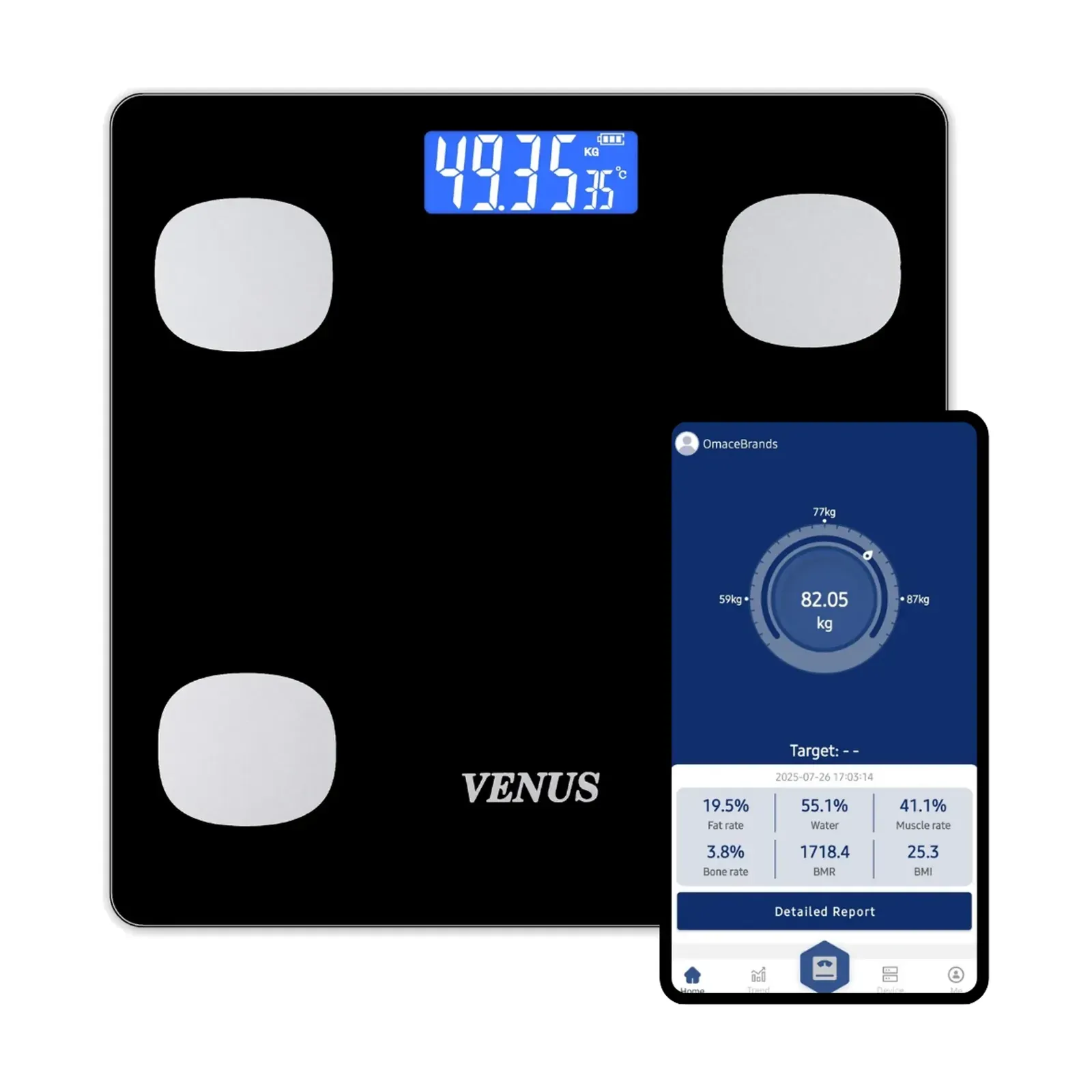
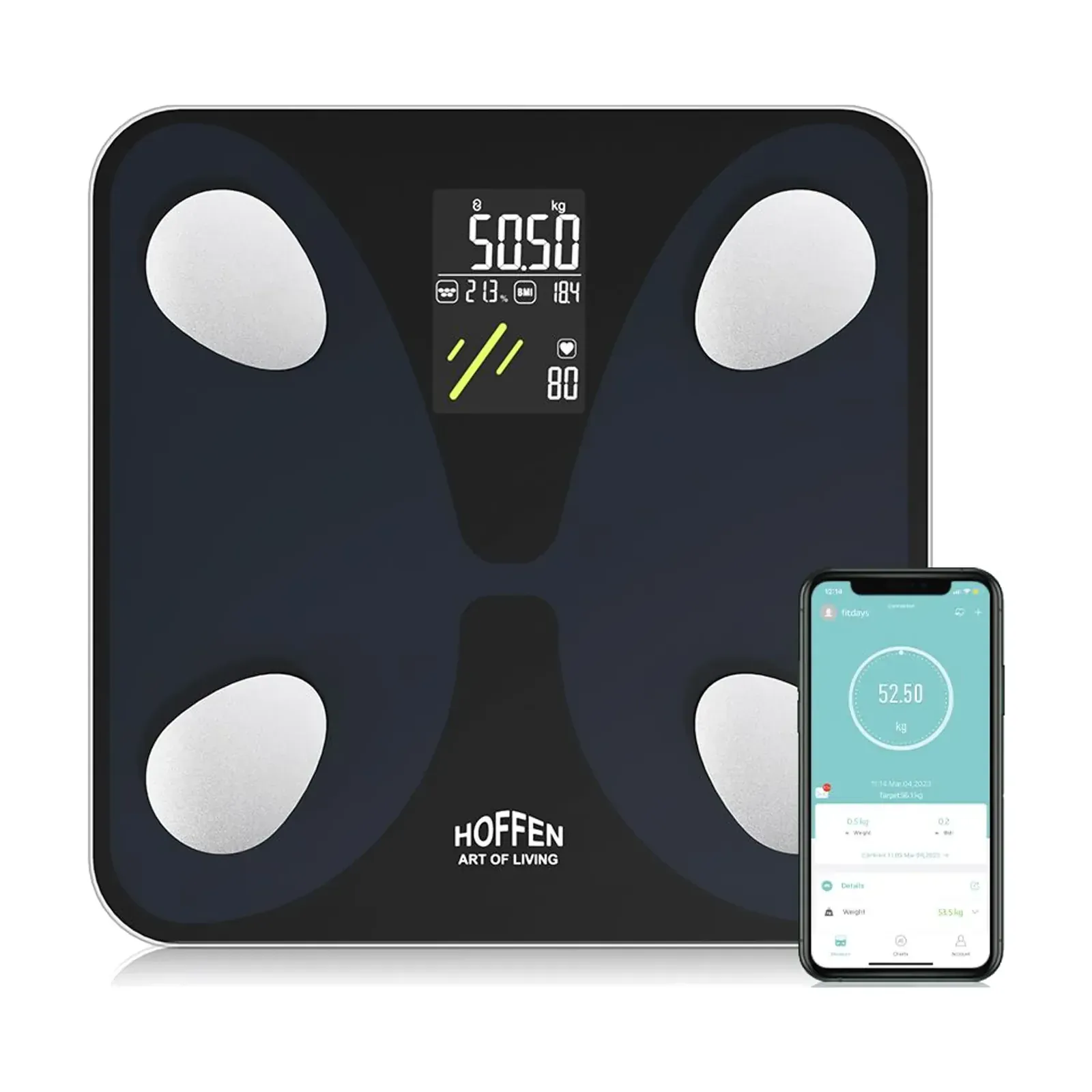
On a body composition scale, BMR is an estimate, not a measured value. It appears next to weight, body fat and similar figures on the display or in the app. Omace Brands Private Limited lists BMR among the readings on the product pages of the Venus EPS-6399 Body Fat Weighing Machine at ₹729, the Hoffen HO-19 Bluetooth Weighing Scale at ₹939 and the Hoffen HO-36 Body Fat Analyzer Scale at ₹1569. The ultrasonic height and weight machine for gyms and clinics lists it as well. The other models are in the smart weighing scale range.
What the number tells you is roughly the energy a body of that size, age and sex would use at rest on average. It does not describe your own metabolism, your thyroid, your muscle or your health. Because weight is the one input that changes daily, the figure moves a little when your weight does. If you change your age or height in the app by mistake, the BMR changes with it.
For the weight itself, the scale is the measuring instrument. For how body fat estimates behave, read how a smart scale measures body fat and whether smart scales are accurate. You can also use the free BMI calculator next to the BMR figure to see how height and weight relate.
How to use a BMR number sensibly
Treat BMR as background information about energy use, not as a score. A few practical points help.
- Weigh yourself at the same time of day, on the same hard floor, so readings are comparable from one day to the next.
- Read the figure over several weeks. A single reading carries more noise than a trend.
- Do not compare your number with someone else's. Different bodies give different values.
- Do not adjust eating or exercise only because a scale or app shows a particular BMR.
This is general information. Ask your doctor about your own readings. A doctor or a registered dietitian decides how much energy a person needs, and a scale does not diagnose anything. Anyone with a medical condition, a pregnancy, or concerns about weight or eating should speak to a professional before using any figure from a device.
Where the number fits in a normal day
BMR is the largest block of daily energy use, but it is not the whole of it. Movement, work, digestion and recovery add to it, which is why the FAO/WHO/UNU report gives a range of 45 to 70 percent and not a fixed share. A person with a desk job and a person who carries loads all day have similar BMR if their bodies are similar, and very different totals.
For a wider look at body measurements, including height and body proportions, see our post on anthropometry.