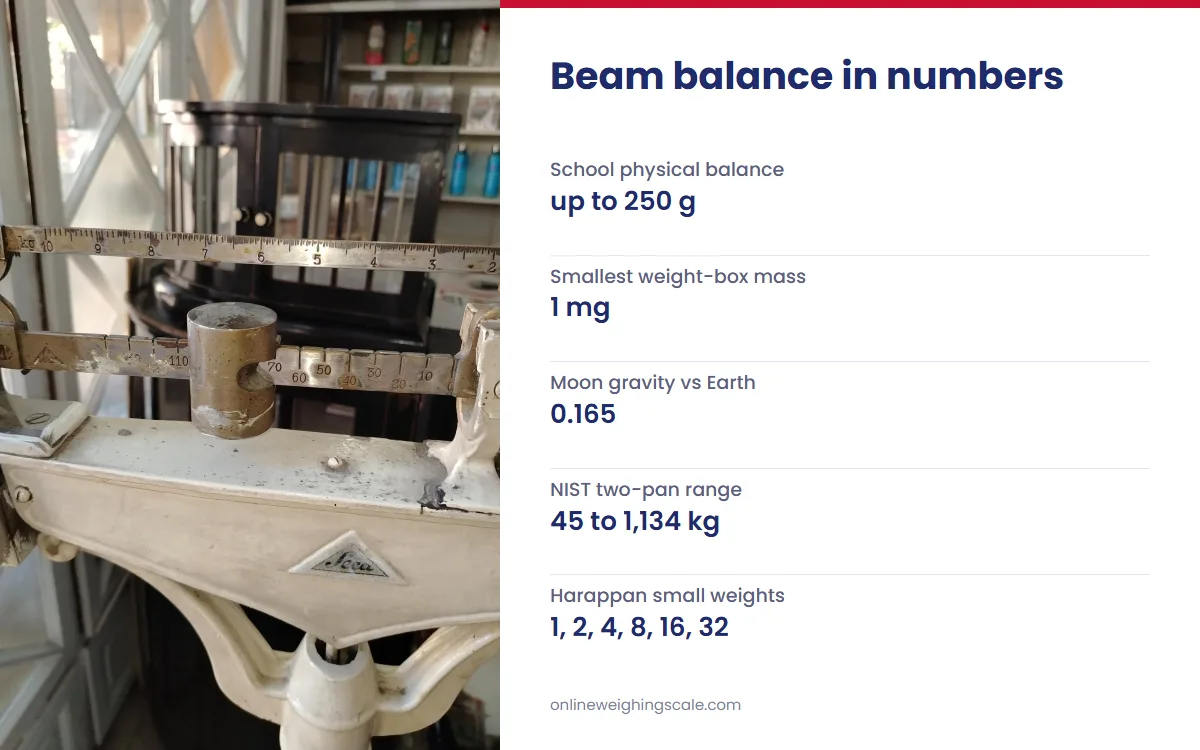
A beam balance measures mass by comparing an object with standard weights on a lever pivoted at its centre. Its two arms are equal, so the beam rests level only when both pans carry equal mass. NCERT's Class 11 physics laboratory manual describes the school physical balance, which weighs objects up to 250 g using standard masses as small as 1 mg.
What Is a Beam Balance?
A beam balance is a rigid bar resting on a pivot at its middle, with a pan hanging from each end. NCERT's Class 11 physics textbook puts it simply: the beam of a balance is a lever. You place the object in one pan and add known weights to the other until the beam rests level and the pointer sits at zero. The total of the weights is the object's mass.
Because gravity pulls on both pans at once, the balance compares masses directly. That is why a beam balance is used to measure mass, while a spring balance measures weight, the pull of gravity. In Indian bazaars the same two-pan idea is the taraju, and some sellers call it a balance beam scale.
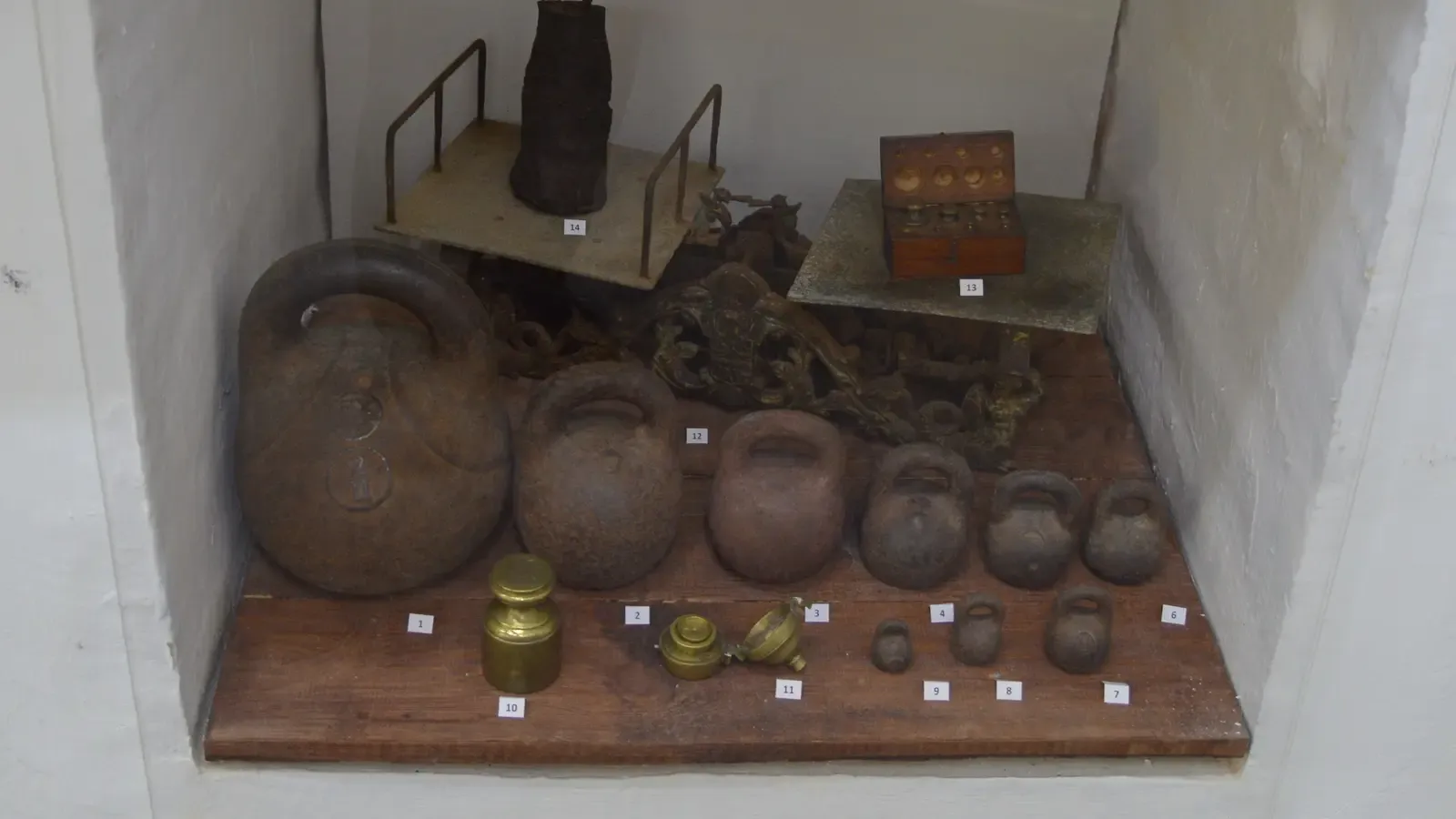
Balances are among India's oldest measuring tools. NCERT's Class 12 history textbook records that Harappan weights were usually cubes of a stone called chert. The smaller weights followed a binary series (1, 2, 4, 8, 16, 32), the larger ones a decimal series, and metal scale-pans have also been found.
Types of Beam Balance
Every type uses the same lever rule. The types differ in how the arms are arranged, how the comparison weight is applied and how fine a reading they give.
Equal-arm balance (common balance)
The common balance has two equal arms, two pans and a pointer at the centre. A common balance is used to measure mass by direct comparison with a set of standard weights, so it needs no scale markings on the beam. It is the shape most people picture, from a vegetable seller's taraju to the scales held by the figure of justice. Its accuracy depends on the quality of the pivot and of the weights placed against the load.
Physical balance
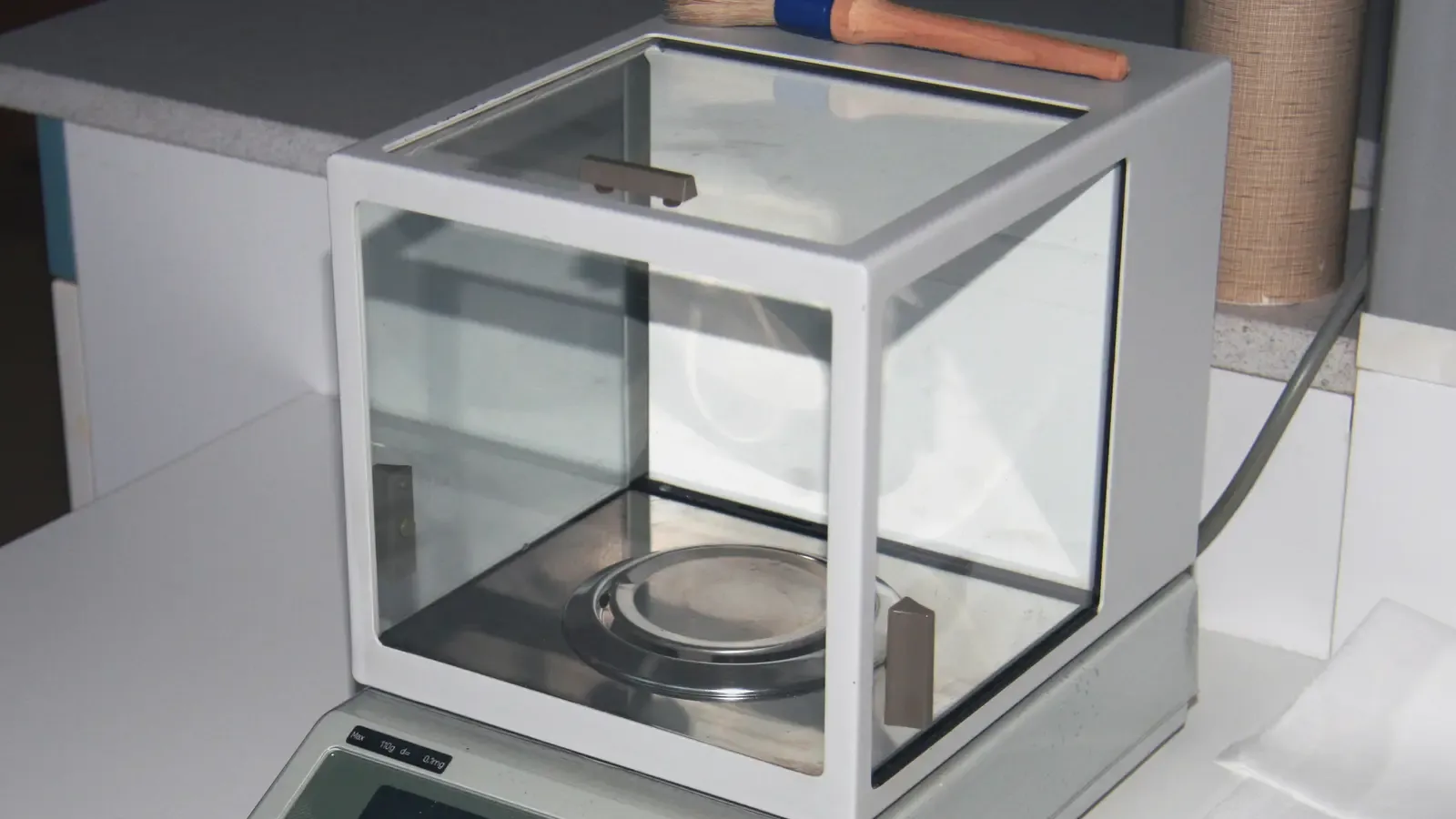
A physical balance is the precise laboratory form of the equal-arm design. The NCERT manual lists its parts: a beam with an agate knife edge resting on a plate at the top of a pillar, pans hung on inverted knife edges, a pointer moving over a small scale, an arresting knob, levelling screws with a plumb line, and a glass case with two doors. Its weight box holds masses of 100, 50, 20, 10, 5, 2 and 1 g, plus milligram masses from 500 mg down to 1 mg. A physical balance is used to measure masses up to about 250 g in school and college practicals.
Unequal-arm balance and steelyard
An unequal-arm balance hangs the load close to the pivot and balances it with a small weight further out. In a steelyard, that weight, called a poise, slides along a marked arm until the beam levels. The principle of moments does the work: a 1 kg poise set 30 cm from the pivot balances 6 kg hung 5 cm from it. A light counterweight can therefore weigh a heavy sack, which made steelyards common in markets and farms.
Triple beam balance
A triple beam balance has a single pan and three parallel beams, each carrying a sliding rider over its own graduated scale. You move the heaviest rider first, then the middle one, then the finest, until the pointer lines up with the zero mark. The mass is the sum of the three rider positions. It suits quick mass readings in school labs, because it needs no separate weight box.
Two-pan comparators in national laboratories
Equal-arm balances still serve at the top of the measurement chain. A NIST paper on its large-mass laboratory describes a manually operated two-pan equal-arm balance, about 40 years old, used to calibrate standards from about 45 kg to 1,134 kg. The paper states that current digital comparators cannot match its repeatability and sensitivity.
Principle of a Beam Balance
The balance works on the principle of moments. The NCERT textbook states it for a lever as load arm × load = effort arm × effort. In a balance with equal arms, the arm lengths cancel, so equal turning effects mean equal weights in the two pans. Gravity acts on both pans at the same place, so it cancels as well, and the balance reports equal masses.
Two conditions for a true beam balance
The NCERT manual names both. The two arms must be of equal length, and the two pans must be of equal mass. A true balance shows it: with empty pans, the beam stays horizontal and the pointer swings equally on either side of zero. Balancing screws at the ends of the beam correct small differences before weighing starts.
Checking a false balance by double weighing
If the arms are slightly unequal, weigh the object twice, once in each pan. Call the two readings W1 and W2. The principle of moments then gives the true mass as the square root of W1 × W2. Readings of 98 g and 102 g give a true mass of 99.98 g, very close to their simple average of 100 g. This method removes the arm error without repairing the balance.
Sensitivity
Sensitivity is how far the pointer moves for a small extra mass in one pan. A longer, lighter beam with its centre of gravity just below the knife edge tips further for the same extra mass, though it also swings longer before it settles. Worn knife edges add friction and dull the response. The NCERT manual notes that arresting the balance protects the knife edges from wear while masses are moved on and off the pans.
Beam Balance in India
Science students in India meet one in Class 11. The CBSE Class 11 physics curriculum for 2025-26 lists the practical "To determine the mass of two different objects using a beam balance", and its apparatus list includes a beam balance and a weight box with gram and milligram weights.
Indian law still treats the beam scale as a trade instrument. Section 22 of the Legal Metrology Act, 2009 requires model approval for weights and measures but provides that it may not be required for any beam scale. Section 24 still requires any weight or measure used in a transaction to be verified before use. Delhi's Legal Metrology (Enforcement) Rules, 2011 allow only class A or class B beam scales, or non-automatic weighing instruments of accuracy class I or II, for trade in bullion and precious stones. The same rules say a shop using a beam scale must hang it from a stand or a chain by a hook, though itinerant vendors are exempt.
Beam Balance Comparison: Quick Reference
The table compares the common types by build, reading method and use. The spring balance is included for contrast, since it measures weight.
| Type | Arms and pans | How you read it | Typical use | Measures |
|---|---|---|---|---|
| Common balance (taraju) | Equal arms, two pans | Add up the standard weights | Shops, markets, homes | Mass |
| Physical balance | Equal arms, two pans, knife edges, glass case | Gram and milligram weights, pointer at zero | School and college labs, up to 250 g | Mass |
| Steelyard | Unequal arms, one hook or pan | Position of the sliding poise | Heavy loads with a light counterweight | Mass |
| Triple beam balance | One pan, three graduated beams | Sum of three rider positions | Quick lab readings | Mass |
| Two-pan mass comparator | Equal arms, two pans | Compare with reference masses | National labs, 45 kg to 1,134 kg at NIST | Mass |
| Spring balance (contrast) | No beam, one hook | Stretch of a spring on a dial | Hanging loads | Weight |
How to Use a Physical Balance
These steps follow the NCERT Class 11 laboratory manual.
- Check that every part is in place, the weight box is complete, and both pans are clean and dry.
- Level the baseboard with the levelling screws until the plumb line's tip sits exactly over the needle point below it.
- Close the glass doors and raise the beam slowly with the knob. The pointer should swing equally either side of zero. If it does not, arrest the balance and turn the balancing screws.
- Arrest the balance. Put the object in the left pan and a standard mass a little heavier than your guess in the right pan, always with forceps.
- Raise the beam gently and watch the pointer. Arrest it again and swap gram masses until the pointer swings nearly equally. You now know the mass to 1 g.
- Add milligram masses in descending order, with the doors closed, until the pointer rests at the centre zero mark.
- Arrest the balance, add up the masses, and return each one to its slot. Repeat the weighing two more times and take the mean.
Common Errors and How to Avoid Them
- Air currents. Close the glass doors before the final reading, since a draught moves the pans.
- Handling weights by hand. Use forceps, and lift milligram masses by their turned-up edge, so skin oil and moisture do not change them.
- Swinging pans. Steady the pans only while the balance is arrested.
- Loading a raised beam. Arrest the balance before adding or removing masses, which spares the knife edges.
- An unlevel base. Recheck the plumb line before each session.
- Parallax. Read the pointer with your eye square to the scale.
Why a Beam Balance Measures Mass, Not Weight
The NCERT manual explains that a physical balance compares the weights in its two pans, and since weight is proportional to mass at one place, it compares masses. Change the place and both sides change together. On the Moon, surface gravity is 0.165 of Earth's, according to NASA's Moon fact sheet. A spring balance there would show about one-sixth of the Earth reading. The two-pan balance would show the same mass as on Earth, because the object and the standard weights both lose weight in the same proportion. The guide to mass vs weight covers the units and the formula.
Beam Balance or Electronic Balance: Where Omace Fits
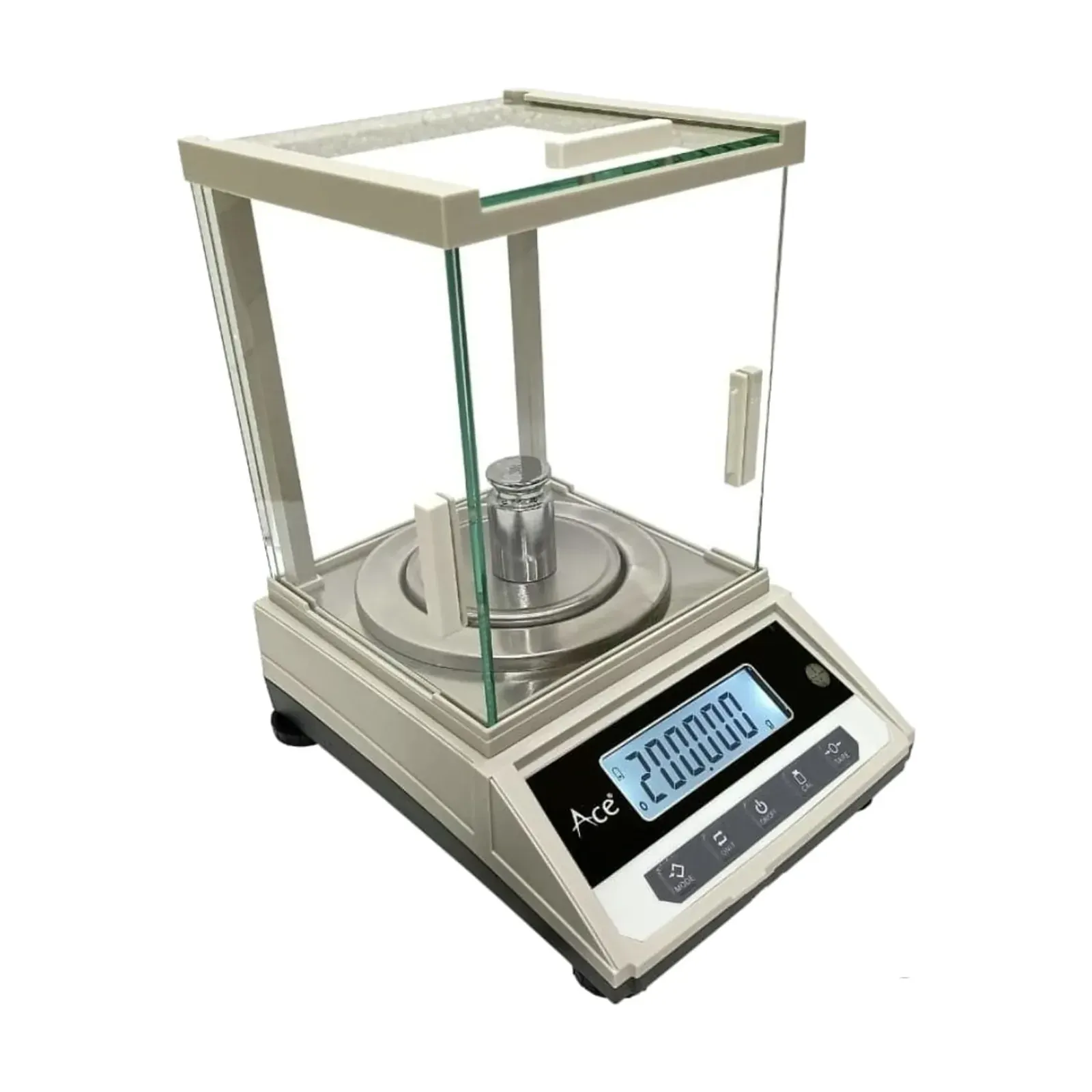
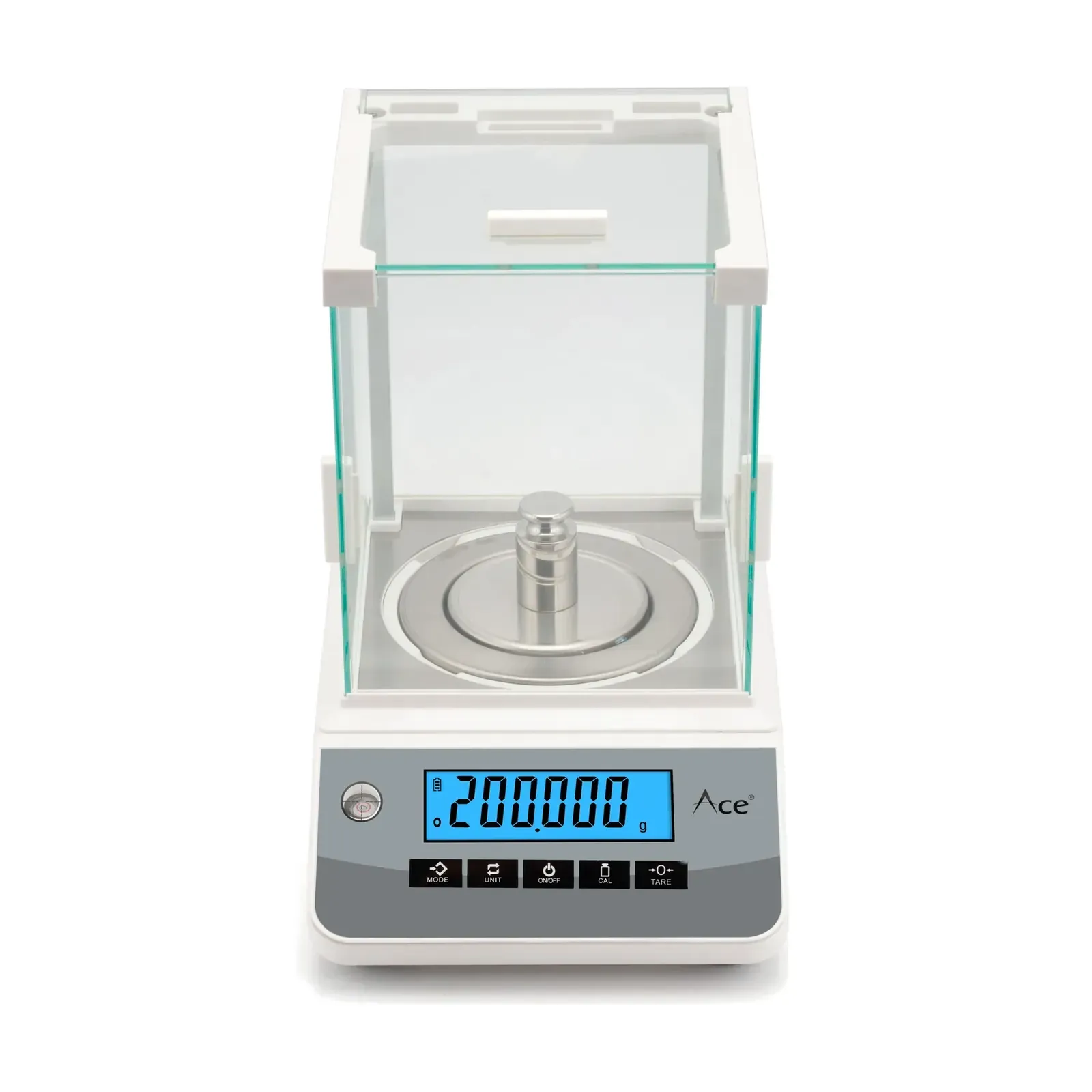
Omace Brands Private Limited does not make or sell beam balances. Its balances are electronic: a load cell under the pan turns force into a reading, and the reading is set against certified test weights before each scale leaves the Bagru factory. An electronic balance gives the answer at once, with no weight box. The Ace JS-5003 electronic balance reads 500 g in 0.001 g steps, the finest Omace offers. The comparison idea lives on inside it, because every Omace digital scale opens calibration mode when TARE is held for about 5 seconds, ready to be checked against a known mass. The guide on weighing scale vs balance explains which suits which job.
Where a Beam Balance Still Makes Sense
A two-pan balance needs no battery and gives the same answer anywhere gravity acts. Its weak points are speed and the care it demands, and its accuracy is only as good as its knife edges and weight box. The two-pan design keeps its place in teaching the principle of moments and in top-level mass comparisons, and Delhi's rules still allow class A and B beam scales for bullion. For everyday weighing, an electronic scale does the job faster.