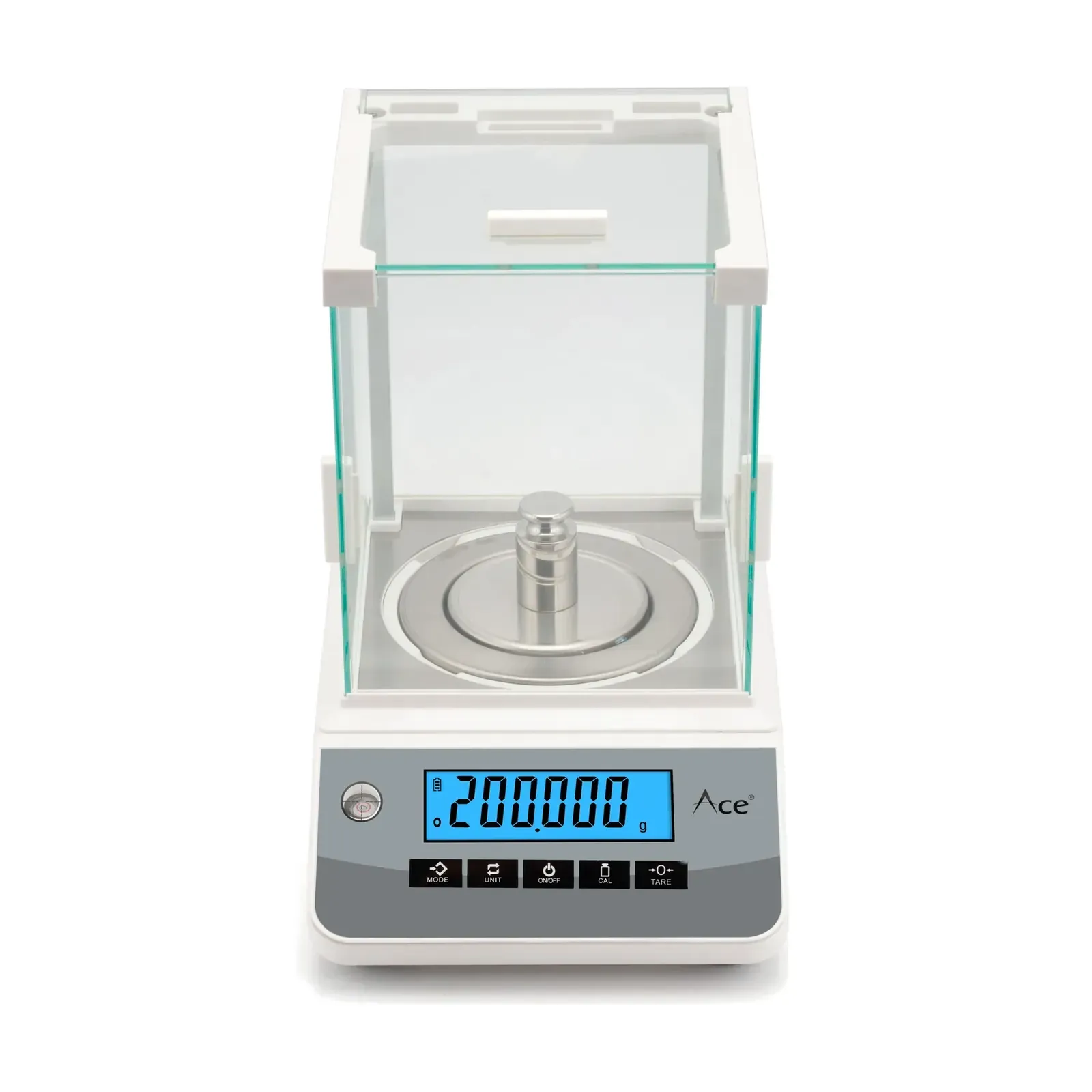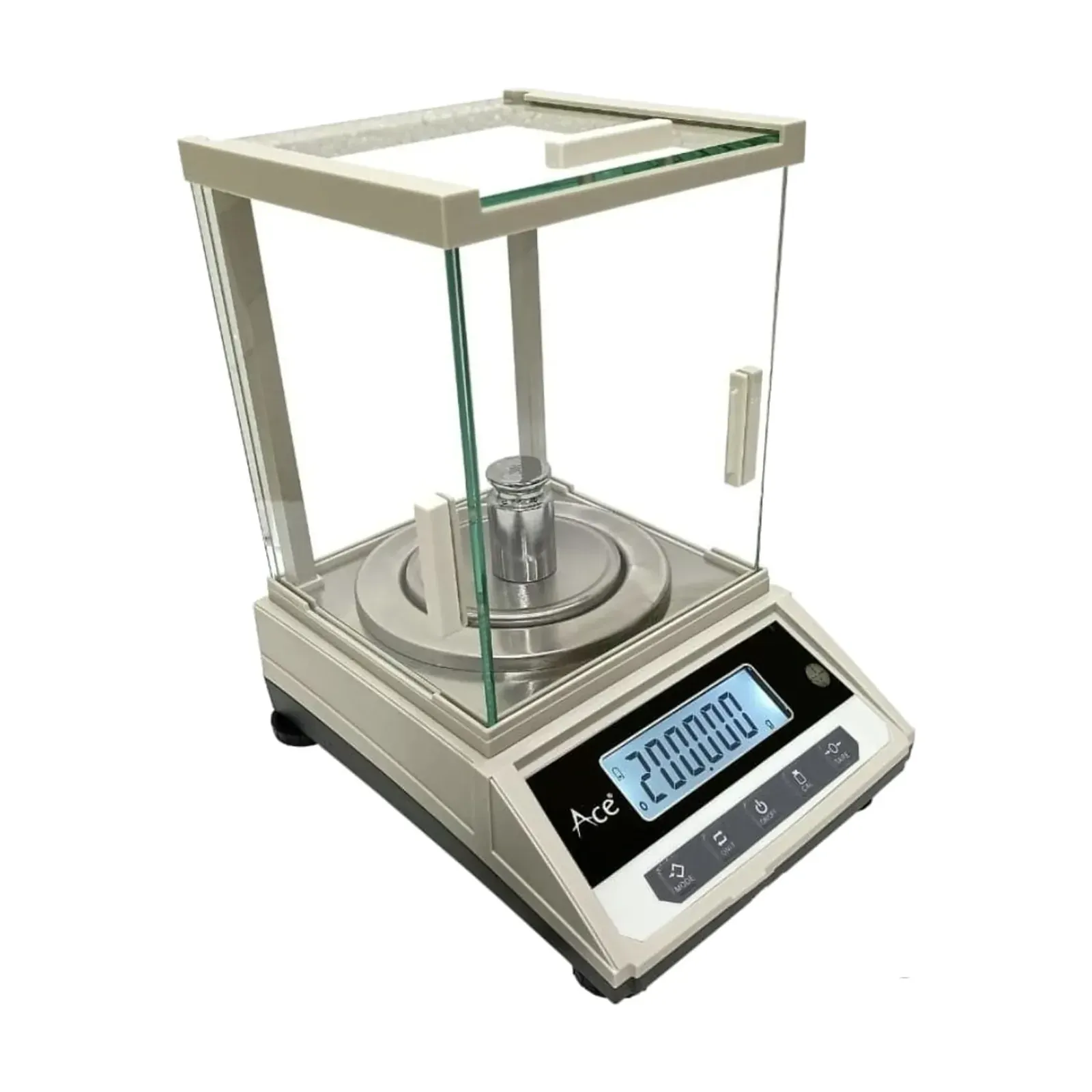
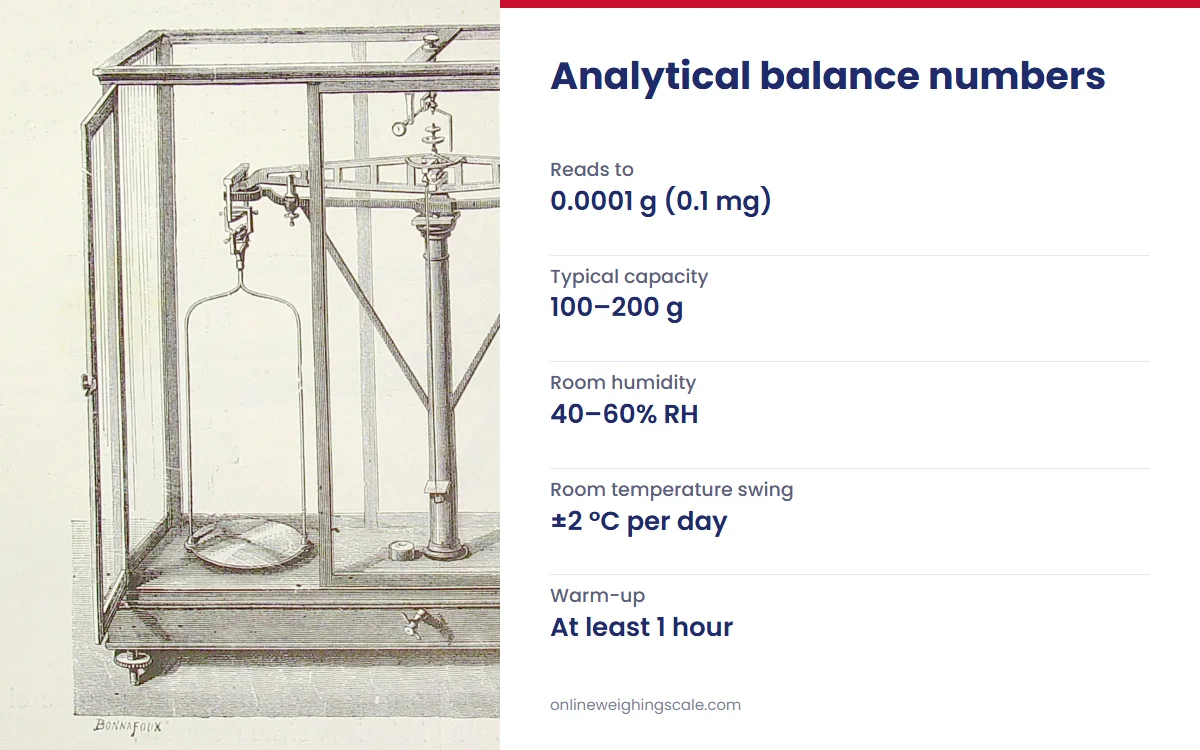
An analytical balance is a laboratory weighing instrument that reads to 0.0001 g, or 0.1 mg. The US Environmental Protection Agency's Method 1664 specifies one capable of weighing 0.1 mg. It needs a draft shield, a level bench and a steady room temperature. Omace Brands Private Limited's finest balances read 0.001 g, so they are not analytical balances.
What an analytical balance is
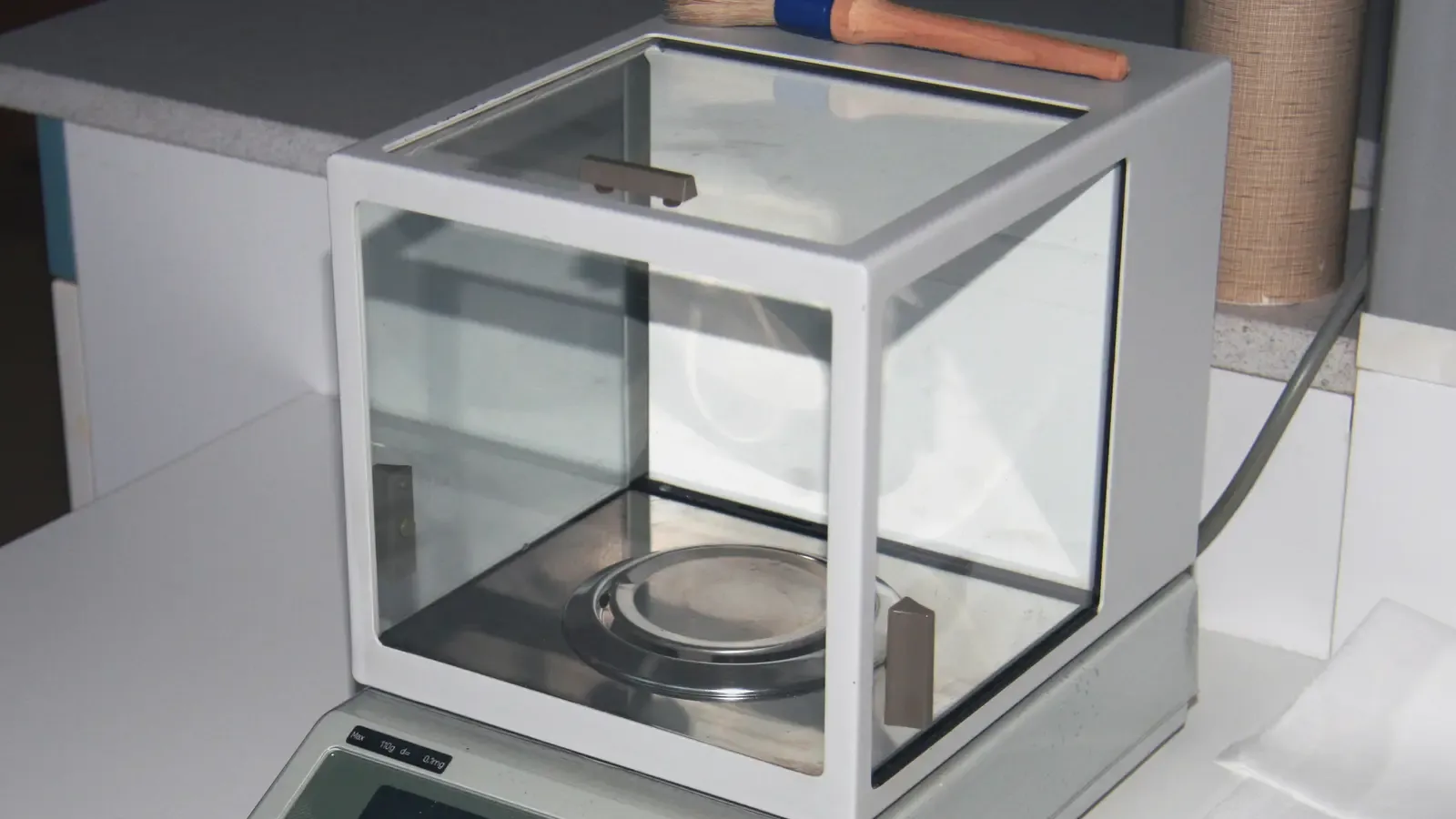
An analytical weighing balance, which some catalogues call an analytical weighing scale, is a digital balance that shows four decimal places of a gram on a small pan inside a glass enclosure. A university analytical chemistry textbook puts a typical electronic balance at a capacity of 100–200 g, reading to the nearest 0.01 mg to 1 mg. NIST, the US national measurement institute, calls analytical balances high precision instruments and warns that excessive shock can damage them.
The word "analytical" is lab language. OIML R 76, the international recommendation for non-automatic scales, sorts instruments into classes I, II, III and IIII and never uses the term. Its class I, special accuracy, starts at a verification interval of 0.001 g and 50,000 intervals.
Indian food test methods show how loosely the label travels. FSSAI's 2022 cereal manual lists an "analytical balance" with 0.001 g sensitivity for foreign matter in grains and another with 0.0001 g readability for an ergot test. One method in its fish manual asks for accuracy to the nearest 0.1 mg. Read the figure in your own method before you buy.
Uses of an analytical balance
In a lab, this balance weighs the small samples and reference materials that later results depend on. NIST's paper on the use of analytical balances covers weighing for quantitative analysis and for preparing solutions. EPA Method 1664 uses one to weigh oil and grease residue from water, and the FSSAI manuals above name one for testing grain and fish samples. A weighing error at this stage carries through to the final result, which is why these methods name the balance at all.
The principle of an analytical balance
An analytical balance usually works by magnetic force restoration, the principle NIST describes for electronic balances. An electromagnet matches the load, and the balance reports how much current that took.
- The pan is linked to a coil that sits in the field of a permanent magnet.
- A load pushes the pan down, and a position sensor detects the movement.
- The control circuit raises the coil current until the magnetic force returns the pan to its original position.
- That current is proportional to the load, and the display converts it to grams after calibration.
The UK National Physical Laboratory's force guide lists force balances at a typical uncertainty of 0.0001% of reading, far finer than the strain gauge cells in the load cell guide. The laboratory's guide to mass and weight says top-loading electronic balances use either this kind of unit or a strain gauged load cell. Either way the balance feels weight, the pull of gravity on the sample, and shows mass. A calibration weight feels the same pull, so calibrating on site cancels local gravity, as the post on mass and weight explains.
Parts of an analytical balance
A diagram of this instrument has a few parts that matter in daily use.
- Weighing pan: a small metal pan, loaded gently at the centre.
- Draft shield: glass doors around the pan that keep air currents off the load.
- Force restoration cell: the coil, magnet and position sensor under the pan.
- Levelling feet and bubble: these set the balance level before use.
- Built-in calibration weight: many electronic balances carry one, according to NIST.
- Display and tare key: the tare key zeroes out the container.
Types of weighing balance compared
The table sets an analytical balance beside the coarser types. The capacity figures for the last three rows are real Ace models from the Omace range.
| Type | Reads to | Capacity | Draft protection | Typical job | Made by Omace |
|---|---|---|---|---|---|
| Analytical balance | 0.0001 g | 100–200 g typical | Enclosed glass shield | Test methods asking for 0.1 mg | No |
| Milligram balance | 0.001 g | 50–500 g | Windshield | Gems, small samples, methods asking for 0.001 g | Yes, Ace |
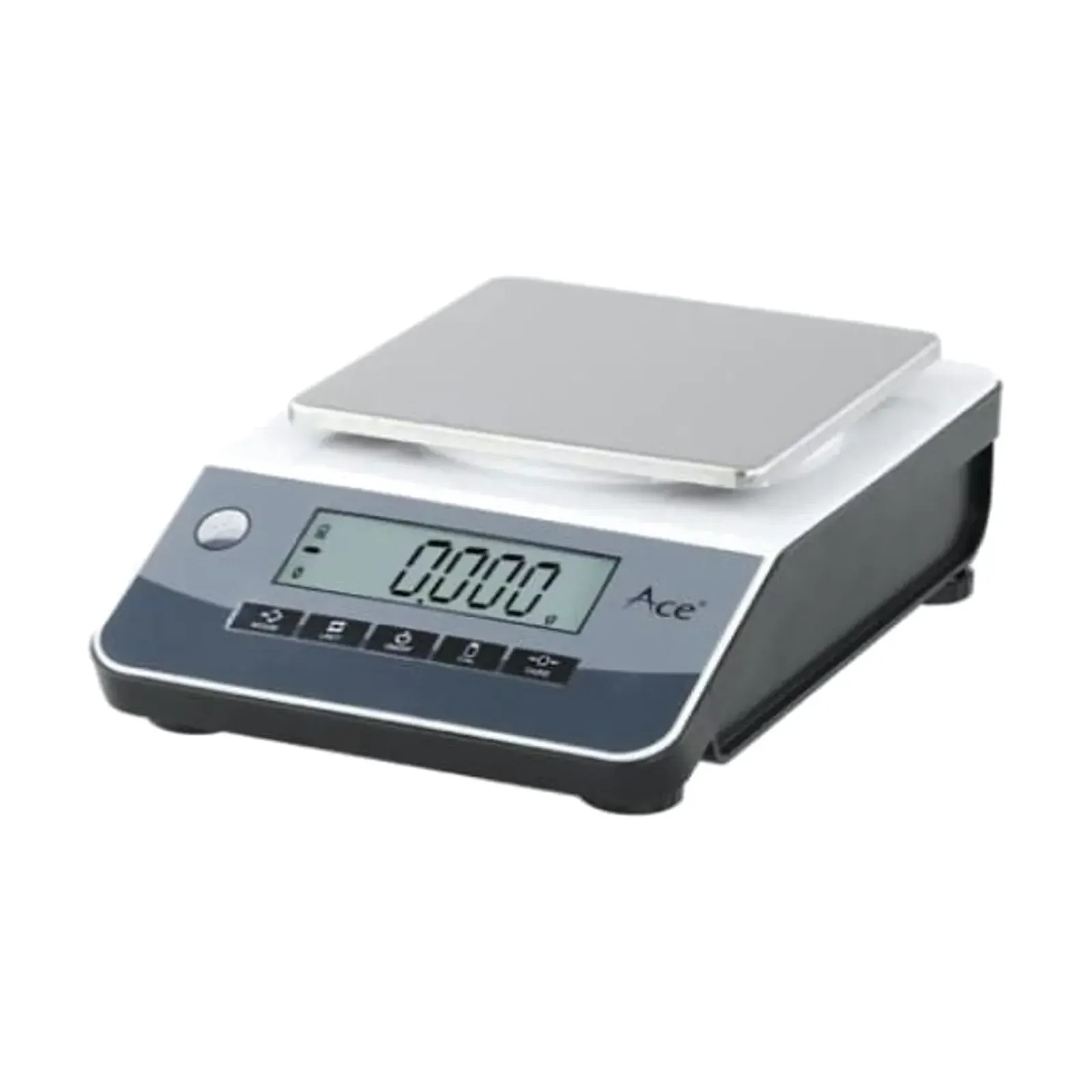
| Precision top-pan balance | 0.01 g | 300 g–2 kg | Clear cover on some models | Gold and small batches | Yes, Ace |
| Bench balance | 0.1 g | 6–10 kg | Open pan | Silver and larger samples | Yes, Ace |
Balances that read finer than an analytical balance are sold as semi-micro, micro and ultra-micro types. Each step reads finer and usually holds far less. These names come from makers and labs, so compare the figure on the data plate. For the wider picture, see weighing scale vs balance.
Readability and allowed error on a balance
The 0.1 mg on the display is readability, the scale division d. The figure that sets the error limit is the verification interval e. NIST says it plainly in its note on e and d: a scale does not get more accurate if it displays more digits. The full explanation is in how accuracy differs from precision.
OIML R 76 lets a lab balance carry an e up to ten times its d. Its own example shows 174.273 g with d = 1 mg and e = 10 mg. By the same rule, a balance with d = 0.1 mg can have e = 1 mg. Table 6 of R 76 then allows ±0.5 mg up to 50 g and ±1 mg from 50 g to 200 g at first verification, and twice that in service.
The smallest sample you should weigh
R 76 sets class I minimum capacity at 100 steps and, under its paragraph 3.4.3, counts those steps in d, which gives 10 mg on a 0.1 mg balance. NIST's Office of Weights and Measures bases the minimum load on e, which gives 100 mg on the same balance if e = 1 mg. The gap matters: an error of 1 mg is 10% of a 10 mg sample and 1% of a 100 mg sample. NIST also recommends keeping most loads between one-quarter and three-quarters of capacity.
How to use an analytical balance
- Site it well. NPL asks for a level surface as free as possible from vibration, direct sunlight, draughts and temperature swings. NIST adds that balances belong away from heating and cooling vents.
- Switch on early. NPL advises leaving an electronic balance on for at least an hour and preferably overnight, subject to the maker's manual.
- Level and calibrate. Check the bubble, then run the calibration routine.
- Exercise the balance. NIST advises placing a load like the one you plan to weigh, reading it and removing it several times, because repeatability improves afterwards.
- Match temperatures. Let the sample and container reach room temperature. NIST reports errors up to 0.2 mg on 20 g standards with a 4 °C difference.
- Tare and load gently. Set the container at the centre of the pan and press tare. Add the sample, then close the doors.
- Read at stability. NIST says readings should be taken at the moment the balance becomes stable, since drift usually follows.
- Keep hands off. Handle small weights with forceps, clean gloves or lint-free cloth, because skin leaves grease and heat.
Weighing by difference, with the container read before and after filling, is common in analytical chemistry. NPL notes that it is open to balance drift, so keep the two readings close together in time.
What disturbs the reading
- Temperature: NIST's limits for high precision work are ±1 °C in 24 hours and under 0.5 °C during a measurement series. General lab work can probably withstand ±2 °C per day.
- Humidity: NIST recommends 40–60% relative humidity. Well below 40%, static discharge can produce erratic readings.
- Magnets: a magnetic sample can disturb the field inside a magnetic force restoration balance.
- Off-centre loads: NPL says electronic balances are generally more sensitive to these than mechanical types.
- Air buoyancy: NIST Handbook 44 explains that a larger body displaces more air and appears lighter. On the conventional values of 1.2 kg/m³ for air and 8,000 kg/m³ for the reference weight, 100 g of water reads about 105 mg light by calculation. That is over 1,000 display steps on this balance, so high precision work applies a correction.
Calibration of an analytical balance
Calibration compares the balance with weights of known mass, and the guide to calibration explains the idea in full. Weights run in classes from E1, the reference standards, down to M3 for industrial settings, as set out in OIML R 111. NPL says a balance should be assessed in the place where it will be used. The guide's checks for an electronic balance are these:
- Off-centre loading: a weight of about half the capacity at the edges of the pan, compared with the centre.
- Scale error and linearity: calibrated weights at about ten equal steps across the range.
- Repeatability: ten applications of a weight, at half load and full load at the least.
- Hysteresis: readings as weights go on, compared with readings as they come off.
How often depends on the method. EPA Method 1664 verifies calibration before and after each analytical batch, at 2 mg and 1,000 mg. Its limits are ±0.2 mg at 2 mg and ±5 mg at 1,000 mg, and a balance outside them must be recalibrated.
When a 0.001 g balance is enough
Plenty of work does not need the fourth decimal place. If your method asks for 0.001 g, or you weigh gems and small lab samples, a milligram balance does the job and copes with a less tightly controlled room. None of the three models below is an analytical balance, and Omace does not claim that accuracy for them. Prices are from the store in November 2026.
- The Ace CY-2003 lab weighing balance reads 200 g in 0.001 g steps, with a glass windshield and a 200 g calibration weight, at ₹27,299.
- The Ace JS-3003 precision weighing balance reads 300 g in 0.001 g steps, with a glass windshield and a 200 g calibration weight, at ₹27,258.
- The Ace JS-5003 electronic balance reads 500 g in 0.001 g steps, with a glass windshield, a backlit LCD and 10 units, at ₹33,453.
If your method names 0.1 mg, or your samples fall below the minimum load worked out above, buy a true analytical balance from a laboratory supplier.
About Omace Brands Private Limited
Omace Brands Private Limited manufactures scales at G-29 RIICO Industrial Area, Bagru, Jaipur. The company has been in the weighing trade since 1994. Its Ace brand covers the jewellery and precision scales, and its balances read 0.001 g at best. Every scale is checked with certified test weights before dispatch.
Omace scales are factory calibrated, and a scale that reads wrong is replaced under warranty. The retail warranty runs 2 years on manufacturing defects. Every Omace digital scale opens calibration mode when TARE is held for about 5 seconds. As a manufacturer, the company holds ISO 9001:2015, ISO 13485:2016, an EU MDR quality certificate, a CE certificate of compliance and a US FDA compliance certificate. Omace scales are made in India.
Choosing the right balance for your work
Start from the smallest sample you weigh and the figure your test method names. Those two numbers usually settle the question between an analytical balance and a milligram balance. Next, look at your room, since a fourth decimal place is of little use beside an open window or an air conditioning vent. If 0.001 g or coarser fits your work, the Ace jewellery and precision scales list each model's capacity and step, so you can check them against your method.