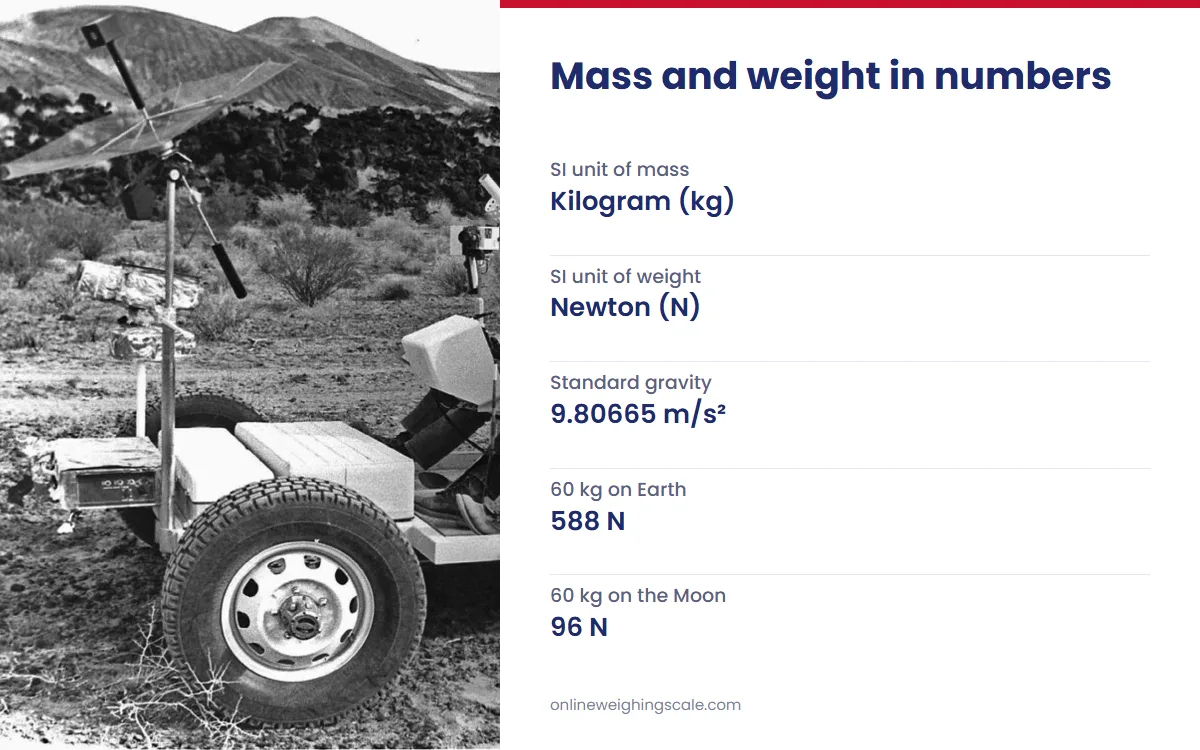
Mass is the amount of matter in an object, and weight is the force of gravity acting on it. A 60 kg person has a mass of 60 kg everywhere, but weighs about 588 newtons on Earth and 96 newtons on the Moon, using NASA's gravity figures. The SI unit of mass is the kilogram, and the SI unit of weight is the newton.
Difference between mass and weight
This table holds the points most class 9 answers need. NIST Handbook 44 defines mass by how much matter a body contains and weight by the force gravity exerts on it, and NCERT's Class 9 science book calls weight the gravitational force with which the Earth pulls an object.
| Point | Mass | Weight |
|---|---|---|
| Meaning | Amount of matter in a body | Force of gravity on a body |
| SI unit | Kilogram (kg) | Newton (N) |
| Depends on place? | No, it stays the same | Yes, it changes with gravity |
| Formula | m = W ÷ g | W = m × g |
| Kind of quantity | Scalar, size only | Vector, acts downward |
| 60 kg person on the Moon | 60 kg | About 96 N |
Everyday speech blurs the two. In Hindi textbooks mass is dravyaman and weight is bhar, while people at home and in the market say vajan for both. The UK National Physical Laboratory notes the same habit in English: for trading purposes, weight is often taken to mean mass.
What mass is
Mass tells you how much material a body holds, and how hard it is to speed up. NCERT's chapter shows the second part: for the same force, a larger mass gets a smaller acceleration. Move a 1 kg packet to the Moon and it still holds the same material, so its mass stays 1 kg.
The kilogram is the SI unit of mass. The BIPM, the international weights and measures bureau, defines it by fixing the Planck constant at 6.62607015 × 10⁻³⁴ J s. That definition arrived in 2019 and replaced a physical prototype, according to CSIR-National Physical Laboratory in New Delhi. The lab still keeps India's copy of that prototype, number 57, known as NPK-57. The BIPM recalibrated it in 1955, 1985, 1992, 2002, 2012 and 2022, and the lab passes its value on to weights from 1 mg to 2,000 kg.
What weight is
Weight is a force, so it has a size and a direction, and it acts downward. Its formula is W = m × g, where g is the acceleration due to gravity. The standard value of g is exactly 9.80665 m/s², and school sums usually round it to 9.8 m/s². NCERT shows that 1 N equals 1 kg m/s², and NIST's guide to the SI gives about 98 N for a 10 kg body on Earth.
That same NIST guide accepts that in everyday use weight is a synonym for mass, and it then treats the kilogram as the right unit. Handbook 44 is firmer and says the incorrect use of weight for mass should be phased out. So "my weight is 60 kg" is fine at home and wrong in a physics exam.
Worked examples
- A student has a mass of 50 kg. Weight on Earth is 50 × 9.8 = 490 N.
- A bag weighs 147 N on Earth. Its mass is 147 ÷ 9.8 = 15 kg.
- That same bag goes to the Moon, where g is about 1.6 m/s². Its weight becomes 15 × 1.6 = 24 N, and its mass stays 15 kg.
Units of mass and weight
The standard unit of weight in science is the newton, while trade and scale displays use units of mass. OIML R 76 lists the milligram, gram, kilogram and tonne for weighing instruments, plus the metric carat for precious stones. NIST's conversion table gives the rest. For a wider list with tola and quintal, see units of measurement.
| Unit | Symbol | Measures | Value |
|---|---|---|---|
| Kilogram | kg | Mass | SI unit of mass |
| Gram | g | Mass | 0.001 kg |
| Tonne | t | Mass | 1,000 kg |
| Metric carat | ct | Mass | 0.2 g |
| Pound | lb | Mass | 0.4535924 kg |
| Newton | N | Weight | 1 kg m/s² |
| Kilogram-force | kgf | Weight | 9.80665 N |
Your weight on other planets
A 60 kg person keeps that mass on every world, and the force changes with local gravity. The gravity figures come from NASA's fact sheet, and the weights are worked out with W = m × g. NASA's Moon fact sheet puts lunar gravity at 0.165 of Earth's, about one-sixth, so a digital scale set on Earth would show about 9.9 kg for that person on the Moon.
| Place | Gravity (m/s²) | Weight of a 60 kg person |
|---|---|---|
| Moon | 1.6 | 96 N |
| Mercury | 3.7 | 222 N |
| Mars | 3.7 | 222 N |
| Venus | 8.9 | 534 N |
| Earth | 9.8 | 588 N |
| Jupiter | 23.1 | 1,386 N |
What a weighing scale really measures
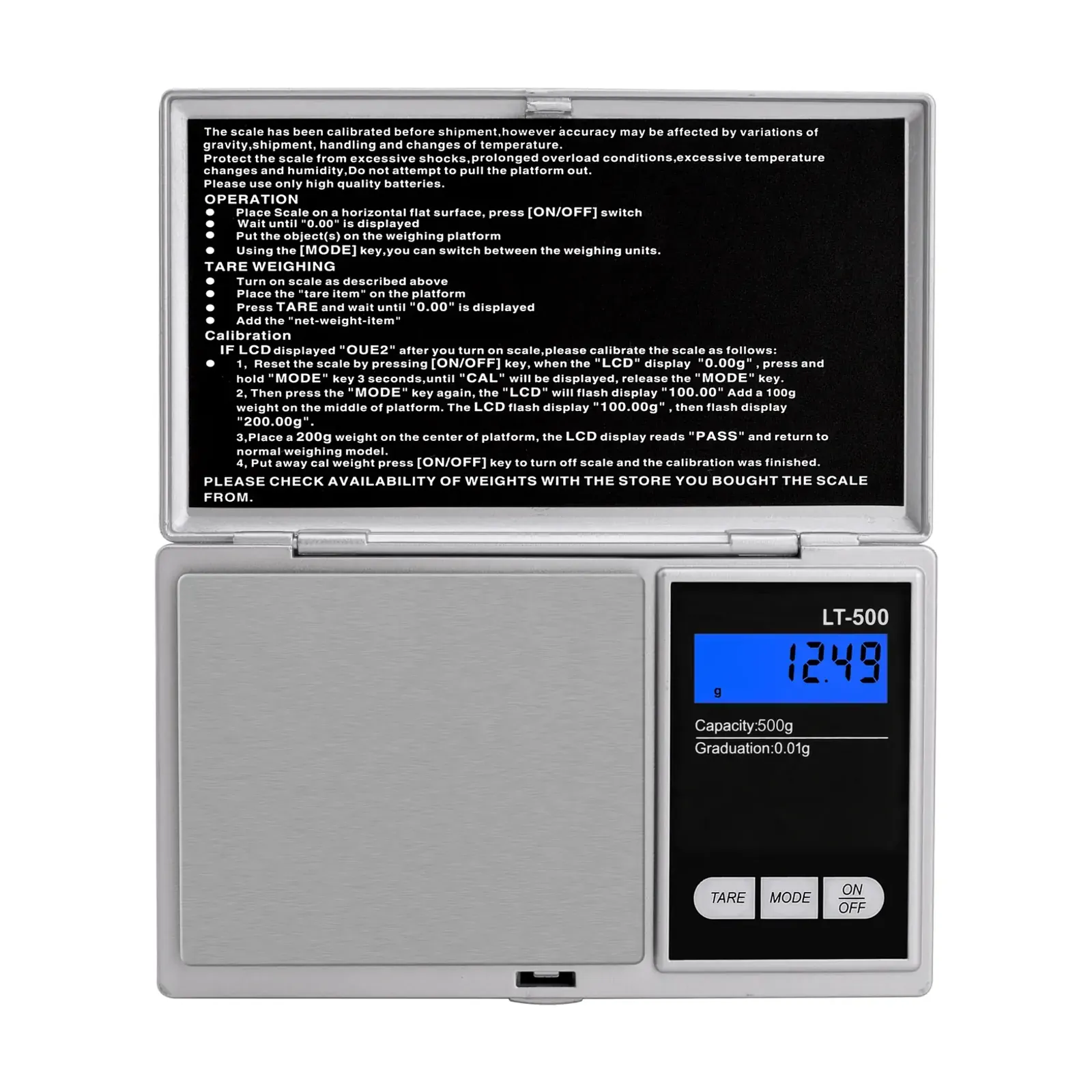
A digital scale senses force and shows mass. OIML R 76 describes a weighing instrument as one that determines the mass of a body by using the action of gravity on it. OIML R 60 says a load cell measures mass only after taking gravity and air buoyancy at its location into account. The load cell guide shows how the force becomes a number.
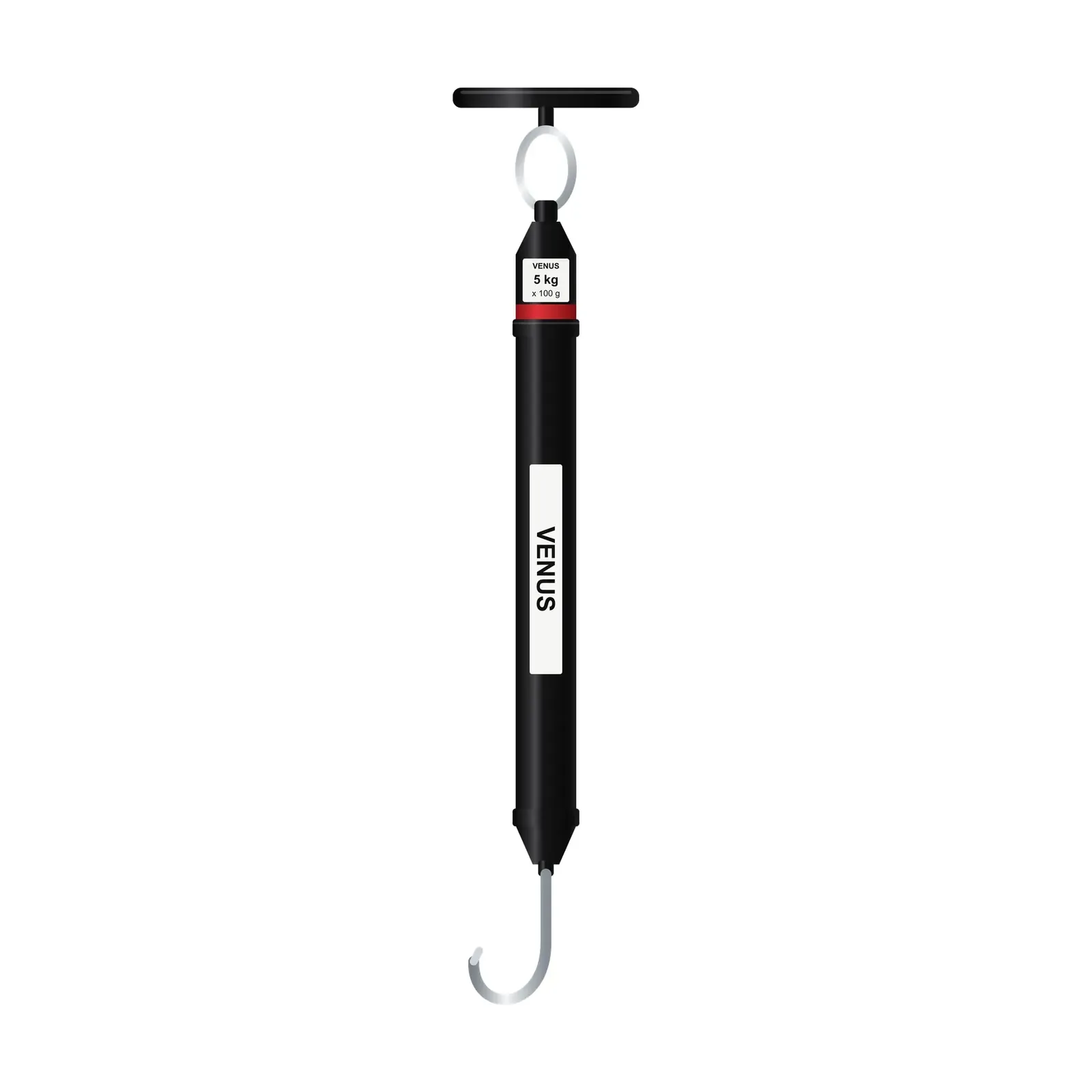
A two-pan balance, the old taraju, works differently. Handbook 44 explains that two bodies of equal mass stay balanced under any value of g, because gravity pulls both pans equally. A spring balance matches the pull of gravity against a spring, so a very sensitive one would read differently in a place with different gravity. It would still balance on the Moon, while a Venus tubular spring balance would read about one-sixth. For more on this, see weighing scale vs balance.
Air adds one more small force. A larger body displaces more air and appears lighter, as Handbook 44 explains. On the conventional values NPL gives, 1.2 kg/m³ for air and 8,000 kg/m³ for the reference weight, 1 kg of water reads about 1.05 g light by calculation.
Gravity also changes across India
Gravity is stronger towards the poles and weaker on high ground. The WELMEC guide for weighing instruments, from Europe's legal metrology cooperation, gives a formula using latitude and altitude. It gives 9.7803 m/s² at the equator and 9.8322 m/s² at the poles, a difference of 0.53%. Each 1,000 m of height takes off another 0.003085 m/s², about 0.03%. WELMEC says real values normally stay within 5 parts in 100,000 of this formula.
The table applies that formula to a few Indian cities, with rounded latitudes and altitudes. From Srinagar to Kanyakumari, gravity changes by about 0.1%.
| Place | Latitude, altitude used | g (m/s²) |
|---|---|---|
| Srinagar | 34.1° N, 1,585 m | 9.7917 |
| Delhi | 28.6° N, 216 m | 9.7915 |
| Jaipur | 26.9° N, 430 m | 9.7896 |
| Mumbai | 19.1° N, 14 m | 9.7858 |
| Chennai | 13.1° N, 7 m | 9.7829 |
| Kanyakumari | 8.1° N, 30 m | 9.7813 |
Why a sensitive scale is calibrated where it is used
A change of 0.1% is about 60 g on a 60 kg person, far too small to matter on a bathroom scale. On a laboratory balance that reads 0.001 g, the same share of the load spans many display steps, so fine balances are checked where they stand.
Calibrating on site with a known weight cancels the difference, because a test weight feels the same local gravity as the load. Handbook 44 says a spring balance is usually adjusted to indicate mass at the locality where it is used. WELMEC asks for final adjustment to the g value of the place of use or to a set gravity zone, and NPL says a balance should be assessed where it will be used.
Every Omace digital scale opens calibration mode when TARE is held for about 5 seconds, and the calibration guide gives the steps. A stamped trade scale is sealed, so a registered repairer recalibrates it. For the error limits that apply, see how accuracy differs from precision.
How Omace Brands sets scales to read mass
Omace Brands Private Limited manufactures scales at G-29 RIICO Industrial Area, Bagru, Jaipur. The company has been in the weighing trade since 1994. Every scale is checked with certified test weights before dispatch, and each scale is factory calibrated. A scale that reads wrong is replaced under warranty, and the retail warranty runs 2 years on manufacturing defects.
Omace shop, platform, chicken and crane scales leave Bagru verified and stamped by Legal Metrology, and the stamp is valid across India. Stamping is compulsory on platform and crane scales. As a manufacturer, the company holds ISO 9001:2015, ISO 13485:2016, an EU MDR quality certificate, a CE certificate of compliance and a US FDA compliance certificate. Omace scales are made in India.
Using the two words correctly
In a science answer, write mass in kilograms and weight in newtons, and show W = m × g. At the shop or on a bathroom scale, "weight" in kilograms is the normal word and everyone understands it. If you want to see how different scales turn that force into a reading, the guide to types of weighing scale covers each design, from spring balances to digital platforms.