Grams measure mass and millilitres measure volume, so grams to ml is a conversion that changes with the liquid. Water comes close to 1 g per ml, but 100 ml of milk weighs about 103 g, cooking oil about 92 g and honey about 143 g.
That gap matters in a Jaipur kitchen as much as anywhere. A recipe that says 200 ml of oil is not asking for 200 g, and a kitchen scale set to grams will show a different number than a measuring jug. This guide gives the density behind each figure, a table you can read off, and the steps for weighing any liquid with the tare key.
Why a gram is not a millilitre
A gram is a unit of mass, the thing a kanta or taraju measures. A millilitre is a unit of volume, the space a liquid fills. The link between the two is density, which is mass divided by volume. Mass in grams equals volume in ml multiplied by density in g per ml.
The metric system was built so that water ties the two together. A 1950 NIST circular notes that, by definition, 1 millilitre of water at 4 °C weighs 1 gram. Water at kitchen temperature is a little lighter than at 4 °C, so 1 g per ml is a very good working figure for water and for nothing else.
Every other liquid has its own density. Oil floats on water because it is lighter. Honey sinks in water because it is heavier. Milk sits just above water, because the fat and protein in it add a little weight.
How much does 100 ml weigh? Table for common liquids
The United States Department of Agriculture (USDA) FoodData Central lists the weight of one US cup for each food. The NIST unit conversion page sets the US cup at 236.6 ml, which turns those cup weights into grams per ml. The table below is worked out from the USDA figures and rounded.
| Liquid | One US cup weighs (USDA) | Density | 100 ml weighs | 1 litre weighs |
|---|---|---|---|---|
| Water | about 237 g | about 1.00 g/ml | about 100 g | about 1 kg |
| Whole milk | 244 g | about 1.03 g/ml | about 103 g | about 1.03 kg |
| Canola oil | 218 g | about 0.92 g/ml | about 92 g | about 0.92 kg |
| Honey | 339 g | about 1.43 g/ml | about 143 g | about 1.43 kg |
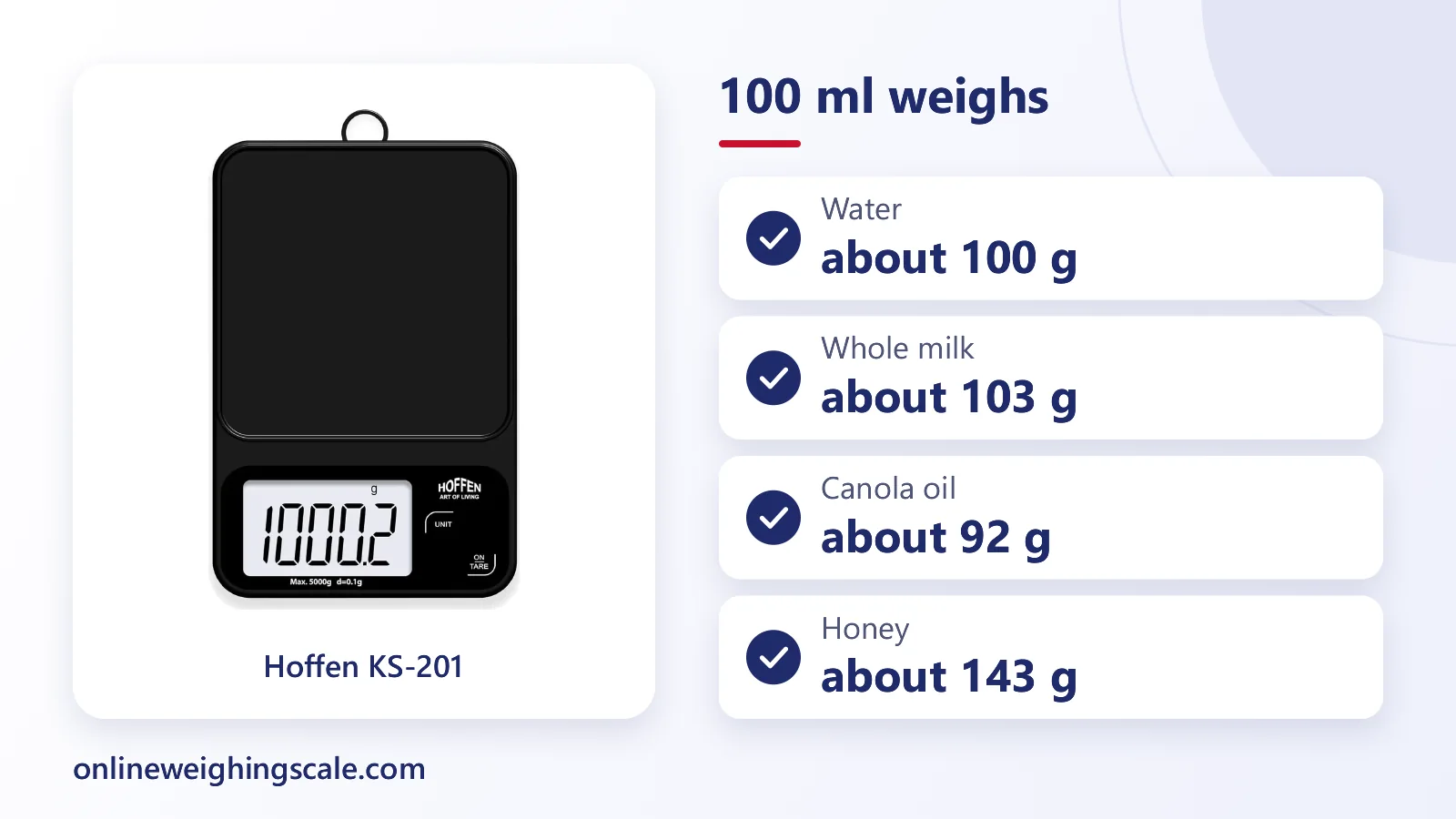
The USDA record for whole milk with added vitamin D gives 244 g for a cup. The record for canola oil gives 218 g, and the record for honey gives 339 g. Brand, fat content and temperature move these numbers by a few percent, so treat them as reliable to within 2 or 3 g per 100 ml.
Other cooking oils such as groundnut, mustard and sunflower oil sit close to canola, but their densities were not confirmed on an official page, so they are left out of the table. Ghee is left out for the same reason. For ghee, weigh the spoonful you actually use.
Quick conversions you can do in your head
- Milk: multiply the ml by 1.03 to get grams. 250 ml of milk is about 258 g.
- Oil: multiply the ml by 0.92. 100 ml of oil is about 92 g, and 1 litre is about 920 g.
- Honey: multiply the ml by 1.43. 50 ml of honey is about 72 g.
- Going the other way, divide the grams by the same number. 200 g of honey is about 140 ml.
These sums give a recipe the right weight in about ten seconds. For cups of flour, sugar or dal, where the volume depends on how tightly the grains pack, use the chart in grams to cups for Indian ingredients.
What the ml mode on a kitchen scale really does
Some digital kitchen scales have a button that switches the display from g to ml. The scale still weighs in grams. It then divides the weight by a fixed density and shows the result as ml.
On most scales that fixed density is water at 1 g per ml, so the ml reading is exact for water and close for thin, watery liquids such as tea, black coffee and plain stock. A few scales add a second, milk setting that uses a density near 1.03. The scale's manual says which one it applies.
For oil the water setting reads low. Pour 100 g of oil on a scale in water ml mode and it shows 100 ml, but the true volume is about 109 ml. For honey it reads high: 100 g of honey shows 100 ml, but the true volume is about 70 ml. So when a recipe needs exact ml of anything other than water, weigh in grams and convert with the table, or measure in a jug.
A simple test shows whether your own scale's ml mode can be trusted. Tare an empty cup, pour in water until the display reads 100 ml, then pour the same water into a jug marked in ml. If the jug agrees, the mode is working for water. Repeat with milk and the jug will show about 97 ml where the scale says 100, because milk is heavier per ml. That small gap is normal and is the reason a milk setting exists on some scales.
How to weigh a liquid with the tare key
- Place the empty bowl or jug on the scale and let the reading settle.
- Press TARE so the display shows 0 g.
- Pour the liquid slowly. Stop a little before the target, because liquid keeps flowing off the lip of the jug.
- Read the grams once the number stops moving. Add or pour out small amounts to reach the weight you want.
- If a recipe gives ml, work out the grams first (ml multiplied by density) and weigh to that number.
To add a second ingredient to the same bowl, press TARE again and the display returns to 0 g. Sticky liquids like honey leave a film on the jug, so weigh honey straight into the bowl you will mix in.
A scale that reads in whole grams is enough for milk, oil and chai. For essences, syrups or a baby's formula, a scale that reads to 0.1 g is steadier. If readings drift or look wrong, the guide on how to calibrate a digital weighing scale at home covers the check.
Milk by weight or by volume
Milk is sold by the litre in a packet, but it can also be recorded by weight at a collection point. The two numbers differ by about 3 percent, because milk is slightly heavier than water. If you collect, sell or buy milk, ask which unit the rate is quoted in before you compare prices. A litre of milk weighs about 1.03 kg, so 100 litres comes to roughly 103 kg.
Which Omace scale suits liquids
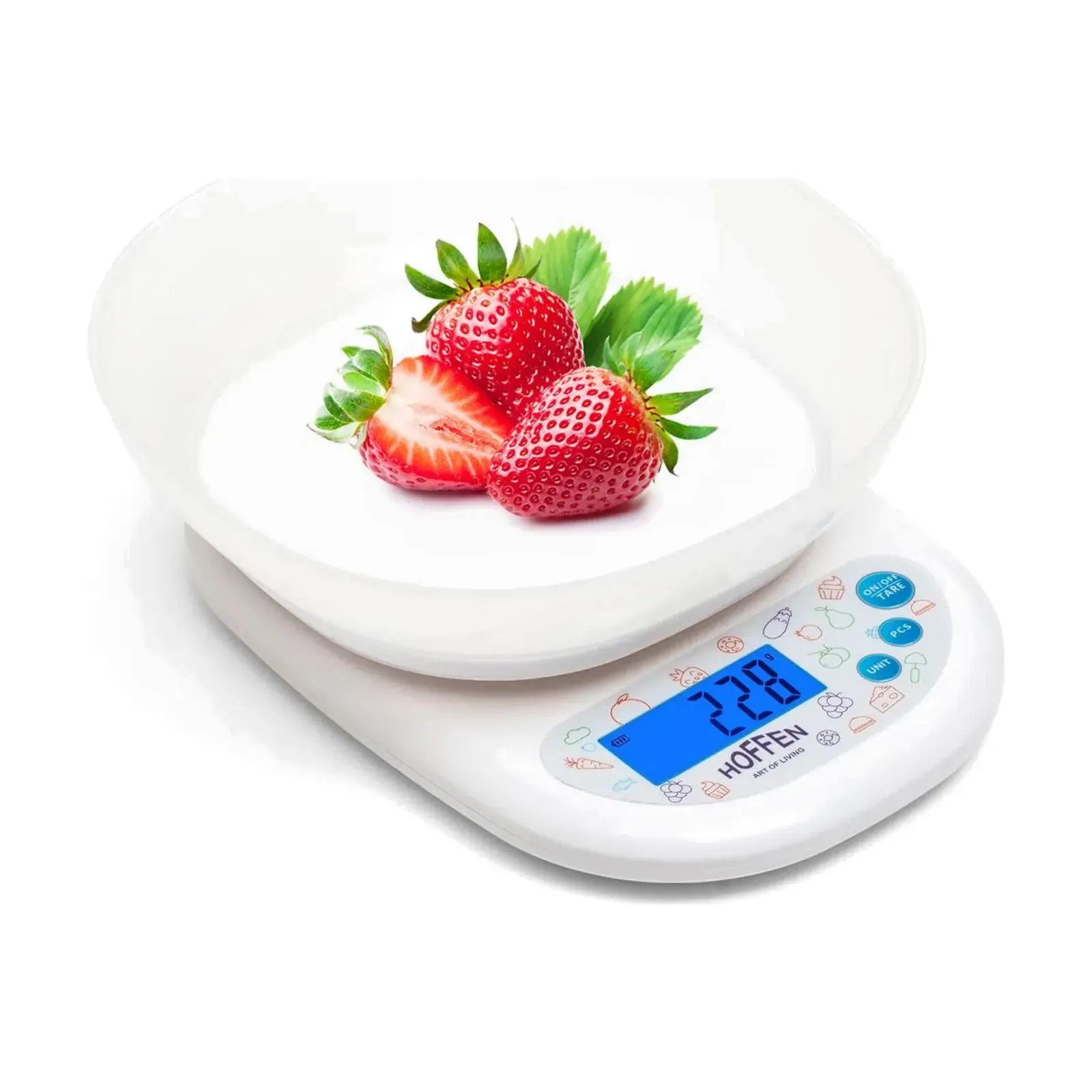
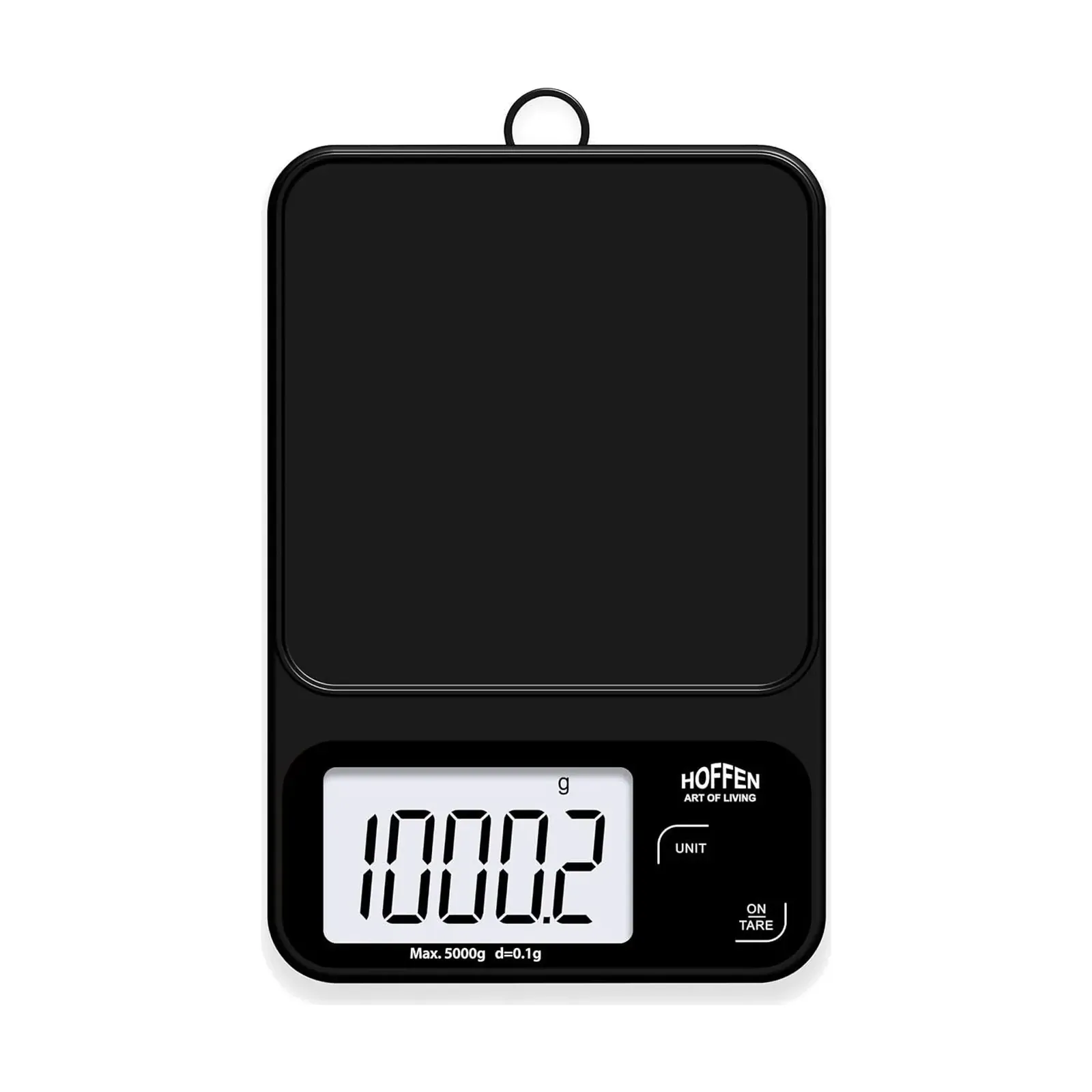
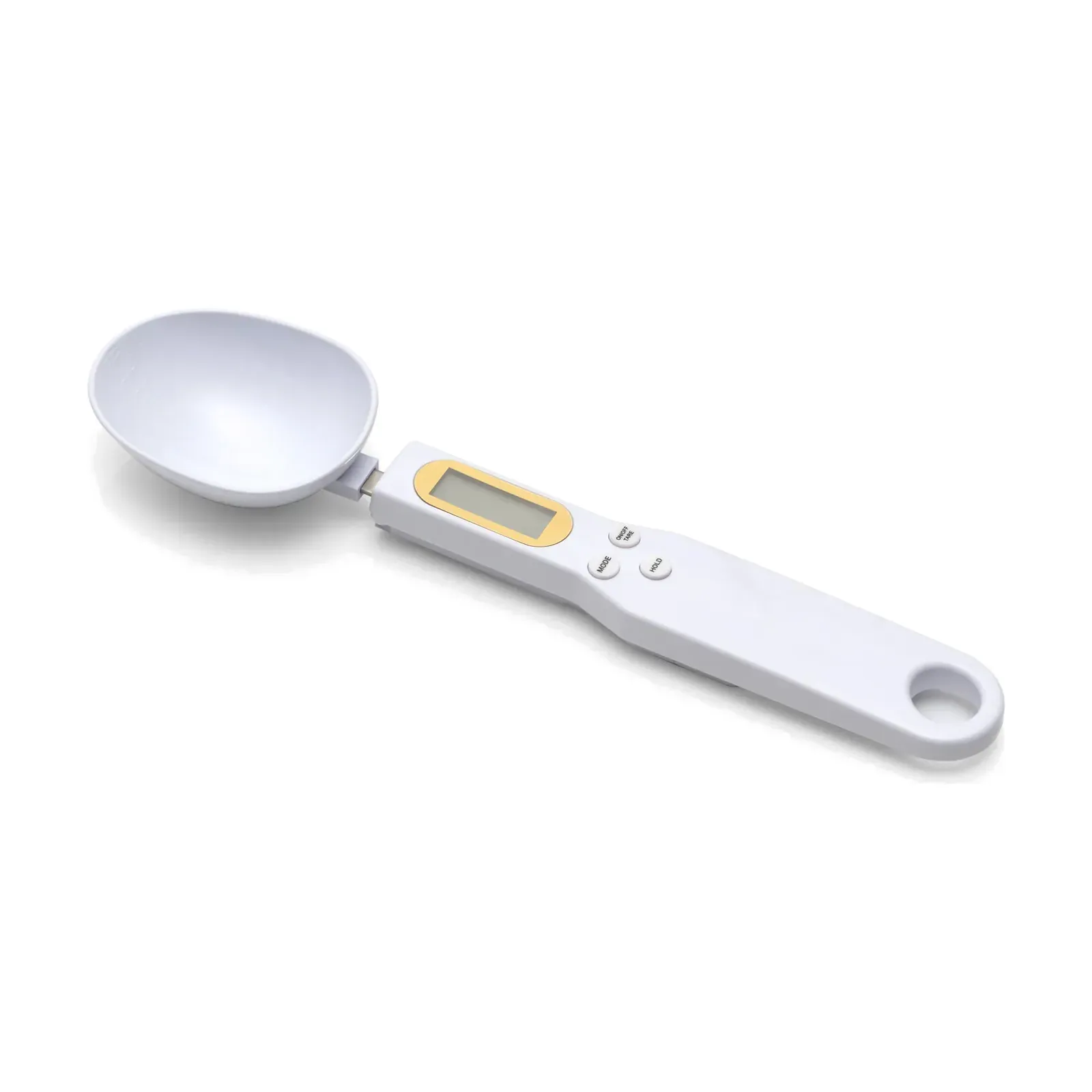
Omace Brands Private Limited has made weighing scales in Bagru, Jaipur since 1994 (see About Omace) and sells kitchen scales under the Hoffen and Venus names. For pouring oil, milk or water by weight, a scale with a bowl and a clear display is the simplest tool. The Hoffen KD-819 kitchen scale with bowl reads 10 kg in 1 g steps and costs ₹519. The Hoffen KS-201 smart kitchen scale reads 5 kg in 0.1 g steps and costs ₹729. The Hoffen digital spoon scale reads 500 g in 0.1 g steps and costs ₹939, which suits small liquid doses.
On Omace digital scales a long press of TARE opens calibration mode on some models and a long press of the M key on others, and the manual for each model shows which. The full steps for a kitchen scale are in how to calibrate a kitchen scale without weights. All models sit in the kitchen scale range.
Which number to trust when a recipe gives both
When a recipe lists grams and ml for the same liquid, trust the grams. Weight does not change with the shape of the jug, the foam on top or the temperature of the day. A scale that is tared and read to the gram repeats the same dish tomorrow, and a jug read by eye does not.