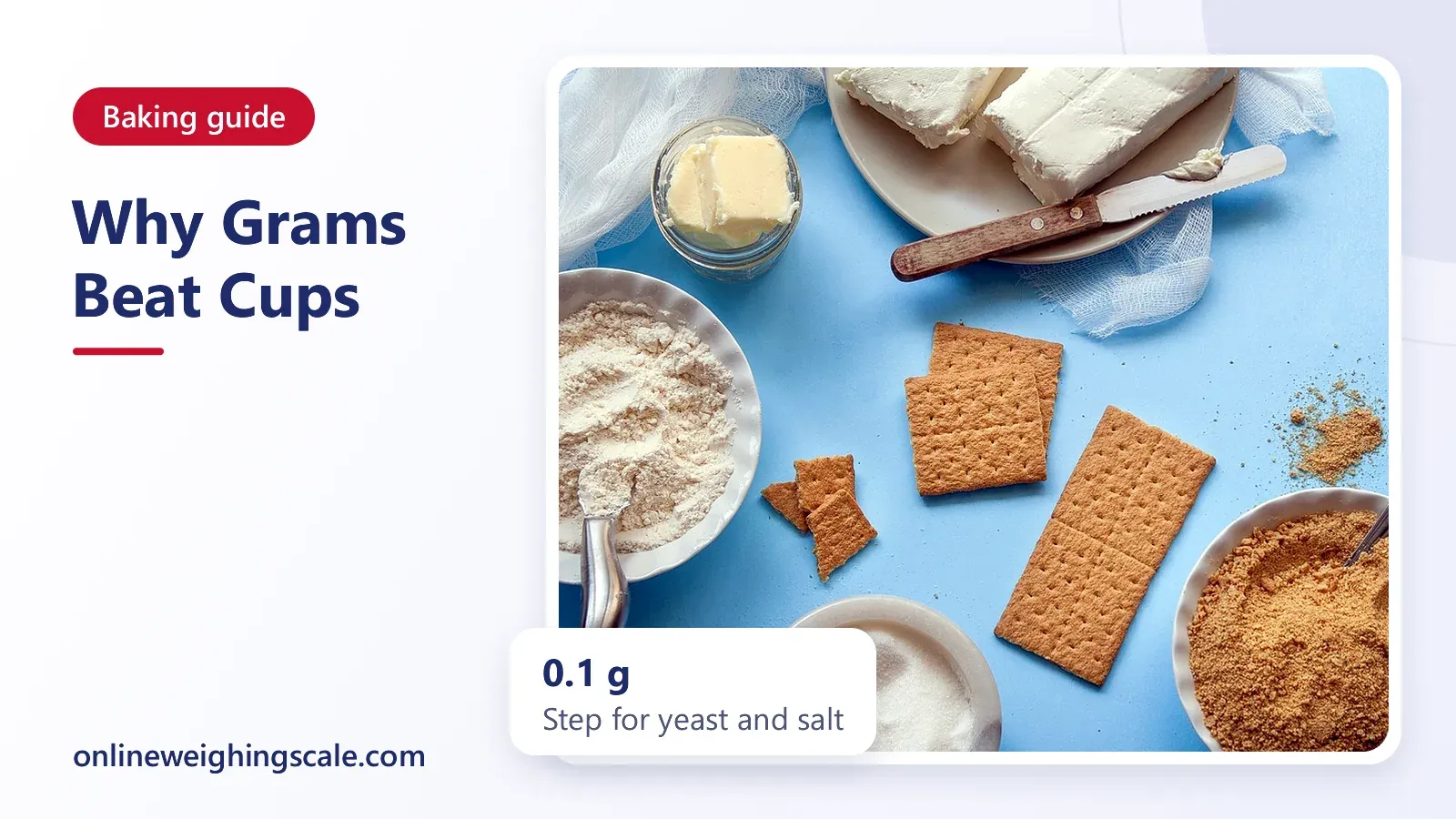
Baking by weight means measuring flour, sugar and butter in grams on a kitchen scale instead of in cups, and it is the single change that makes a recipe repeat itself. A cup of wheat flour weighs a different amount each time it is filled, while 100 g on a scale is always 100 g.
This guide explains why the cup misleads, how to work in grams, how baker's percentages let you scale any recipe, and what scale a home baker needs. Conversions for common Indian ingredients sit in the separate grams to cups chart.
Why a cup of flour is not a fixed amount
Flour is a powder that settles in its container and packs down under pressure. A cup measures space, not mass, so the grams inside it depend on how tightly the flour sits. A University of Illinois Extension sourdough guide says recipes are written in grams because grams are a more accurate unit of measurement than cups and give more consistent results.
That gap decides the bake. Extra flour gives a dry cake, a stiff dough and a tight crumb. Too little gives a flat cookie and a wet loaf. The recipe was never wrong; the cup was.
The way you fill the cup changes the result. Dipping the cup into the bag packs the flour, while spooning it in lightly and levelling the top gives less. A North Dakota State University Extension column on accurate measurement for baking warns that if you pack flour into the cup, you will have too much flour in your recipe. Humidity, sifting and how long the bag has sat on the shelf add more variation, and a monsoon kitchen in Jaipur behaves differently from a dry winter one.
What the measurement authorities say
The US National Institute of Standards and Technology (NIST) runs a Metric Kitchen programme. Its page of culinary measurement tips states that measuring ingredients by mass with an appropriate kitchen scale is a best practice to improve recipe accuracy. It also says that using a dry cup for a liquid, or the reverse, is a common way of introducing measurement errors.
A NIST news item on its metric recipes goes further and says that measuring in grams on a digital scale is significantly more accurate, repeatable and consistent than volume cups. These pages do not give an exact error figure for flour, so this guide does not either. Where this guide gives a flour weight, it comes from the worked example below.
Grams, cups and spoons compared
| Method | What varies | Typical use |
|---|---|---|
| Grams on a scale | Only the scale's own small error | Flour, sugar, butter, water, salt, yeast |
| Cups, spooned and levelled | How loosely the flour was filled | Rough home recipes |
| Cups, scooped from the bag | Packing, which adds flour | Best avoided for flour |
| Teaspoons and tablespoons | Heap, level and the size of the spoon set | Small amounts of salt, baking soda, spices |
Spoons are a quiet source of trouble. An Indian household spoon, a measuring spoon and a spoon from the cutlery drawer are three different sizes. Baking soda and baking powder act on the whole batter, so a heaped spoon where a level one was meant shows up in taste and rise.
Liquids behave better in a jug, but weighing them also works. Water is easy because 1 mL of water weighs 1 g. Milk, oil, honey and curd are not exactly 1 g per mL, so a recipe written in grams for those should be weighed in grams, not poured to a mark.
How to weigh ingredients one after another with tare
The tare key sets the display to zero with whatever is on the pan. NIST's cookware and tools page advises pressing zero to remove the weight of the bowl before each new measurement, and notes that this saves washing and drying several measuring cups and spoons. The routine is the same on any digital kitchen scale:
- Switch the scale on and put the empty mixing bowl on the pan.
- Press TARE so the display reads 0.
- Add the flour until the display shows the recipe's grams.
- Press TARE again. The display returns to 0 with the flour still in the bowl.
- Add the sugar, then tare, add the salt, then tare, and so on down the list.
Pour slowly near the target. If you overshoot, take a spoonful out rather than starting over. Keep the scale on a flat counter, away from the fan or a window, because moving air disturbs a sensitive reading. Eggs can go in the same bowl; weigh them last, cracked, so the shell does not count.
Many scales switch off after a minute or two. If that happens mid-recipe, lift the bowl, switch on and put the bowl back. The scale then reads the bowl and its contents as a fresh weight, so press tare again and carry on from the next ingredient.
Baker's percentages explained with one example
A baker's percentage writes every ingredient as a share of the flour weight, and the flour is always 100 percent. A community college culinary maths guide states that each ingredient in a formula is expressed as a percentage of the flour weight, and that the flour weight is always 100 percent. To find an ingredient's figure, divide its weight by the flour weight and multiply by 100. Because every figure is measured against flour, the total comes to more than 100 percent, which is normal.
Take a simple bread dough made with 500 g of flour:
| Ingredient | Weight | Baker's percentage |
|---|---|---|
| Flour | 500 g | 100% |
| Water | 350 g | 70% |
| Salt | 10 g | 2% |
| Dry yeast | 3.5 g | 0.7% |
The water figure, 70 percent, is called hydration; the University of Illinois Extension guide defines it as the weight of water divided by the weight of flour, times 100. It tells you how wet the dough will feel before you touch it. Two recipes with different batch sizes can be compared at a glance, because 70 percent is 70 percent whether the flour is 500 g or 5 kg.
Scaling is the real gain. To bake with 800 g of flour, multiply each percentage by 800. Water becomes 560 g, salt 16 g and yeast 5.6 g. No cup conversion and no guessing is involved. The same trick lets you change one thing, say a little more water, and see its effect without recalculating the rest.
Baker's percentages are written for grams. They cannot be done in cups, since a cup of flour and a cup of water do not weigh the same, which is another reason bakers who share formulas use scales.
What scale a home baker needs
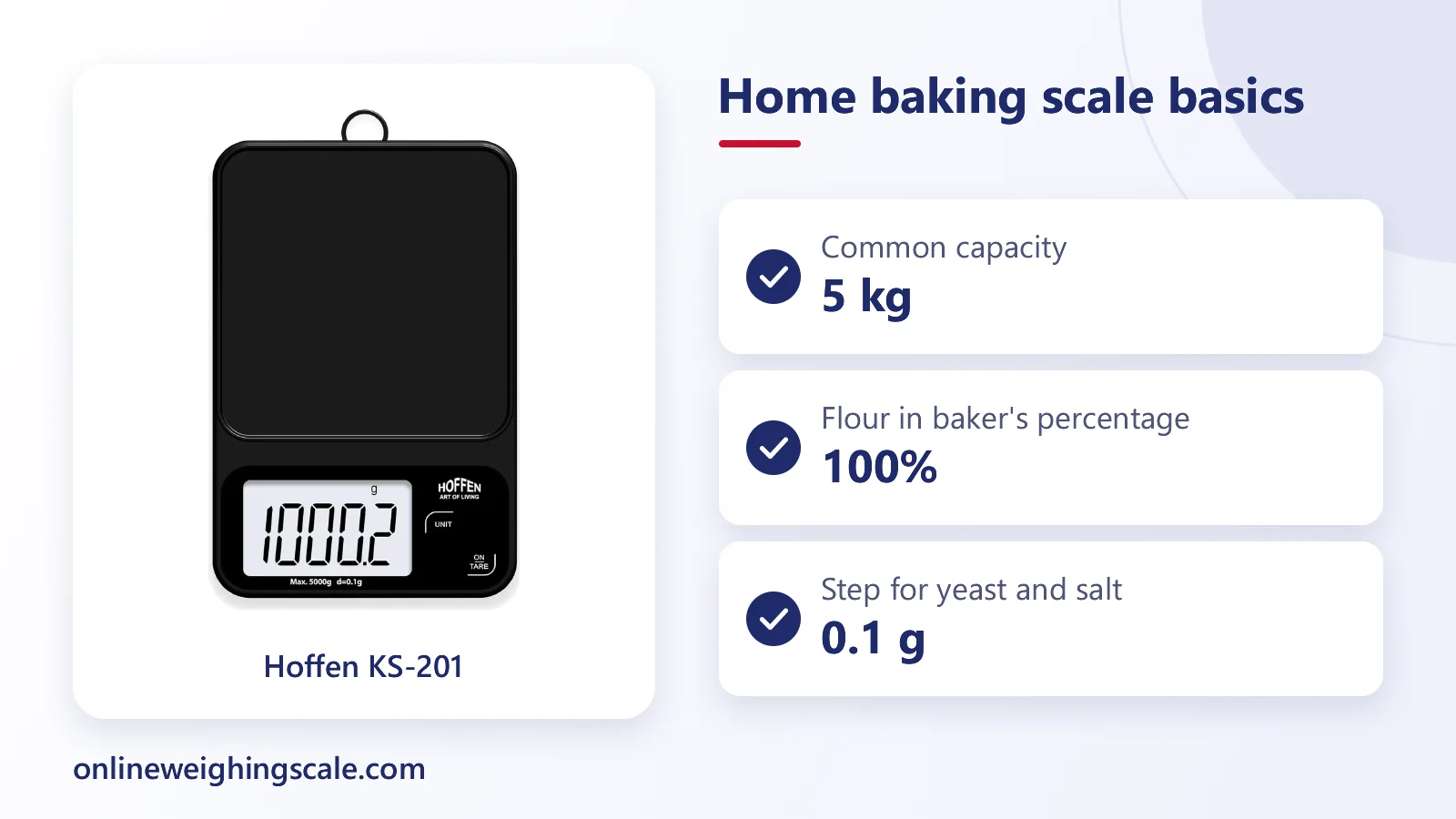
For cakes, cookies and bread, a kitchen scale that reads in 1 g steps is enough for flour, sugar, butter and milk. A 5 kg capacity is a common choice for home cooking, as the NIST cookware page notes, because the heaviest load is the bowl plus the ingredients. A flat, easy-to-wipe top and a clear backlit display matter more than extra features.
Small amounts need a finer step. In a loaf with 500 g of flour, 3.5 g of yeast is a tiny quantity, and a 1 g scale can only show 3 g or 4 g, which is a swing of roughly 15 percent either way. A 0.1 g scale shows 3.5 g properly. The same applies to salt in a small batch, baking soda and spices. Very small amounts can be too light even for some home scales, which is why some bread books give spoon equivalents as well.
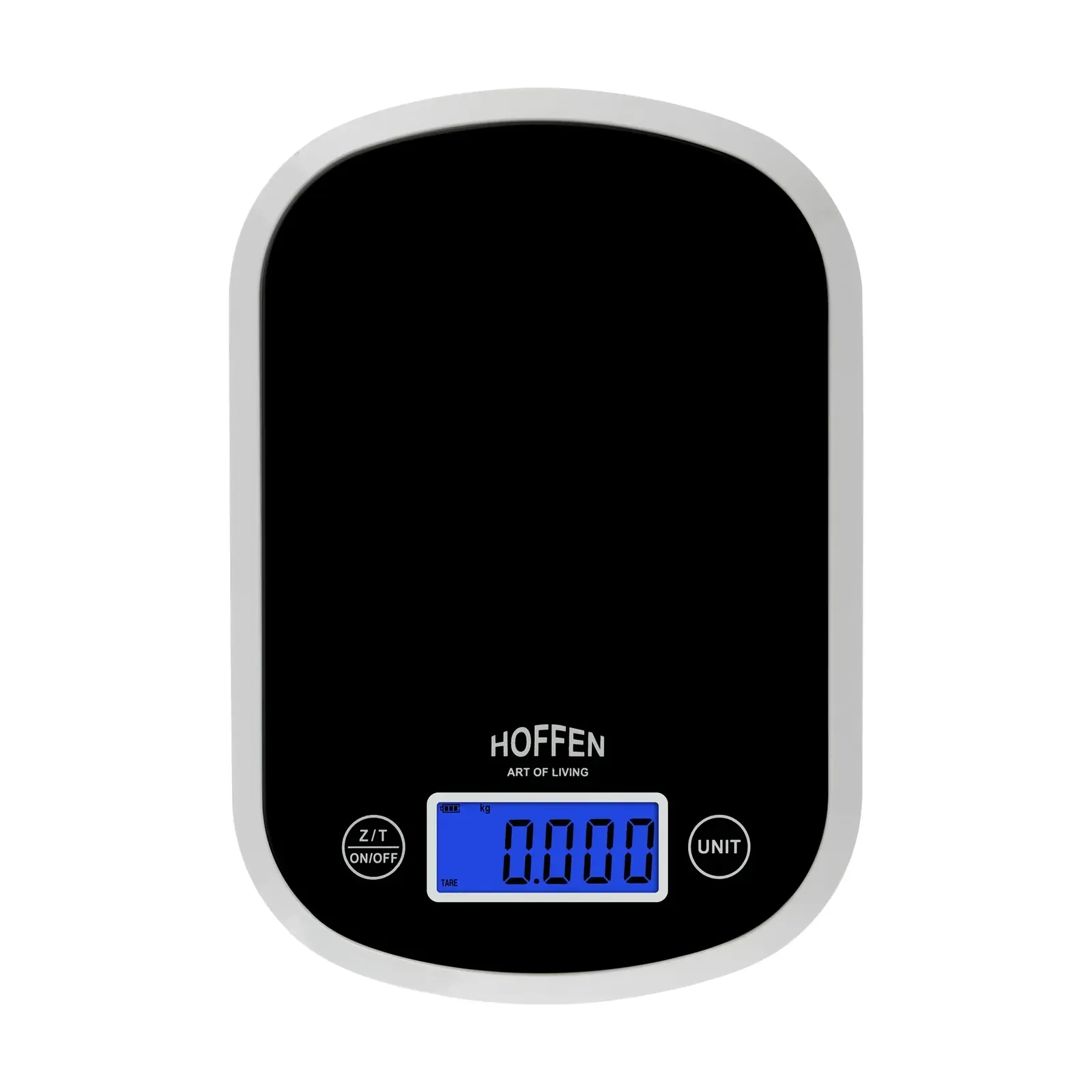
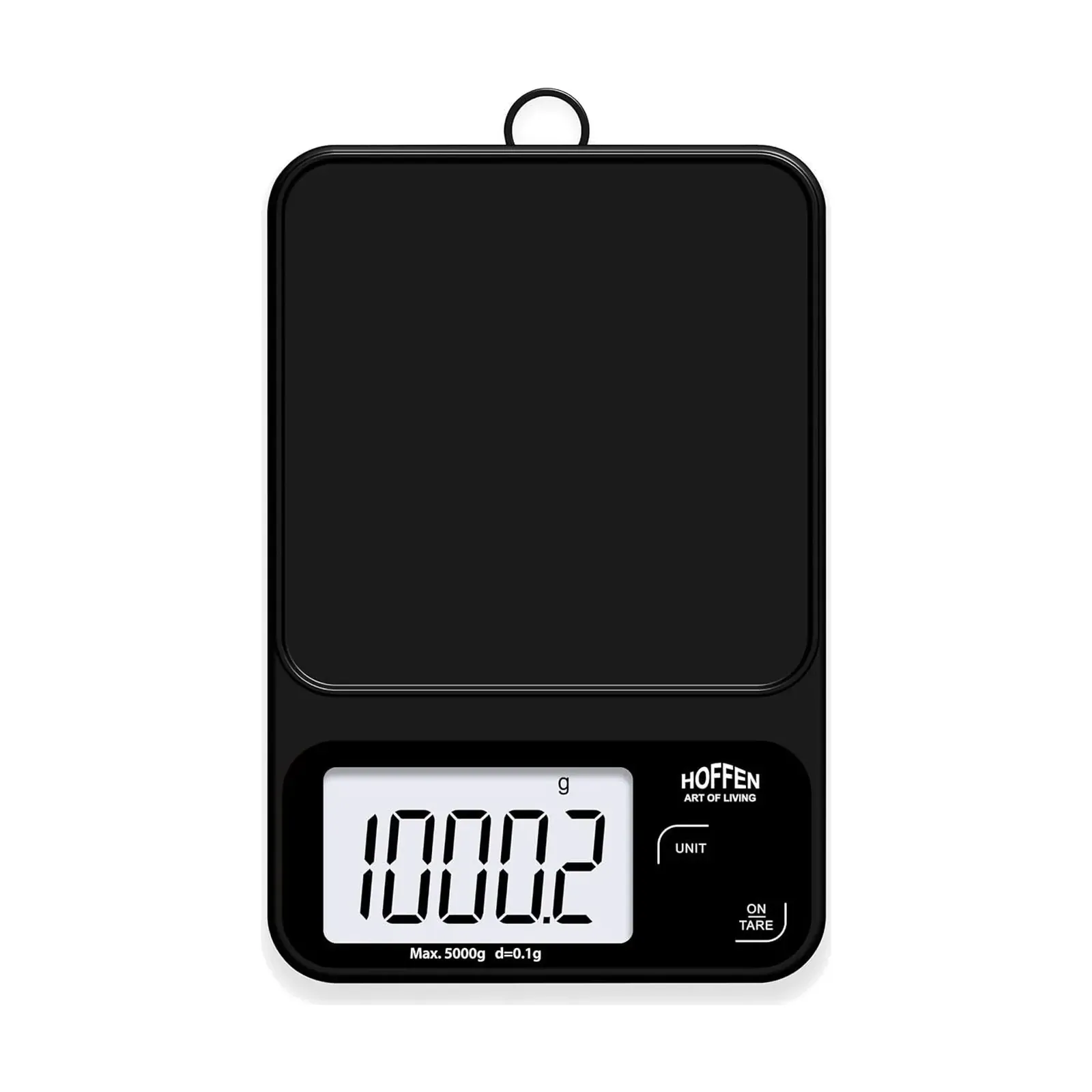
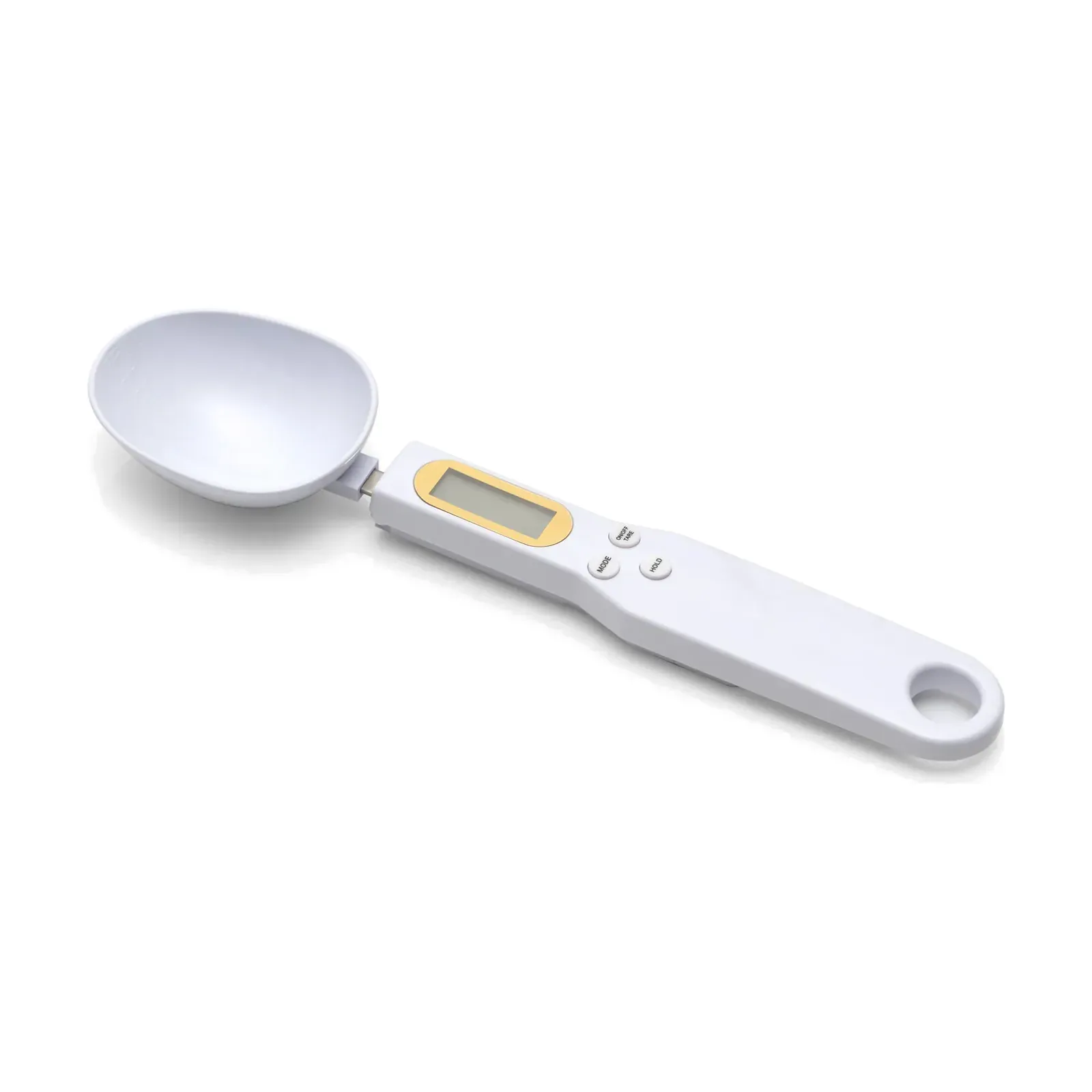
Omace Brands Private Limited makes kitchen scales under the Hoffen and Venus brands, and the kitchen scale range covers both needs. The Hoffen KS-601 Digital Kitchen Scale reads 5 kg in 1 g steps with a large display and costs ₹629. The Hoffen KS-201 Smart Kitchen Scale with App reads 5 kg in 0.1 g steps with Bluetooth and costs ₹729. For a very small dose, the Hoffen Digital Spoon Scale reads 500 g in 0.1 g steps and costs ₹939. Prices are as listed on the store today.
The guide on how to choose a kitchen scale covers capacity, platforms and batteries in more detail. A scale that seems to drift can be checked at home, and the steps are in the post on calibrating a kitchen scale without weights. On Omace digital scales a long press of TARE opens calibration mode on some models and a long press of the M key on others, and the manual for each model shows which.
Making the switch from cups without ruining a recipe
Start with recipes that already list grams. Many modern recipes do, and they will behave the first time. For a family recipe written in cups, bake it once the old way and weigh what you put in. NIST suggests exactly this for converting a traditional recipe: measure with a standard tool first, then weigh the result in grams with a kitchen scale. Write the grams on the recipe card in pencil.
Do this twice and compare. If the two flour weights differ by 15 or 20 g, that is the cup talking, and you can now pick the weight that gave the better result. From then on the recipe has a fixed number.
Recipes forgive different amounts. Delicate sponges and fine pastry are the least forgiving, while a chapati dough or a rough tea cake is the most. If you only plan to change one thing in your kitchen, weigh the flour, because flour is where cups err most.
Weighing helps with more than accuracy
A scale also gives a faster, cleaner kitchen. One bowl and a tare key replace a stack of cups and spoons. A recipe can be halved or doubled by arithmetic on grams, and a gift batch for twelve takes the same effort as a batch for six. Leftover flour, sugar or butter can be kept to the exact gram the recipe needs, which also wastes less.
The habit carries over to other kitchen work. Coffee brewers measure beans and water in grams for the same reason, and the coffee to water ratio chart is built on mass.
Start with one recipe this weekend
Pick a recipe you bake often, weigh each ingredient as you add it, and note the grams. That one pass gives you a recipe that will turn out the same next month, in any kitchen with a scale.