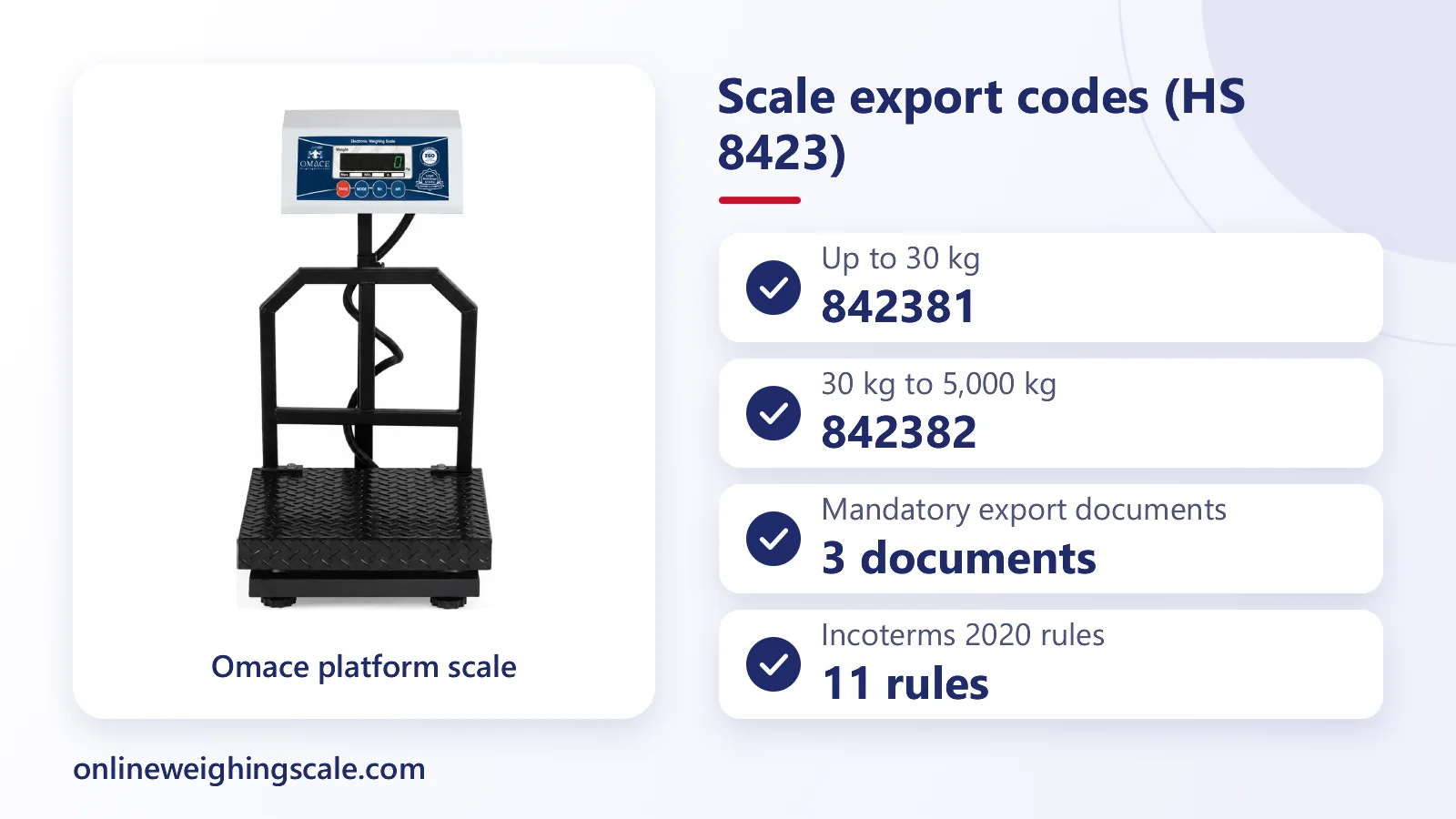
Importing weighing scales from India as an OEM buyer starts with HS heading 8423, which sorts scales into six-digit subheadings by use and capacity. A scale of up to 30 kg sits under 842381, and one above 30 kg up to 5,000 kg sits under 842382. Omace Brands Private Limited makes scales in Bagru, Jaipur, for OEM buyers. This guide covers codes, export papers, trade terms and approvals.
Which HS code covers a weighing scale?
The Harmonized System is the world customs language, and weighing machinery sits in heading 8423. The United Nations Statistics Division classification for heading 8423 lists the subheadings below.
| Subheading | What it covers |
|---|---|
| 842310 | Personal weighing machines, including baby scales, and household scales |
| 842320 | Scales for continuous weighing of goods on conveyors |
| 842330 | Constant-weight scales and scales that discharge a set weight into a bag or container |
| 842381 | Maximum capacity not exceeding 30 kg, excluding balances of 5 cg sensitivity or better |
| 842382 | Maximum capacity above 30 kg and up to 5,000 kg |
| 842389 | Maximum capacity above 5,000 kg |
| 842390 | Weights of all kinds and parts of weighing machinery |
A bathroom scale and a baby scale go under 842310. A kitchen scale, a shop kanta of 30 kg and a luggage scale usually fall under 842381, because they are capacity scales below the 30 kg line. A 100 kg platform scale falls under 842382. Fine laboratory balances that read to 5 cg or better are kept out of 842381, so ask your customs broker where they go.
Only the first six digits are common to every country. India and the buyer's country each add further digits for their own tariff, and duty rates follow the buyer's schedule. Your customs broker should confirm the full code before the order is placed, because the rate depends on it. The Indian Trade Portal of the Ministry of Commerce offers a search for ITC-HS codes and tariff that accepts two to six digits.
What does an Indian exporter need before shipping?
An Indian manufacturer needs an Importer-Exporter Code before any export. The Foreign Trade Policy 2023 chapter on general provisions says the IEC is a 10-character alphanumeric number, mandatory for any export or import activity, and that it is the same as the PAN. The same Indian Trade Portal guide, How to Export from India, lists a GST registration, a bank account authorised for foreign exchange, and registration on the ICEGATE customs portal as the other early steps.
The buyer does not file any of this. These are the supplier's duties, but a serious OEM buyer asks for the IEC and the bank details early, because they show that the factory is set up to export.
Which export documents come with the goods?
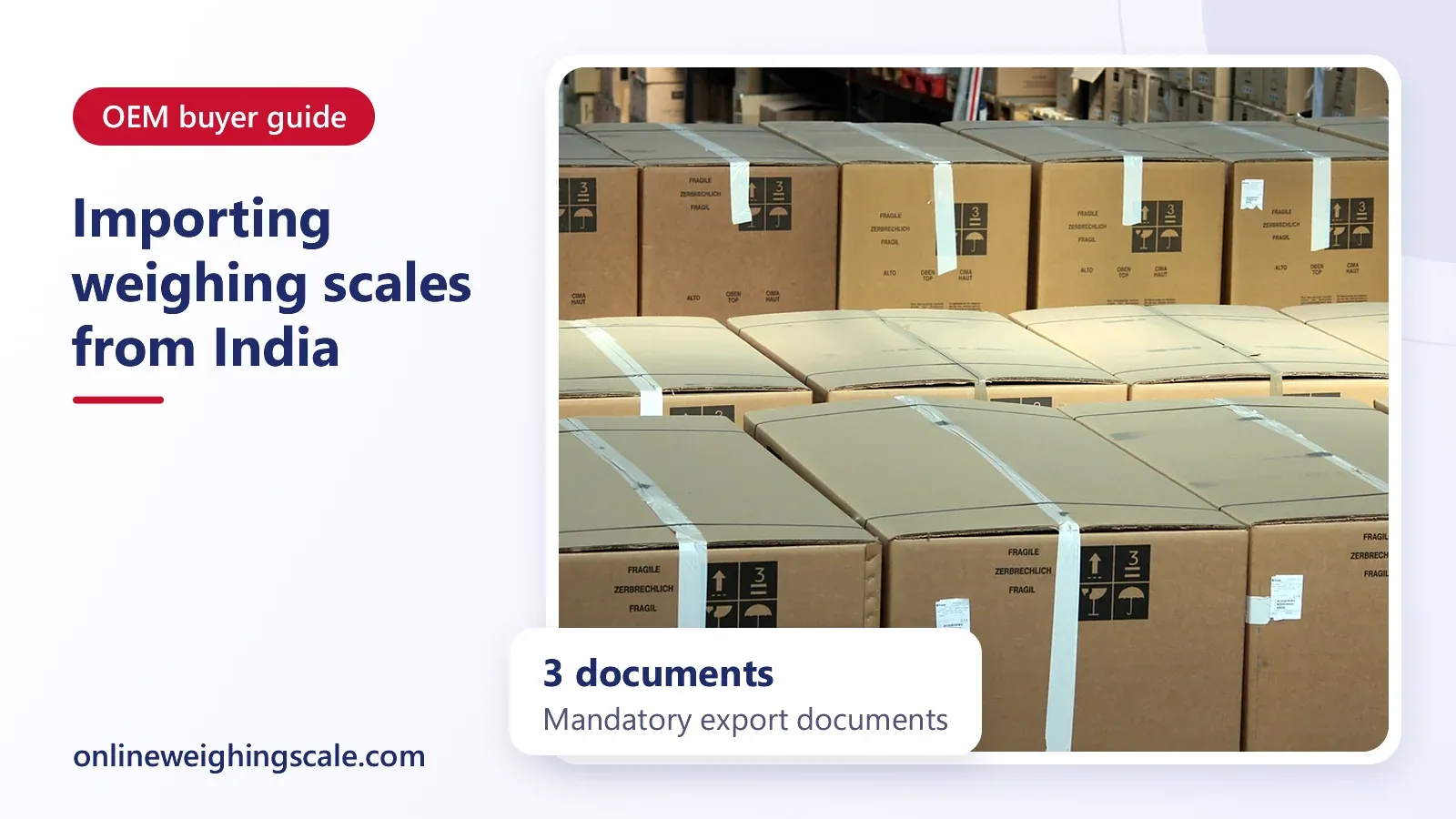
The same DGFT chapter, at paragraph 2.06, names three mandatory documents for export of goods from India. They are the bill of lading, airway bill, lorry receipt, railway receipt or postal receipt (whichever fits the transport), the commercial invoice cum packing list, and the shipping bill or bill of export.
- Commercial invoice cum packing list. It states the buyer, the seller, the model codes, quantities, unit values, the Incoterm and the net and gross weights per carton.
- Transport document. A bill of lading for sea freight, an airway bill for air freight. It is issued by the carrier or its agent.
- Shipping bill. The customs declaration of the exporter, normally filed electronically by a customs house agent.
A certificate of origin is not on the mandatory list. The same DGFT chapter, at paragraph 2.62, says certificates of origin under preferential and free trade agreements are issued by designated agencies, and that approved exporters may self-certify under certain schemes. Ask your customs broker whether your country gives a duty benefit for Indian goods and whether the certificate is worth requesting. Some buyers also ask for a quality or test certificate, and some banks ask for one under a letter of credit.
Which Incoterm should an OEM buyer choose?
Incoterms are the rules of the International Chamber of Commerce that say who pays for and manages freight, insurance and customs clearance, and where risk passes from seller to buyer. The US International Trade Administration explains that there are 11 Incoterms 2020 rules. Seven suit any mode of transport (EXW, FCA, CPT, CIP, DAP, DPU and DDP) and four are for sea and inland waterway only (FAS, FOB, CFR and CIF).
Under FOB, the seller loads the goods on the ship at the named Indian port and the buyer takes over the freight from there. Under EXW, the buyer collects the goods at the seller's premises and arranges everything else. The right choice depends on whether you already have a freight forwarder in India and how much of the shipping you want to control.
The same trade.gov page gives two cautions that matter. Write the version, Incoterms 2020, on the contract and the export papers. And remember that Incoterms do not set the price, the payment method or when ownership passes, so the sales contract has to state those separately.
Does a scale need approval in the buyer's own country?
A scale for trade use needs the approval of the country where it is used, and the Indian stamp does not replace it. The Indian Legal Metrology stamp is valid in India. A shopkeeper in another country needs a scale that passes that country's legal metrology rules. The OIML R 76-1 recommendation for non-automatic weighing instruments is the common base for those rules. It sets out the requirements for instruments subject to official metrological control and groups them into four accuracy classes: I (special), II (high), III (medium) and IIII (ordinary).
Each country then applies its own approval route, with its own marks, labels and test laboratories. This post names none of them, because they differ and they change. Ask the buyer's metrology office what a trade scale needs before the order is placed, and give the supplier that list. Electrical and battery rules of the buyer's country may apply as well, so ask about those in the same enquiry.
Omace Brands Private Limited holds ISO 9001:2015, ISO 13485:2016, an EU MDR quality certificate, a CE certificate of compliance and a US FDA compliance certificate as a manufacturer, listed on the certificates page. These are company certificates. They do not approve a product for trade use in another country, and OEM buyers should not treat them as one. For how stamping works at home, see the post on Legal Metrology in India.
How does the OEM and private label route work?
An OEM order means the factory builds the scale to the buyer's specification and the buyer sells it under the buyer's own name. Omace Brands Private Limited has been in the weighing trade since 1994 and manufactures at G-29 RIICO Industrial Area, Bagru, Jaipur (see About Omace). The categories, options and terms for OEM buyers are on the private label manufacturing page, and minimum orders and OEM terms come from those pages and from a direct enquiry, not from this post.
The decisions an OEM buyer settles with any factory are the same everywhere:
- the model and capacity, which also fixes the HS subheading;
- display type, units, battery or adaptor, and the plug the buyer's country uses;
- the brand name, logo, colour and carton artwork;
- the language of the manual and of the markings;
- the approval marks the buyer's country asks for.
Omace Brands Private Limited states that every scale is checked with certified test weights before dispatch. On Omace digital scales a long press of TARE opens calibration mode on some models and a long press of the M key on others, and the manual for each model shows which, which helps an importer recalibrate units after a long sea journey. Stamped trade scales are sealed, and a registered repairer recalibrates those. The post on what calibration is explains the steps.
How should a buyer test the samples?
Order a sample of each model before the production order. Check the display, the key response, the battery or charging, the capacity and the reading at a few known weights, using a test weight you trust. Press the pan with a hand to see the reading settle without drift.
Treat the sample as the reference. Keep it, label it, and compare the first production carton against it. If the readings differ, say so in writing before the main shipment leaves. Ask the supplier for its sample terms in writing.
What happens if a scale needs repair after import?
Omace Brands Private Limited repairs its commercial scales when the buyer asks. The buyer pays the shipping both ways and the repair cost. Spare parts depend on availability, so ask first on the contact page before shipping anything back. No turnaround time or price is promised in advance, and home scale repair is not offered. Importers who plan for a repair route in the contract save time later.
A checklist for the first enquiry
Send the supplier the model or the capacity and the division you need, the quantity, the brand details, the destination port or city, the Incoterm you prefer and the approval your country asks for. Ask for the IEC, the pro forma invoice, the HS code the supplier uses, the carton size and weight, and the lead time for samples and for production. If you are still deciding whether to start a brand, the post on how to start a weighing scale brand in India covers the business side.
Duty, freight and insurance are separate lines on the cost of an import. Ask a licensed customs broker in your country for a landed-cost estimate. Rules on duty and approvals change, so verify them with your own authorities, checked November 2026 for the Indian side of this guide.