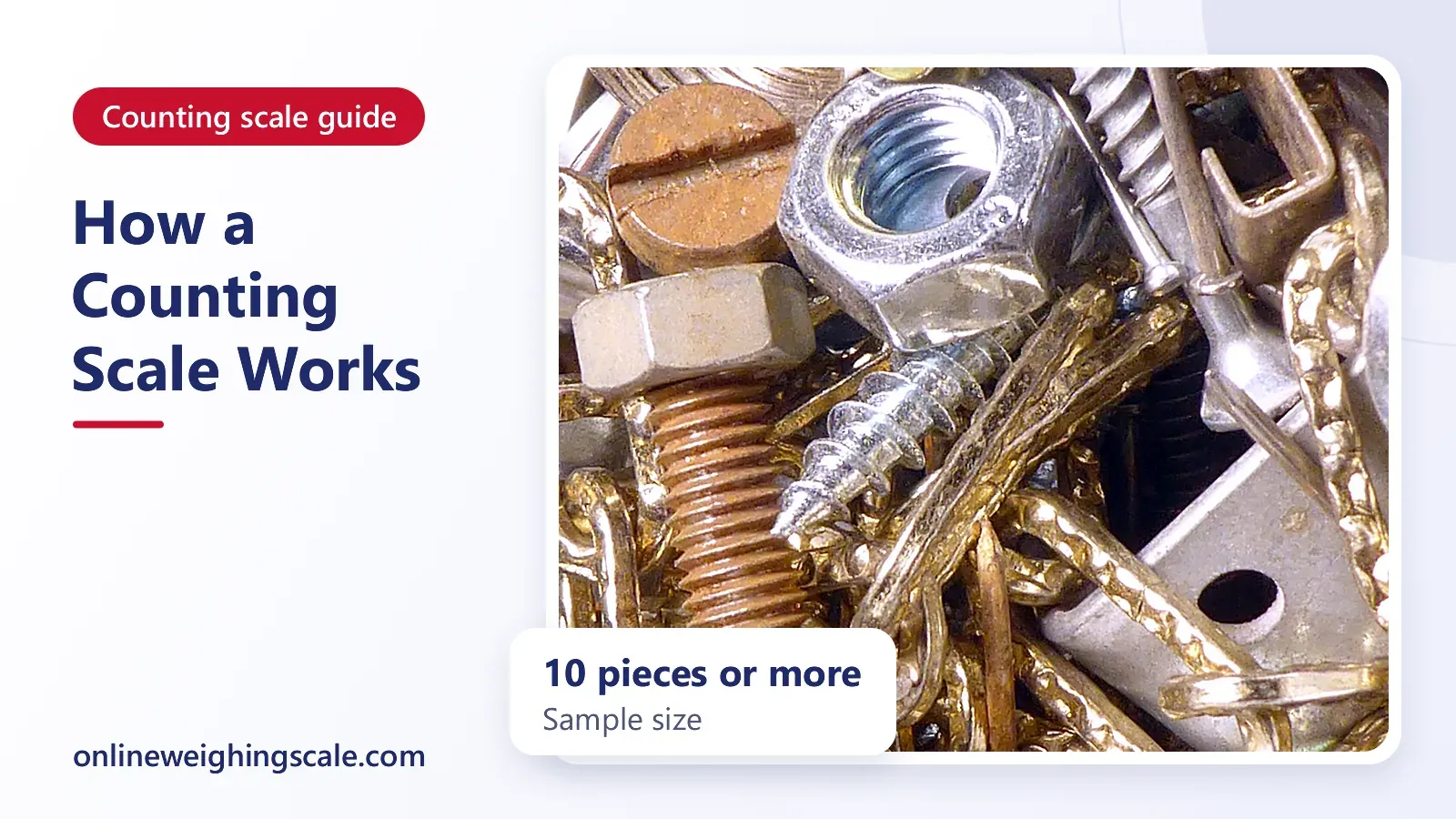
A counting scale works out how many identical pieces are on the pan by dividing the total weight by the weight of one piece. It finds that single-piece weight from a sample, usually 10 or more pieces, which you place on the pan and key in. After that, the scale shows the count for every further load.
How a counting scale works, step by step
Every counting scale is an ordinary weighing scale with a small calculator added. The load cell still measures only weight, and the calculator turns that weight into a number of pieces. The steps are the same on a kitchen model, a pocket model and a large bench model.
- Place the empty container on the pan and press TARE so the display reads zero.
- Put a known number of pieces in the container. This is the sample, for example 20 screws.
- Tell the scale the sample size by pressing the count or sample key and entering 20.
- The scale divides the sample weight by 20 and stores the result as the average piece weight.
- Pour the rest of the parts into the container. The scale divides the new total weight by the stored piece weight and shows the count.
Here is a worked example. Twenty screws weigh 50.0 g, so one screw is stored as 2.5 g. The container with all the screws now reads 1,250 g. Dividing 1,250 by 2.5 gives 500 screws. The scale never looks at the screws. It trusts that every piece weighs the same as the average of the sample.
That trust is the whole method, and it is also its limit. Anything that changes the average piece weight between the sample and the full load changes the count, and the scale cannot tell. The sections below explain where this goes wrong and how to keep it right.
The three display windows: weight, unit weight and count
Many counting scales show three numbers at the same time, usually in three small windows or in three labelled sections of one screen. Reading them in the right order helps you spot a problem early.
| Window | What it shows | What to check |
|---|---|---|
| Weight | Total weight on the pan, after tare | It returns to zero when the pan is empty |
| Unit weight | Average weight of one piece, from your sample | It matches what you expect for one piece |
| Count | Weight divided by unit weight | It changes by one piece when you add one piece |
If the unit weight window shows a number far from what one piece should weigh, the sample was entered wrongly. A common cause is keying 10 when you placed 20 pieces. Redo the sample before counting thousands of parts against a wrong figure.
Some models also let you type a known piece weight directly, which saves the sampling step when you count the same part every day. A stored value is only as good as the last time the part was checked, so recheck it when a new batch of parts arrives.
Why a bigger sample counts better
A scale shows weight in steps called divisions. A scale with a 0.1 g division cannot tell 12.46 g from 12.54 g, so the sample weight carries a rounding uncertainty of up to half a division. Divide that uncertainty by a small sample and the piece weight is off by a larger share. Divide it by a large sample and the share shrinks.
The table below uses a scale with a 0.1 g division and parts that weigh 2.5 g each. The error shown is the rounding of the sample alone, carried over to a load of 1,000 pieces.
| Sample size | Sample weight | Rounding share | Possible miscount in 1,000 pieces |
|---|---|---|---|
| 5 pieces | 12.5 g | 0.40% | About 4 pieces |
| 10 pieces | 25.0 g | 0.20% | About 2 pieces |
| 20 pieces | 50.0 g | 0.10% | About 1 piece |
| 50 pieces | 125.0 g | 0.04% | Under 1 piece |
The same effect works on the piece-to-piece spread. If individual parts vary a little, a sample of 5 might happen to hold five heavy ones. A sample of 50 averages those differences out. This is why counting scales ask for a sample of 10 or more, and why many operators use 20 or 50 for small, light parts.
Minimum piece weight against the scale division
A counting scale cannot count a part that is too light for its division. If one piece weighs less than a division, the sample weight barely moves when you add a piece, and the count becomes a guess.
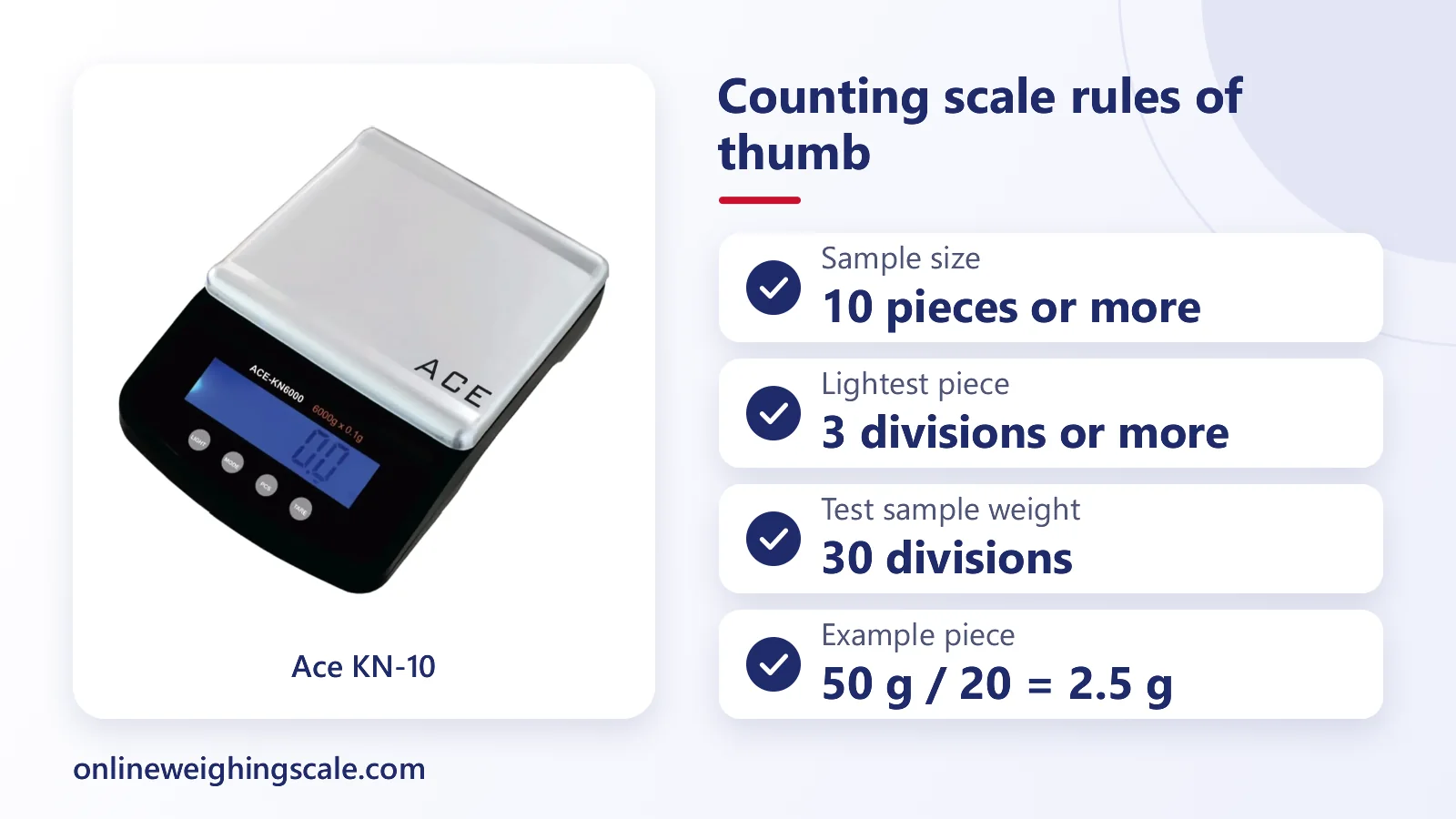
The National Institute of Standards and Technology publishes a rule for this in NIST Handbook 44, Section 2.20 (2024 edition, paragraph S.1.2.3). For Class I or Class II prescription scales with a counting feature, the sample must have an individual piece weight of at least 3 e, where e is the verification scale interval, and at least 10 pieces. The handbook also says such a scale must be marked with its minimum piece weight and minimum sample count (S.6.6), and its counting test refuses a sample under 30 e (N.1.10). That is 3 divisions for each of the 10 pieces.
These are United States figures, so treat them as a sound reference and not as an Indian rule. The table shows what the 3-division guide means in practice.
| Scale division | Lightest piece for the 3-division guide | Typical parts |
|---|---|---|
| 0.01 g | 0.03 g | Tiny electronic parts, small beads |
| 0.1 g | 0.3 g | Small washers, light screws |
| 1 g | 3 g | Nuts, bolts, bottle caps |
| 5 g | 15 g | Heavy fasteners, small castings |
Choose a scale by its division and not only by its capacity. A 30 kg scale with a 5 g division is a poor choice for counting 5 g washers, even though the total load is well within capacity. A finer division, or a smaller scale with a 0.1 g division, counts those washers far better. The post on accuracy and precision explains why a finer display alone does not make a scale more correct.
Where counting scales are used
A counting scale pays for itself wherever parts are too many or too small to count by hand and the cost of a short or long count is real.
- Hardware and fastener shops: nuts, bolts, screws and rivets sold by the piece from a loose bin.
- Electronics stores and workshops: resistors, capacitors, connectors and small components sorted into packets.
- Stock-taking: weigh a full carton, divide by the stored piece weight, and get the stock count without opening it.
- Packing lines: filling a bag with exactly 100 or 500 pieces of the same item.
- Coin and token counting: counting identical coins or tokens in bulk by weight.
- Jewellery and bead work: counting identical beads, studs or findings before a job.
In a shop, a counting scale also settles arguments. When a customer pays for 200 nails, the count on the display is easy to show to both sides.
What goes wrong, and how to prevent it
Most counting errors come from the parts, not the scale. A scale with a good division and a correct calibration still miscounts when the load is not what the sample was.
| Problem | Why the count goes wrong | Fix |
|---|---|---|
| Mixed parts | A different size or material is in the load, so the average weight changes | Sort the parts first |
| Piece-to-piece variation | A small sample does not represent the whole batch | Use a larger sample |
| Wrong sample count keyed | The stored piece weight is wrong from the start | Check the unit weight window |
| Drafts and vibration | Air moves the pan, so the weight reading drifts | Shield the pan or move the scale away from fans |
| Dirt or oil on parts | Residue adds weight that is not in the sample | Clean and dry parts before sampling |
| Container not tared | The weight of the tray is counted as parts | Press TARE with the empty tray in place |
A simple habit catches most of these. After counting, take out five pieces and see that the count drops by exactly five. If it drops by four or six, the stored piece weight or the scale needs attention. A scale that has drifted should be recalibrated, and the steps are in the guide to calibrating a digital weighing scale. For the meaning of calibration itself, see what calibration is.
The weight itself comes from a load cell, so any fault that disturbs the weight, such as a wobbly pan, a bent platform or a low battery, disturbs the count as well.
Counting for trade is not weighing for trade
A scale that counts and a scale that is legal for selling goods are separate questions. NIST Handbook 44 requires a scale with an operational counting feature to carry the marking "The counting feature is not legal for trade", on both the operator and customer sides, unless it is a Class I or II prescription scale that meets every counting requirement in the handbook. In India, scales used in trade fall under Legal Metrology (see the Department of Consumer Affairs page), and the Legal Metrology guide and the price computing scale calibration post explain what applies. Before you charge a customer by count, check what your local Legal Metrology office says about your scale.
Counting scales and Omace
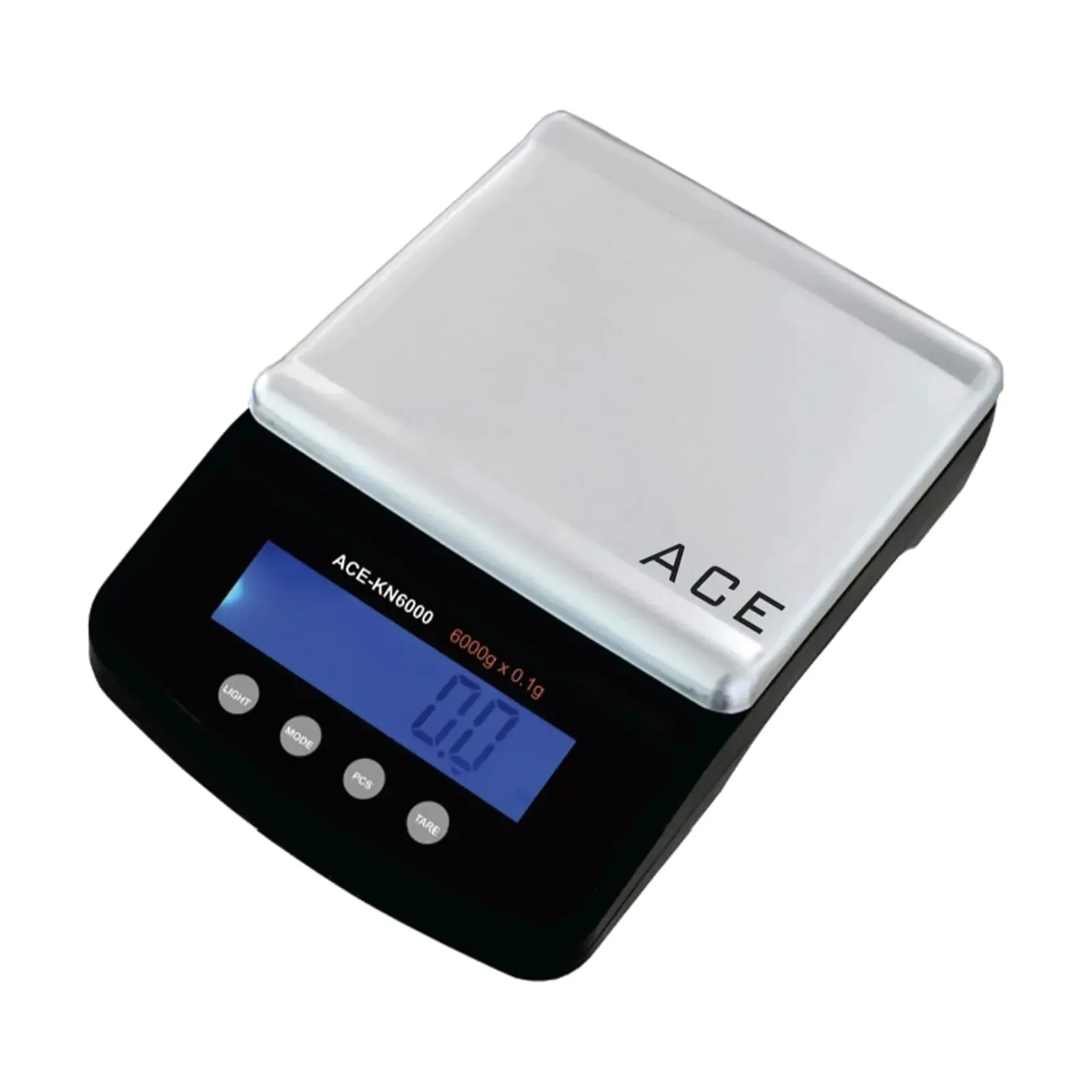
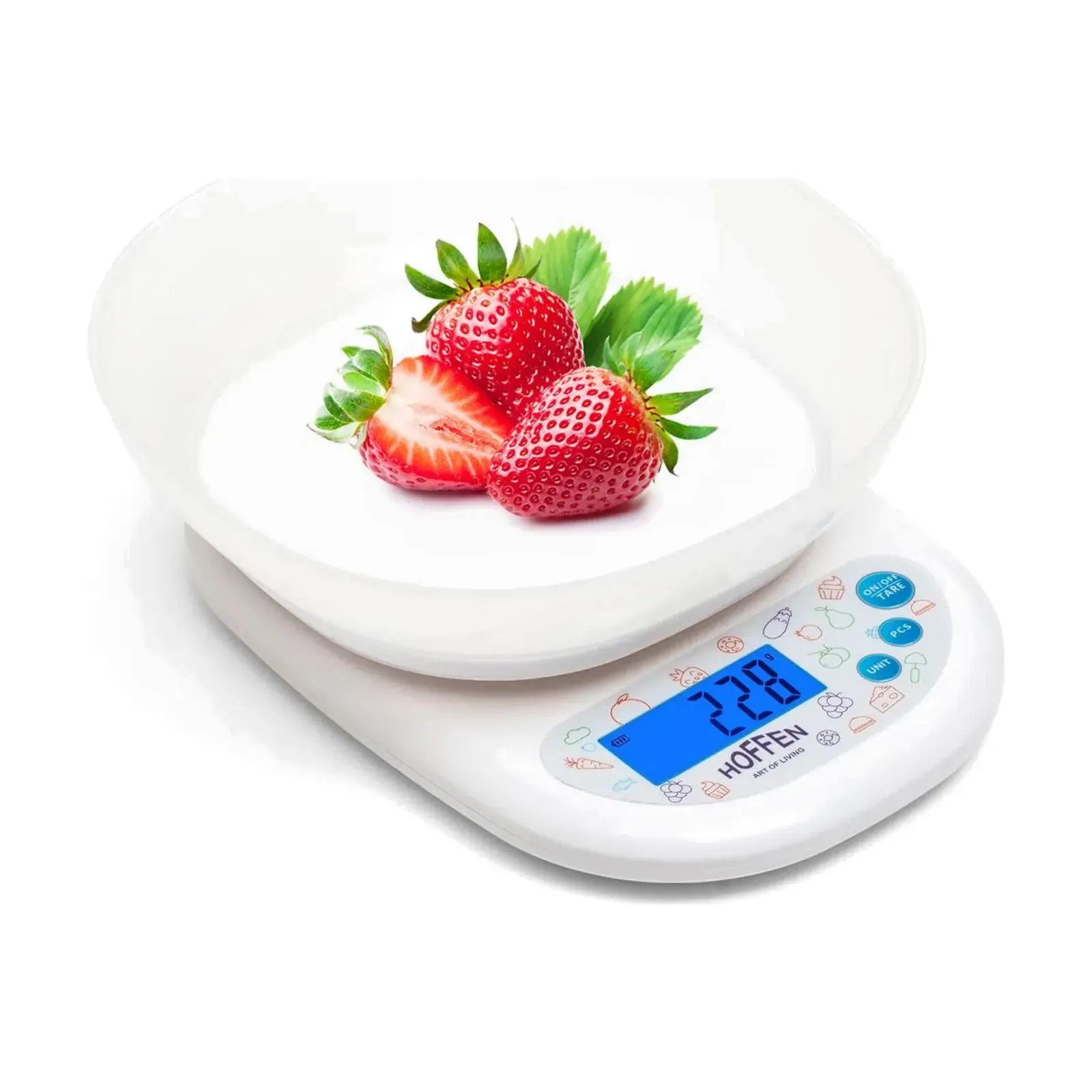
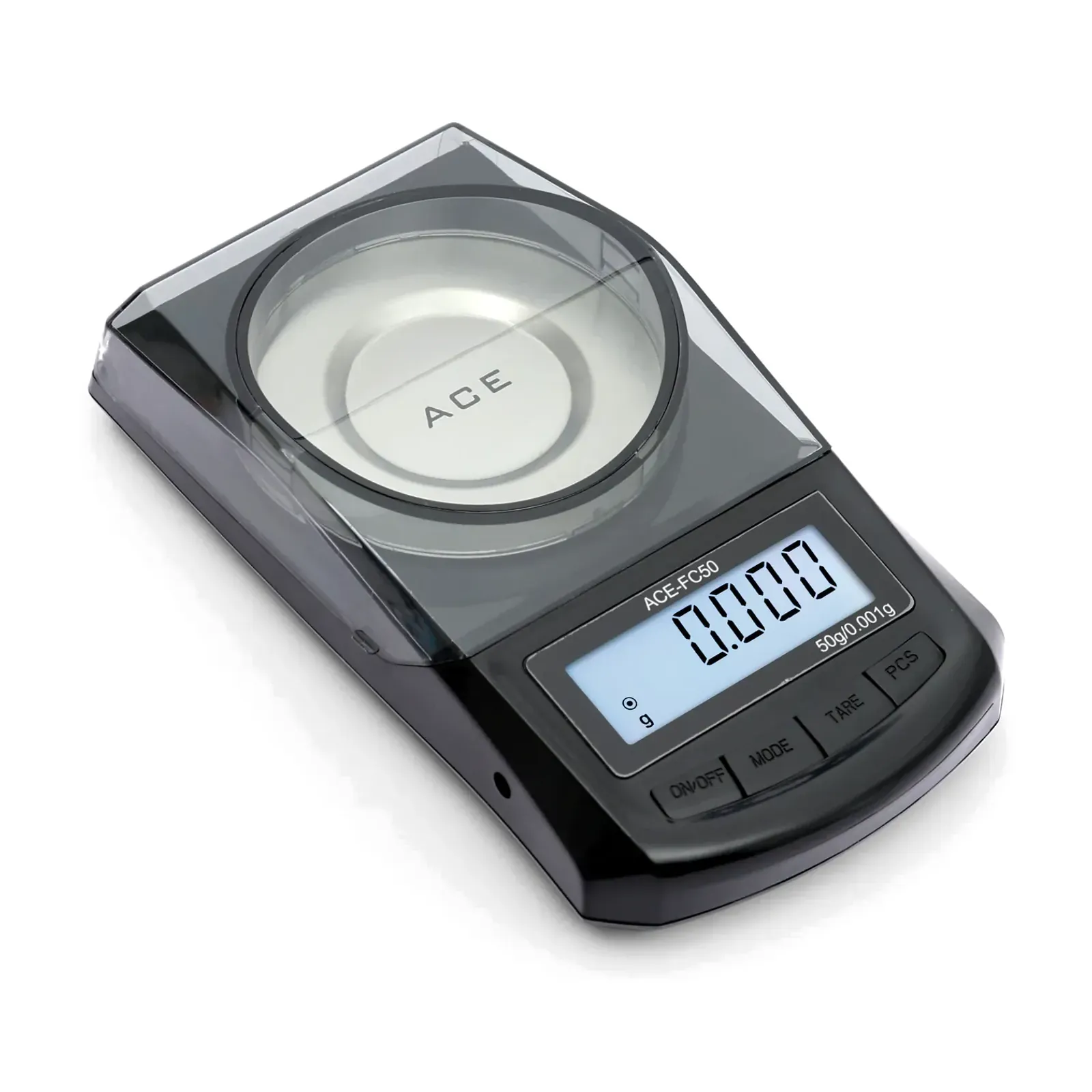
Omace Brands Private Limited does not list a product called a counting scale online today. Several of its scales do carry a counting function in the product name, and the shop describes them that way. These are the Ace KN 10 kg model, which lists piece counting at ₹4,199, the Hoffen KD-819 with a bowl, which lists piece counting at ₹519, and the Ace FC-50, which has a counting key on a 0.001 g pocket scale at ₹4,719. Prices were checked on 20 November 2026 and include GST.
The Ace JL-300 and PL-500 pocket scales also list a counting key. For heavier loads, the table-top shop scales are the place to start, though the product pages decide which have a count function. Read the page of the exact model before buying, because the count function is a feature of that model.
Omace repairs its commercial scales when the buyer asks. The buyer pays shipping both ways and the repair cost, and spare parts depend on availability, so contact Omace first. For a wider view of scales for a shop, the guide to the best weighing scale for a small business compares the common types.
How to pick and set up a counting scale
Start with the lightest part you will ever count. Divide its weight by 3 to find the largest division the scale can have, using the guide above. Then check that the capacity covers the heaviest full container.
At the counter, place the scale on a flat, firm surface away from a fan or an open door. Let it warm up for the time its manual states, tare the container, and enter a sample of at least 20 for small parts. Recheck the unit weight each time a new batch of parts is opened.
With these habits, a counting scale gives a fast and repeatable count for a loose stock of identical parts.