OEM, ODM and private label are three ways to get a weighing scale made under your own brand, and the difference is who designed the product. An OEM buyer brings or approves the design, an ODM buyer picks the design the factory already owns, and private label puts the buyer's name on a finished model.
The three terms get mixed up in quotations, on trade portals and in phone calls with factories. A buyer who asks for "OEM" but means a ready model with a logo will get a different quote and a different timeline from what he expected. This guide is for an OEM buyer, a dealer moving into his own brand, or someone starting a scale brand in India. It sets out what each term means, who owns what, and what a manufacturer such as Omace Brands Private Limited states on its own page.
OEM, ODM and private label in one table
| Model | Who designs the scale | Who sells it | Typical buyer |
|---|---|---|---|
| OEM (original equipment manufacturer) | The brand owner, or the brand owner approves a specification | The brand owner, under his name | A company with its own product idea or spec sheet |
| ODM (original design manufacturer) | The factory | The brand owner, under his name | A company that wants a catalogue of ready designs |
| Private label | The factory, with a finished model | The brand owner, under his name | A dealer or new brand who wants speed |
| White label | The factory, one plain product | Several sellers, each with a sticker | A reseller with no brand investment |
In practice the lines blur. Many factories call every order OEM, and Omace Brands Private Limited uses the words OEM and private label together on its private label manufacturing page. Ask the factory in writing which of the three it means before you compare quotes.
What OEM means for a weighing scale
OEM means the manufacturer builds the product for another company's brand. For a weighing scale the brand owner may supply a drawing, a body shape, a specification of capacity and resolution, or only a list of features. The factory produces to that brief and the finished scale carries the buyer's name, not the factory's.
The strength of OEM is control. You decide the capacity, the display, the colour, the packing and the manual. The cost is time and money up front. A new body shape needs a mould, and a mould is paid for once before the first piece comes off the line. Who owns that mould, and whether the factory may use it for another buyer, should be written into the order agreement. Omace states on its page that exclusivity, meaning a fixed design, colour or feature set reserved for your brand, can be discussed and included in the order agreement. Omace Brands Private Limited keeps a buyer's artwork, designs and order details confidential.
What ODM means
ODM means the factory designs the product and the buyer chooses from it. The electronics, the load cell, the body and the firmware already exist. The buyer selects a model, asks for changes such as colour or logo, and sells it as his own range.
ODM is quicker than OEM because the development work is done. The trade-off is that the same base design may exist in other brands' hands unless you negotiate exclusivity. The factory keeps the design rights, and you keep the brand. Omace Brands Private Limited does OEM and private label manufacturing. A buyer who wants his own design built, or a finished Omace model under his name, can write to Omace. A buyer with an ODM requirement should discuss it with Omace through the contact page.
What private label means
Private label is the simplest of the three. The manufacturer already makes a finished scale, and the buyer's brand goes on it. The Omace page lists what can change: logo printing on the product, colour and finish options, branded packaging, a brand logo on the app screen where the model has an app, printed user manuals with your brand name, and your own barcode, MRP and retail labels. Full custom outer box printing is available above the full-customisation tier.
Private label suits a dealer or a new brand because the product is already proven. It is a quicker route to a shelf, and the investment is mostly packaging and stock. For the business side of starting out, the post on how to start a weighing scale brand in India goes through costs and margins.
White label against private label
People searching for white label versus private label are usually asking the same question. White label means one plain product that several resellers each put their own sticker on. Private label usually means the product is made for one brand, with the packaging, manual and sometimes the colour set for that brand alone. The more exclusive the product, the more it behaves like private label or OEM. The more generic, the closer it is to white label.
Who owns what in each model
Ownership is where disputes begin, so settle it before the first payment. Ask about each of these items and get the answer in the agreement.
- Brand and logo: always the buyer's. The factory should not sell the same branded product to anyone else.
- Product design: the buyer in a true OEM build where he supplied it, the factory in ODM and private label.
- Tooling and moulds: agree it in writing, with a clause on what happens if you move to another factory, so there is no argument later.
- Artwork files: agree in writing who keeps the box and manual artwork files. Omace keeps your artwork and designs confidential.
- Exclusivity: a design, colour or feature set reserved for you, which has to be agreed in the order terms.
What the brand owner must do himself under Indian law
Putting your name on a scale makes you responsible for what is on the carton. Under the Legal Metrology (Packaged Commodities) Rules, the Department of Consumer Affairs lists declarations on every package such as the name and address of the manufacturer, packer or importer, the net quantity, the month and year of packing or manufacture, the maximum retail price, and customer care details. A brand owner who sells under his own name should confirm with the Legal Metrology department, or a compliance adviser, exactly which declarations apply to his product and which name goes on the carton. The legal metrology guide explains the Act, the department and the rules in general terms.
Model approval is a separate matter. Section 22 of the Legal Metrology Act, 2009 requires every person to seek approval of the model of a weight or measure before manufacturing or importing it, so the duty sits with the maker or importer of the instrument. Section 24 requires a weight or measure used in a transaction to be verified before use, and section 33 penalises selling or using an unverified one. The Jan Vishwas Acts of 2023 and 2026 did not change section 33, as the texts on the Department of Consumer Affairs page show. The post on legal for trade weighing scales covers what that means, and the one on stamping charges covers the fees. Ask your manufacturer which of its models are approved and stamped before you list them for trade use. Do not sell a trade scale that has no stamp.
Omace Brands Private Limited holds company certificates as a manufacturer, listed on its certificates page. A certificate belongs to the company that earned it. It does not pass to your brand just because your name is on the carton, so ask how the factory's certificates apply to your product.
What Omace states about order terms
Everything in this section comes from the Omace private label page. Terms differ by model and order, so confirm in a written quotation.
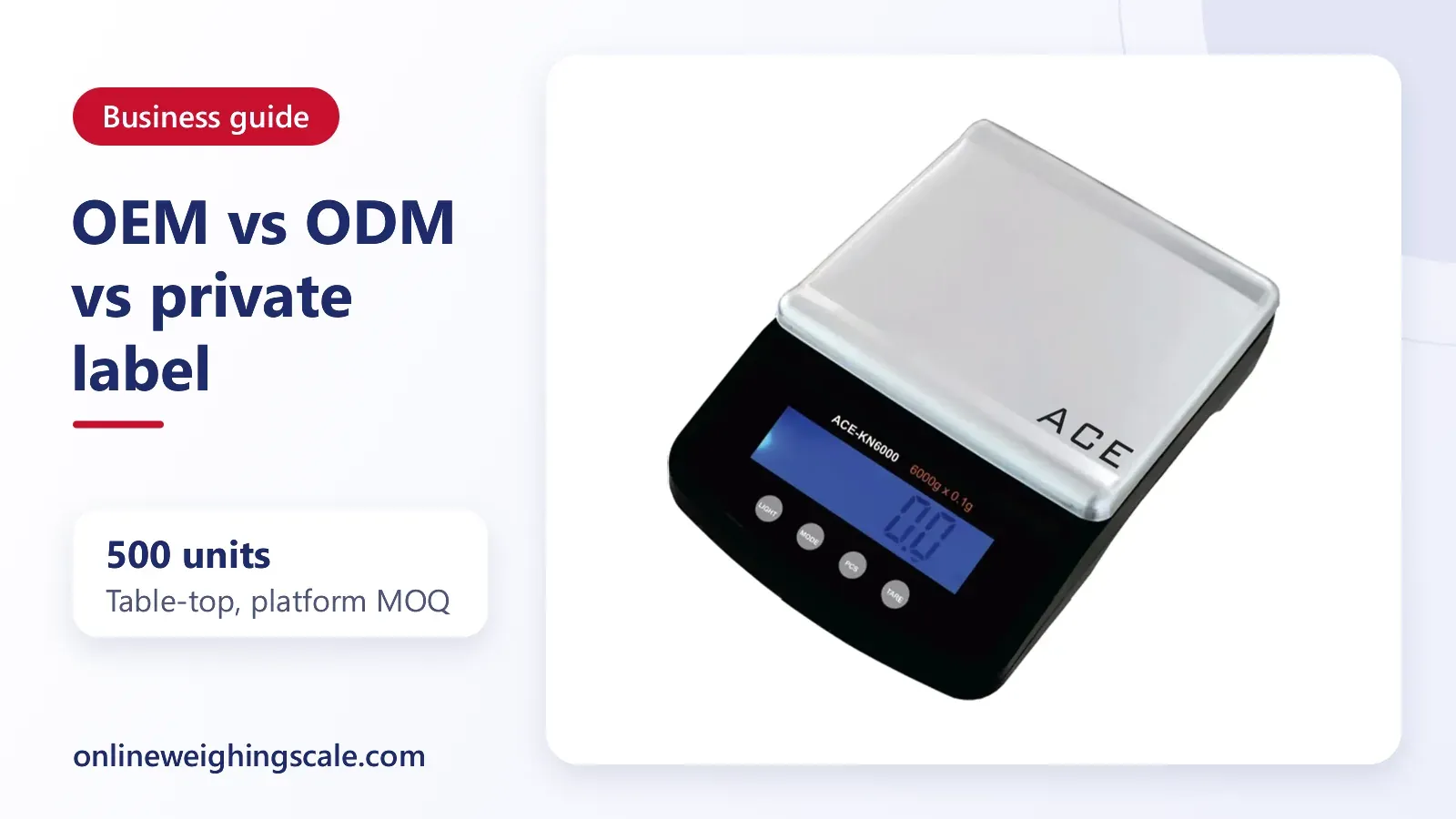
- Minimum order: 1,000 units for bathroom, kitchen and smart body scales. 500 units per model for table-top, chicken and platform scales.
- Lead time: most orders are completed within 40 days of confirmation, depending on quantity, customisation and destination.
- Payment: 50% advance at order confirmation and 50% before dispatch.
- Samples: available for all models subject to availability, charged separately and adjusted against the bulk order once confirmed.
- Approval: production is locked once the sample is approved, and a mock-up is sent for approval for outer box printing.
- Warranty: covers manufacturing defects for the period stated for each model.
The page does not give the number for the full-customisation tier or the sample price, so ask for both in the quotation.
Questions to ask any scale manufacturer
Whether the word on the quotation is OEM, ODM or private label, these questions separate a serious factory from a trading desk.
- Do you manufacture the scale yourself, and may I see the production line? A trader and a factory can quote the same price and behave very differently when something fails.
- Which of the three models is this quotation, in your words, and who owns the design?
- Who owns the mould and the artwork, and what happens to them if I change factory?
- Can my design or colour be reserved for my brand, and is that in the written order terms?
- Which declarations will be printed on the carton, and in whose name?
- Is the model approved for trade use, and will the units be verified and stamped before dispatch?
- How is each unit tested before it ships, and can I see a sample made to the final specification?
- What does the warranty cover, who handles a customer's claim, and how do spare parts reach me?
On repairs, Omace Brands Private Limited repairs its commercial scales when the buyer asks. The buyer pays the shipping both ways and the repair cost. Spare parts depend on availability, so ask first through the contact page.
Which route fits which buyer
A buyer with a clear product idea and money for tooling suits OEM. A buyer who wants a range from the factory's own catalogue and a little customisation suits ODM. A dealer who wants his name on proven models, in the shortest time, suits private label. A reseller who needs no brand at all is a white label buyer.
Start with a small number of models, one sample you have tested yourself, and a written list of who owns what. Then send the enquiry through the private label manufacturing page and ask for the terms for your product category in writing.