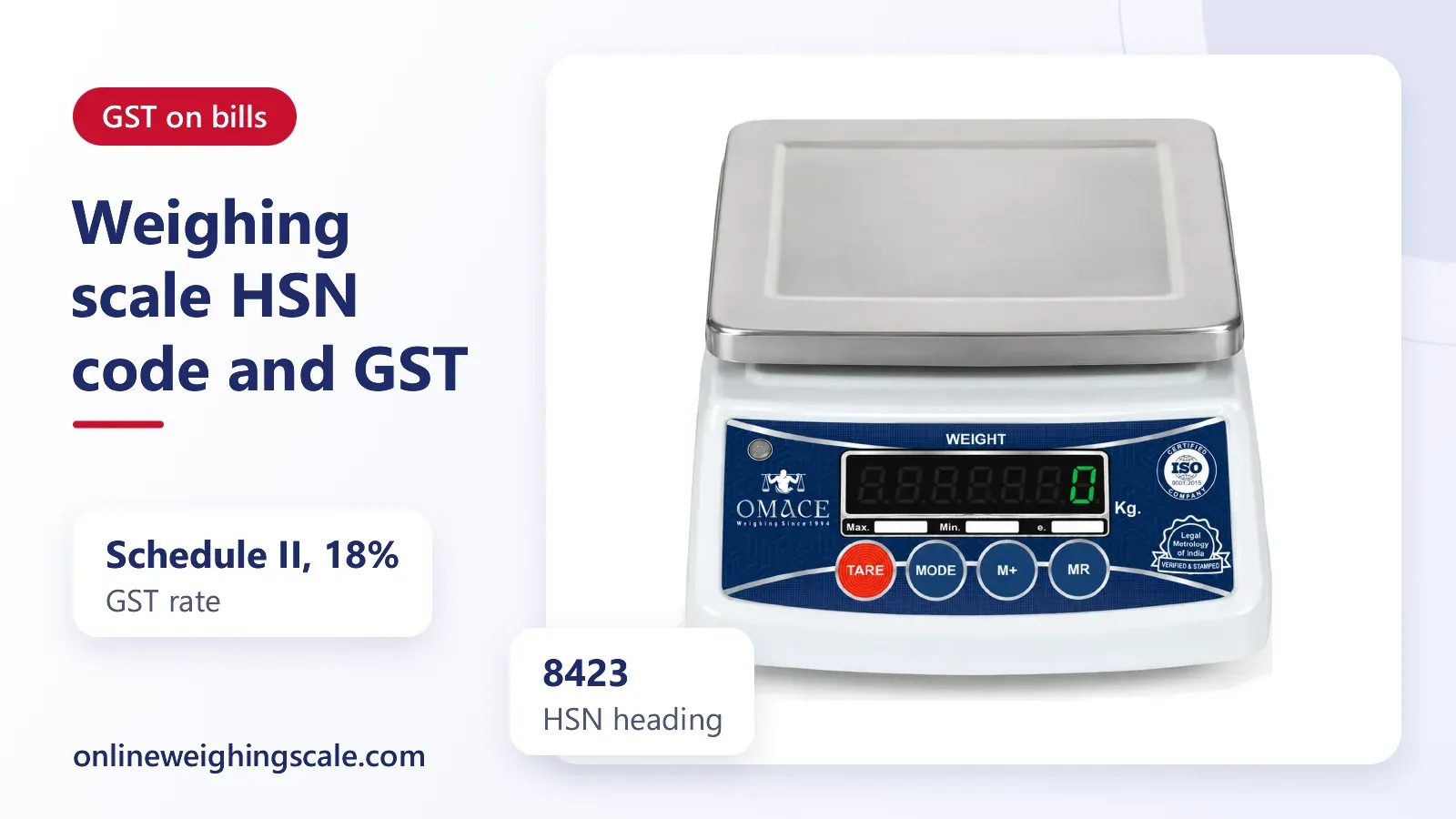
The HSN code for a weighing scale is 8423, the heading for weighing machinery in the GST rate schedule. A dealer or OEM buyer needs this code on every invoice, and it decides which GST rate applies to the sale.
This post is written for an OEM buyer, a dealer, or someone starting a weighing scale brand. It covers the heading, what sits outside it, the rate as the notification states it, how many digits an invoice needs and where to check a line before you bill. Rates were checked in November 2026 against the notification text. This is general information, and a chartered accountant or GST practitioner decides how your own goods are classified.
What HSN 8423 covers
HSN stands for Harmonised System of Nomenclature, the world customs code that India uses for goods under GST. The World Customs Organization publishes it, and its HS 2022 nomenclature lists heading 8423 as weighing machinery. The first four digits are the heading. For weighing machinery the heading is 8423, which is why searches for weighing machine hsn code and hsn code 8423 lead to the same place.
The GST rate notification (9/2025-Integrated Tax (Rate), serial 412) describes the entry in these words: weighing machinery, excluding balances of a sensitivity of 5 centigrams or better, including weight operated counting or checking machines, and weighing machine weights of all kinds. Read plainly, that covers:
- Bathroom and personal scales, which the WCO nomenclature names as personal weighing machines, including baby scales, and household scales.
- Kitchen, shop and kanta type counter scales.
- Platform, crane and hanging scales.
- Counting and checking scales.
- Test weights and other weighing machine weights.
The code follows the machine, not the technology inside it. An electronic weighing machine hsn code is the same 8423 as a mechanical dial scale or a spring type kanta, because the heading groups all of them as weighing machinery. Analog or digital, battery or mains, the heading is the same.
Balances that sit under 9016
The same notification lists a second entry, heading 9016 (serial 569), for balances of a sensitivity of 5 cg or better, with or without weights. Five centigrams is 0.05 g. A laboratory or jewellery balance that works in milligrams is therefore the kind of article heading 9016 is written for, and an ordinary scale that cannot resolve that fine a difference falls under 8423.
This matters to a buyer of jewellery and lab models. The line between the two headings is the sensitivity of the instrument. Sensitivity is a technical term and is not the same as the display step printed on a datasheet, and the shop-floor words "pocket scale" or "lab balance" do not decide it either. For any model near the edge, ask your accountant to confirm the heading in writing, and keep the datasheet with the invoice file.
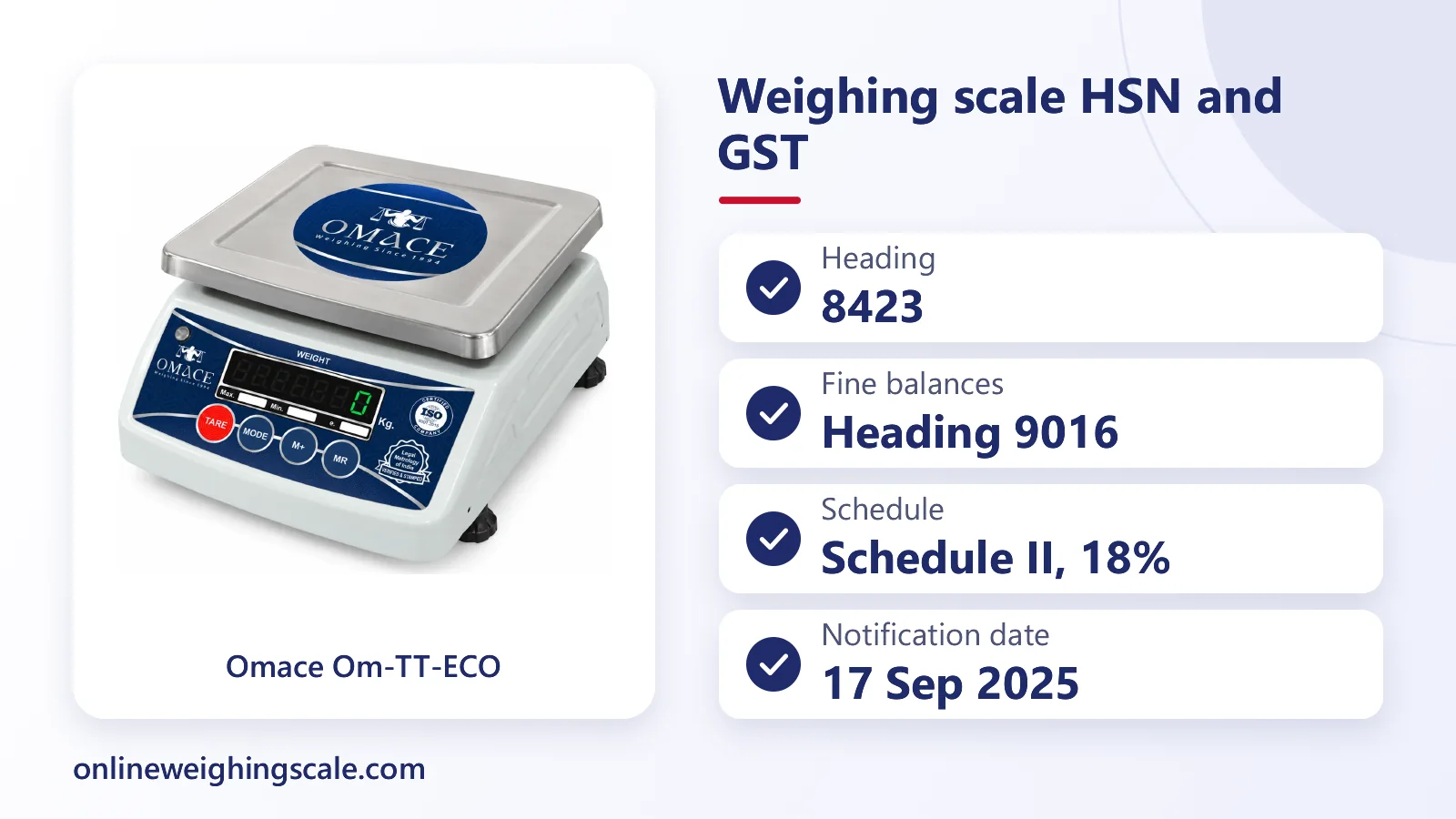
| Heading | Entry in the 17 Sep 2025 notification | Schedule |
|---|---|---|
| 8423 | Weighing machinery, counting or checking machines, weighing machine weights (serial 412) | Schedule II, 18% |
| 9016 | Balances of 5 cg sensitivity or better (serial 569) | Schedule II, 18% |
Sub-headings, parts and the digits that follow 8423
Below the four-digit heading, the world code continues to six digits. The WCO HS 2022 nomenclature splits 8423 into 8423.10 personal weighing machines, including baby scales, and household scales; 8423.20 scales for continuous weighing of goods on conveyors; 8423.30 constant weight scales and scales for discharging a predetermined weight into a bag or container; 8423.81 other weighing machinery up to 30 kg; 8423.82 above 30 kg up to 5,000 kg; 8423.89 other; and 8423.90 weighing machine weights of all kinds and parts of weighing machinery. India's own Customs Tariff continues beyond six digits, and this post gives no Indian line or duty figure because none was read on a CBIC page. Take them from the Customs Tariff on the CBIC website before you print them on a shipping bill.
Parts need a separate check. The GST entry names machines, counting and checking machines, and weights. It does not name spare parts, although the world code groups "parts of weighing machinery" with weights under 8423.90. A search for weighing machine parts hsn code therefore has no single answer. A load cell, an indicator board, a platform pan or a power adaptor may each be classified under its own heading, depending on what the part is and what it is mainly made for. Classify each part on its own and note the reason in your records.
The GST rate for weighing machinery
Heading 8423 sits in Schedule II of Notification No. 9/2025-Integrated Tax (Rate), dated 17 September 2025, and the schedule is the 18 per cent one. The notification states that it came into force on 22 September 2025. The same document puts heading 9016 balances in Schedule II as well.
That notification replaced the 2017 rate notification and rebuilt the rate list into schedules of 5, 18 and 40 per cent, plus small special schedules. Heading 8423 does not appear in the 5 per cent or the 40 per cent schedule in that document. So the weighing scale gst rate for goods under this entry reads 18 per cent for inter-State supply.
For a sale inside one state, GST is charged as central tax and state tax instead of integrated tax. The Ministry of Finance FAQ on the 56th GST Council decisions, published by PIB, says the changes in CGST rates on goods are in Notification No. 9/2025-Central Tax (Rate) dated 17 September 2025. The text of that notification could not be opened for this post, so check the CGST and SGST columns on the CBIC rate finder before you set up your billing software. Do not copy a rate from a tax-aggregator site. Those pages disagree with each other, and some still show rates from before September 2025.
Three things can still change the figure on a particular bill:
- The model may fall under a different heading, such as 9016 for a very fine balance, and that heading carries its own entry.
- A part sold by itself follows its own code, as above.
- Rates change by notification. Anything here dated November 2026 should be checked again on the CBIC rate finder before a large order.
How many HSN digits an invoice needs
GST law ties the number of HSN digits to turnover. Notification No. 78/2020-Central Tax dated 15 October 2020, made under rule 46, sets the digits on a tax invoice: 4 digits if the aggregate turnover in the preceding financial year is up to ₹5 crore and 6 digits above ₹5 crore. The GST portal advisory on Table 12 of GSTR-1 uses the same 4-digit and 6-digit split for reporting. The advisory adds that from the May 2025 return period the HSN has to be chosen from a drop-down list in GSTR-1, so a free-typed code is no longer accepted there.
A dealer with a turnover of ₹5 crore or less can therefore put 8423 on the invoice. A larger dealer needs six digits. In both cases the code on the bill, the code in the return and the code in your stock master should match, otherwise an e-invoice or a GSTR-1 filing may flag the line. The same notification adds a proviso: a registered person with aggregate turnover up to ₹5 crore in the previous financial year may leave the digit count out of a tax invoice for supplies to unregistered persons.
HS codes for export and import
An exporter or importer uses the same first six digits of the world code, and India's customs forms use a longer national code that follows the Customs Tariff. The Indian customs duty rate for each line sits in the Customs Tariff. This post does not state a duty figure, because none could be confirmed on a CBIC page. Check the line on the tariff the week you ship, since duty is changed in the Union Budget and by separate notifications.
If you buy finished scales from a manufacturer in India for export, ask the manufacturer for the code it uses on its invoice and compare it with the ITC-HS line your freight agent files. A mismatch is a common reason for a held shipment.
A short checklist for OEM buyers and dealers
If you are placing an OEM order, the code on the invoice from Omace Brands Private Limited and the code you will use on your resale invoice should describe the same article. The steps below keep the paperwork in order.
- Note the model's capacity and readability from the datasheet.
- Decide between 8423 and 9016 on the sensitivity, as explained above, and confirm it with your accountant for fine balances.
- Look the heading up on the CBIC rate finder and read the entry against the Schedule II text.
- Use 4 or 6 digits as your turnover requires on the invoice, and pick the code from the drop-down in GSTR-1.
- Write the notification number and the date you checked on the file copy.
The tax code is only part of what a dealer needs. A shop, platform or crane scale used for trade also needs verification by Legal Metrology before you sell it, as explained in the Legal Metrology guide and the post on stamping charges. Omace Brands Private Limited, in Bagru, Jaipur, supplies shop, platform, chicken and crane scales verified and stamped by Legal Metrology, and the stamp is valid across India.
Selling under your own brand: the OEM view
An OEM buyer who sells scales under a private label bills the retailer or dealer with the same HSN code as the manufacturer, because the brand name does not change what the article is. Your own GST registration, invoice series and rate treatment come with it. The page on private label manufacturing explains how an OEM order with Omace works, and the post on starting a weighing scale brand covers the business side. Dealers can read about bulk and dealer orders on the dealer page.
Where to check the rate yourself
Use the CBIC GST rate finder, search by the four-digit heading, and read the schedule and the entry description, not only the rate shown. Then compare it with the notification PDF on the CBIC site. When a tax-aggregator page disagrees with the notification, the notification wins. If the rate on your bill still looks wrong, a chartered accountant should confirm it before you file, and Omace Brands Private Limited will share the model's datasheet on request through the contact page.