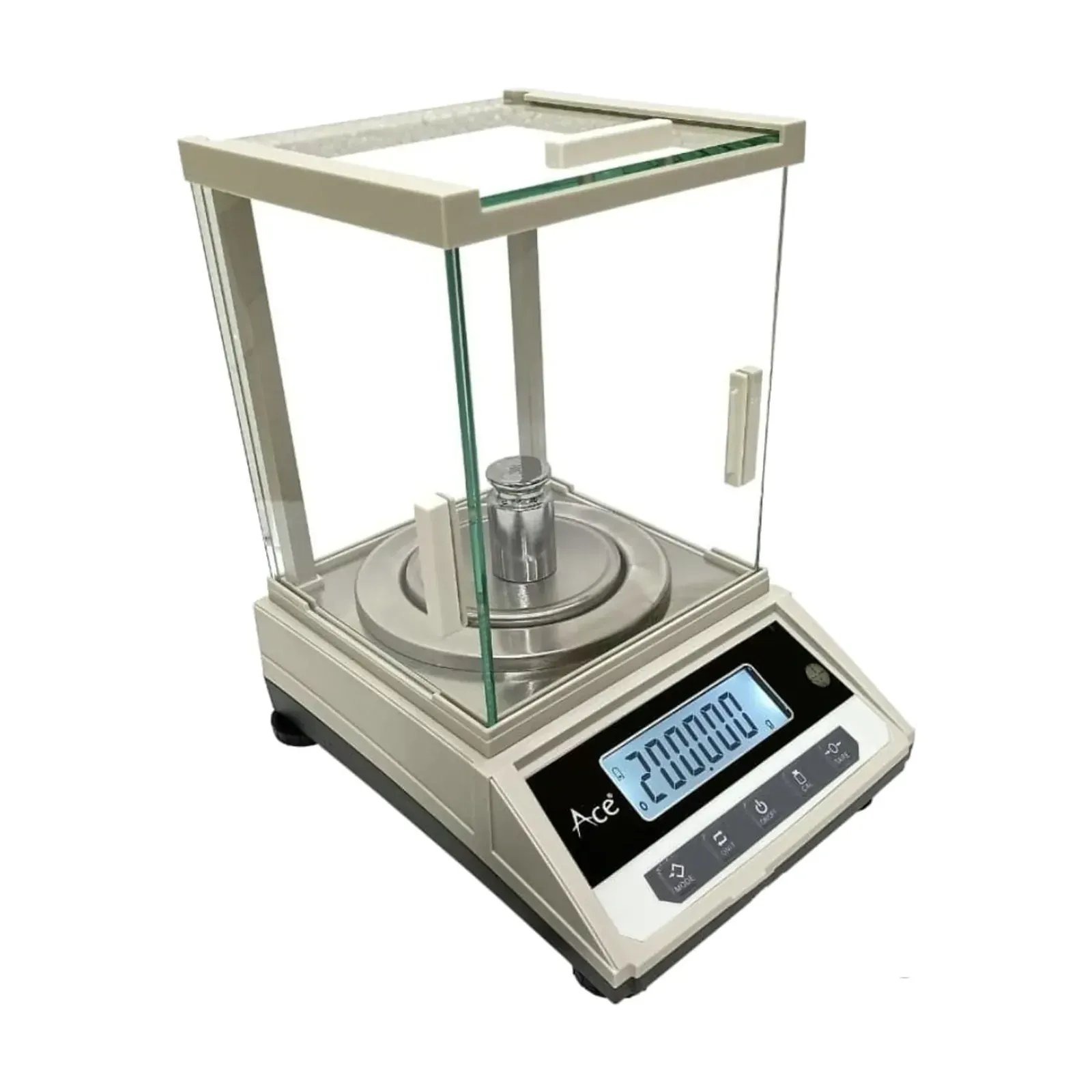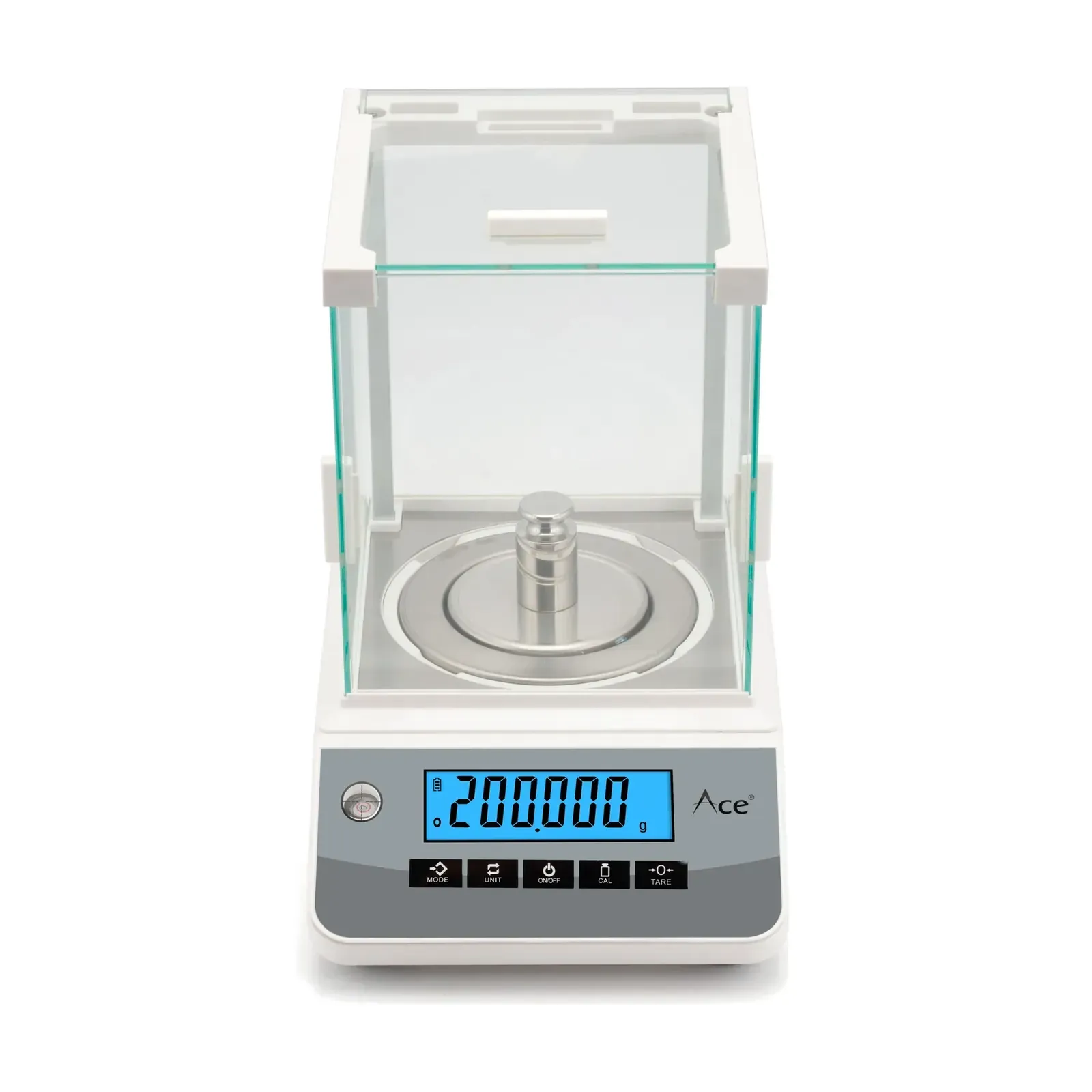
A 1 mg weighing scale for jewellers is now written into the official gazettes of Rajasthan, Puducherry and the Andaman and Nicobar Islands, checked November 2026. Other states have reported or draft changes, and this post names only the three whose gazette text was read.
Omace Brands Private Limited, a scale maker in Bagru, Jaipur, wrote this for jewellers, bullion traders and goldsmiths who keep hearing that a 1 mg balance is now compulsory. The answer depends on your state, and the proof is the gazette notification, which each link below opens.
What the gazettes say, state by state
| State or territory | Official notification | What the text requires |
|---|---|---|
| Rajasthan | G.S.R. 77, dated 28 Oct 2026, Rajasthan Gazette of 29 Oct 2026 | Class I or Class II instrument, verification interval 1 mg or less, for gold, silver and precious metal |
| Puducherry | First Amendment Rules, dated 2 Jun 2026 | Class I or Class II instrument with verification interval of 1 mg or less (or a class A or B beam scale) |
| Andaman and Nicobar Islands | Notification 251/2026, dated 24 Aug 2026 | Class I or Class II instrument with verification scale interval of 1 mg (or a class A or B beam scale) |
Each row is the substituted or added sub-rule of the state's own Legal Metrology (Enforcement) Rules, 2011. All three come into force on the date of publication in the official gazette.
Rajasthan: the state this maker works in
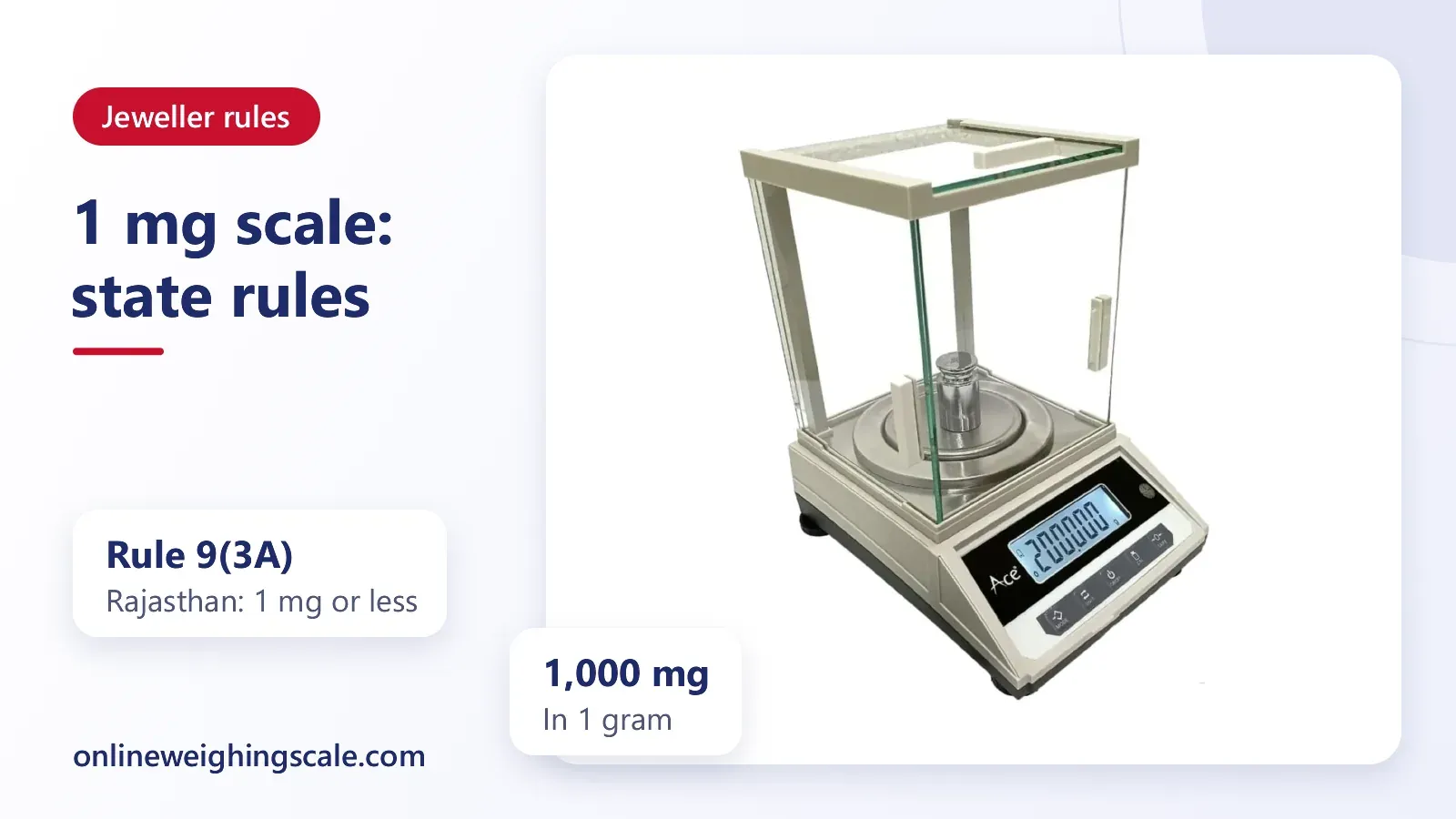
The Department of Consumer Affairs, Rajasthan, notified the Rajasthan Legal Metrology (Enforcement) (Second Amendment) Rules, 2026 on 28 October 2026. The gazette text, posted on the state Legal Metrology website, adds a new sub-rule (3A) to rule 9. It says a non-automatic weighing instrument of high accuracy class (class II) or special accuracy class (class I), having a verification interval of 1 mg or less, shall be used in any transaction or protection of gold, silver and precious metal.
The rules apply from the date of publication in the gazette, 29 October 2026. The text read here states no penalty and no grace period, so ask the district Legal Metrology office how it will apply the rule to your shop.
Puducherry and the Andaman and Nicobar Islands
The Puducherry Government published the First Amendment Rules on 2 June 2026. The gazette notification substitutes sub-rule (3) of rule 9 so that only a class A or class B beam scale, or a class I or class II non-automatic weighing instrument with a verification interval of 1 mg or less, shall be used in any transaction or protection referred to in sub-rules (1) and (2). Those two sub-rules are not part of the notification, so check with the Controller of Legal Metrology which trades they cover.
The Andaman and Nicobar Administration made a near identical change. Its extraordinary gazette of 24 August 2026 substitutes rule 9(3) with class A or B beam scales, or class I or class II instruments having a verification scale interval of 1 mg. That text says 1 mg, where Rajasthan and Puducherry say 1 mg or less.
A state that is not listed may still have a rule, or a draft. Read your own state's gazette before you decide, because this post does not cover states whose official text could not be read.
What e and d mean on a jeweller's balance
Two numbers sit on every precision balance. The display step, called d, is the smallest change the screen shows, such as 0.001 g. The verification scale interval, called e, is the step used when the instrument is verified for trade. The gazette texts above all speak of the verification interval, which is e, not d.
On many shop scales d and e are the same. On others the screen shows more digits than the verified step, so a display of 0.001 g does not by itself tell you that the instrument is verified at e = 1 mg. The verification plate or stamp certificate is the place to look.
What 1 mg means on a gold bill
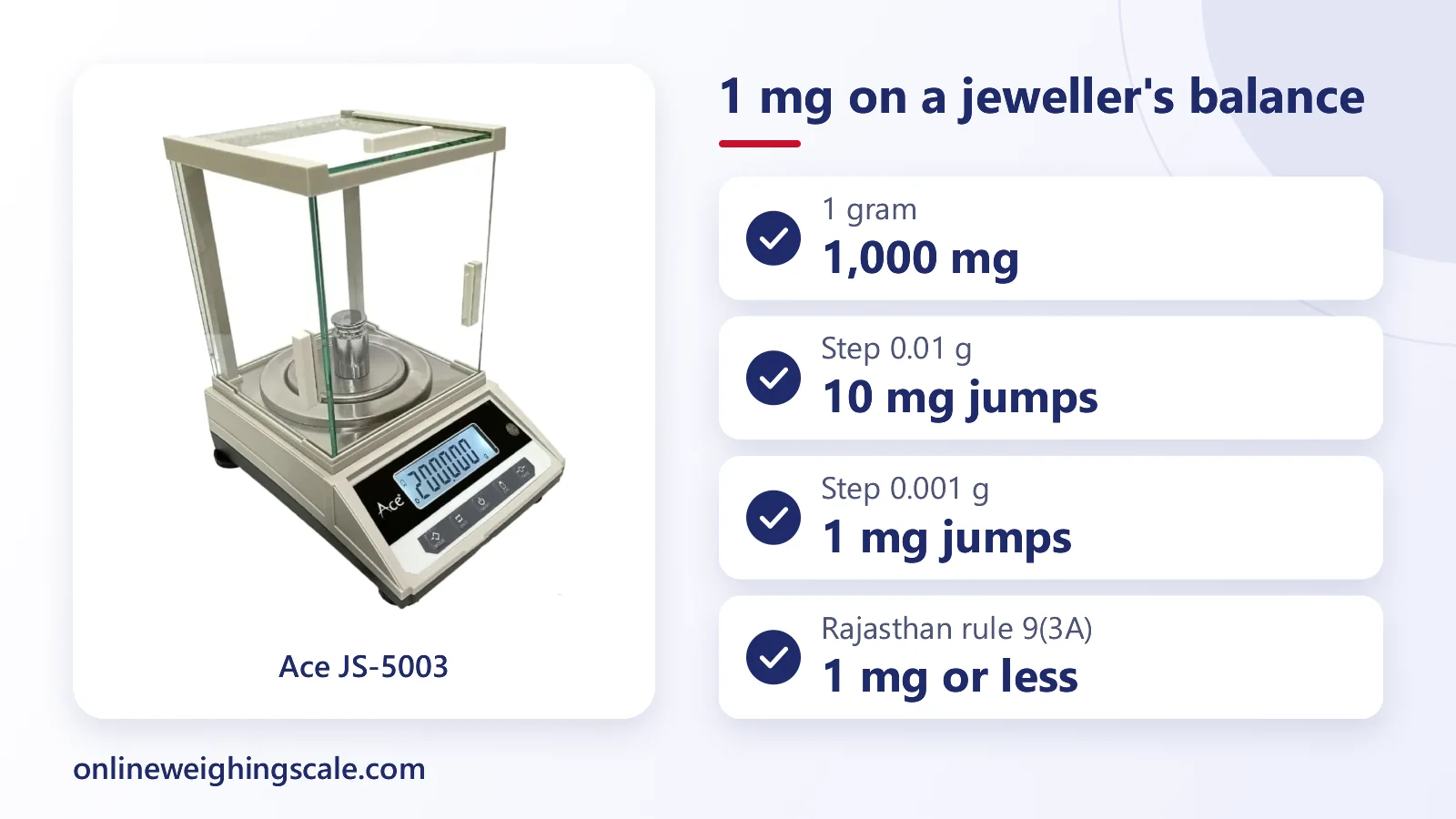
One gram is 1,000 mg. A balance that steps in 0.01 g moves in 10 mg jumps, so a reading can sit up to 5 mg away from the true value just from rounding. A balance that steps in 0.001 g moves in 1 mg jumps, so that rounding gap falls to 0.5 mg.
For a necklace of 20 g, the 0.01 g balance can therefore hide a few milligrams either way, while the 1 mg balance narrows it. The rounding arithmetic here is simple division.
Class I and Class II in plain words
The gazettes ask for Class I, called special accuracy, or Class II, called high accuracy. OIML R 76-1, the international standard for non-automatic weighing instruments, sets out four classes. Its Table 3 lists a verification scale interval of 0.001 g for class I and for the finest range of class II, and says class I needs at least 50,000 intervals, so a 1 mg class I balance has a capacity of at least 50 g. A footnote adds that it is not normally feasible to test and verify an instrument below e = 1 mg.
The class is not shown on the display, so ask the seller where it is recorded for your model. For tolerances, the same standard's Table 6 allows an error of 0.5 e on initial verification up to 50,000 intervals for class I and up to 5,000 for class II. In service the allowed error is twice that. Our guide on calibrating a gold scale and OIML classes goes through the classes and test weights in more detail, and the jewellery scale buying guide covers capacity and windshields.
What BIS asks of a hallmarking jeweller
The Bureau of Indian Standards, in its guidelines for registered jewellers (circular of 1 January 2024), asks for a weighing balance of 0.01 g accuracy to be available for verification of the weight of the jewellery. That is a separate duty from the state rules above, and a 1 mg balance is finer than it asks.
Verification and stamping
The gazette texts speak of a verification interval, and verification is what gives the stamp, so in practice the instrument must be verified and stamped. A balance that reads 0.001 g but carries no valid stamp is unlikely to meet a rule written around a verification interval, even if its readings are good.
Verification is done under the state Legal Metrology department, so ask that office how and how often it is done in your district. For how the stamp, the fee and the department fit together, see Legal Metrology in India, what legal for trade means and stamping charges. Those pages own the detail, so it is not repeated here.
What to check on the balance you own
- Read the data plate for maximum capacity, d and e, and ask where the accuracy class is recorded.
- Find the verification stamp and its date, and keep the certificate in the shop.
- Place a certified test weight, such as 100 g, and note how the reading compares. A drift of a few milligrams means calibration is due.
- Check that the balance is level, away from fans and counters that shake, and has a windshield.
- Ask your state Legal Metrology office in writing whether the 1 mg rule applies to your shop, and keep the reply. Ask the seller in writing which class the model is approved for.
A balance that reads steadily on the same weight, shows no drift as it warms up and returns to zero after loading is behaving well. Our page on scale problems and fixes covers the faults that interfere with this.
Omace balances that read to 0.001 g
Omace Brands Private Limited has been in the weighing trade since 1994 and makes scales at G-29 RIICO Industrial Area, Bagru, Jaipur. Three Omace balances read to 0.001 g: the Ace JS-3003 (300 g x 0.001 g, glass windshield, ₹27,258), the Ace JS-5003 (500 g x 0.001 g, ₹33,453) and the Ace CY-2003 (200 g x 0.001 g, ₹27,299). The rest of the Ace range is listed under jewellery weighing scale.
A 0.001 g readout is a display fact. Whether any model can be verified and stamped at e = 1 mg for a given state is a separate question, and this post does not claim that an Omace model meets any state rule. Ask before you buy, and check the verification plate of whatever you choose. On Omace digital scales a long press of TARE opens calibration mode on some models and a long press of the M key on others, and the manual for each model shows which, though a stamped trade scale is sealed and a registered repairer recalibrates it.
Omace Brands Private Limited also repairs its commercial scales when the buyer asks. The buyer pays the shipping both ways and the repair cost, and spare parts depend on availability, so ask first through the contact page.
Read the gazette before you spend
Find your state's gazette, read the text for your shop type, then ask the district Legal Metrology office what verification they will accept. Only then compare balances. State rules are changing through 2026, so a rule that is a draft today can be notified next month.