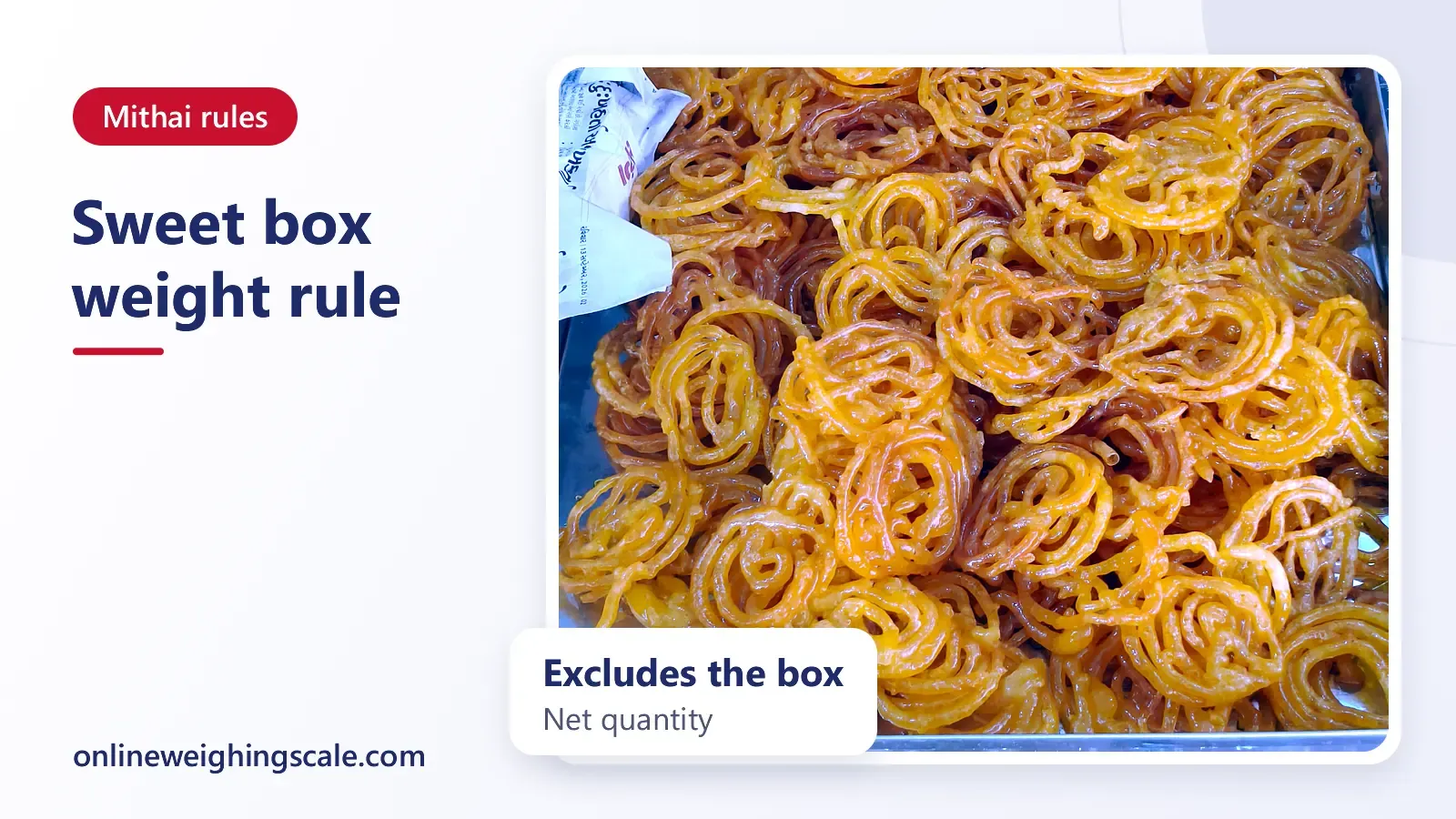
A sweet shop in India should weigh mithai without the box, because the Legal Metrology (Packaged Commodities) Rules, 2011 define net quantity as the quantity of the commodity in a package, excluding the packaging or wrapper. A customer who pays for 1 kg should receive 1 kg of sweets, and the box is extra.
This post separates what the official texts say from what they do not say. No Act or Rule that I read mentions a mithai box being weighed together with the sweets. The rule comes from the general net-quantity rule, and from a plain public advice that one state's Legal Metrology department gives to sweet shops. Both are quoted below, with the links, so you can read them yourself. Checked November 2026.
What the Packaged Commodities Rules say about net quantity
The Rules sit under the Legal Metrology Act, 2009, and the Department of Consumer Affairs publishes them with all amendments. Three provisions matter for a box of sweets.
- Rule 2(f) defines net quantity as the quantity by weight, measure or number of the commodity contained in the package, excluding the packaging or wrapper.
- Rule 11(1) says that in declaring the net quantity, the weight of wrappers and materials other than the commodity shall be excluded.
- The Fourth Schedule lists “Rasgulla, Gulabjamun and other sweet preparations” against the unit “Weight”, so a packed box of sweets is declared in grams or kilograms, with the container left out.
The same source defines a packer as a person who pre-packs a commodity in a bottle, tin, wrapper or otherwise, in units suitable for sale. A sealed box of kaju katli with 500 g printed on it is therefore a package, and the 500 g has to be the sweets alone. All of this is in the Department of Consumer Affairs book of the Rules with all amendments.
The Rules apply to packages meant for retail sale. Rule 3 keeps some goods outside the chapter, such as packages of more than 25 kg or 25 litres, which does not touch a normal mithai box.
What a state Legal Metrology department tells sweet shops
The one official page I found that names sweet shops is a public awareness note from the Odisha Legal Metrology directorate. Point 5 reads, in the department's words, that in bakeries and sweet shops the tare weight of the empty packaging box should be deducted while arriving at the net weight of the commodity. You can read it in the Odisha department awareness note.
That note is from Odisha, not from the central department, and it is an advice to the public rather than a section of the Act. It still states the practice in one sentence, and it matches the net-quantity definition above. News stories about checks on sweet shops are not official text, so none is linked here. Your own state's department is the one that decides in your shop, so a shopkeeper in Rajasthan, Punjab or Kerala should read their state department's notices.
The same Odisha note has two more points a buyer can use. It asks buyers to insist that the commodity is checked when they doubt the exact net contents of a packaged item. It also asks them to make sure that an electronic weighing instrument shows 0 when nothing is on it.
Why the Act itself backs a net-weight sale
Three sections of the Legal Metrology Act, 2009 explain why a box that eats into the weight is a problem for the shop.
- Section 10 says any transaction, dealing or contract in goods shall be made by such weight, measure or number as may be prescribed.
- Section 12 makes void any custom, usage or practice that permits a person to demand or receive a quantity of an article less than, or more than, the quantity specified by weight, measure or number in the contract or other agreement. “We always weigh with the box” is a custom, and this section says a custom of that kind is void.
- Section 18(1) says no person shall pack, sell or possess for sale any pre-packaged commodity unless the package is in the prescribed standard quantities and bears the prescribed declarations.
I read these three sections in the Act as first published. The Jan Vishwas (Amendment of Provisions) Act, 2026 later changed other sections of the Legal Metrology Act, mainly the penalties, and the changed text is in its Schedule (serial 66).
What changed in the penalty on 1 May 2026
Section 36(1) of the Legal Metrology Act covers a pre-packaged commodity that does not conform to the declarations on its package. The Jan Vishwas (Amendment of Provisions) Act, 2026 replaced that sub-section. It now says the offender shall be warned with an improvement notice, shall be liable to a penalty of up to five lakh rupees for the second offence, and for later offences a fine of not less than twenty-five lakh rupees but up to fifty lakh rupees.
The change to the Legal Metrology Act came into force on 1 May 2026 by a notification of 27 April 2026 from the Department of Consumer Affairs. The amendment also lets a legal metrology officer who has reason to believe a rule is being broken serve an improvement notice that lists the measures to take within a reasonable period. A shop that ignores such a notice can have its registration or approval suspended or revoked.
These figures apply to pre-packaged goods that do not match their declarations. Whether a short sweet box counts under that section, or under another one, depends on how the box was packed and sold, and a magistrate or the department decides that. This post does not claim a fixed penalty for weighing a box with the sweets.
A worked example with round numbers
These numbers are made up to show the arithmetic. Suppose a shop sells barfi at ₹800 per kg and the empty box weighs 150 g.
| Item | Box weighed in | Box deducted |
|---|---|---|
| Reading on the scale | 1,000 g | 1,000 g after tare |
| Barfi in the box | 850 g | 1,000 g |
| Price charged | ₹800 | ₹800 |
| Real price per kg of barfi | about ₹941 | ₹800 |
The buyer who pays ₹800 for 850 g of barfi has paid about ₹941 per kg, which is ₹141 per kg more than the board price. On a wedding order of 20 kg in 1 kg boxes, the same 150 g per box adds up to 3 kg of box that the customer paid for at the sweet rate.
How a shop weighs sweets the right way
- Place the empty box on the pan, with its lid if the lid goes on the box.
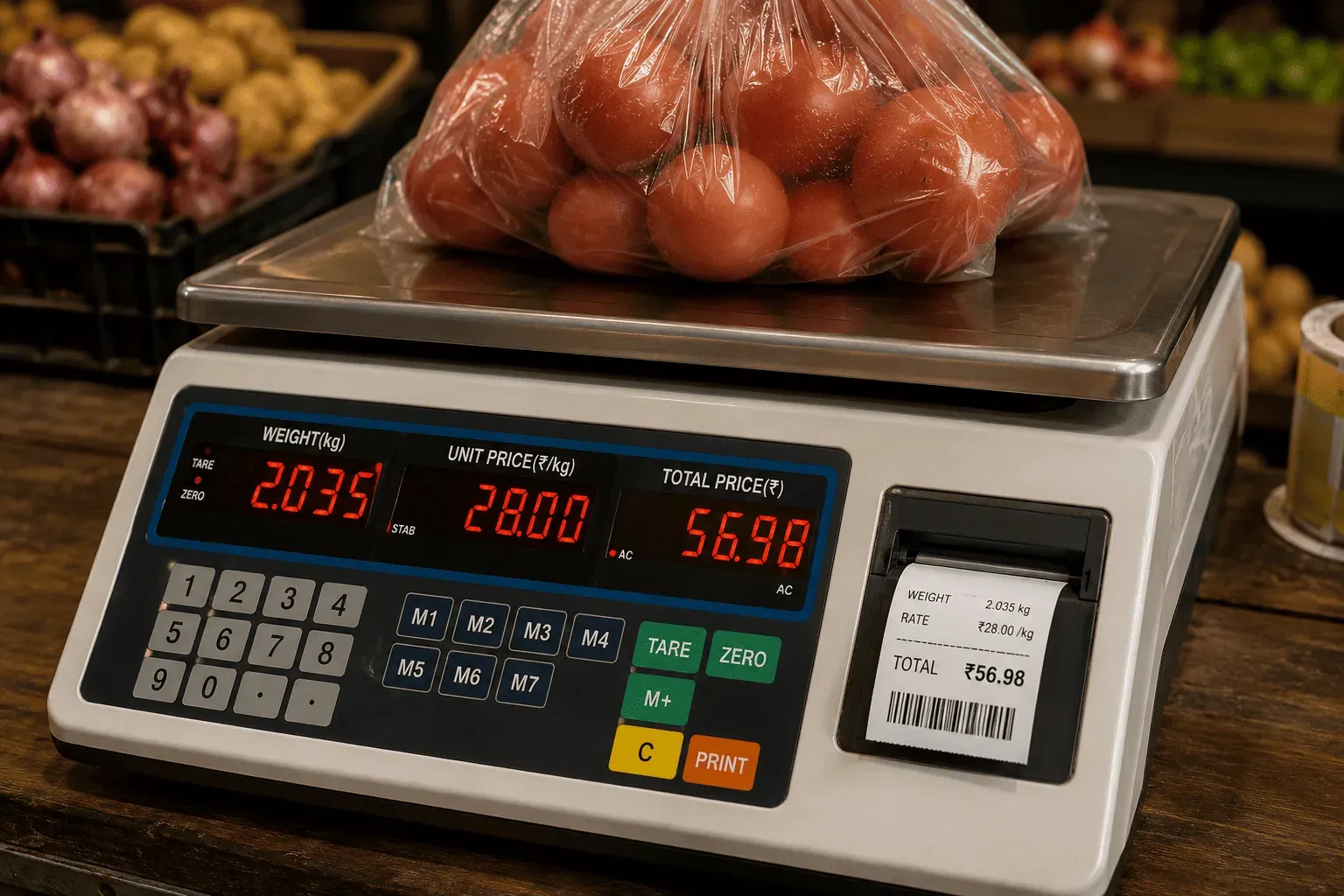
- Press the TARE key until the display shows 0. This removes the box weight from the reading. The post on tare and zero explains the two keys.
- Add the sweets until the display shows the weight the customer asked for.
- Turn the display or the pole display toward the customer, so the weight is visible to the buyer.
- Keep the rate per kg on a board or on the scale, and say it aloud when the weight is large.
A sealed pre-packed box follows the Rules above: the printed weight is the net weight of the sweets. For ribbon, extra wrapping or a gift hamper, charge for the packing as a separate item at a stated price. The Rules are about the quantity of the commodity, so a visible price for the packaging keeps the sweet weight honest.
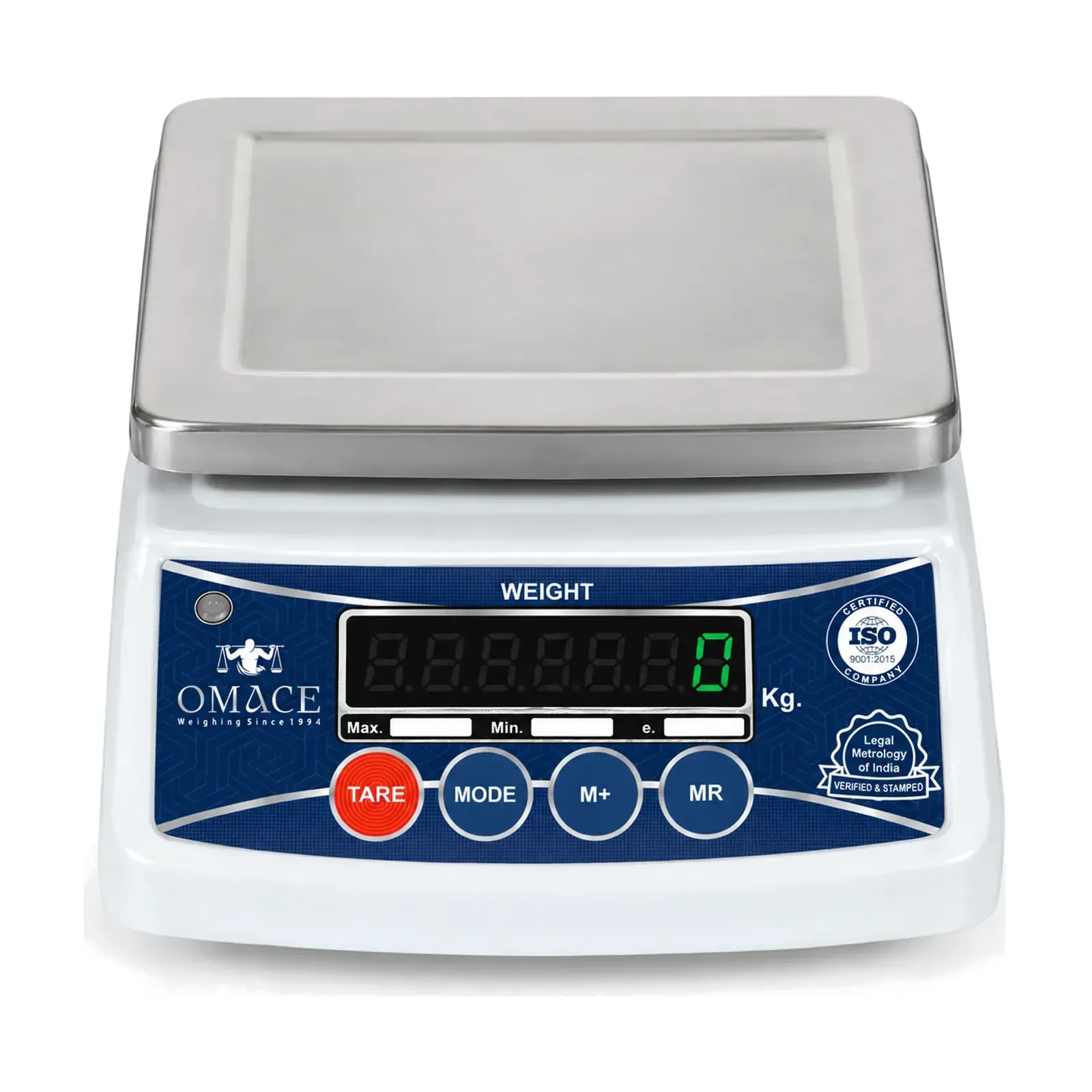
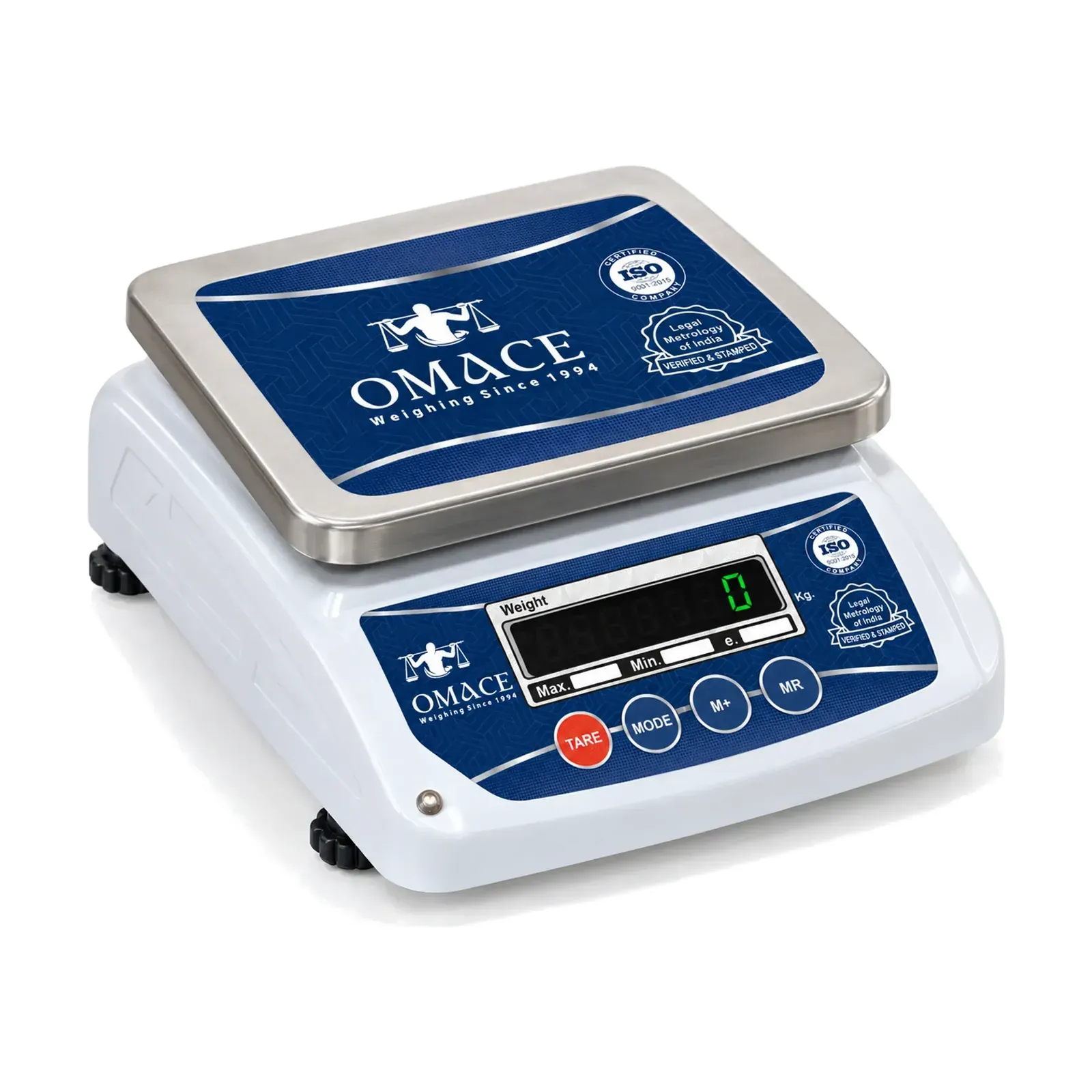
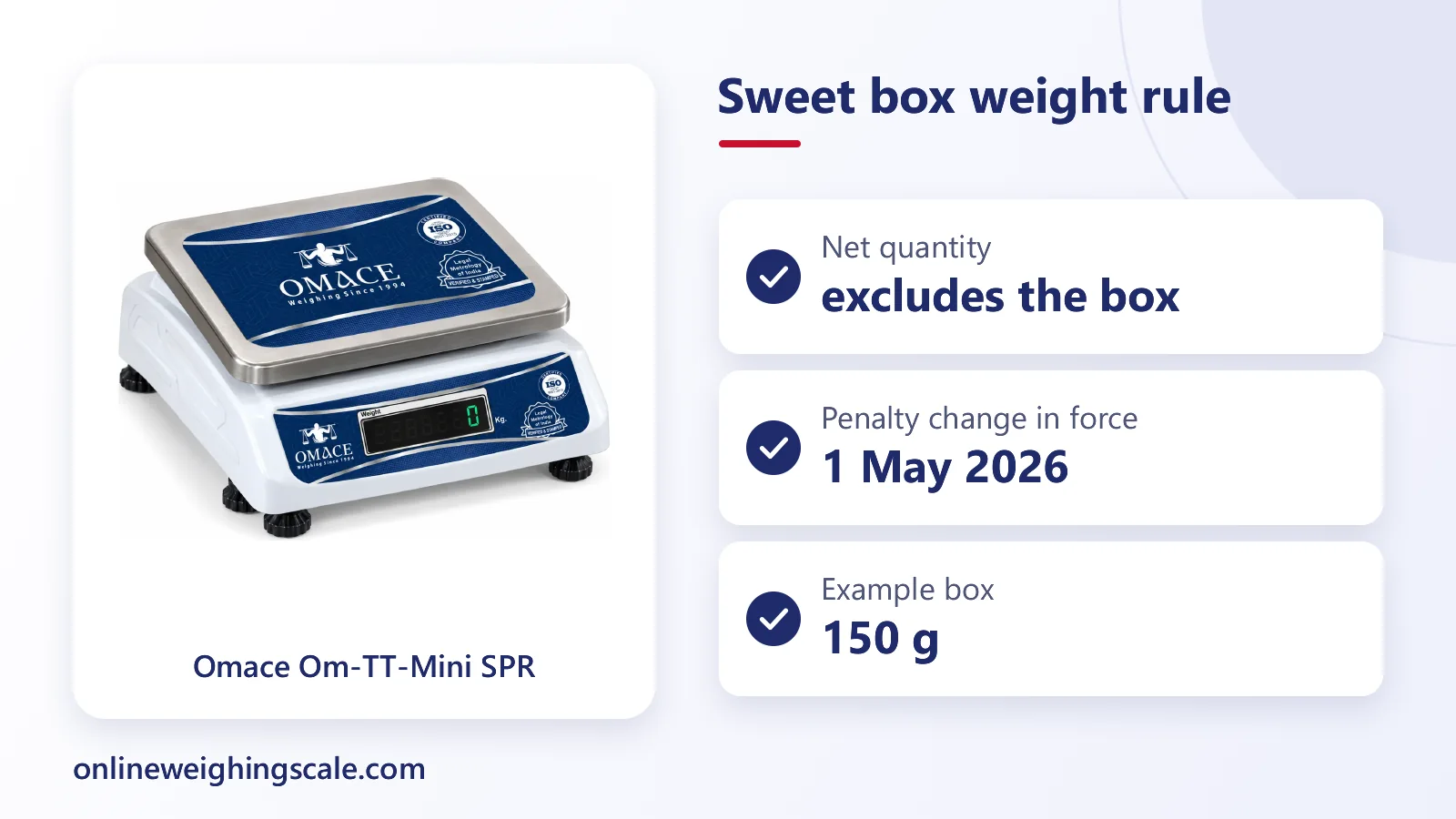
The scale has to be verified and stamped as well, or the tare step means little. Omace Brands Private Limited ships its shop, platform, chicken and crane scales from Bagru verified and stamped by Legal Metrology, and the stamp is valid across India. For what the stamp means, read Legal Metrology in India and stamping charges. A counter scale for mithai is usually a 20 kg or 30 kg model. The Omace Om-TT-ECO Kirana Weighing Machine (10 kg and 20 kg, ₹2310 today) and the Om-TT-Mini SPR Double Display Weight Machine (20 kg and 30 kg, ₹2625) have a display on both sides, so the customer can read the weight. Check the capacity and the step size on the product page before you choose.
How a customer can check the weight
- Ask the shop to weigh the empty box first and press tare. The shop does this in a few seconds.
- Look at the display with the empty box on the pan. A digital scale should show 0 before the sweets go in, as the Odisha note advises.
- Look at the stamp or sticker on the scale. A scale with no stamp is a reason to ask questions.
- At home, weigh the empty box of the same kind on a kitchen scale and compare it with the full box. The difference is the weight of the sweets, within the error of your own scale. If the numbers look short, speak to the shop first.
- If the shop will not correct it, write to the Legal Metrology department of your state. A written complaint with the bill and the weights is easier for an officer to act on. The post on how to spot a rigged weighing scale lists more signs of a bad scale.
Sweets sold by piece and boxes sold by weight
Some mithai is sold by number, such as a box of 12 ladoo with the count printed. The declaration of quantity can be in number where the commodity is sold by number, and Rule 12 allows weight, number or a combination if that gives accurate information to the consumer. When a box says both a count and a weight, the weight is still the weight of the sweets.
Dry fruit boxes, namkeen and bakery items follow the same idea, but I have not read an official page for each of them, so this post does not state a separate rule for them. The Odisha note names bakeries together with sweet shops.
What is left open
No Act or Rule I read says “the sweet box shall not be weighed with the sweets” in those words. The practice follows from the net-quantity definition in Rules 2(f) and 11(1), from Section 12 of the Act, and from the written advice of a state department. A state may issue its own notice, and the Gazette and the department's site carry the current text. For a dispute, the officer of your state is the person to ask.