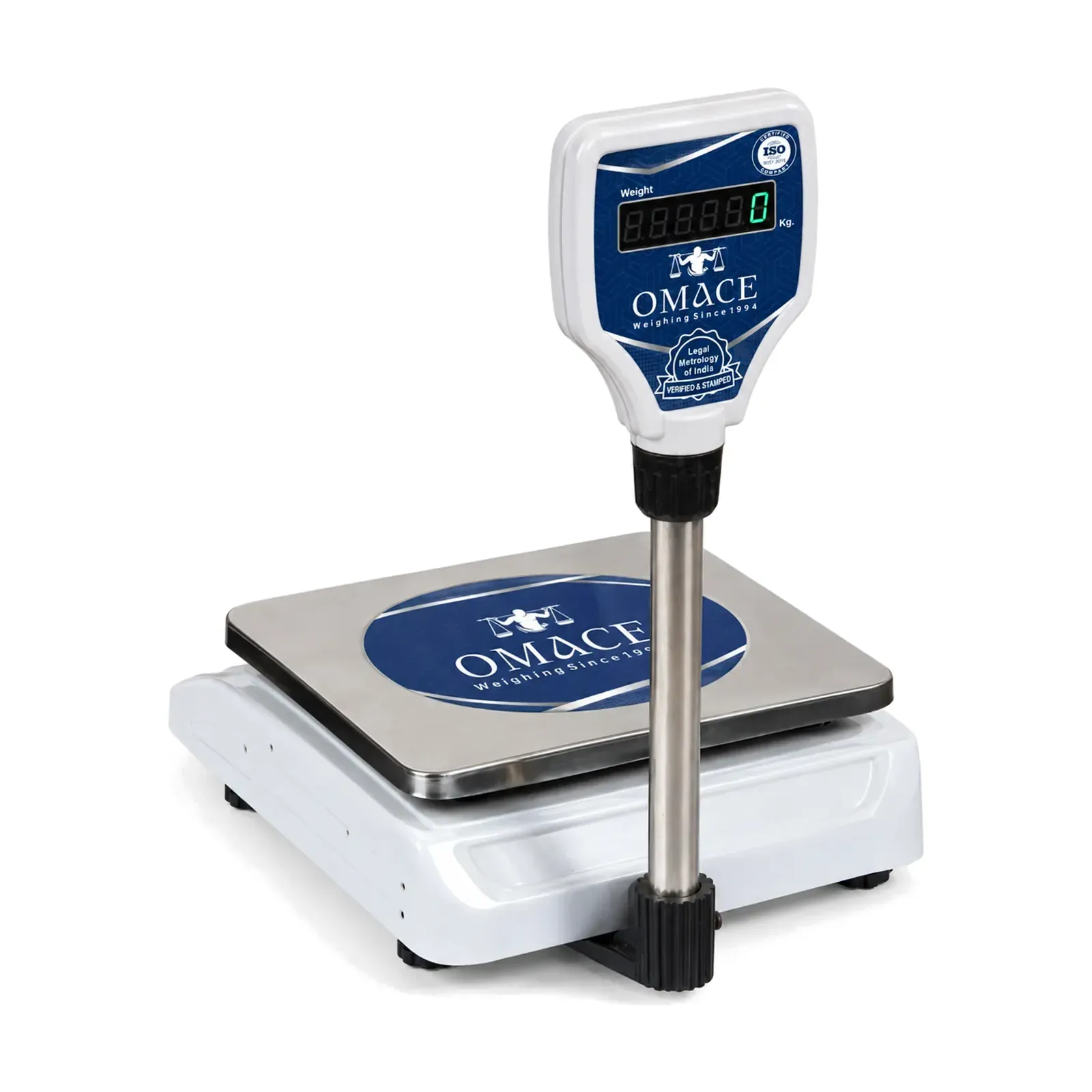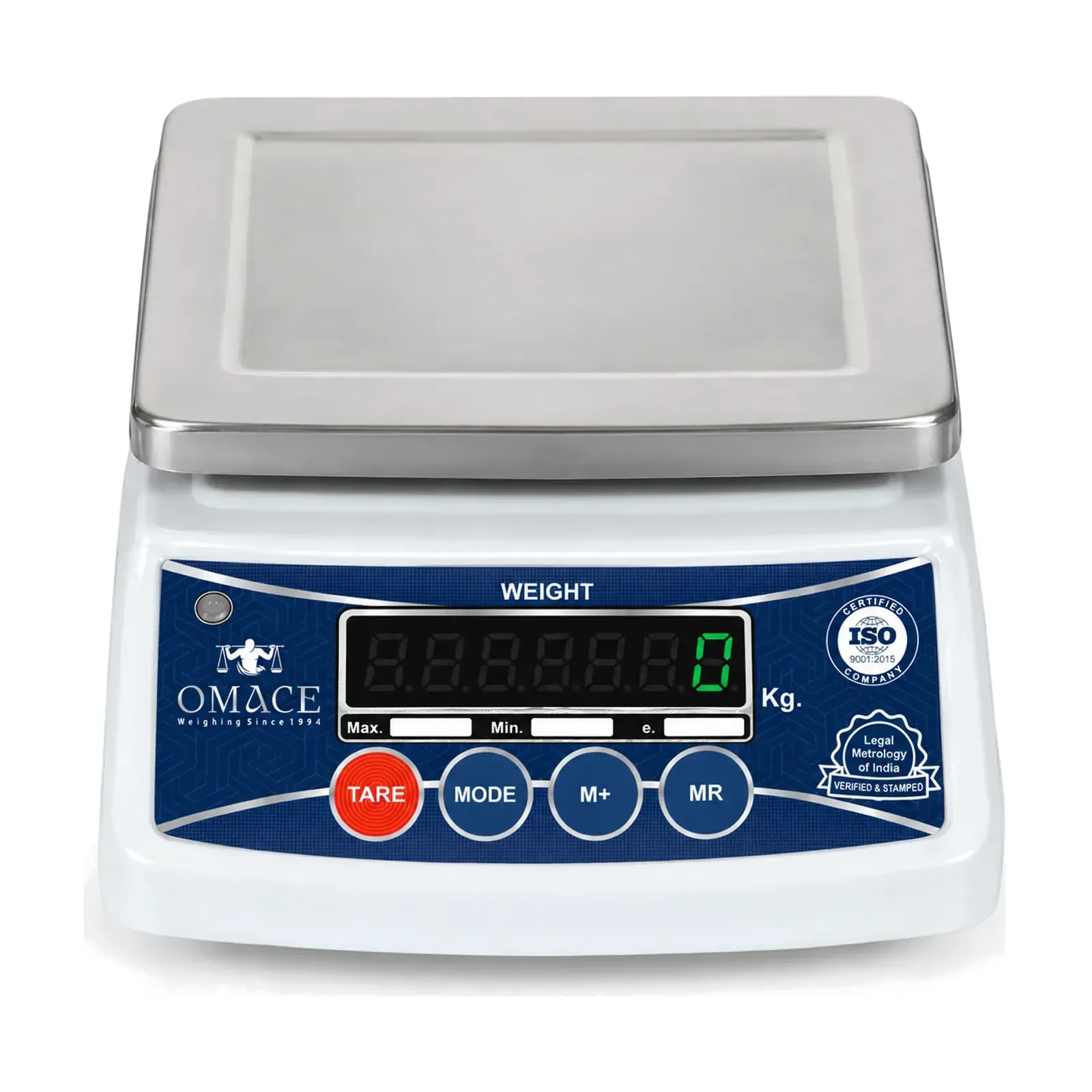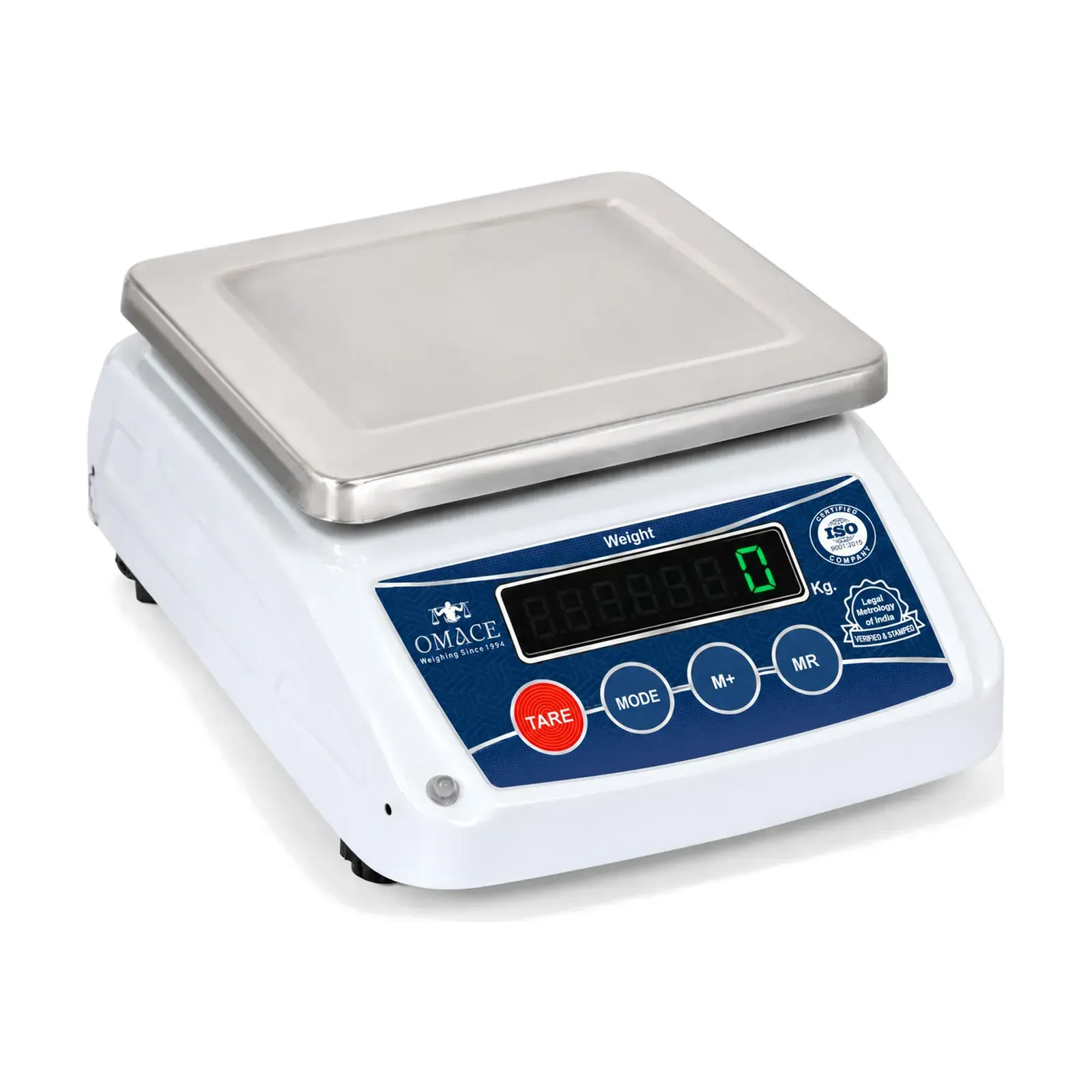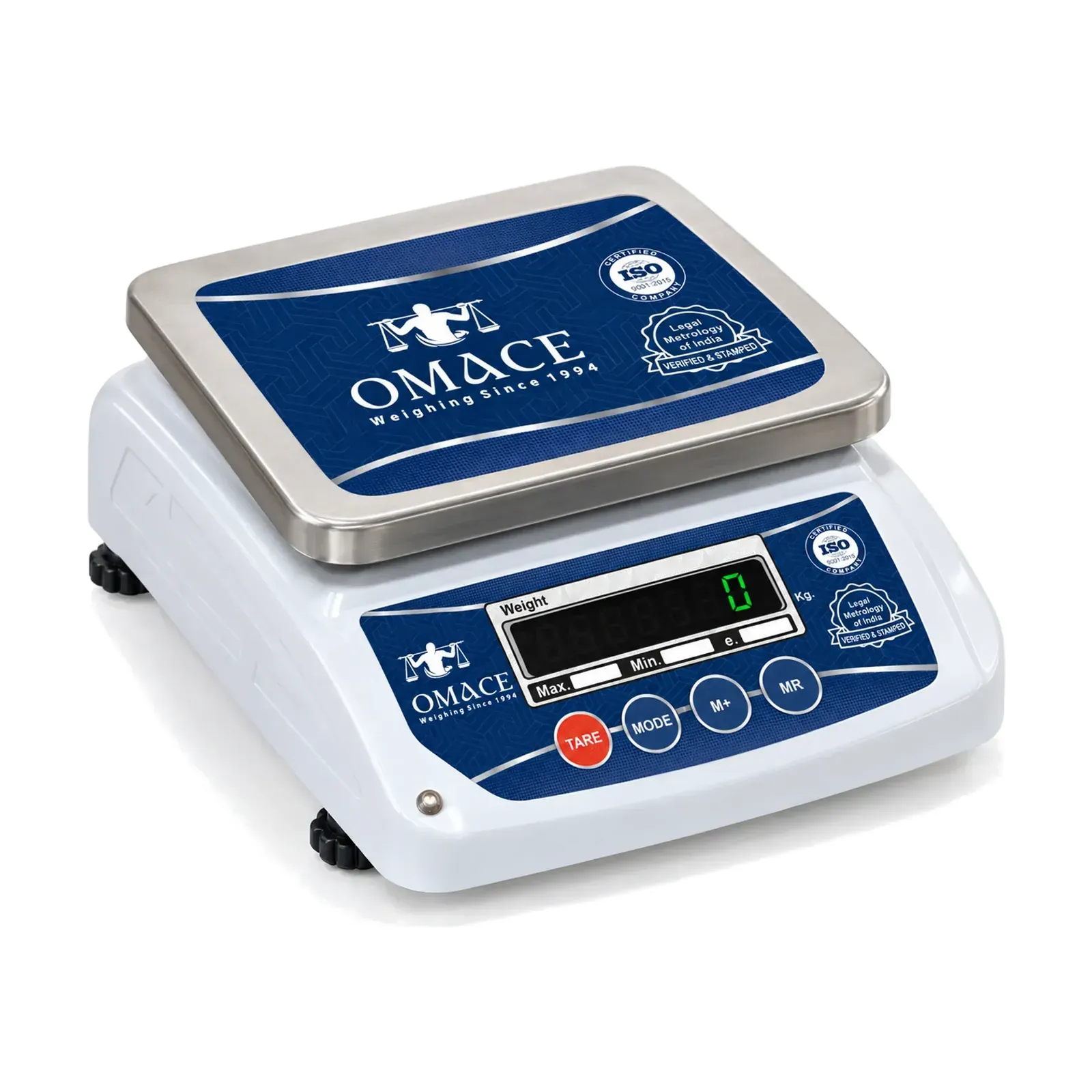

A weighing scale for a vegetable shop should carry 30 kg, read in 5 g steps and keep working on a built-in battery through a power cut, because a sabzi seller weighs hundreds of small lots in a day. That fits most carts, thelas and counter shops. The sections below help you choose by what you sell, where you stand and how the verification stamp fits in.
What a sabzi seller asks from a kanta
A vegetable weighing machine works all day, in the sun, with wet hands and a customer waiting. It needs a clear display on both sides, a pan that is easy to wipe and a battery that lasts a full market day. Accuracy matters because a few grams lost on every sale add up over a month, and a customer who feels short-weighed does not return.
Most shoppers buy by the half kilo and the kilo, so the scale spends its life between 100 g and 5 kg. A heavy-duty platform is wasted on that work. A small digital bench scale of 10 to 30 kg is the usual choice.
Capacity and division: pick by what you sell
Capacity is the heaviest load the scale can show. Division, also called least count, is the smallest step it can show. A 30 kg scale that reads in 5 g steps shows 1.235 kg as 1.235 kg, but a scale that reads in 50 g steps shows the same load as 1.25 kg, and you give away or take 15 g without knowing. As a worked example from OIML R 76-1 Table 3, class III allows at most 10,000 verification intervals (capacity divided by division): 30 kg at a 5 g division is 6,000 intervals and sits in class III, while 30 kg at a 2 g division is 15,000 and falls under class II.
A good rule is to choose a capacity about twice your heaviest single weighing. If your biggest sale is a 10 kg bag of onions, a 30 kg scale leaves comfortable room, and a 20 kg scale is the least you should consider. Running a scale at its limit shortens its life and makes the reading drift.
| What you sell | What to pick |
|---|---|
| Tomato, onion, potato, gourds by the kilo from a cart | 30 kg capacity, 5 g steps, rechargeable |
| Coriander, mint, green chilli, ginger, garlic in small lots | Finer steps, 1 g if you can, 10 kg capacity is enough |
| Fruit by the kilo at a counter shop | 20 to 30 kg, flat pan or bowl, display facing the customer |
| Stall with no power point | Rechargeable battery with a charger you can plug in at night |
| Crates or sacks bought from the mandi | A platform scale of 100 kg or more, kept apart from the selling scale |
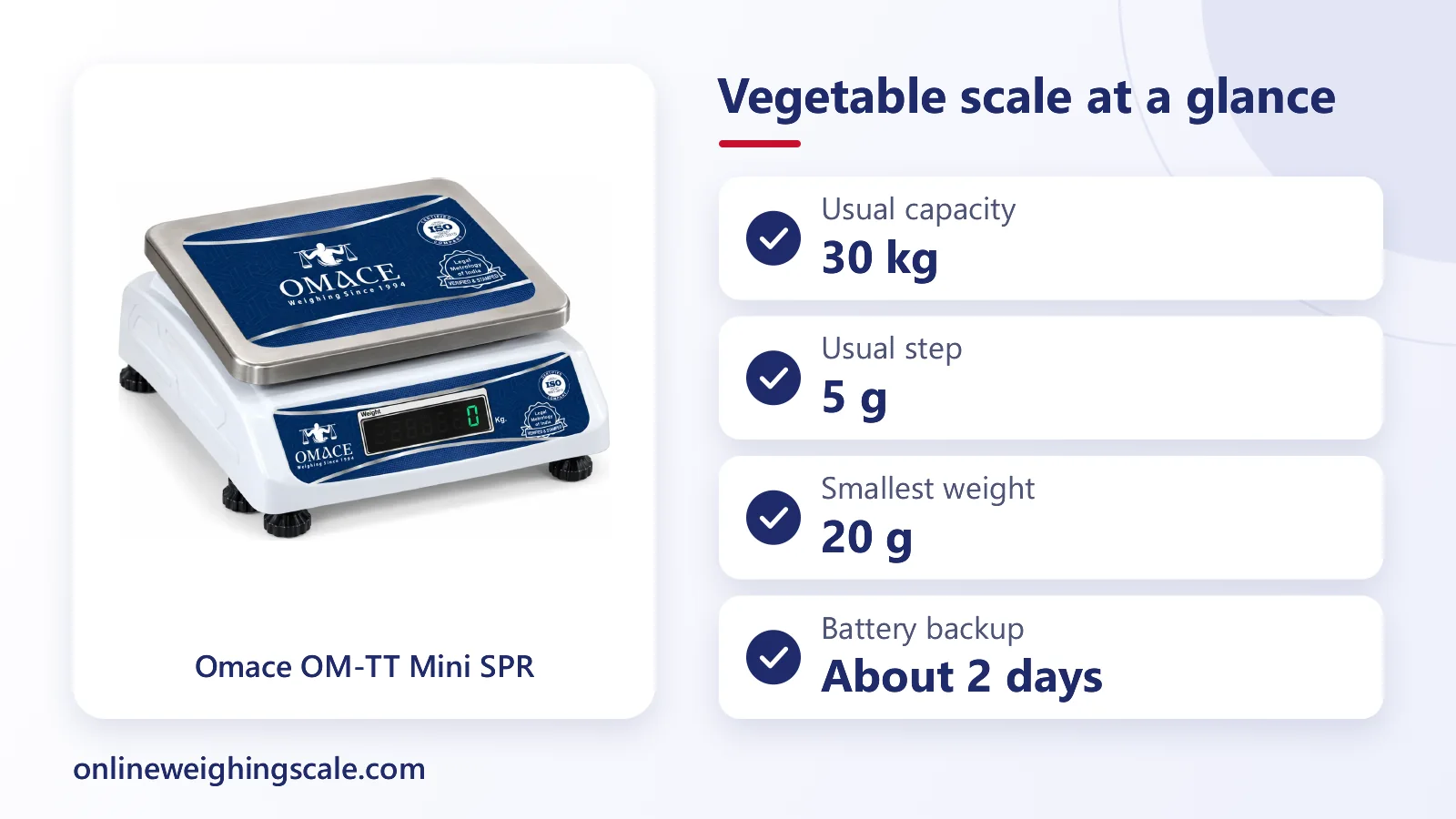
Light leafy produce is where division matters most. The Om-TT vegetable scales read in 5 g steps at 30 kg, which is fine for a kilo of tomatoes, but a bunch of coriander worth a few rupees weighs only a few tens of grams, and a coarse step then shows large errors. Many sellers keep one scale for the heavy lots and a small one for herbs. Omace sells small-capacity models in the pocket scale range for exactly that kind of light work.
Flat pan or bowl
A flat steel pan suits vegetables that stack: potatoes, onions, bottle gourd, brinjal. You can wipe it with a cloth and nothing hides underneath. A deep bowl or tray suits loose small items such as peas, green chillies, cherry tomatoes and berries, because it stops them rolling off.
Many sellers keep a light plastic tray on the flat pan for loose fruit and press TARE to remove the tray weight. Always zero the scale with the tray in place, before the produce goes on. If you forget, the customer pays for your tray.
Battery backup for a cart or mandi stall
A cart has no socket. The Om-TT shop scales have a built-in battery with a backup of about 2 days, charged by plugging the 220 V cord into a socket, so you can charge at home at night and sell all day. Charge it when the low battery sign shows.
Do not wait until the display goes blank. A weak battery makes some scales show unstable or jumping readings well before they switch off. Charge on a fixed routine, as you would a phone. If your scale starts to behave strangely, the post on a weighing scale not working lists the common causes in order.
Dust, water and rough handling
Vegetable stalls are wet. Water from sprinkled greens, juice from cut fruit and mud from root crops all reach the scale. Keep the display and buttons out of direct spray, wipe the pan after each rush and never wash the scale under a tap. If water gets inside the case, switch it off, open the battery cover where it allows, and let it dry in the shade before you try it again.
Put the scale on a flat, firm surface. A tilted plank or a wobbly crate changes the reading. Keep wind off the pan too, because a light breeze moves a lightly loaded pan and the number flickers.
The verification stamp: what a seller needs to know
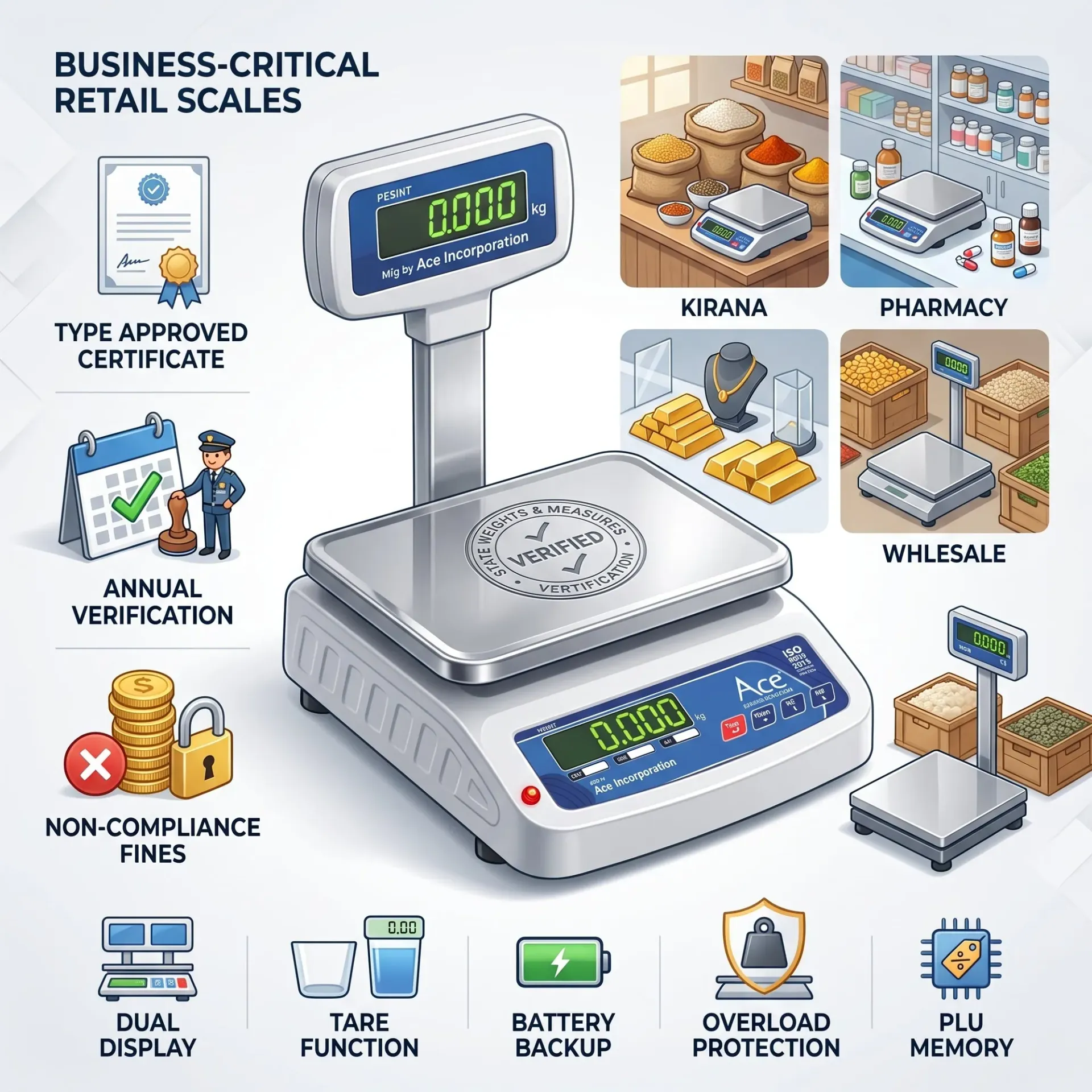
A scale used to sell by weight is a trade instrument, and Indian law treats it differently from a kitchen scale. The Department of Consumer Affairs explains that weights and measures used in trade are periodically verified by State Government officers against standard weights, and that verification and stamping is a provision of the Legal Metrology Act, 2009. Using an unstamped scale for sales can bring action from the Legal Metrology inspector in your area. Since 1 May 2026 an officer can also serve an improvement notice under the Jan Vishwas (Amendment of Provisions) Act, 2026, and the penalty amounts in the Legal Metrology Act were revised, so ask the state office for the current figure.
The Om-TT shop scales are accuracy class III, the medium class in OIML R 76-1. Omace shop scales leave the Bagru factory in Jaipur verified and stamped by Legal Metrology, and the stamp is valid across India. Ask for the stamp on any scale you buy, whatever the brand. Look for it on the body and keep the bill.
Fees, test centres and how re-verification works are covered in weighing scale stamping charges, and the wider rules are in Legal Metrology in India. For the meaning of the phrase itself, read what legal for trade means. The General Rules amendment of 18 December 2025 sets twenty-four months as the verification period for counter machines, beam scales and weights, so ask your local Legal Metrology office which category your scale falls in.
A stamped trade scale is sealed. On Omace digital scales a long press of TARE opens calibration mode on some models and a long press of the M key on others, and the manual for each model shows which, but on a stamped scale the seal should not be broken by you. A registered repairer recalibrates it and the inspector re-stamps it.
Plain weighing or price computing
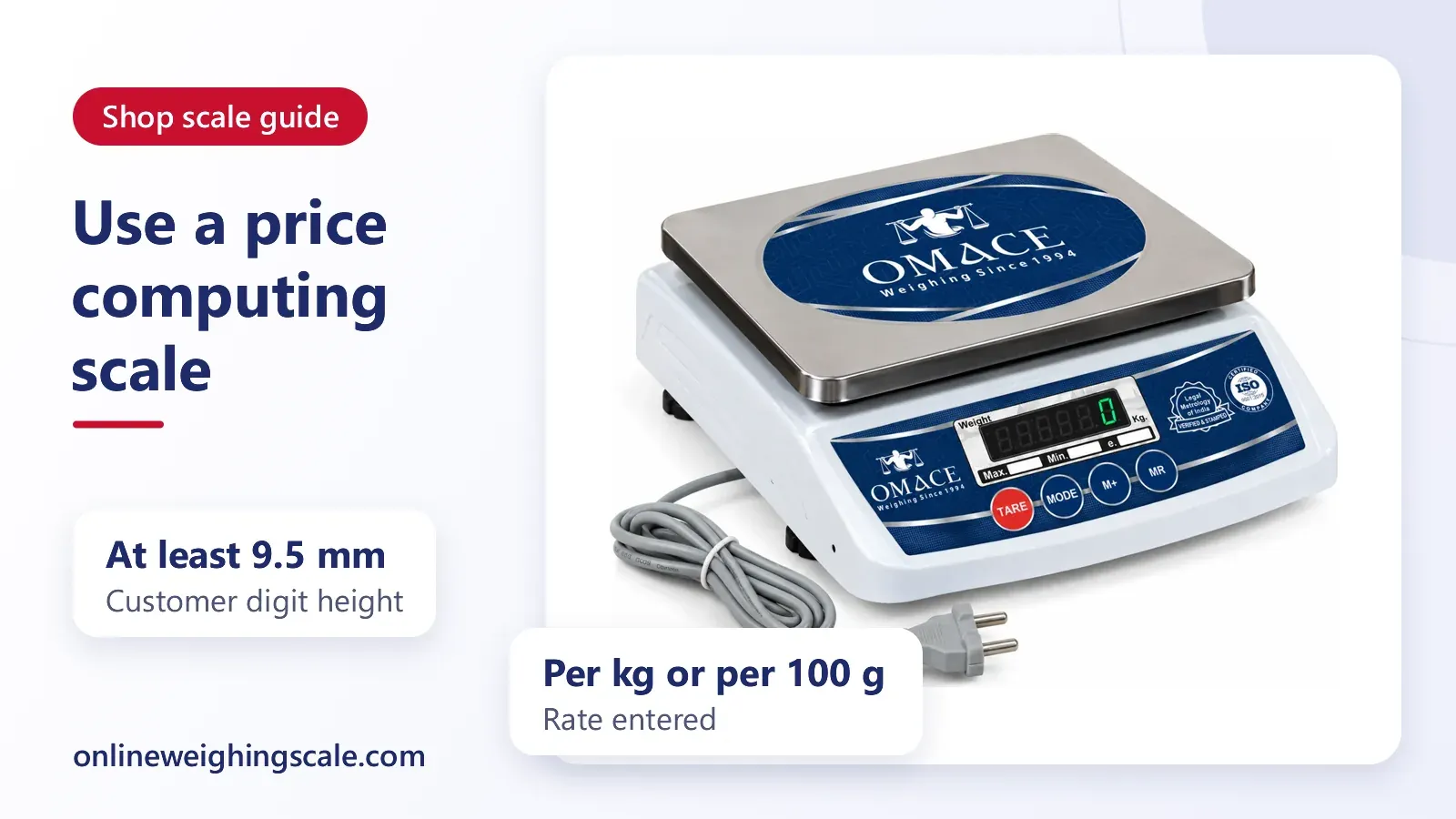
A plain weighing scale shows weight only, and the Om-TT shop scales are of this kind: they weigh only and do not compute price. You read the weight, multiply by the rate and say the amount. A price computing scale lets you key in the rate per kilo and shows the amount payable beside the weight.
Price computing saves time at a busy counter and removes mental sums, which helps if a helper serves customers. The cost is a keypad that gets wet and sticky and a rate that you must change when the mandi rate moves. For a single-person cart with five or six items, many sellers do well with plain weighing and a printed rate card. For a counter shop with ten or more rates and a helper, price computing earns its place. The post on price computing scale calibration shows how to test the amount as well as the weight.
Which Omace shop scale fits which seller
Omace Brands Private Limited makes a range of shop weighing scales. Prices below are today's prices with GST and may change, so confirm on the product page.
- For a cart or counter selling by the kilo: the Omace Om-TT-Running SPD Vegetable Weighing Machine, 30 kg x 5 g with a pole display and a 240 x 300 mm stainless steel pan, is ₹3255.
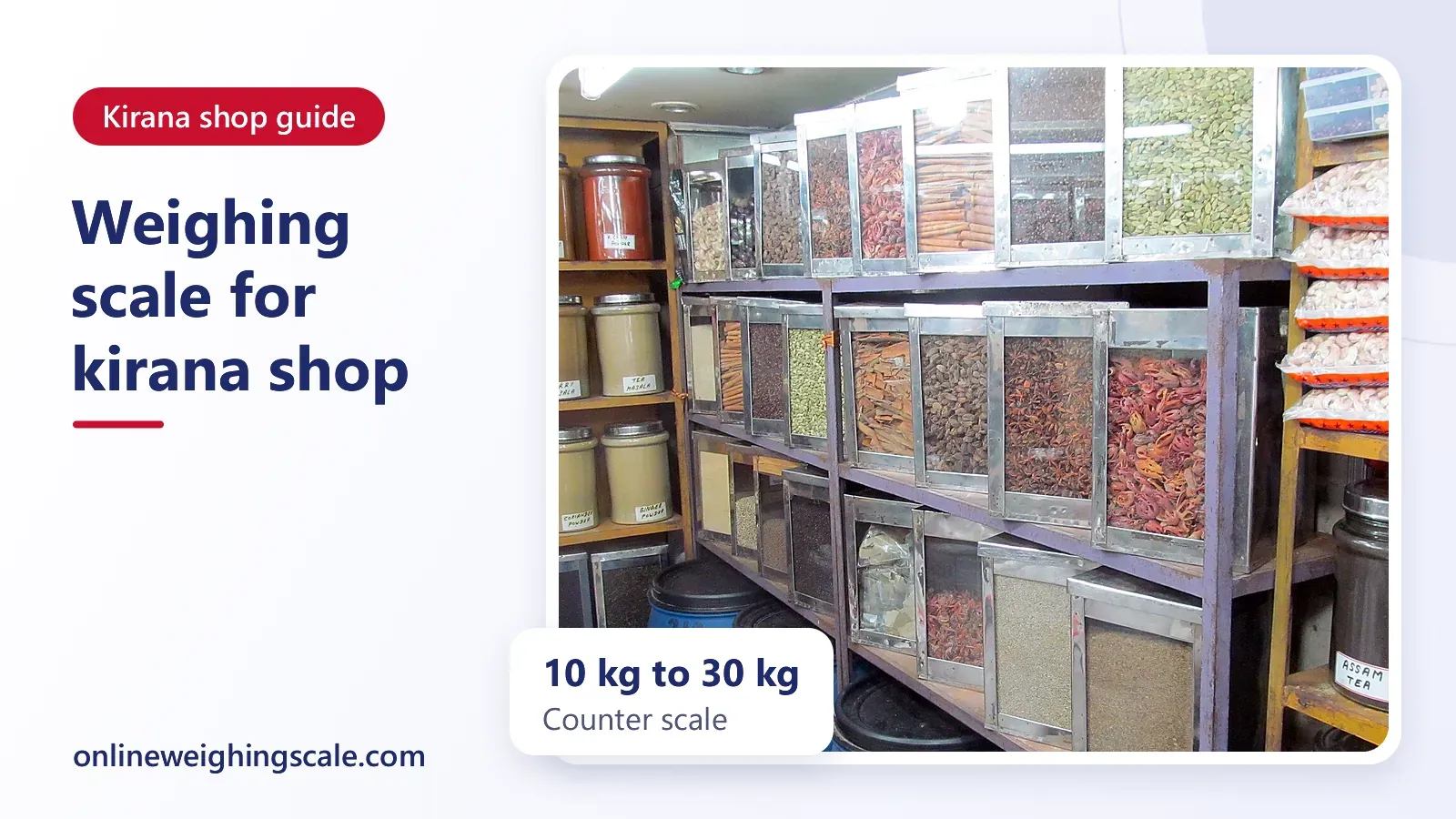
- For a kirana-style corner selling vegetables with groceries: the Omace Om-TT-ECO Kirana Weighing Machine, 10 kg x 1 g or 20 kg x 2 g with double-side green LED and a 160 x 190 mm stainless steel pan, is ₹2310. The post on the weighing scale for a kirana shop goes deeper on that case.
- For a small stall with light lots: the Omace Om-TT-Micro Mini Weighing Machine, 10 kg x 1 g with double-side green LED and a 130 x 160 mm pan, is ₹1995.
- For a bigger load, 20 kg x 2 g or 30 kg x 5 g with a front and back display and a 175 x 225 mm stainless steel pan: the Om-TT-Mini SPR Double Display Weight Machine is ₹2625, and the Om-TT-Mini SPD with Pole Display is ₹2730.
This is why a scale around ₹2,000 to ₹3,300 is a common spend for a shop-grade vegetable machine. Prices of other makers vary widely, and a cheap unstamped scale can cost more in a penalty than it saved. A broader view of options sits in best weighing scale for small business.
Habits that keep customers trusting your kanta
Zero the scale before every sale and watch it return to 0 when the pan is empty. Face the display towards the customer. Do not press the pan with a finger or let the produce lean on the pole. Test the scale each morning with a known weight such as a sealed 1 kg packet, and read the post on a 30 kg kanta calibration if the reading is off.
Omace Brands Private Limited has been in the weighing trade since 1994, and every scale is checked with certified test weights before dispatch. Omace repairs its commercial scales when the buyer asks. The buyer pays the shipping both ways and the repair cost, and spare parts depend on availability, so write to Omace first through Contact Us before sending a scale.
Choosing the right scale before the season starts
List what you sell, the heaviest sale you make, whether you have a socket and whether a helper serves customers. Those four answers pick the capacity, the division, the battery and the display type. Then check for the stamp, and weigh a known packet on the first day.