A model approval certificate is the Government of India's permission, under section 22 of the Legal Metrology Act, 2009, to manufacture or import one tested design of a weight or measure. Every OEM buyer, dealer or new brand owner who plans to sell weighing scales in India should know it exists, because the state licence to make or import scales depends on it.
What Model Approval Means Under Section 22
Section 22 of the Legal Metrology Act, 2009 says every person, before manufacturing or importing any weight or measure, shall seek approval of the model. The manner, the fee and the authority are left to the rules. Those rules are the Legal Metrology (Approval of Models) Rules, 2011, which came into force on 1 April 2011.
The rules define a model as the final physical form of a weight or measure, with every component that gives it its metrological qualities assembled. Every scale built to that model should then match it in dimensions, construction, material and performance, within the tolerances the rules allow. So the approval attaches to a design, not to each kanta that leaves a factory.
Model approval is separate from stamping. Approval clears the design once. Verification and stamping then happen on each instrument, as our guide to Legal Metrology in India and the note on calibration versus verification explain.
Which Weights and Measures Need It
Section 22 covers any weight or measure, so a weighing scale sold for trade needs an approved model unless the Act itself excuses it. The first proviso of section 22 says approval may not be required for cast iron, brass, bullion or carat weights, for any beam scale, for length measures (not being measuring tapes) used in retail trade for textiles or timber, and for capacity measures up to twenty litres used for kerosene, milk or potable liquors.
The words are "may not", so the exemption leaves room for the authorities and is not a guarantee for the maker. An electronic platform scale, a counter scale or a crane scale falls outside that list, so the maker needs approval for it. Rule 17 adds a further route: where approval is ordinarily not necessary, an officer who acquires such an instrument can ask the Director of Legal Metrology to have a model tested, and a failed model puts the maker's licence for that instrument at risk.
A second proviso lets the prescribed authority approve a model that is already approved in a country outside India, either without any test or after such test as it thinks fit, if it conforms to the standards under the Act. That helps an importer, but the importer still has to apply.
Who Applies: Maker or Importer
Section 22 puts the duty on "every person" who manufactures or imports, so the applicant is the manufacturer or the importer. Under rule 5, the application goes to the Director of Legal Metrology. Where the model is imported, the application gives the name and address of the overseas manufacturer and of the dealer in India.
For an OEM buyer this matters in practice. If you sell a scale under your own brand that another factory makes, ask whose approval covers it. The difference between OEM, ODM and private label changes who holds the paperwork, and the private label manufacturing page lists what Omace Brands Private Limited can make for a brand owner.
What the Application Contains
Rule 5 asks for the applicant's full name and address, a short description of the instrument and its class, data on its metrological and technical qualities, the manufacturer's test procedure, and the trade or brand name and type. At least two copies of the following also go in:
- Sketches and section-wise drawings of the whole arrangement and installation.
- A description of how it is built and how it works.
- The safety devices that stop fraudulent or inaccurate operation, and how far the instrument can be adjusted.
- The places where the verification stamp or seal will go.
- Two photographs showing the mandatory declarations.
- The circuit diagram, for a digital scale.
- User manuals and printed literature.
The rule also asks for full details of any supplementary device fitted to the instrument.
Which Laboratories Test the Model
Rule 6 says the applicant deposits the testing fee in favour of a recognised laboratory, and the Director sends the application documents to that laboratory. Recognition comes from the Director under rule 4. Among the conditions, rule 4(3) asks the laboratory to hold a certificate from the National Accreditation Board for Testing and Calibration Laboratories (NABL) in the field where model tests are proposed. The list of recognised laboratories is notified from time to time, under rule 3.
These laboratories differ from a Government Approved Test Centre. A test centre verifies and stamps instruments in the field, while a recognised laboratory tests designs. The GATC guide covers the centres.
Under rule 7 the tests check the model against the standards under the Act and the rules or against OIML recommendations, its ability to keep accuracy after use, its behaviour under varied conditions, whether it carries the mandatory declarations, and whether the sealing places stop fraudulent use. OIML is the International Organization of Legal Metrology.
From Test to Certificate
After the tests, the laboratory sends its report to the Director with a recommendation. The Director either asks for more tests or recommends the certificate to the Central Government, which may issue it and authorise the Director to authenticate it. If the laboratory does not recommend approval, rule 9 has it give reasons, and the applicant can make a representation to the Director. A disapproved model can be re-submitted after changes, and rule 10 treats it as a fresh application for fees and tests.
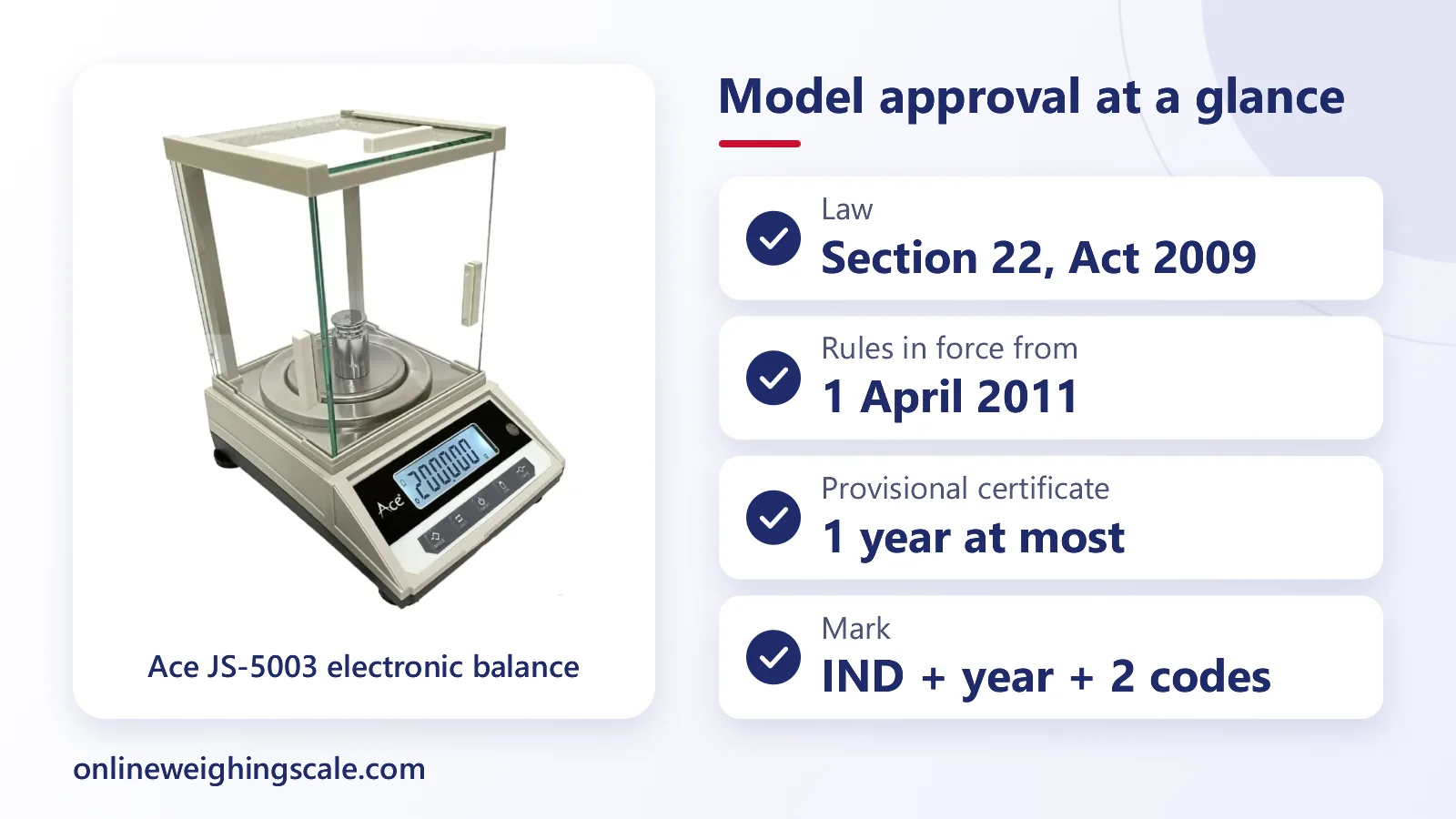
Where testing is likely to take more than three months, rule 6(8) lets the Director issue a provisional certificate so the maker can manufacture at his own risk. Rule 8(7) says a provisional certificate stays valid for no more than one year, though the Central Government can extend it. If the model then fails, instruments sold under the provisional certificate have to be withdrawn at the manufacturer's cost.
A tested model stays at the laboratory until the applicant collects it. Under rule 6(7), a model not removed within six months of the certificate being granted or refused is forfeited to the Central Government.
What the Certificate and the Mark Show
Rule 11 lists what a certificate carries: its number, a short description of the model, the mark assigned, the category of weight or measure, a statement of the test results, any special conditions for making, verifying and using it, and the places where the verification seal or stamp may go. It takes effect from its publication in the Official Gazette, and the Director has it published there.
Under rule 12, the mark has the letters IND, the last two digits of the year of issue, the code number of the laboratory and the code number of the model. The mark goes on the model and on each instrument made to it, at the place the certificate names. Rule 8(8) assigns each approved model a code number, and rule 8(9) says that other denominations built on the same principles and with the same materials need no fresh approval.
So a buyer can read an approval from the instrument itself. The certificate number and mark are public, and the plate or label of an approved scale should carry the model approval mark.
Model Approval Rules at a Glance
The table gathers the points above from the 2011 rules, read in the Government of West Bengal copy.
| Point | What the rules say |
|---|---|
| Applicant | Manufacturer or importer, to the Director (rule 5) |
| Tested by | A recognised laboratory (rules 4 and 6) |
| Provisional certificate | Valid no more than one year unless extended (rule 8) |
| Effective from | Publication in the Official Gazette (rule 11) |
| Mark | IND, two digits of the year, laboratory code, model code (rule 12) |
| Ends by | Revocation or suspension (rules 13 and 14) |
How Long It Lasts: Validity, Changes and Revocation
The text of the 2011 rules that Omace Brands Private Limited read for this guide sets a period only for a provisional certificate, which is one year. It gives no fixed period for a full certificate. The Department of Consumer Affairs may amend that, so ask the department or the maker for the current position on any certificate you rely on (checked November 2026).
A certificate can end sooner. Rule 13 allows revocation if the model no longer complies with the units in the rules or the standards in force, if defects in reliability, accuracy or performance are generally noticed in use, if the manufacturer breaks the conditions of the certificate, or if the approved design or circuit diagram is significantly altered. Rule 14 lets the Director suspend a certificate, and rule 15 has such orders published. After revocation, production stops from the date in the order, and rule 20 suspends the state licence to make or import that instrument.
If a maker changes a material, rule 18 asks him to send the substitute material to the Director within seven days of first using it, and the laboratory may then treat it as a new model.
What Happens Without Approval
Rule 20(1) says a State Government must be satisfied that the Central Government has granted a certificate before it issues a licence to manufacture or import a weight or measure. So a scale without an approved model cannot be made or imported under a valid licence. Section 32 of the Act separately sets a penalty for failing to submit a model for approval, and later laws have amended the penalty provisions, so read the current text before quoting an amount.
Practically, an OEM buyer should not buy scales from a maker who cannot show the approval, however good the price. The same goes for a dealer. A trade scale also needs verification before use, as explained in the stamping charges guide, and the legal for trade note explains what that phrase means.
How a Buyer Can Ask for the Approval
Ask the maker or importer in writing for the certificate copy and the model code, then check that the model and its denominations match the scale you are buying. The certificate is published in the Gazette, and the mark IND with its year and two code numbers is on the instrument. Check the capacity and class too, because a certificate for one design does not cover a different principle or material.
Omace Brands Private Limited, which manufactures scales at Bagru, Jaipur, answers such requests through its contact page. Name the model you are asking about and say whether you are an OEM buyer, a dealer or a user.
This is general information about the rules, not legal advice. For your own licence or import, ask the Legal Metrology department of your state or the Department of Consumer Affairs.