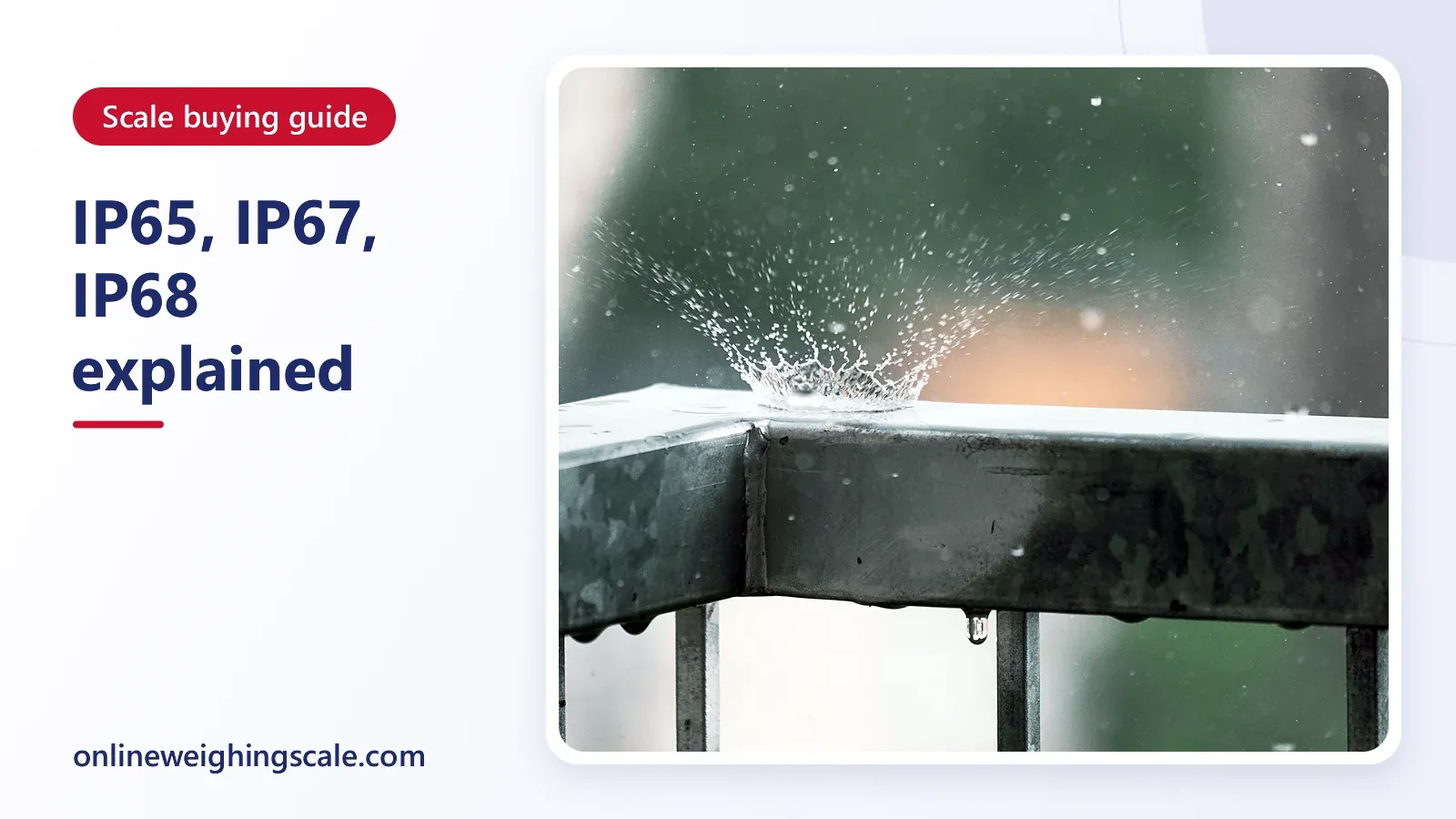
An IP rating for a weighing scale is a two-digit code from IEC 60529 that says how well its body resists dust and water. The standard covers electrical equipment with a rated voltage up to 72.5 kV.
The code is useful because a shop-floor word like "waterproof" promises nothing in particular. A fish counter, a dairy collection point and a chemical store all get wet in different ways, and each way matches a different digit. This guide reads the code digit by digit, then maps it to real places in India where a kanta gets washed, splashed or left in the rain.
What the two digits in an IP rating mean
The IP Code is defined by IEC 60529, the international standard titled Degrees of protection provided by enclosures (IP Code). The IEC page states that the standard classifies enclosures for electrical equipment with a rated voltage not exceeding 72.5 kV, which covers every digital scale and indicator sold in India. The Bureau of Indian Standards lists the Indian adoption as IS/IEC 60529:2001, Degrees of protection provided by enclosures (IP Code).
The first digit rates protection against solid objects and dust. The US Department of Homeland Security reproduces the levels of the standard in an appendix to a 2024 market survey report. In its table a 5 means dust protected, where dust is not entirely prevented but does not enter in enough quantity to interfere with satisfactory operation, and a 6 means dust-tight, with no ingress of dust.
The second digit rates protection against water. The same DHS table starts with vertically dripping water at 1 and climbs through spraying (3), splashing from any direction (4), jets from a 6.3 mm nozzle from any direction (5), powerful jets (6), temporary immersion (7) and continuous immersion (8).
Two details matter when you read a datasheet. The digits describe water in general, so the rating says nothing on its own about salt water, oils or solvents. The immersion levels also answer a different question from the jet levels. In the table, 7 and 8 describe being under water and 5 and 6 describe being hit by jets, so a scale tested for immersion may not have been tested for jets. Some datasheets list two codes for one product for this reason.
IP54, IP65, IP66, IP67 and IP68 in one table
The table below puts the common codes side by side. The wording is a plain summary of the levels in the DHS table of IEC 60529. Ask the maker for the full test conditions behind any code.
| Code | Dust | Water | What it survives on a scale |
|---|---|---|---|
| IP54 | Dust protected | Splashing from any direction | Splashes and wet hands. No hose. |
| IP65 | Dust-tight | Water jets from a nozzle | Gentle hose rinse from a distance. |
| IP66 | Dust-tight | Powerful water jets | Heavy hosing during cleaning. |
| IP67 | Dust-tight | Temporary immersion | A dip or a flooded floor. Jets are not promised. |
| IP68 | Dust-tight | Continuous immersion, more severe than for 7 | Depends on what the maker wrote down. |
The 5 level in the DHS table uses a 6.3 mm nozzle. Level 7 means the enclosure is temporarily immersed under standard conditions of pressure and time. The full test values sit in the standard itself.
IP65 vs IP67: which one survives a hose
Many buyers assume IP67 is simply better than IP65. The standard treats them as answers to different questions. IP65 asks whether the scale survives jets of water. IP67 asks whether it survives being underwater for a short time. A scale marked only IP67 has not necessarily been tested against a jet, so a shop that hoses its counter every evening should look for 65 or 66 in the water digit, or a double code that lists both.
For a fish or meat counter the usual risk is a hose or a bucket thrown across the floor, not a dive. An IP65 or IP66 body fits that. For a scale that may stand in a flooded drain or be dropped in a tank, IP67 matters more. Many makers fit a single enclosure that carries both a jet code and an immersion code, and printing both on the datasheet is the honest way to show it.
IP68 weighing scale: read the small print
IP68 sounds like the top of the table, but the digit alone does not give the depth or the time. In the DHS table an 8 means the equipment is suitable for continuous immersion in water under conditions more severe than for a 7. Two IP68 scales can therefore differ, and the datasheet has to say how.
The practical rule is simple. Treat "IP68" as an incomplete sentence until the datasheet gives the depth, the duration and the water type. A weighing scale also has a cable running from the load cell to the display, and that cable entry is the usual weak point, so ask whether the rating covers the cable and the connector as sold.
Washdown scale: match the rating to your cleaning
A washdown scale is built to be cleaned with water on the production floor. Some datasheets quote a level above IP68 for hot, high-pressure washing. This post does not explain that level, because no authority page read for it defines the test. If your cleaning uses hot pressure water, ask the maker to state the test in writing. Whatever the code, check that the display, charging port and keypad share the same rating as the platform.
Which rating suits which place
These are practical starting points, not rules from the standard. Match the real water on your floor to the second digit, then ask the seller to confirm it in writing.
- Fish and meat shop: machhi and mutton counters are rinsed with a hose and a bucket several times a day, so look for IP65 or IP66 at least. A waterproof weighing machine for a fish shop also has to survive salt and slime, which the IP Code does not test, so the steel grade below matters as much as the digits.
- Dairy and sweet shops: daily wipe-downs and the occasional spill suggest IP54 to IP65, with a smooth stainless surface that cleans easily.
- Chemical store or plant: the IP code covers water and dust only. Acids, solvents and oils need a separate chemical-resistance answer from the maker, and the scale area may also need a rating for explosive atmospheres, which is a different standard.
- Outdoor mandi or farm gate: monsoon rain and dust call for IP65 as a sensible floor. Shade for the display helps more than any digit.
- Dry godown and counter: IP54 is usually plenty. A plain scale with no rating often does the job, and it costs less.
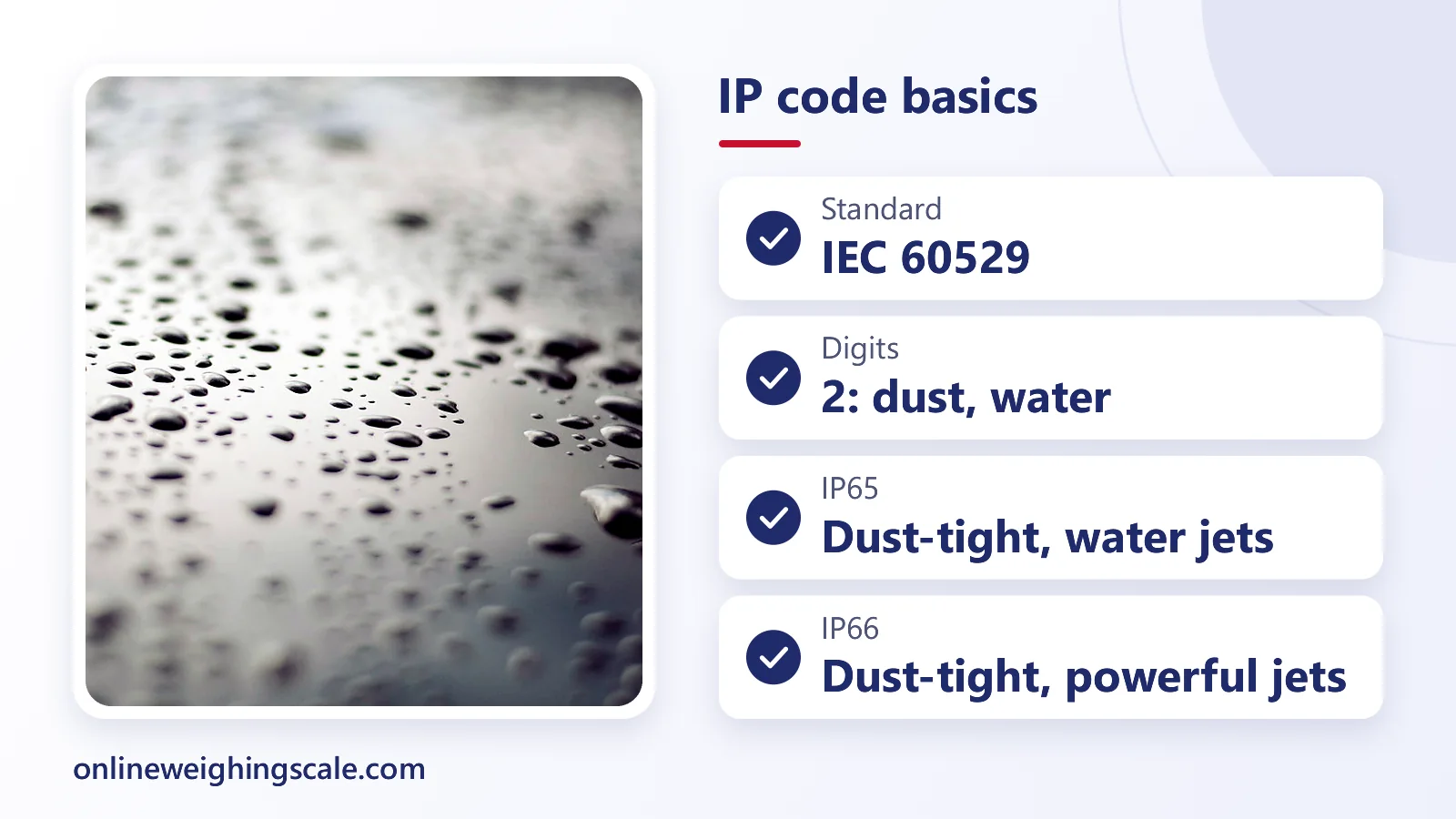
Why "waterproof" alone means nothing
IEC 60529 classifies enclosures by numbered degrees of protection. Under that system a product is rated at a stated level against a stated test, and the word "waterproof" does not appear among the levels in the DHS table. A listing that says waterproof weighing scale without a code leaves out the depth, the duration, the nozzle and the water type.
An IP rating also describes the enclosure when the product is new. A cracked cover, a worn rubber gasket or a loose cable gland removes the protection, and the scale does not tell you when that happens. The rating is a starting point and not a lifetime promise.
Stainless steel in one paragraph
Stainless steel is rust-resistant and not rust-proof, and grades differ in how well they stand up to salt and cleaning chemicals. This is general advice, since the IP Code does not test it. For fish, brine and sea-coast shops, ask which grade the platform and the pan are made from, and ask the seller to put it in writing, because a glance cannot tell you.
Caring for a washdown scale
- Close the charging port cover and any battery door before cleaning, and point the hose away from the display.
- Rinse off salt, blood and strong cleaners after use. Salt is hard on stainless steel.
- Dry the pan and wipe the display. Standing water under the pan creeps toward the load cell.
- Do not point a pressure washer at a scale unless the maker says its rating allows it.
- Check the rubber seals and cable entry every few months and replace anything cracked.
- If readings drift after a soaking, read the causes in our guide to a weighing scale that is not working before opening anything.
A stamped trade scale is sealed, so a shop owner should not break the seal to dry the inside. Omace Brands Private Limited repairs its commercial scales when the buyer asks. The buyer pays shipping both ways and the repair cost, and spare parts depend on availability, so ask first through the contact page.
What an IP code does not tell you
An IP code says nothing about capacity, step size or platform size, and those decide whether a scale fits the job. The industrial scale buying guide covers capacity and accuracy, and the platform weighing scale range on the store lists each model with its specifications. This post was written by Omace Brands Private Limited, which has made scales in Bagru, Jaipur since 1994 (see about us).
An IP code also does not replace legal metrology. A scale used for trade in India still needs stamping, explained in the legal for trade guide.
Questions to put to the seller before you pay
- What is the full IP code, with both digits, and is it printed on the product or only in an advertisement?
- Does the rating cover the display, keypad, charging port and cable, or only the platform?
- If it says IP68, what are the depth, the time and the water type?
- Which stainless steel grade are the pan and platform?
- Who repairs the scale after water damage, and what does it cost?
Ask any seller to answer all five in writing. A seller who only repeats "waterproof" has not told you anything you can hold them to.