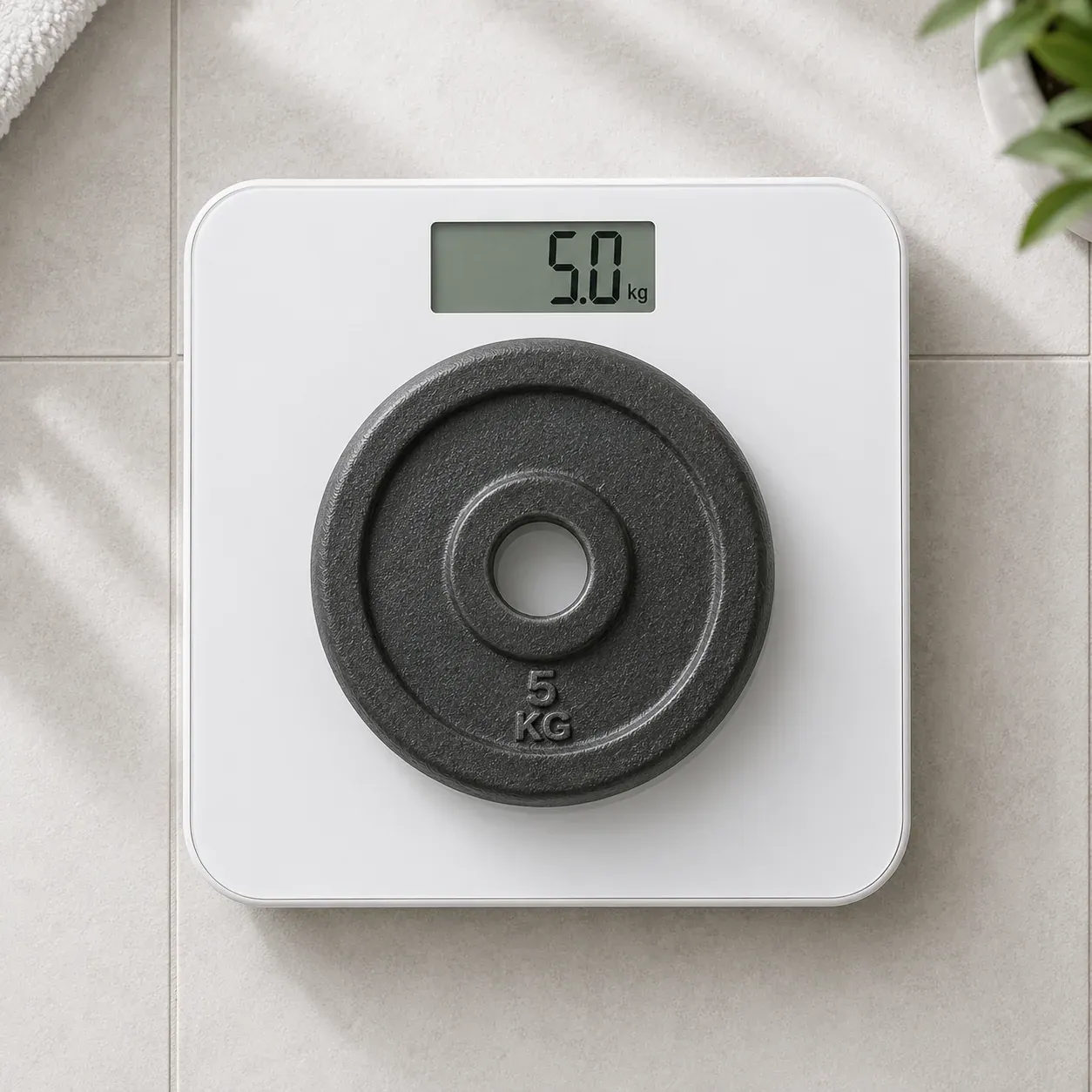
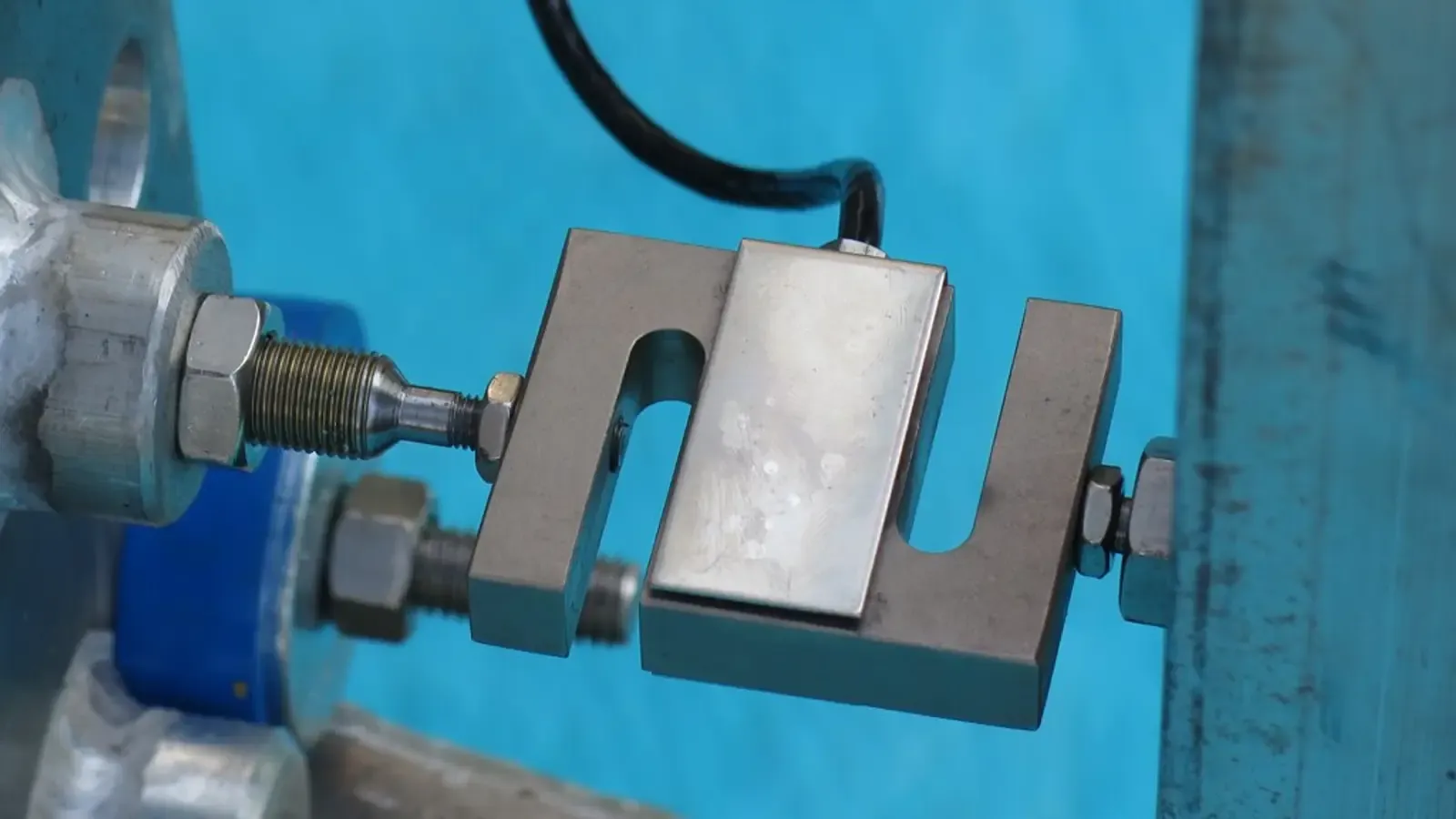
A load cell is the sensor inside a digital weighing scale that turns force into an electrical signal. A typical strain gauge load cell gives 2 millivolts per volt of supply at full load, according to the UK National Physical Laboratory's Guide to the Measurement of Force. Omace Brands Private Limited fits load cells in every digital scale it makes at Bagru, Jaipur.
What a load cell is
OIML R 60, the international recommendation on load cells, defines one as a force transducer that measures mass by converting it into another measured quantity, after allowing for gravity and air buoyancy at the place of use. In everyday terms, a load presses or pulls on a small block of metal, the metal bends by a tiny amount, and electronics read that bend as kilograms. Gravity appears in that definition because a scale senses force and shows mass, as the post on how mass differs from weight explains.
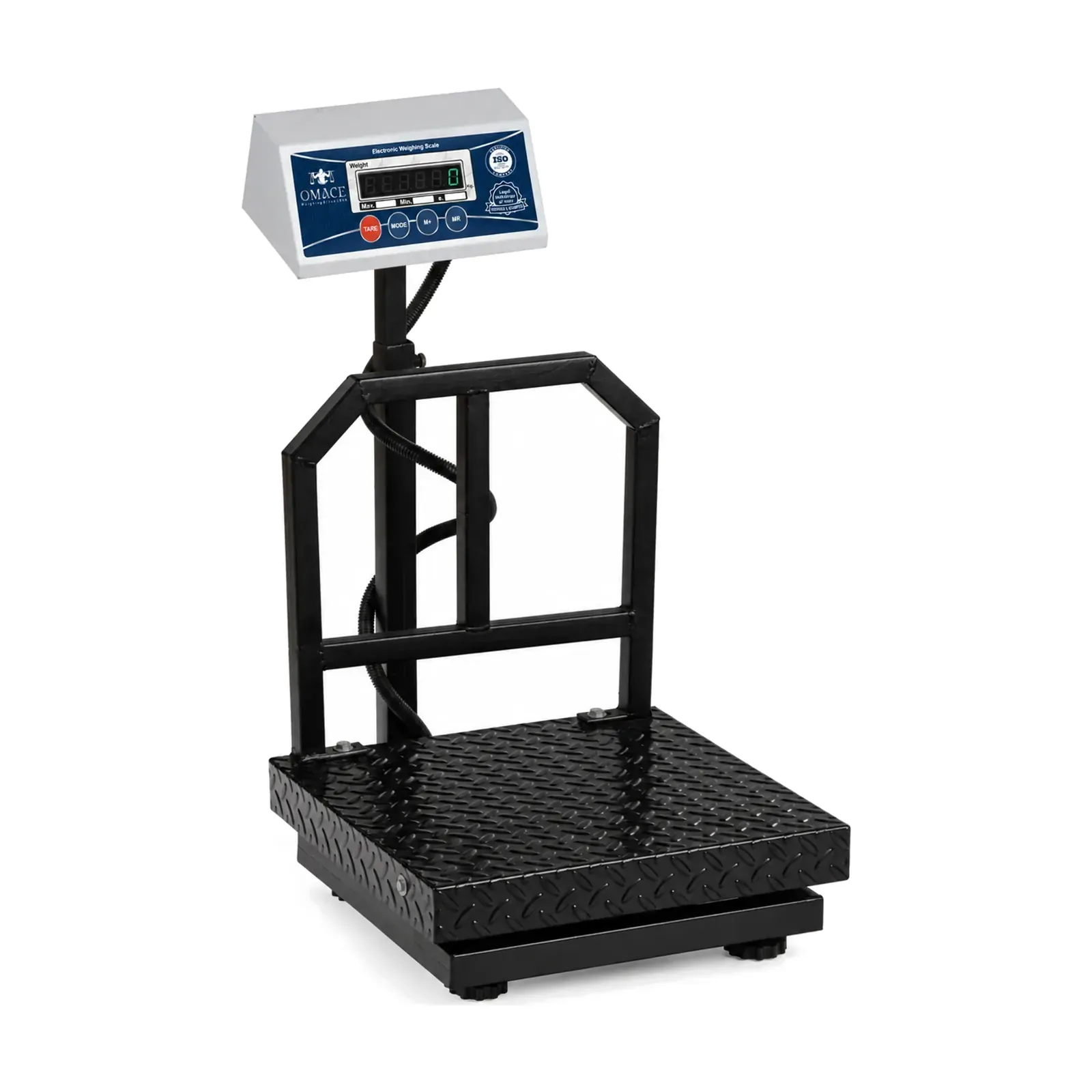
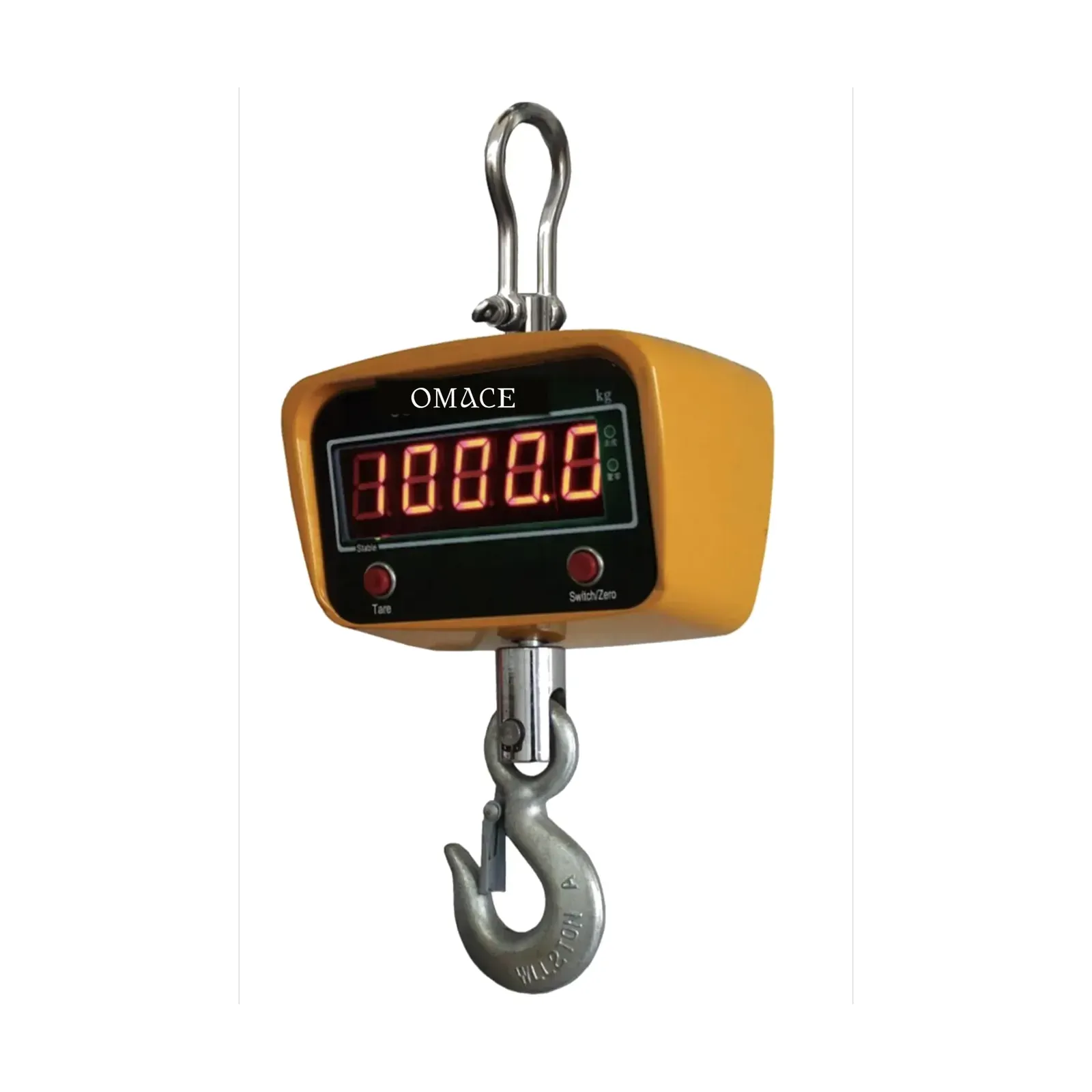
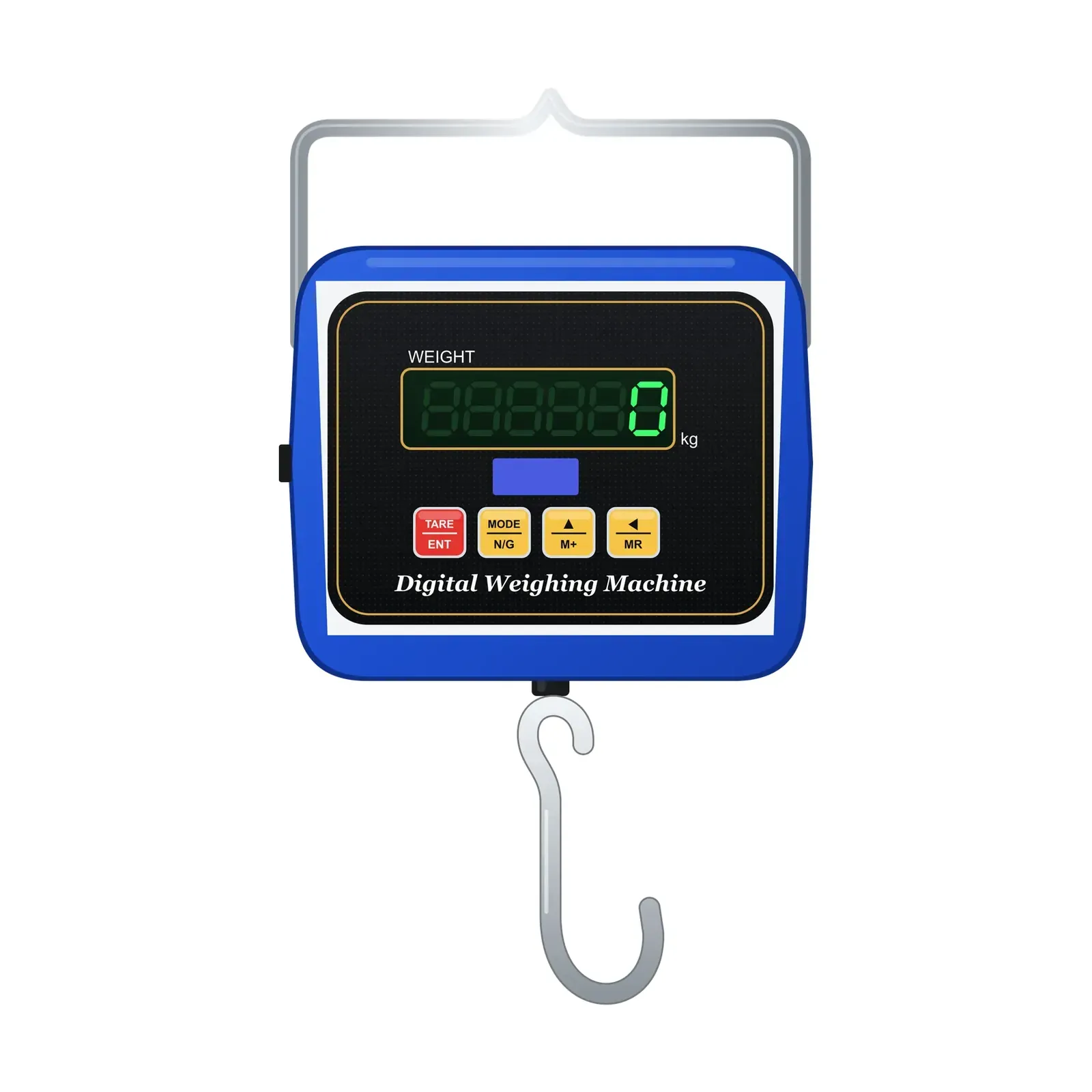
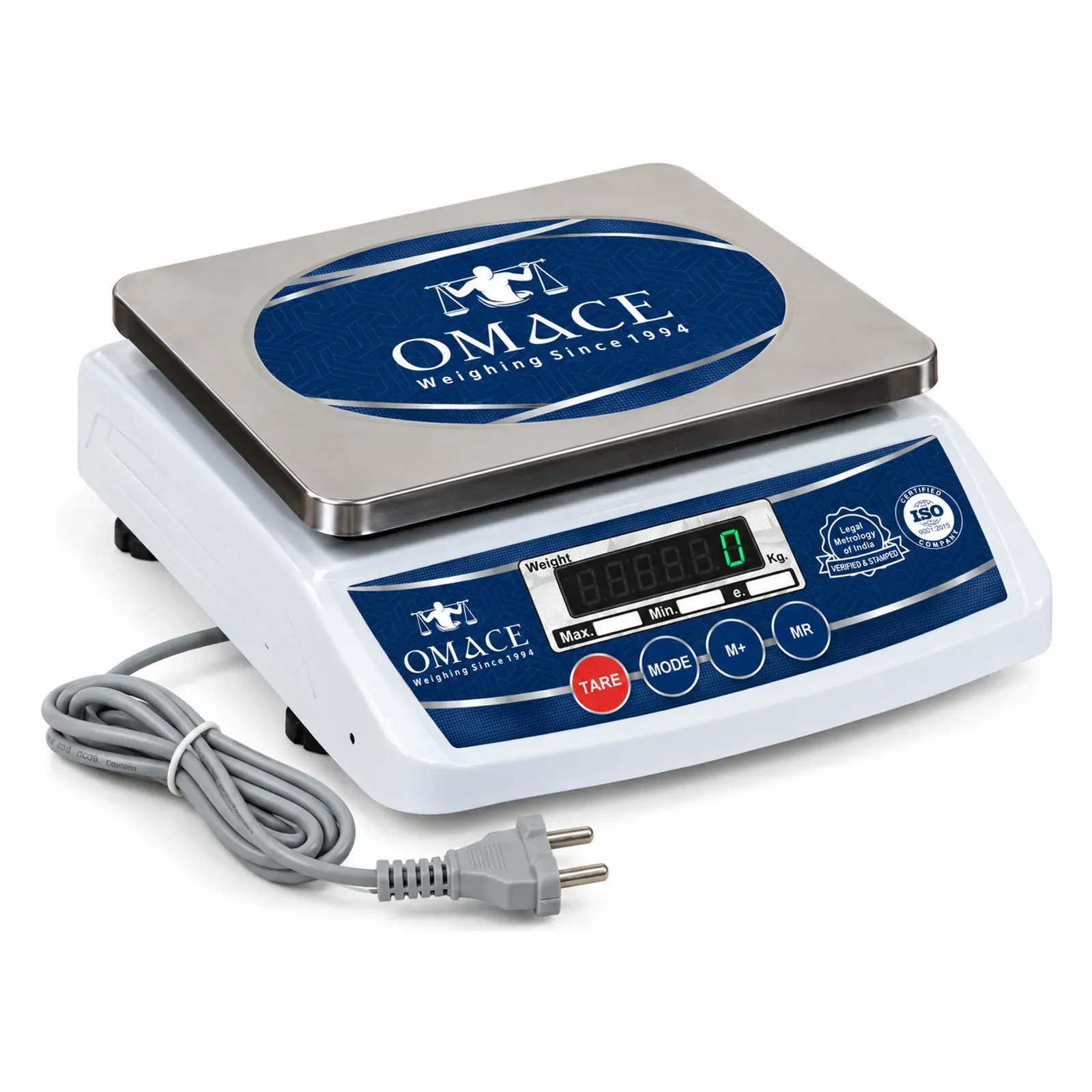
The NPL guide treats "load cell" as the common name for a force transducer and says strain gauge types are the most common on the market. One or more of them sit under the pan of a shop kanta, inside a hanging weighing scale, under the deck of a platform weighing scale and beneath a weighbridge. Factories also build load cell weighing systems for batch mixing, lorry loading, packing and vessel filling. A mechanical dial scale or a tubular spring balance works on a spring instead, so it has no load cell and needs no battery.
How a load cell works
The working principle has four stages, from bending metal to a number on the display.
- The load bends a spring element. This metal block is usually tool steel, stainless steel, aluminium or beryllium copper, picked because its strain follows the force closely with low hysteresis and low creep.
- Strain gauges follow the bend. A foil gauge is a metal pattern 2–5 µm thick on a backing 10–30 µm thick, bonded to the block. Stretching makes the conductor longer and thinner, which raises its electrical resistance.
- A Wheatstone bridge turns resistance into voltage. Four gauges normally form the bridge, half in compression and half in tension. Temperature acts equally on all four, so its effect stays small.
- Electronics read the voltage. The cell needs a steady excitation voltage, and its output is amplified before the indicator shows a value. Calibration against known weights ties that value to kilograms. OIML R 76 calls a cell with its own amplifier and analogue-to-digital converter a digital load cell.
The signal is very small. Take a 30 kg cell with 2 mV/V output on a 5 V supply as a worked example: full load gives 10 mV. A scale that shows 30 kg in 5 g steps has 6,000 steps, so each step is about 1.7 microvolts. A signal that small is why weak batteries, loose wires and damp connectors can make a reading wander.
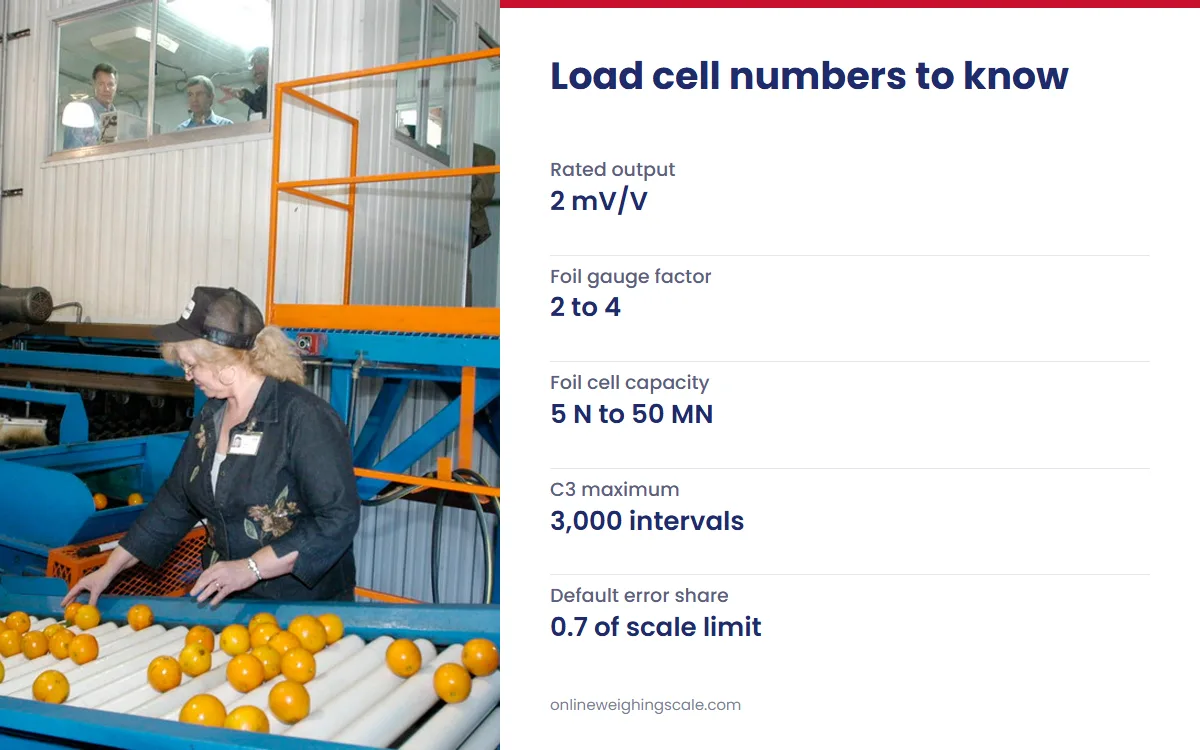
Foil gauges are the most widely used type and sit in the majority of precision load cells. Their gauge factor, which is the output for a given strain, is typically 2 to 4. Semiconductor gauges reach 100 to 150, but their output is non-linear with strain and they need careful temperature matching.
Types of load cells
Load cells are sorted two ways: by how the force is sensed, and by the shape of the metal element. The table covers the first sort, using Table 3 of the NPL force guide. The mass column is a rough conversion added for scale users, at about 102 g per newton.
| Type | Typical capacity | In mass, about | Typical uncertainty | Best fit |
|---|---|---|---|---|
| Foil strain gauge | 5 N to 50 MN | 0.5 kg to 5,100 t | 0.02–1% of reading | Most digital scales and process weighing |
| Semiconductor strain gauge | 0.01 N to 10 kN | 1 g to 1 t | 0.2–1% of reading | Small forces with a high output signal |
| Hydraulic | 500 N to 5 MN | 51 kg to 510 t | 0.25–5% of reading | Sites with no power or an explosive atmosphere |
| Pneumatic | 10 N to 500 kN | 1 kg to 51 t | 0.1–2% of reading | Air pressure read on a dial |
| Piezoelectric | 1.5 mN to 120 MN | 0.15 g to 12,200 t | 0.3–1% of reading | Fast, changing forces such as impacts |
| Force balance | 0.25 N to 20 N | 25 g to 2 kg | 0.0001% of reading | Laboratory balances |
Strain gauge load cells by shape
Figure 4 of the same guide lists the usual shapes and their rated capacities. Each element is designed to measure force along its main axis and to ignore side loads.
- Double-bending beam: 5 N to 10 kN, about 0.5 kg to 1 t.
- S-beam: 50 N to 50 kN, about 5 kg to 5 t.
- Shear beam: 1 kN to 500 kN, about 100 kg to 51 t.
- Double-ended shear beam: 20 kN to 2 MN, about 2 t to 204 t.
- Ring: 1 kN to 1 MN, about 100 kg to 102 t.
- Compression or tension cylinder: 50 kN to 50 MN, about 5 t to 5,100 t.
The direction of the load matters as much as the shape. Hanging and crane scales pull on the cell, so it works in tension, while bench and platform scales load it from above. OIML R 60 has separate marks for tension and compression on the cell's classification.
Hydraulic load cells
A hydraulic load cell is filled with a liquid, usually oil, under a pre-load pressure. Force on the loading member raises the fluid pressure, which a transducer or dial gauge reads. With a pressure transducer the cell deflects only about 0.05 mm at full force. Most hydraulic cells fall between 500 N and 200 kN, about 51 kg to 20 t. They need no external power, which suits potentially explosive atmospheres. The NPL guide quotes around 0.25% uncertainty at best and 0.5–1% for a whole system, and temperature can shift them by 0.02–0.1% per °C.
Pneumatic load cells
A pneumatic load cell applies the force to one side of a piston or flexible diaphragm and balances it with air pressure on the other side. That counter-pressure is proportional to the force and shows on a pressure dial. The working principle is close to the hydraulic type, with air in place of oil.
Piezoelectric, capacitive and force balance types
A piezoelectric cell uses a crystal, today mostly artificial quartz, that produces an electric charge in proportion to the force. A small leak of charge makes the signal drift, so the NPL guide says these sensors suit dynamic work and cannot take truly static measurements. That makes them a poor fit for a sack resting on a platform.
A capacitive cell senses the changing gap between two plates as the spring moves, and the guide mentions it in small domestic scales. A force balance sends current through a coil in a magnet's field until the restoring force matches the load. The same idea sits inside an analytical balance.
Accuracy classes and what C3 means
OIML R 60 ranks load cells into four accuracy classes, A to D, by the number of verification intervals each cell can divide its range into. Each class has the same interval limits as the matching scale class in OIML R 76.
| Load cell class | Lower limit | Upper limit | Scale class with the same limits |
|---|---|---|---|
| A | 50,000 intervals | Unlimited | I, special accuracy |
| B | 5,000 intervals | 100,000 intervals | II, high accuracy |
| C | 500 intervals | 10,000 intervals | III, medium accuracy |
| D | 100 intervals | 1,000 intervals | IIII, ordinary accuracy |
C3 means class C with a maximum of 3,000 intervals. R 60 gives C3 5/35 as a full example: class C, 3,000 intervals, compression, usable from +5 °C to +35 °C. A temperature mark is needed only when the limits differ from −10 °C to +40 °C. The letters NH mean the cell was not put through the humidity test.
The cell does not get the scale's whole error allowance. R 60 assumes an apportionment factor of 0.7 unless the certificate says otherwise, so the cell may use 70% of the allowed error, and makers may declare between 0.3 and 0.8. Annex F of OIML R 76 also expects a separately tested cell to have at least as many intervals as the scale. A 30 kg scale in 5 g steps has 6,000 intervals, so that check needs a cell rated for 6,000 or more. R 60 itself says a measuring instrument need not use a separately approved load cell.
Load cell specifications worth reading
R 60 judges a cell's errors together as one total error envelope, but a data sheet lists them one by one. These are the lines that tell you most.
- Capacity and safe load limit: R 60 expects the maximum capacity, minimum dead load and safe load limit to be marked or supplied with the cell.
- Rated output: this is the output at rated capacity minus the output at zero force, usually 2 mV/V.
- Non-linearity and hysteresis: non-linearity is the drift from a best-fit straight line, and hysteresis is the gap between rising and falling loads, usually largest at mid-range.
- Creep: this is the change in output over time under a steady force. The NPL guide gives 0.03% of rated output over 30 minutes as an example figure.
- Temperature effect: a strain gauge cell has one coefficient for zero and another for full-scale output, so both need checking if the site gets hot.
- Repeatability: this is the agreement between outputs when one force is applied again and again.
What damages a load cell
Overload comes first. The NPL force guide warns that overloading can at the very least compromise a cell's calibration, especially under dynamic loading, so dropping a heavy sack on a pan does more harm than setting it down slowly. Side loads and off-centre loads are next, because the element is built to read along one axis. Damp is another risk, since the guide lists protection of the gauges against humidity among the things that decide a cell's reliability. Heat changes matter too, and the guide advises letting a system settle into its surroundings before accurate work.
A damaged cell usually gives itself away. The reading will not return to zero, it creeps under a steady load, or it changes as the load moves around the pan. To test this, the NPL guide on mass and weight places a weight of about half the capacity at the edges of the pan and compares each reading with the centre.
Recalibrate before you blame the cell, using the steps in how to calibrate a digital weighing scale. Calibration corrects a wrong span. It cannot straighten a bent element or dry out a damp bridge, and those faults need a repairer.
How to choose a load cell for a weighing job
- Capacity: pick a cell that stays within its design range, and allow for shocks and overload events as well as the normal load.
- Direction: use a tension cell for a hanging load and a compression or beam cell for a load from above.
- Number of cells: a cell at every loading point reduces uncertainty and limits off-centre error. The NPL guide calls weighing with one active cell on a three-legged tank usually poor, because the centre of gravity moves.
- Uncertainty needed: the same guide says 5–10% of full-scale output is frequently acceptable for crane overload protection, and most other uses need 0.1–2%. An overload alarm and a crane scale are different jobs.
- Whole scale or loose cell: most buyers need a finished scale, where the maker has already matched cell, electronics and capacity. Choose from crane scales by capacity and step. The Omace OCS crane scale runs from 1 to 50 tonnes, with 40 and 50 tonnes built on buyer request.
Load cells in Omace scales
Omace Brands Private Limited manufactures scales at G-29 RIICO Industrial Area, Bagru, Jaipur. The company has been in the weighing trade since 1994. It fits load cells in every digital scale it makes. Every scale is checked with certified test weights before dispatch.
Omace shop, platform, chicken and crane scales leave Bagru verified and stamped by Legal Metrology, and the stamp is valid across India. Stamping is compulsory on platform and crane scales. Every Omace digital scale opens calibration mode when TARE is held for about 5 seconds. A stamped trade scale is sealed, so a registered repairer recalibrates it.
As a manufacturer, the company holds ISO 9001:2015, ISO 13485:2016, an EU MDR quality certificate, a CE certificate of compliance and a US FDA compliance certificate. Omace scales are made in India. A scale that reads wrong is replaced under warranty, and the retail warranty runs 2 years on manufacturing defects.
Where to read next
A load cell is one part of a chain, and the rest of the chain decides what you see on the display. The guide to types of weighing scale shows which designs use a load cell and which use a spring. If you already know the capacity and step you need, start from the category for your job, and treat the cell's class as one more question to ask the maker.