A spring balancer is an overhead tool support: a spring-loaded drum and cable that carries a hand tool's weight, so the worker only guides it. The Canadian Centre for Occupational Health and Safety advises that tools used in one hand weigh 1.4 kg or less, and that heavier tools hang from a counterbalance. A spring balancer takes no measurement; the hanging weighing tool with a similar name is a spring balance.
What is a spring balancer?
A spring balancer, also sold as a tool balancer, hangs above a workstation from a beam, rail or trolley. Inside its housing a coiled flat spring turns a drum, and a steel wire rope wound on that drum carries the tool on a hook. The spring's pull is set to match the tool's weight. When the operator lets go, the tool stays roughly where it was left: at hand height, off the bench and clear of the floor.
Factories fit them wherever one worker picks up the same tool many times a shift. Common loads are screwdrivers and nut runners on car and two-wheeler assembly lines, spot-welding guns, grinders, spray guns and the large saws used in meat plants.
The main parts of a spring balancer are these:
- Housing and top hook: the body and its main suspension point.
- Drum and mainspring: the coiled spring stores the pull and turns the drum.
- Wire rope and stopper: the cable carries the tool, and a stopper clamped on it limits how far it retracts.
- Tension adjuster: a worm gear or ratchet that raises or lowers the spring's pull.
- Safety eye: a second point for a secondary wire or chain to a separate anchor.
- Drum lock or brake: on many models, a lock for tool changes and a brake that holds the drum if the spring breaks.
How a spring balancer works
A spring on its own pulls harder the further it is stretched. NCERT's Class 11 physics textbook states this as Hooke's law: the spring force is proportional to the displacement, F = −kx, where k is the spring constant in newtons per metre. That rule is exactly what a weighing spring balance needs, because a heavier load stretches the spring further and the pointer moves down the scale. In a tool support it is a nuisance, because the pull would change as the cable runs out and the tool would creep up or sink.
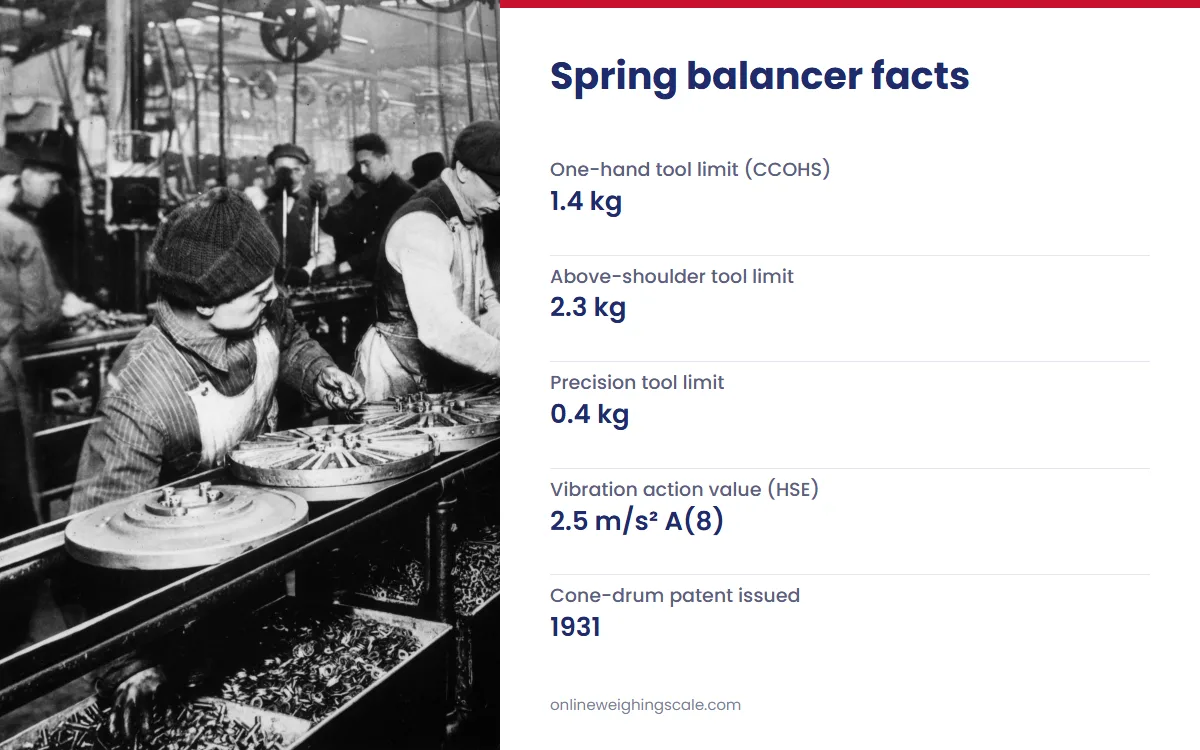
The fix dates back about a century. A US patent for a spring balancing device, filed in 1925 and issued in 1931, winds the cable on a drum shaped like a truncated cone, with a spiral groove. As the cable pays out it moves to a different radius on the cone, and the change in leverage offsets the change in spring force. The patent says a properly proportioned groove lets the device balance a given weight through any range of travel. Many balancers still use a tapered drum of this kind, so the pull stays close to even over the whole stroke.
That even pull gives the floating feel some sellers call zero gravity. The spring carries the weight, and the operator supplies only the small force needed to move the tool up, down or across.
Spring balancer vs spring balance
The two names differ by two letters and do opposite jobs. A spring balance is a weighing instrument: hang a load from its hook and the stretch of the spring shows the weight in kilograms. A spring balancer carries a tool and shows no reading at all. Its purpose is to cancel the tool's weight so the hand does not feel it.
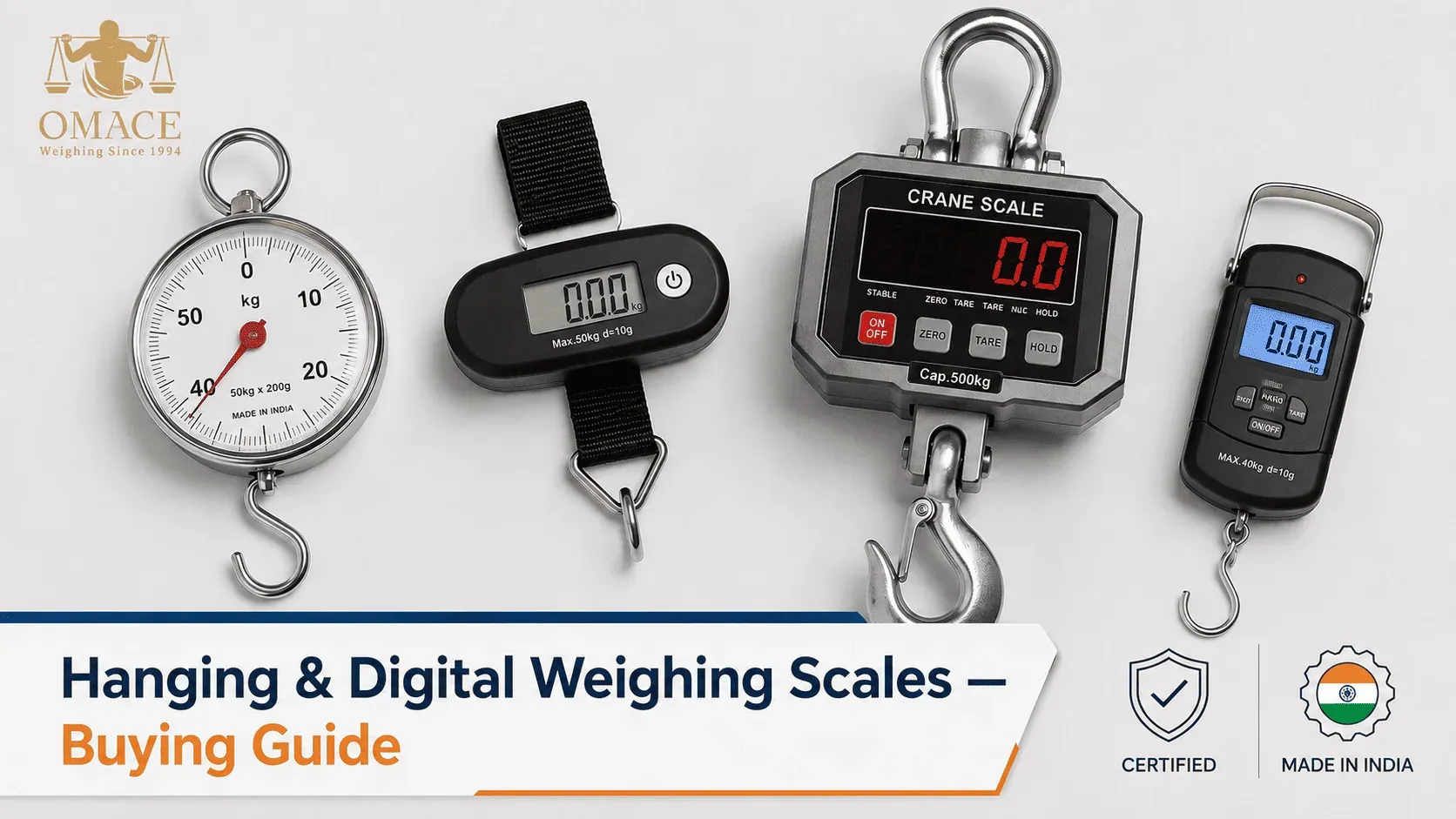
The names are easy to confuse in a search box, so a shopkeeper looking for a hanging kanta can land on a tool support, and a plant engineer looking for a tool support can be shown a weighing scale. Omace Brands Private Limited makes weighing scales, including spring balances, and does not make spring balancers.
| Point | Spring balancer | Spring balance |
|---|---|---|
| Job | Holds a tool so it feels weightless | Measures the weight of a hanging load |
| Reading | None | Weight on a dial or a tubular scale |
| Spring pull | Kept close to even over the cable's travel | Grows with stretch, as Hooke's law predicts |
| Where it hangs | Fixed above a workstation | From a hand, hook or tripod when needed |
| Typical users | Assembly lines, welding shops, meat plants | Shops, farms, homes and luggage checks |
Types of spring balancers
Makers' catalogues list spring balancers from about 0.5 kg up to roughly 200 kg of load, split into narrow bands so each spring works close to its design load. Within that spread, the designs differ mainly in what the tool does when it is let go.
| Type | How it holds the tool | When released | Best for |
|---|---|---|---|
| Tool retractor | Spring pull a little above the tool's weight | Tool rises back overhead | Light tools used now and then |
| Standard spring balancer | Spring pull set equal to the tool's weight | Tool floats where it was left | Screwdrivers, nut runners, small grinders |
| Heavy-duty spring balancer | Larger spring, drum lock and a brake if the spring fails | Tool floats where it was left | Welding guns, large saws, heavy drills |
| Air balancer | Pneumatic cylinder sized to the load | Tool holds or moves on air pressure | Heavy tools moved often |
| Articulating arm | Jointed arm fixed to a bench or column | Tool stays put; the arm takes the torque | Nut runners with high reaction torque |
Tool retractors
A retractor is the lightest kind. Its spring pulls slightly more than the tool weighs, so the tool rises back overhead when released. It suits light tools picked up now and then, such as a small screwdriver or an air blow gun, and it keeps hoses and cables off the bench. For a tool held for long spells, that steady upward pull tires the wrist.
Standard spring balancers
A standard spring balancer is set so its pull equals the tool's weight, and the tool floats wherever it is released within the stroke. This is the kind seen above most assembly stations. One unit covers a band of weights, and the tension adjuster trims it to the exact tool.
Heavy-duty and safety spring balancers
Heavy-duty units carry welding guns, large grinders and saws. They usually add a drum lock for tool changes, a brake that stops the drum if the spring breaks, and an eye for a secondary safety wire. A failed hook or cable under a heavy tool can cause a serious injury, so these features matter more as the load band rises.
Air balancers and articulating arms
Some supports use no spring at all. An air balancer holds the load on a pneumatic cylinder, and an articulating arm carries the tool on a jointed arm that also takes the twisting reaction of a nut runner. These suit heavier tools, or jobs where torque reaction strains the wrist. The CCOHS guidance names articulating arms, tool holders and straps alongside counterbalances as ways to support a heavy tool.
Why factories hang tools on balancers
Weight is the first reason. The CCOHS hand tool design guidance gives these limits for tools held in the hand:
| How the tool is used | CCOHS weight guideline |
|---|---|
| Precision work, for good control | 0.4 kg |
| Operated with one hand | 1.4 kg or less |
| Used away from the body or above shoulder height | 2.3 kg |
| Heavier than these limits | Support with a counterbalance, tool holder, articulating arm or straps |
Vibration is the second. The UK Health and Safety Executive's guidance L140 on the Control of Vibration at Work Regulations 2005 says balancers or tensioners help support a tool's weight and let it be used with light grip and feed forces. The same guidance explains that the harder a worker grips or pushes a vibrating tool, the more efficiently the vibration passes into the hand and arm. It names counter-balancers for heavy drills, grinders, nut runners and nailing guns, so that the operator does not support the machine's weight. Those regulations set a daily exposure action value of 2.5 m/s2 A(8) for hand-arm vibration.
The everyday gains are plainer. A hung tool waits at the same height every time, it is not dropped and damaged, and its hose stays off the floor where people trip on it.
How to choose a spring balancer and set the tension
- Total hanging weight: add the hose, cable, socket, bracket and anything else that hangs with the tool. Pick a balancer whose band contains that total, and never one whose top figure is below it.
- Stroke: measure how far the tool travels between its rest position and its lowest working point, and choose a cable travel that covers it with room to spare.
- Mounting: the beam, rail or trolley must carry the balancer, the tool and the jolt of a sudden drop, and there must be a separate anchor for the safety wire.
- Duty: a tool cycled every few seconds wears the cable and spring faster than one used a few times an hour, so check the maker's rating for continuous work.
- Surroundings: oil mist, washdown water, dust and heat all shorten cable life, so pick a housing suited to them.
Setting the tension takes a few minutes. The adjuster turns in different directions on different models, so keep the maker's sheet at hand.
- Hang the balancer from its main point and fit the safety wire to a separate anchor.
- Lock the drum, then hang the tool and its hose from the cable hook.
- Release the lock and adjust the tension in small steps until the tool stays put at mid-stroke.
- Move the tool to the top and bottom of its travel, and fine-tune if it drifts.
- Set the cable stopper so the tool rests within easy reach, below shoulder height.
- Lock the drum or reduce the tension before taking the tool off, because a freed cable whips upward.
Spring balancer safety and inspection
A balancer holds a heavy object over a person's head and hands, so the way it fails deserves attention. On 21 May 2024 the Health and Safety Executive for Northern Ireland issued a safety alert after a retractable-wire tool balancer failed at a meat plant. The wire cord snapped where the stop is crimped to it, and the suspended circular saw fell and struck an operator's arm.
HSENI treats tool balancers as work equipment under PUWER, the work equipment regulations, which call for suitable equipment, a maintenance and inspection regime, trained staff and a risk assessment. A balancer attached to a crane that lifts and moves a load counts as a lifting accessory under LOLER. One fixed to an overhead beam to support a tool over a short range stays under PUWER. These rules apply in the UK, and the same split is a sensible way to judge any installation, including a balancer hung from the trolley of an EOT crane.
- Look along the cable before each shift, with extra care at the crimped stopper and the hooks.
- Replace any cable with kinks, broken strands or rust, and never knot or splice it.
- Run a secondary wire or chain from the balancer body to a separate anchor.
- Stay within the rated band, since an overloaded spring loses stroke and wears early.
- Leave spring repairs to the maker or a trained fitter, because a wound mainspring stores a lot of energy.
Weigh the tool before you choose a spring balancer
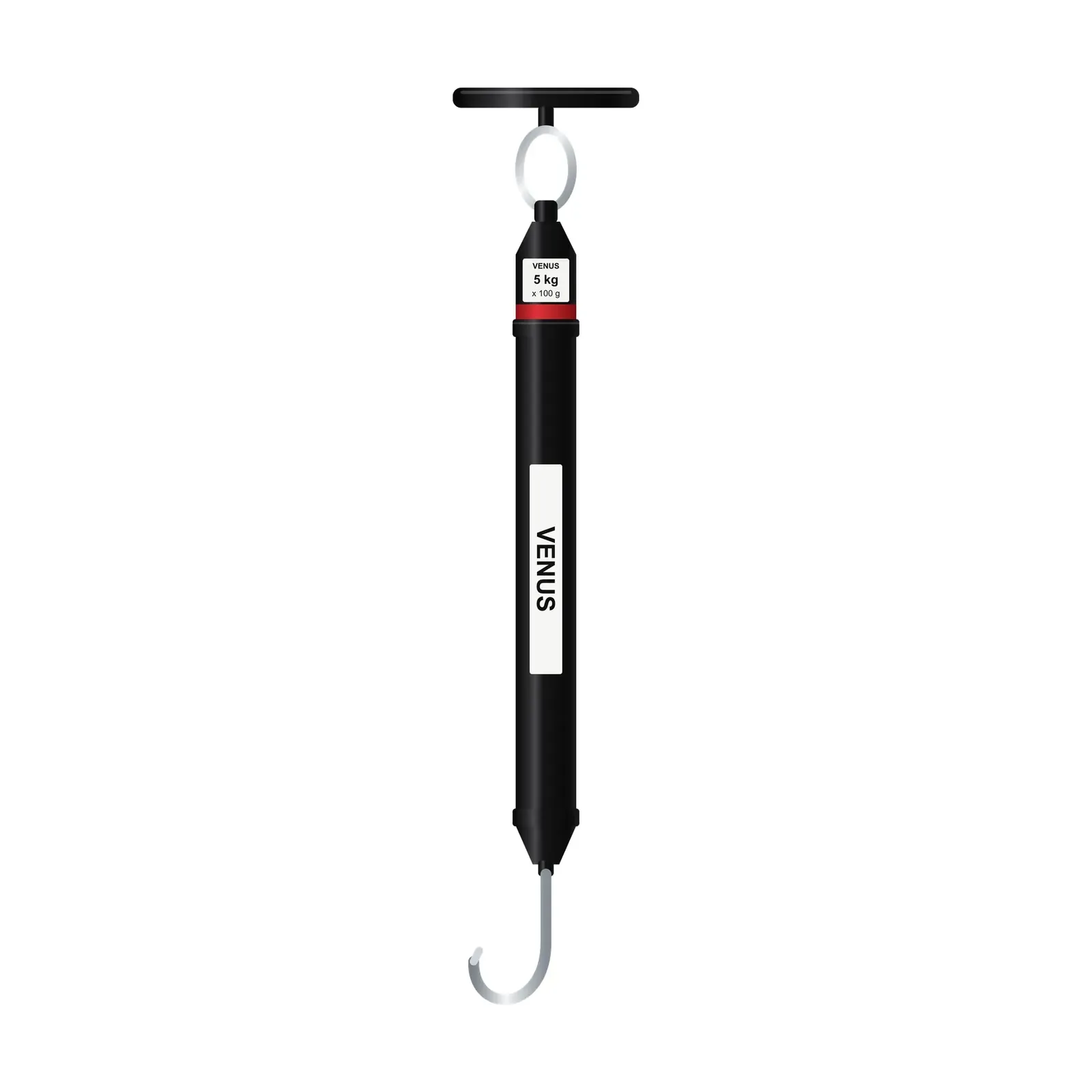
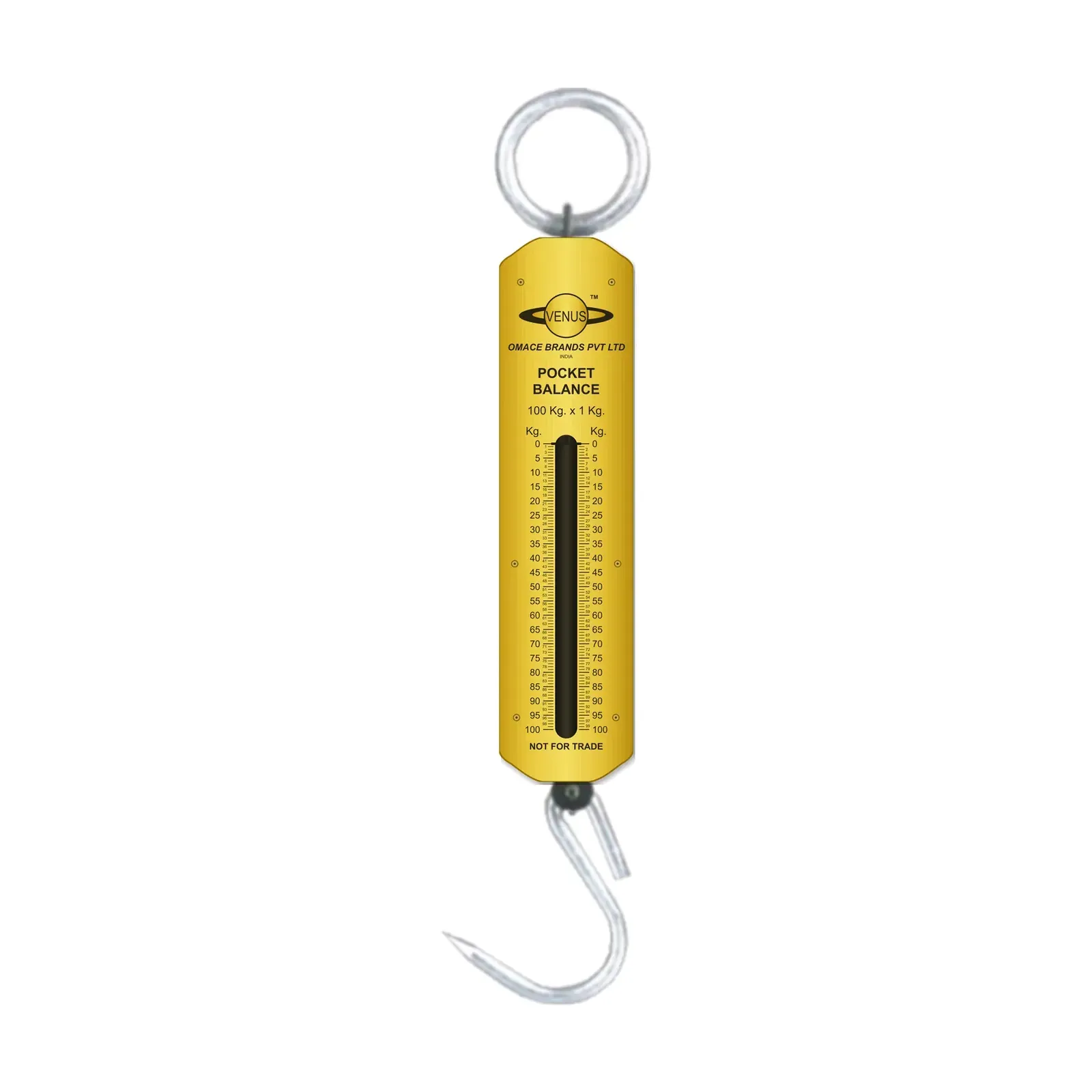
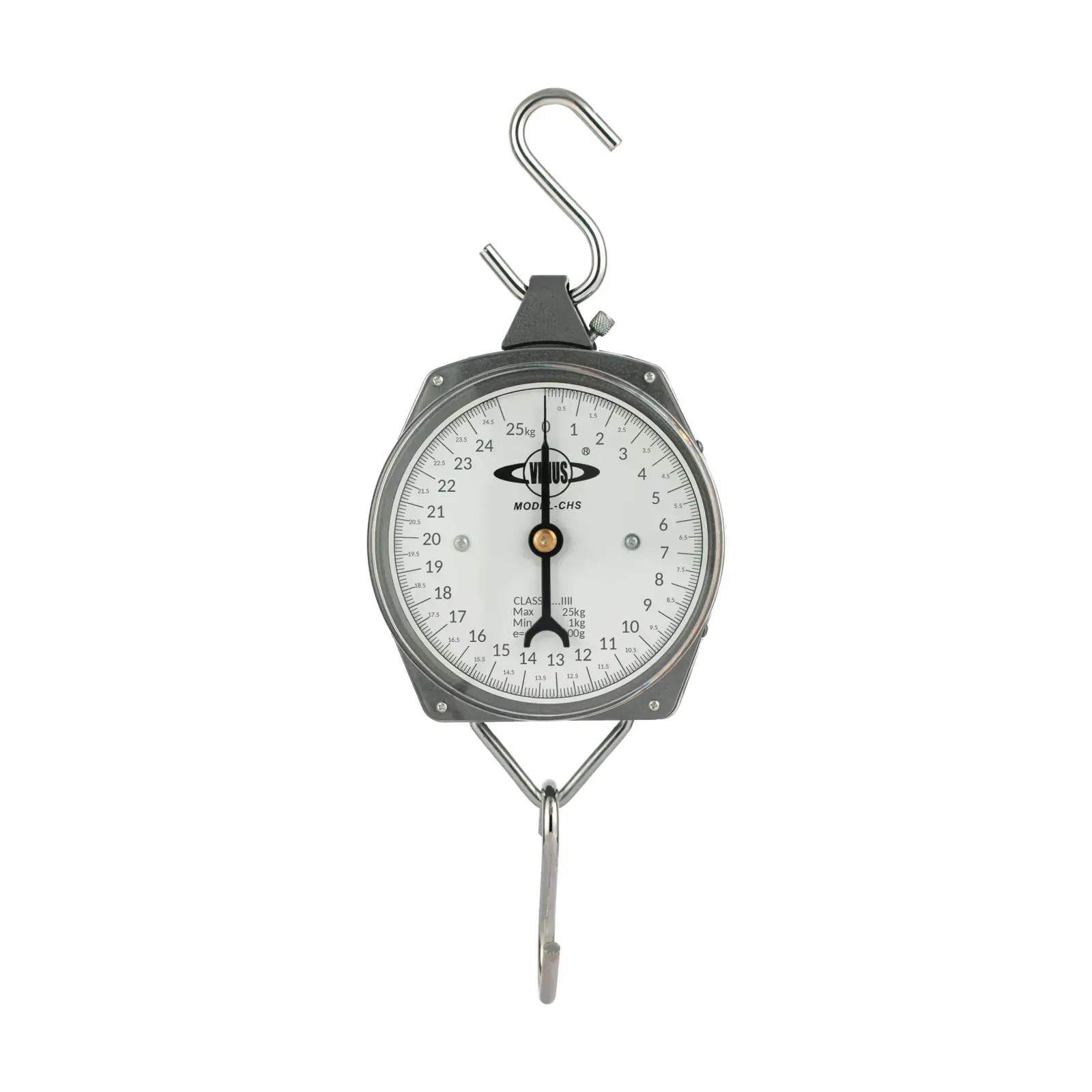
A balancer picked from the tool's catalogue weight often comes out wrong, because the hose, socket, cable and bracket add to the load. Hang the whole assembly from a weighing scale, exactly as it will hang at the station, and note the total. A tubular spring balance in 5 kg and 25 kg sizes covers screwdrivers, nut runners and most grinders, and it needs no battery. Welding guns and heavy saws need one of the hanging weighing scales that read up to 200 kg. Choose the balancer band that contains your reading, and weigh again whenever the tool, hose or attachment changes. Omace Brands Private Limited makes these spring balances and hanging scales in India, and each one leaves the factory calibrated.
Where a spring balancer earns its place
A spring balancer pays for itself when a tool is heavier than the CCOHS guidelines or has to be used above the shoulder. It also helps with light tools that are picked up many times an hour. A tool used a few times a day may only need a hook or a holster, and heavy reaction torque is better handled by an articulating arm. Whichever support you fit, it can only be as good as the weight it was set to, so start from the tool's true hanging weight and keep the cable inspected.