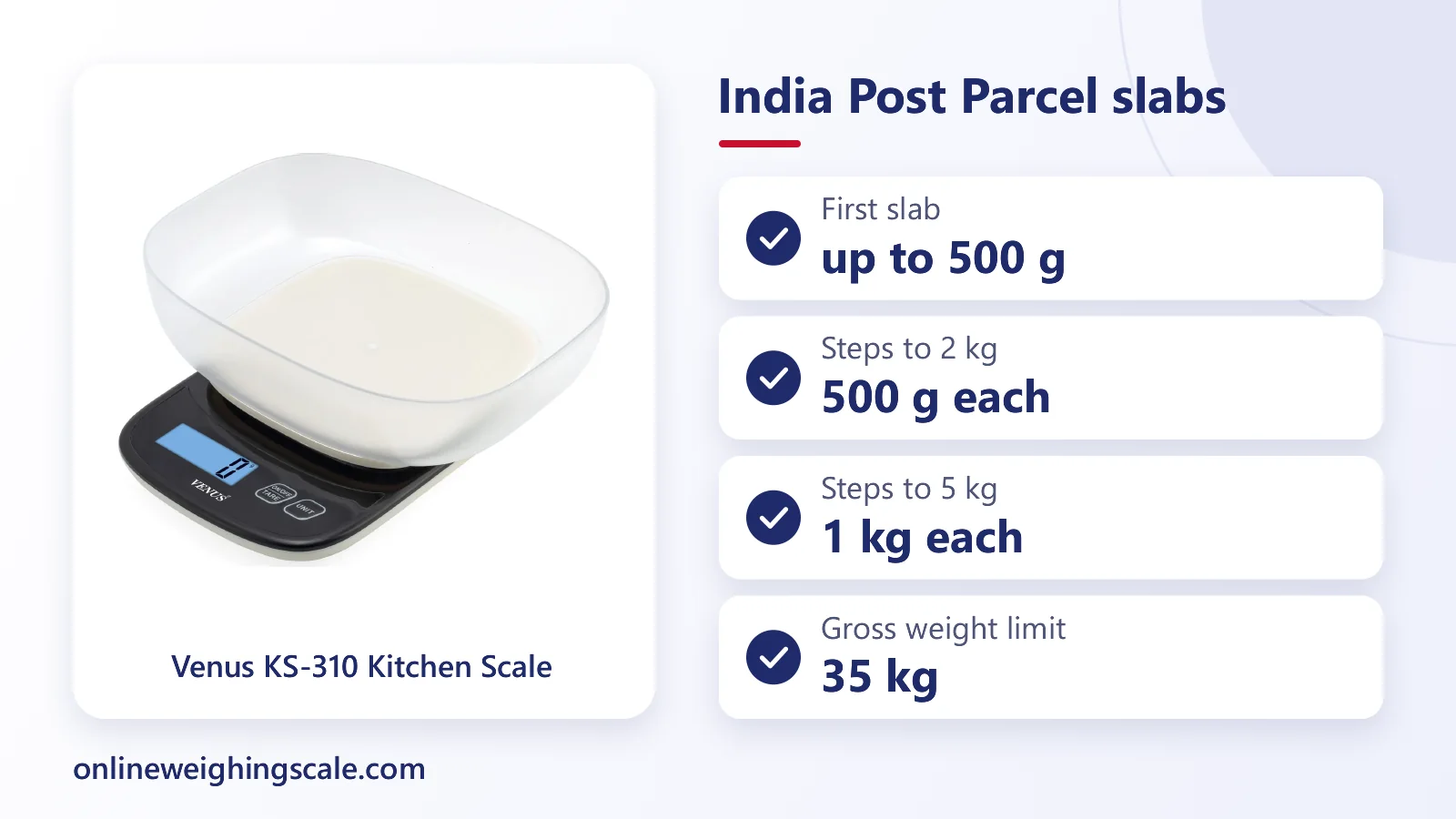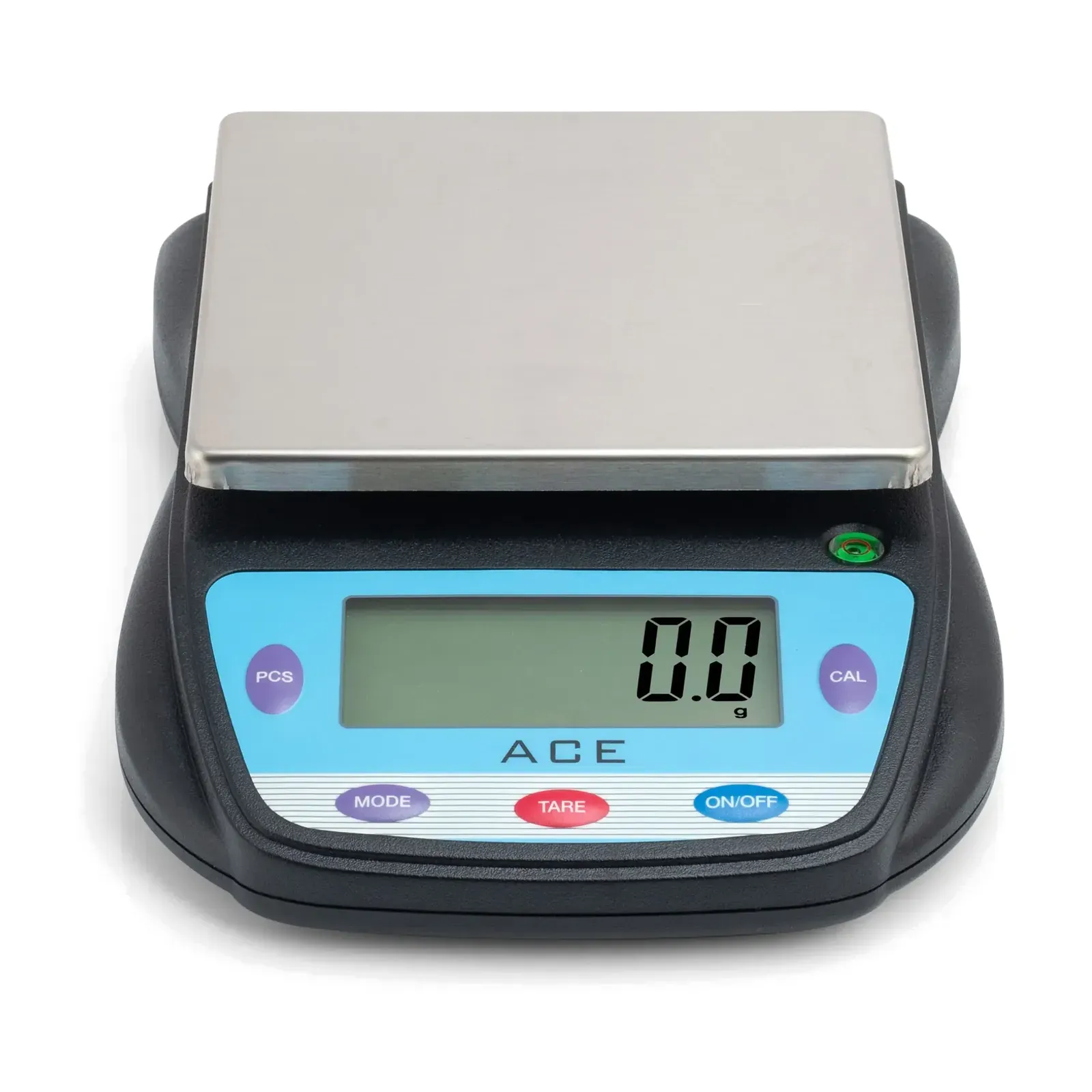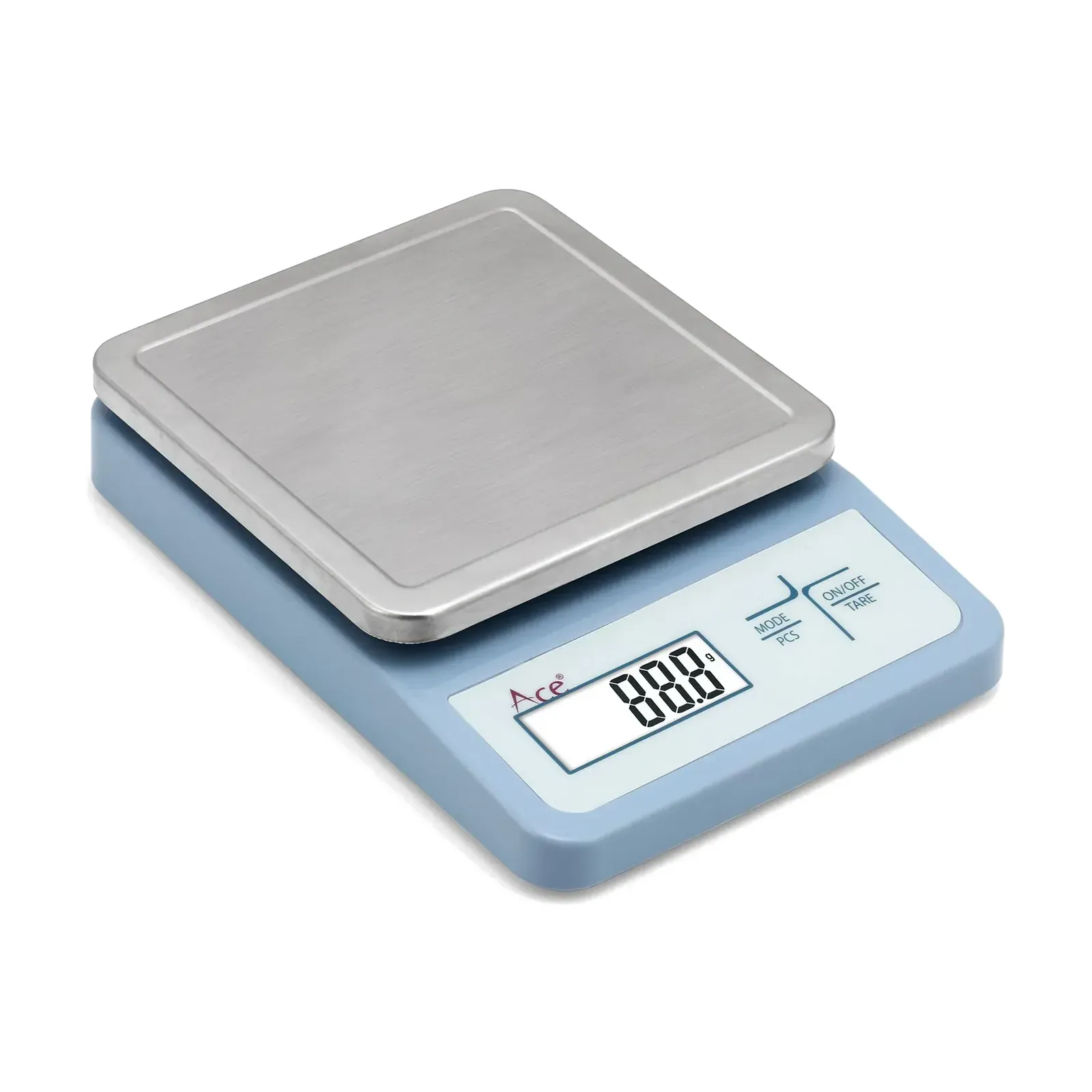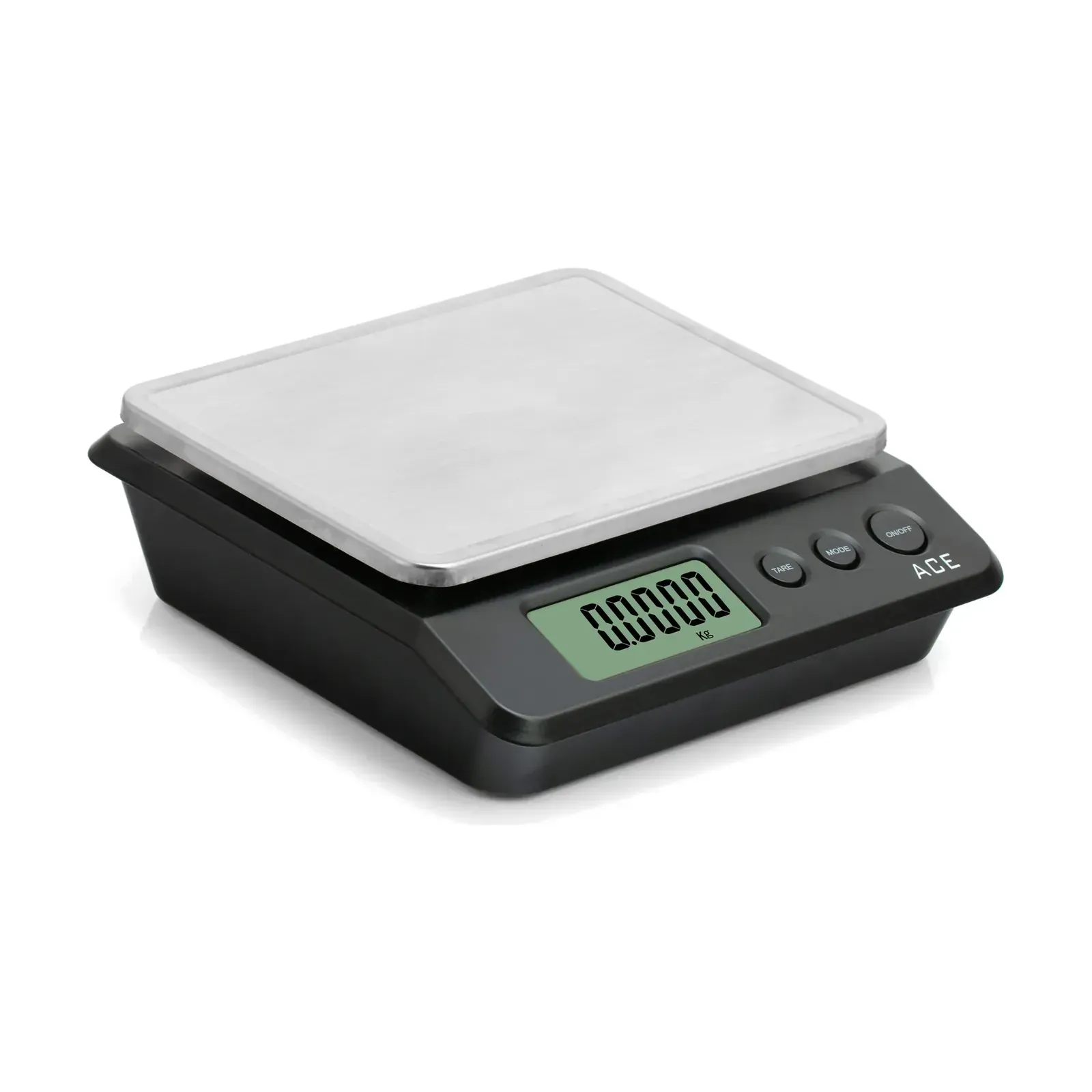
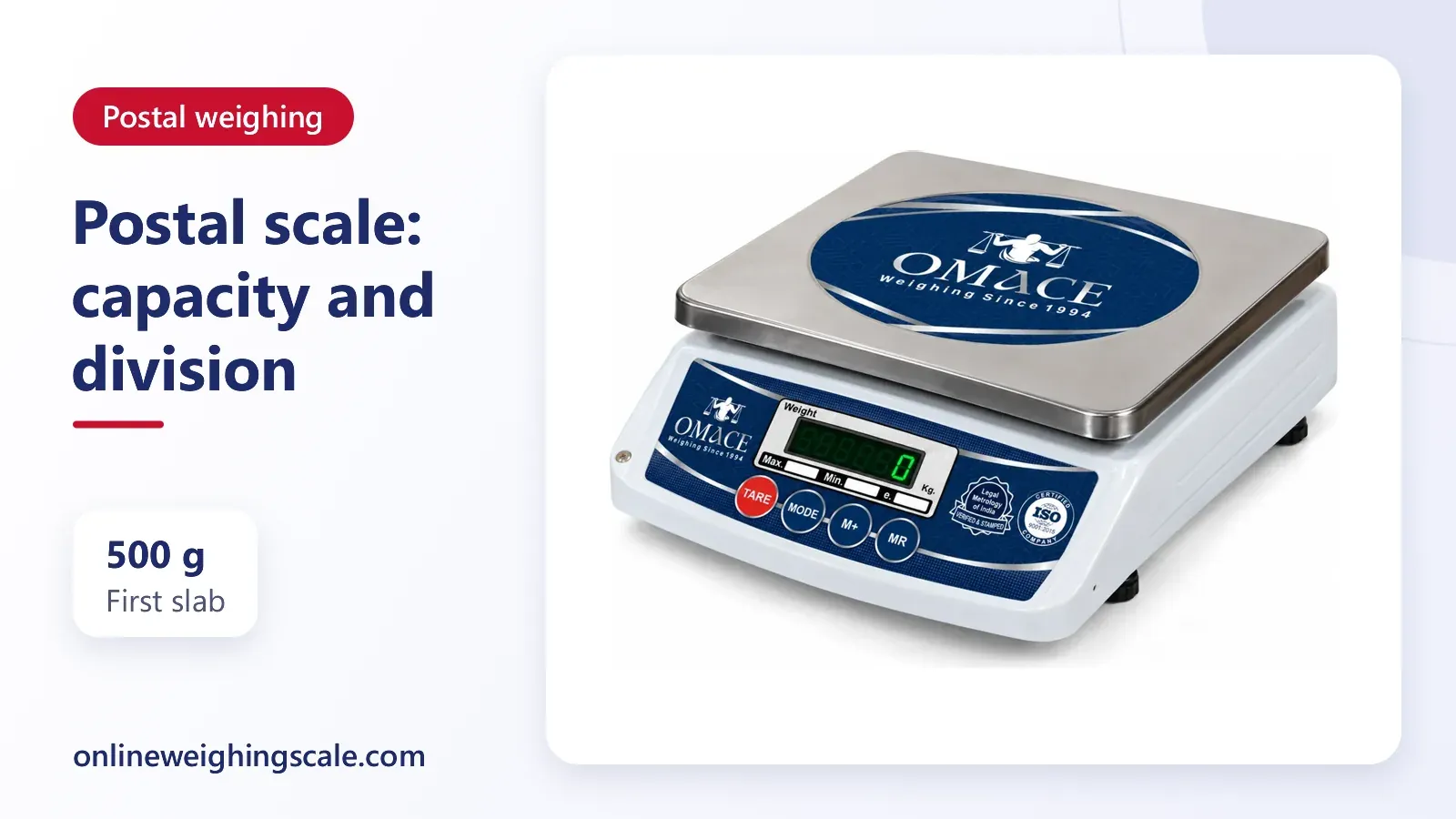
A postal scale is a table-top digital scale that weighs letters, packets and parcels so the sender can choose the correct India Post weight slab. For India Post Parcel the Department of Posts charges in steps of 500 g up to 2 kg, then in steps of 1 kg up to 5 kg, and a scale that reads in whole grams is enough for most senders.
What a postal scale is
The name covers any small digital scale that lives on a packing table and answers one question: which slab does this packet fall in? Some people say shipping scale, parcel weighing scale or courier weighing machine. The hardware is the same. It is a flat steel or plastic pan on a load cell, a display and a TARE button, and it runs on a battery or a USB cable.
The same scale then gets used for something else the moment you start sending bigger boxes. A packing table that handles envelopes in the morning may need to take a 20 kg carton of stock by evening. That is why capacity and division matter more than the label on the box.
The weight slabs India Post uses
India Post prices by weight slab and by distance, and the slab edges are what you are really weighing against. All figures below were read on the Department of Posts website in November 2026, and the department can revise them, so check the page before you print a rate card.
Letters and documents by Speed Post
The Department of Posts Speed Post tariff page lists document slabs of up to 50 g, 51 to 250 g and 251 to 500 g. A Press Information Bureau release on the revised Speed Post tariff gave charges for these slabs that range from ₹19 for up to 50 g locally to ₹93 for 251 to 500 g at the longest distances, before GST.
A normal printed letter or a few pages sits in the first slab. The 50 g edge is the one people miss, because a thick envelope with a card insert or a few extra sheets crosses it easily. A scale that shows single grams settles the question in a second.
Parcels by India Post Parcel and Speed Post Parcel
The India Post Parcel page treats an item as a parcel when it weighs more than 500 g, or when it meets the minimum size of 140 × 90 mm (100 mm in roll form). The same page sets the upper limits: gross weight of 35 kg or the volumetric weight as defined, length not above 1.5 metres, and length plus girth not above 3 metres.
The slabs on that page run as follows.
| Slab | Local | Other states |
|---|---|---|
| Up to 500 g | ₹28 | ₹72 |
| 501 to 1000 g | ₹48 | ₹114 |
| 1001 to 1500 g | ₹60 | ₹171 |
| 1501 to 2000 g | ₹87 | ₹239 |
| 2001 to 3000 g | ₹116 | ₹337 |
| Every additional 1 kg beyond 5 kg | ₹30 | ₹90 |
The page marks these retail rates as effective from 1 August 2026, with GST charged as applicable. It also lists the within-state and zone or metro columns, and slabs for 3001 to 4000 g and 4001 to 5000 g. The Speed Post Parcel page uses the same slab names and the same size and weight conditions, with air transmission and a higher price.
The pattern is clear from the table. A parcel that weighs 1,010 g goes into the 1001 to 1500 g slab and costs ₹12 more locally than one weighing 990 g, and ₹57 more to another state. Weighing to the nearest gram near a slab edge can save real money.
Which division you need
Division, also called readability, is the smallest step the display shows. Capacity is the most the pan can carry. A scale marked 30 kg x 1 g reads up to 30 kg in steps of 1 g.
For India Post work, a 1 g division is enough at every slab edge listed above, from 50 g to the 500 g steps and the kilogram steps. A 0.1 g or 0.01 g division adds nothing for postage. It helps when you also weigh small items before packing, such as a ring in a pouch, and then it is the product, not the postage, that needs the precision.
Accuracy near an edge still depends on the scale being right. A scale that reads 8 g high will push an envelope over the 50 g line. Weigh a known weight on it now and then. On Omace digital scales a long press of TARE opens calibration mode on some models and a long press of the M key on others, and the manual for each model shows which, and the post on how to calibrate a digital weighing scale at home walks through the steps.
Capacity for letters, small parcels and cartons
Pick the capacity from the heaviest thing you ever send, then add some room. A scale used at 95 percent of its capacity every day wears faster and is easy to overload by accident.
- Letters and documents. Anything up to 500 g. A 600 g or 3 kg scale with fine division is plenty.
- Small parcels. Garments, books, accessories and gift boxes between 500 g and 5 kg. A 6 kg or 10 kg scale covers the 500 g and 1 kg slab steps comfortably.
- Cartons. Boxes between 5 kg and 30 kg. A 30 kg scale reads these and the additional-kilogram step above 5 kg.
- Heavy cartons. India Post accepts a gross weight up to 35 kg, so a box of 30 kg to 35 kg needs a platform scale with a larger capacity.
Packed parcels often weigh 10 to 20 percent more than the goods inside, once cartons, tape and fillers go on. Weigh the finished parcel, not the product.
Omace scales that suit a packing table
Omace Brands Private Limited makes scales in Bagru, Jaipur, and every digital scale is checked with certified test weights before dispatch. The company has been in the weighing trade since 1994 (see about us). The models below are listed with today's prices including GST, and none of them is certified as a postal scale. They are ordinary digital scales that work well for this job.
| Use | Model | Capacity x division | Price |
|---|---|---|---|
| Letters, small items | Ace KB-6000 | 6 kg x 0.1 g, or 600 g x 0.01 g | ₹2729 |
| Parcels to 3, 6 or 10 kg | Ace KS-RE-3 | 3, 6 or 10 kg, USB charging | ₹1359 |
| Cartons | Ace PS-30 | 30 kg x 1 g, or 15 kg x 0.5 g | ₹1889 |
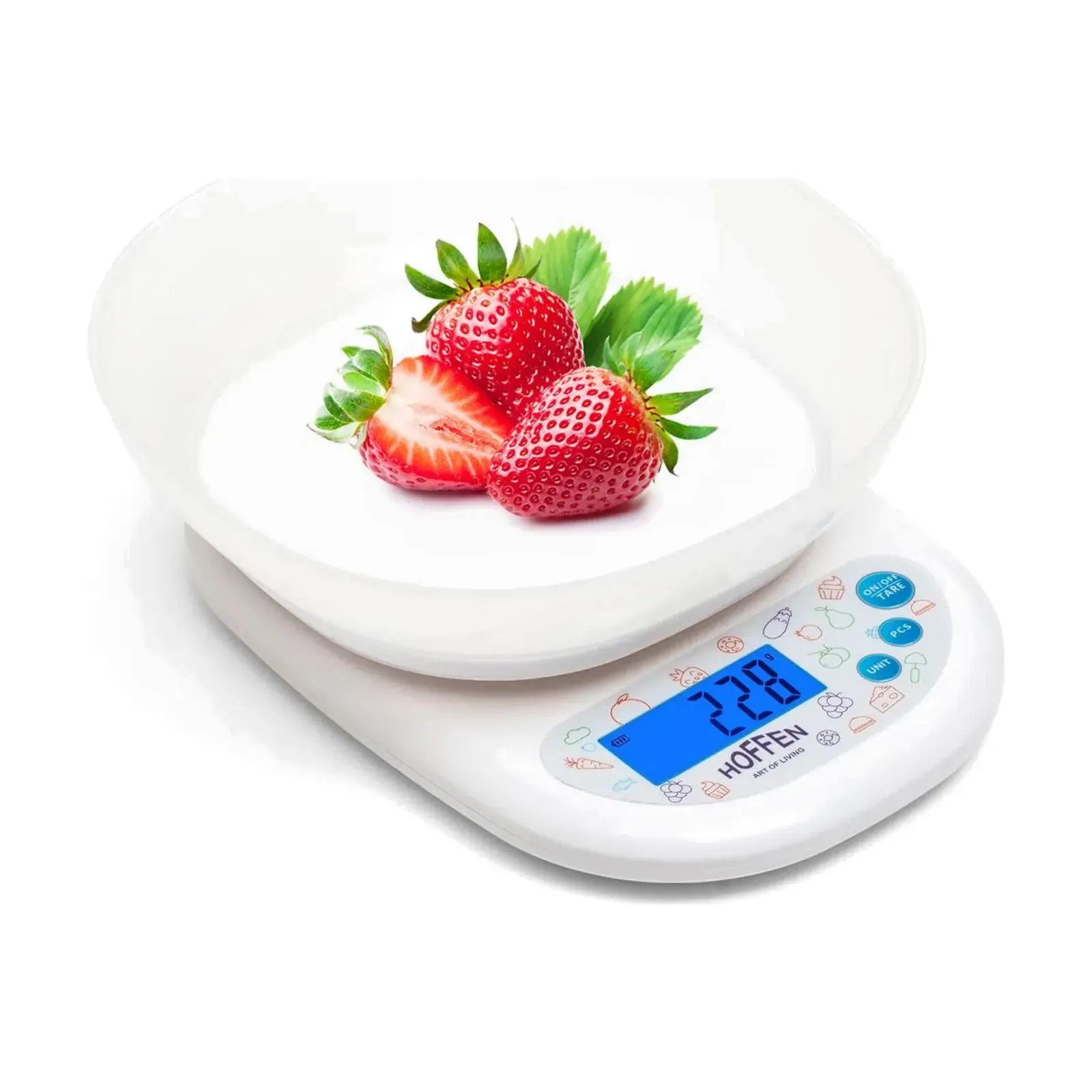
| Home sellers on a budget | Hoffen KD-819 | 10 kg x 1 g, piece counting | ₹519 |
The Ace KB-6000 has two ranges, so the same scale handles a letter at 0.01 g steps and a packed parcel up to 6 kg. The Ace KS-RE rechargeable scale comes in 3, 6 or 10 kg and charges over USB, which is handy when the packing table has no spare socket. The Ace PS-30 is the one for cartons of stock. The Hoffen KD-819 is a kitchen scale with a 10 kg range that a home seller with a few orders a week can also use. Table-top counter models for a shop are under weighing machine for shop.
If a shop or godown packs parcels all day, the bench scale versus platform scale post explains when to move up to a platform scale, and the platform weighing scale range covers the larger capacities.
Measure the box as well as the weight
India Post refers to the volumetric weight of a parcel in its own conditions, and rates for private couriers also use box size. A large light box can be charged as if it were heavier. The scale tells you the actual weight and a tape measure gives the length, width and height. The post on volumetric weight explains how the two numbers are compared. India Post's own definition of volumetric weight sits in its Post Office Regulations and is not repeated on the parcel page, so this post gives no divisor.
Using the scale well
Put the scale on a hard, level table, not on a cushion or a loose sheet. Switch it on and wait for zero. Place the empty box on the pan and press TARE only if you want the net weight of the contents. For postage, weigh the finished parcel with the box, tape and filler, because the post office will weigh the same thing.
Write the weight on a label as you pack, so that a slab dispute at the counter is settled by the number you already have. Keep the pan clean and away from a running fan, since moving air shifts the reading by a few grams on a small pan.
If the scale stops responding or drifts, Omace Brands Private Limited repairs its commercial scales when the buyer asks. The buyer pays the shipping both ways and the repair cost, and spare parts depend on availability, so ask first through the contact page.