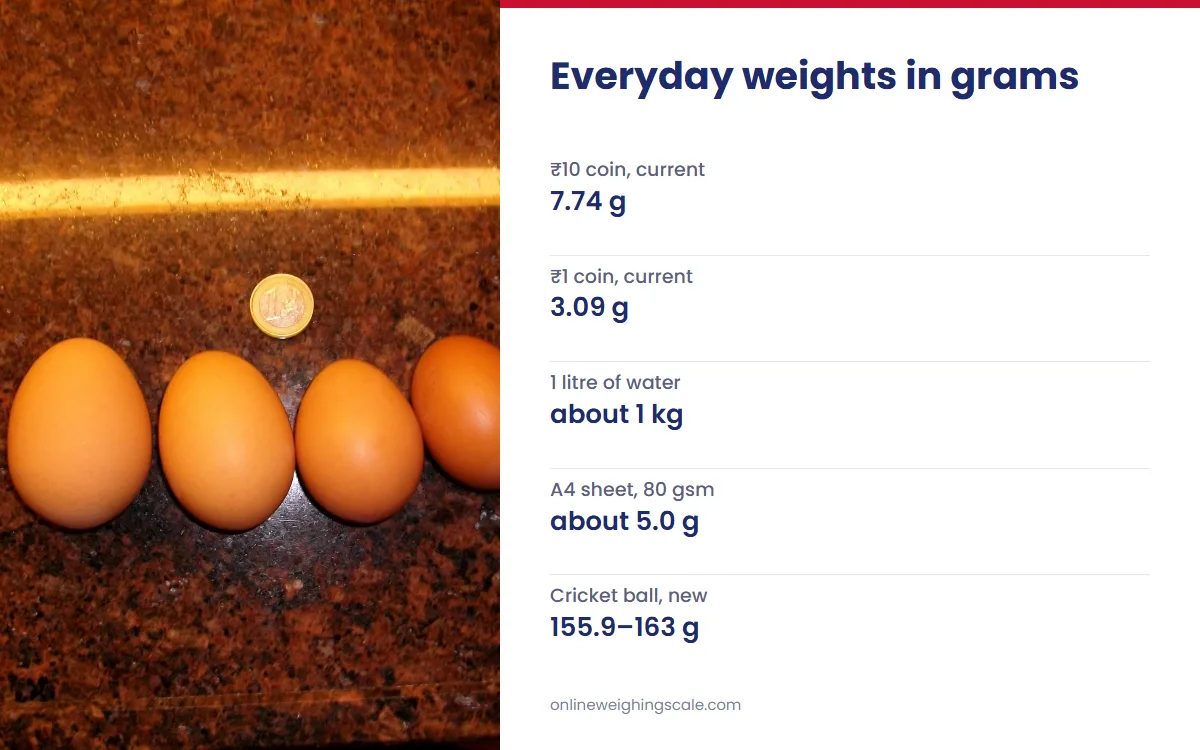
Everyday objects make useful reference weights once you know their official figures. A new ₹10 coin weighs 7.74 g, according to the coin specifications of the Security Printing and Minting Corporation of India (SPMCIL). A litre of water weighs close to 1 kg. These figures help with a rough check of a kitchen scale, while certified test weights remain the proper test of accuracy.
How much Indian coins weigh
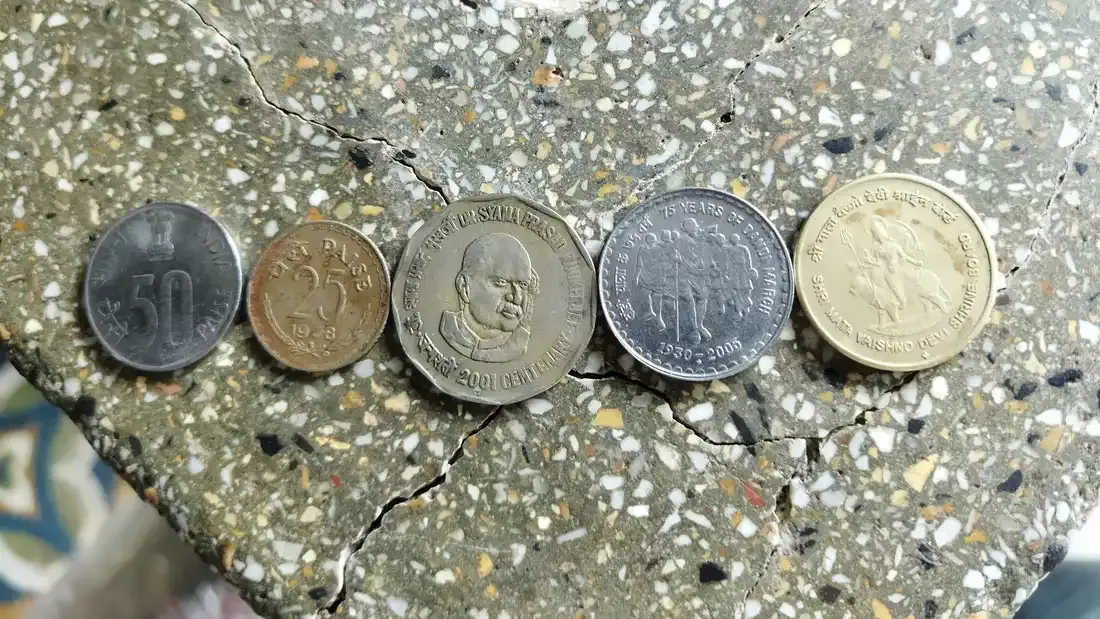
Coins are the handiest known weights in an Indian home. SPMCIL, the Government of India's mint company, publishes the metal, weight and size of every coin design issued for circulation. The table covers the coins issued since 2019, the series designed so that visually impaired people can tell them apart. The 2022 Azadi Ka Amrit Mahotsav designs use the same weights and sizes.
| Coin | Weight | Diameter | Metal |
|---|---|---|---|
| ₹1 | 3.09 g | 20 mm | Ferritic stainless steel |
| ₹2 | 4.07 g | 23 mm | Ferritic stainless steel |
| ₹5 | 6.74 g | 25 mm | Nickel brass |
| ₹10 | 7.74 g | 27 mm | Nickel-brass ring, nickel-silver centre |
| ₹20 | 8.54 g | 27 mm, 12-sided | Nickel-silver ring, nickel-brass centre |
The figures come from SPMCIL's coin sheets for the ₹1, ₹2, ₹5, ₹10 and ₹20.
Older coins are still in circulation, and they weigh differently. The 2011–2019 ₹1 coin weighs 3.79 g and measures 22 mm. The 2007–2011 ₹1 coin weighs 4.85 g and measures 25 mm. The 2011–2019 ₹2 coin also weighs 4.85 g, and the ₹5 coin of the same years weighs 6.00 g. Earlier ₹10 designs weigh 7.71 g against 7.74 g for the current one.
Each coin also carries a tolerance. SPMCIL lists the current ₹10 coin at 7.74 g plus or minus 2.5%, which allows anything from 7.54 g to 7.93 g. A worn or dirty coin can drift further from its official figure.
Water, eggs, rice and LPG
A litre of water
A litre of water weighs about 1 kg, and the match is deliberate. When France set up the metric system, the gram was defined as the mass of 1 cubic centimetre of water at 4 °C, according to NIST's history of the kilogram. A litre holds 1,000 cubic centimetres, so it weighs close to 1,000 g. One millilitre of water therefore weighs about 1 g. Warm water is very slightly lighter per litre, and the lines on a measuring jug are far less exact than a scale, so treat this as a rough figure.
Eggs
Egg weight depends on the grade. A 2024 study in the Indian Journal of Animal Sciences sorted eggs by the Indian standard grades. Small eggs weigh 38–44 g and medium eggs 45–52 g. Large eggs weigh 53–59 g, extra large 60–70 g, and jumbo eggs more than 70 g.
A grain of rice
A single grain of rice is too light for most kitchen scales. ICAR's Indian Institute of Rice Research lists the 1,000-grain weight of the Pusa Basmati 6 variety at 22.3 g. One grain of that variety weighs about 0.022 g, or 22 mg. That is why grain weights are usually quoted per 1,000 grains.
An LPG cylinder
A domestic LPG cylinder in India holds 14.2 kg of gas, and the commercial size holds 19 kg, according to a Petroleum Ministry reply in the Rajya Sabha. The empty cylinder's own weight is marked on it. A full cylinder on a hanging scale should read that marked figure plus 14.2 kg.
Paper and stationery
Paper is sold by gsm, which means grams per square metre. The Delhi High Court's practice directions describe A4 paper as 29.7 cm × 21 cm. That sheet covers 0.0624 square metres. A sheet of 80 gsm A4 paper therefore weighs about 5.0 g, and a 75 gsm sheet about 4.7 g. A ream of 500 sheets of 80 gsm paper holds about 2.5 kg of paper, before the wrapper.
The same arithmetic works for any paper. Multiply the sheet area in square metres by the gsm printed on the pack, and the answer is the weight of one sheet in grams.
Sports balls
Sports balls carry weight limits set by their governing bodies. The ICC's men's Test playing conditions require a new cricket ball to weigh between 155.9 g and 163 g. A match football weighs 410–450 g at the start of a match under the IFAB Laws of the Game. A feathered shuttlecock weighs 4.74–5.50 g under the BWF Laws of Badminton. A shuttle weighs a little more than a current ₹2 coin.
Phones, calculators and other gadgets
Gadgets vary too much for one honest figure. The weight of a phone or a calculator is printed on its box or in the maker's specification sheet, usually in grams. A cover, case or extra battery adds to it. To find the real figure, place the item on a kitchen scale that reads in 1 g steps. For something small, such as earbuds or a watch, a pocket scale reading 0.01 g gives a closer number.
Weight of common objects: quick reference
| Object | Weight | Kind of figure |
|---|---|---|
| ₹10 coin, current series | 7.74 g (7.54–7.93 g) | Official specification with tolerance |
| ₹1 coin, current series | 3.09 g | Official specification |
| 1 litre of water | About 1 kg | Metric definition, water near 4 °C |
| Large egg | 53–59 g | Grade range |
| A4 sheet, 80 gsm | About 5.0 g | Worked out from size and gsm |
| Men's cricket ball, new | 155.9–163 g | Playing rule range |
| Grain of rice (Pusa Basmati 6) | About 0.022 g | From the 1,000-grain weight |
| Gas in a domestic LPG cylinder | 14.2 kg | Net filling |
Using coins to check a scale
Coins make a fair rough check for a kitchen scale. Ten current ₹10 coins have an official weight of 77.4 g, and the tolerance allows anything from 75.4 g to 79.3 g. A kitchen scale reading in 1 g steps should land inside that band. If you know the coins' series, the check gets tighter. The guide on how to calibrate a kitchen scale without weights walks through the full method.
Coins cannot certify a precise scale. A pocket scale reading 0.01 g can show the difference between two ₹10 coins, so a coin only tells you whether the reading is roughly right. The guide to calibrating a pocket scale and checking it with coins explains how to use them sensibly. Calibration itself needs a certified test weight of the right class.
Every Omace digital scale opens its calibration mode when TARE is held for about 5 seconds. Stamped trade scales are sealed, and only a registered repairer can recalibrate them. At Omace's Bagru factory, every scale is checked with certified test weights before dispatch, as described on the tested before dispatch page.
Which scale weighs what
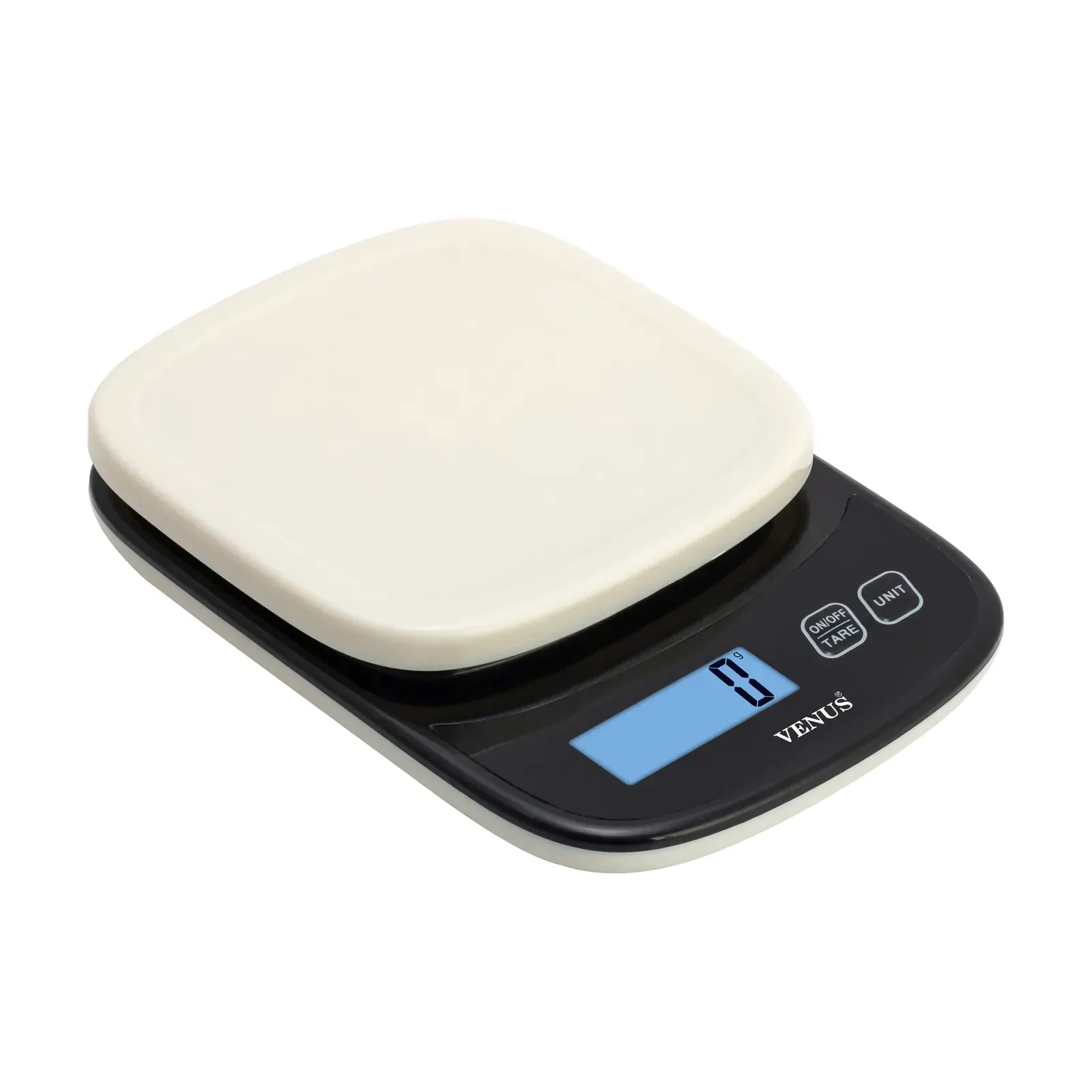
- Coins in groups, eggs and kitchen ingredients: a kitchen scale reading in 1 g steps. The Venus KS-310 kitchen scale weighs up to 10 kg in 1 g steps for ₹629–₹679.
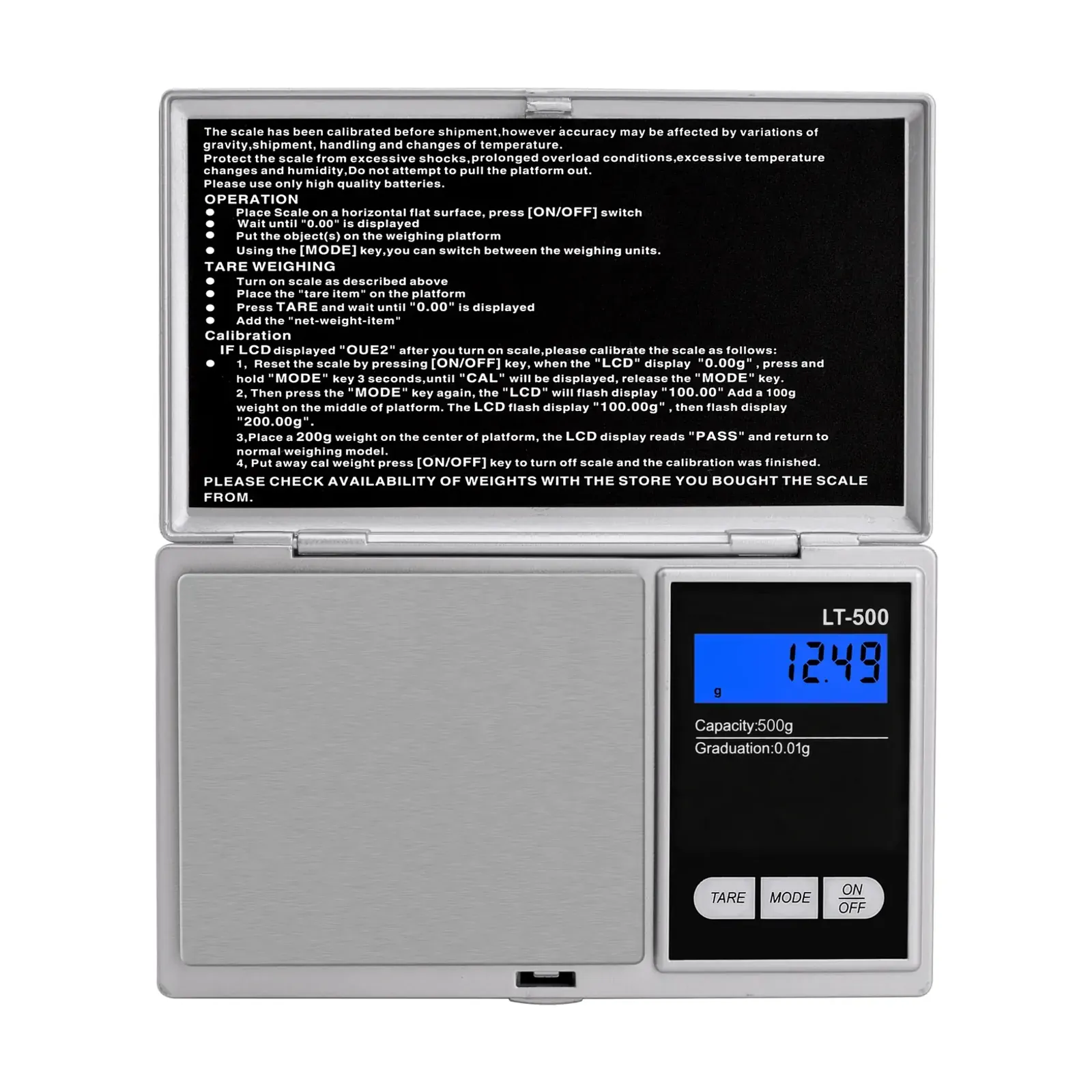
- A single coin, a ring or a gold chain: a pocket scale reading 0.01 g. The Ace LT-500 digital pocket scale weighs up to 500 g in 0.01 g steps for ₹1,149.
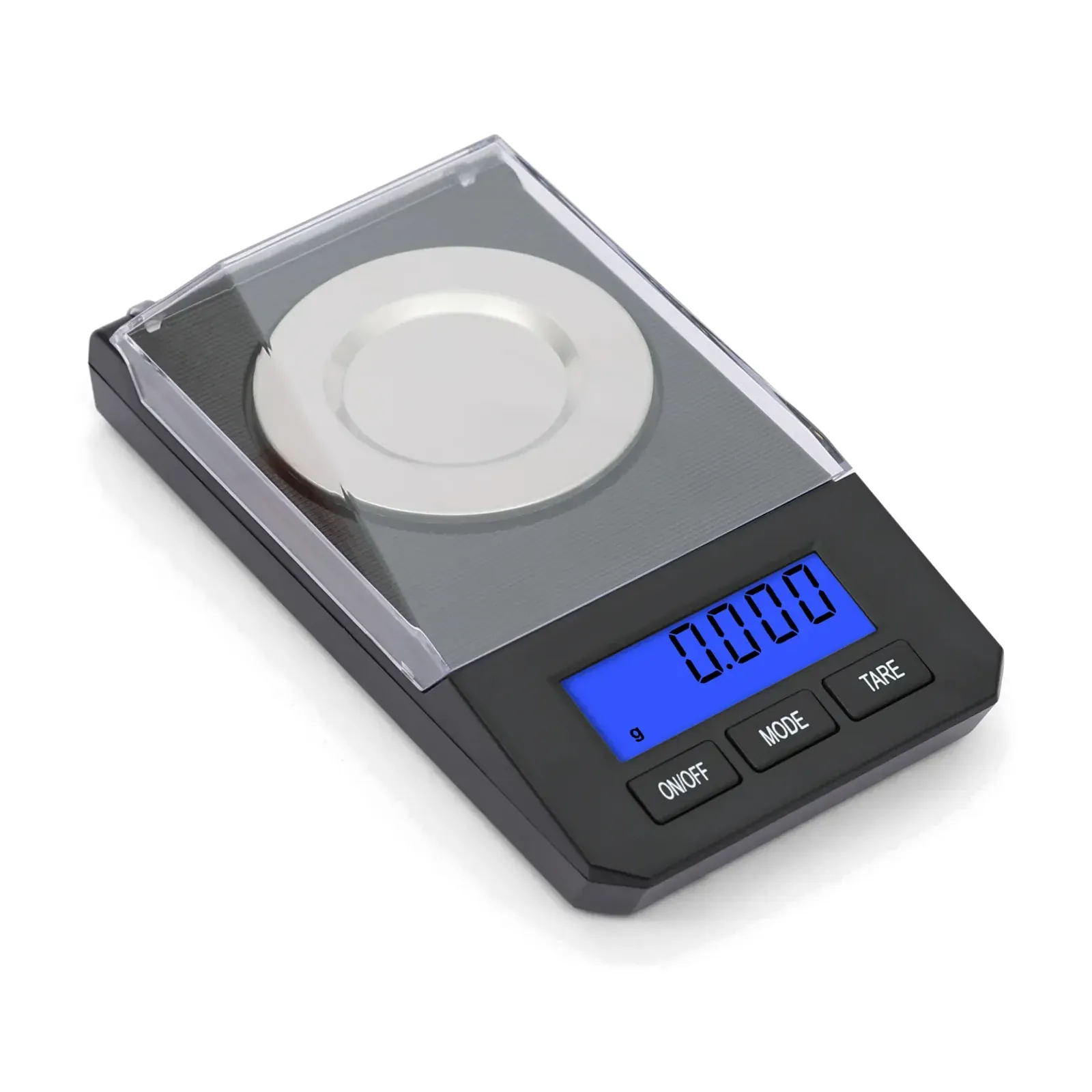
- Rice grains, seeds and other tiny items: a milligram scale reading 0.001 g. The Ace FN-50 milligram scale weighs up to 50 g in 0.001 g steps for ₹2,099.
- Parcels, sacks and gas cylinders: a hanging or platform scale with enough capacity for the load, such as those in the hanging weighing scales range.
Scales made and checked in India
Omace Brands Private Limited has manufactured weighing scales in Bagru, Jaipur since 1994 (about Omace). It sells them under the Omace, Ace, Venus and Hoffen names. Every scale is factory calibrated and checked with certified test weights before dispatch. A scale that reads wrong is replaced under warranty. As a manufacturer, Omace Brands Private Limited holds ISO 9001:2015 and ISO 13485:2016 certificates, an EU MDR quality certificate, and CE and US FDA compliance certificates, listed on the certificates page. Store purchases carry a 2-year warranty on manufacturing defects, and every Omace product is made in India.
Mass, weight and the numbers behind them
Every figure here is a mass in grams or kilograms, though everyday speech calls it weight, or vajan. The difference between the two is explained in mass vs weight. For anything that matters, such as gold, medicine or goods sold by weight, weigh the item itself on a scale of the right readability and use the typical figures only as a guide.