
A crane load chart is the maker's table of the heaviest load a crane may lift at each boom length and working radius. OSHA's crane rule caps a truck-mounted crane's rating at 85% of the load that would tip it over. Read the chart for the exact setup on site, then subtract the hook block and rigging before comparing it with the load.
What a load chart shows and who must keep it
Every number on the chart is a rated capacity. OSHA defines rated capacity as the maximum working load the manufacturer permits under specified working conditions. Those conditions are the boom length, the radius, the outrigger spread, the counterweight and the side of the crane the load sits on. Change one of them and the permitted load changes with it.
The chart has to travel with the machine. OSHA's construction rule says load charts must be readily available in the cab at all times. Where the charts exist only on a screen and the screen fails, the crane operator must stop work or shut down safely until they are back.
Indian law uses the older term safe working load. Section 29 of the Factories Act, 1948 barred loading any lifting machine beyond its safe working load except for a test. Where marking the figure on the machine was not practicable, the Act asked for a table of safe working loads displayed in a prominent place. Assam's Building and Other Construction Workers Rules, 2007 go further for cranes whose capacity changes with the jib. Such a crane needs an automatic safe load indicator, and where one cannot be fitted, a table of safe working loads at each jib radius or inclination must be kept on the crane. That table is a load chart by another name.
Britain's Health and Safety Executive asks for the same discipline. Its guide to lifting equipment at work says equipment must be visibly marked with its safe working load. It also says the safe load indicators on jib cranes must be set correctly for the job and for the way the machine is configured.
The parts of a load chart
Canada's Red Seal standard for mobile crane operators lists five parts: notes on the factors affecting capacity, the capacity charts, the range diagram, technical data and parts of line. It expects an operator to work out gross load, net capacity and the deductions in the maker's notes before a lift.
Capacity chart
The capacity chart is a grid. Boom lengths run across the top, working radius runs down the side, and each cell gives the permitted load in tonnes or kilograms. A crane carries several of these grids, one for each setup. The Red Seal standard names the setups an operator must match: on outriggers, on rubber (standing on its tyres), crawler tracks extended or retracted, the counterweight fitted and the boom or jib in use. Use only the grid that matches the crane as it stands. An empty cell means the crane must not work at that boom length and radius at all.
Range diagram
The range diagram is a side view of the boom's reach. Curved lines show each boom length, straight lines show the boom angle, and the scales give radius along the ground and height above it. The Red Seal standard uses it to find the boom length and any jib offset a job needs. Check it whenever the load must pass over a roof, a wall or a stack of material, because the hook has to clear the obstacle with the load hanging below it.
Notes and deductions
Read the notes before the numbers. They state what the capacities assume about the ground, the outrigger setting and the wind, and what must be subtracted from each cell. OSHA's definition of a load includes the load-attaching equipment, such as the load block, ropes, slings and shackles. So the hook block, every sling and shackle, a spreader beam and any crane scale hung under the hook come off the chart figure before the load itself. A jib carried folded on the side of the boom is a common deduction too.
Parts of line and line pull
The hoist rope runs through sheaves in the boom head and the hook block, and each fall of rope between them is one part of line. The parts share the load, so more parts let a winch of fixed pull raise a heavier load, at a slower speed. The Red Seal standard has operators calculate line pull, working load limit, the minimum parts of line and the size of hook block. A chart cell can show more than the rope reeving can carry, and the lower of the two limits always wins.
Load chart terms: quick reference
| Term | What it means | Where you find it | Common mistake |
|---|---|---|---|
| Rated capacity | Maximum working load the maker permits for a stated setup | Capacity chart cell | Treating it as the net load |
| Working radius | Horizontal distance from the slewing centre to the hoist line, load applied | Down the side of the grid | Measuring before the boom takes the load |
| Boom length | Length of boom extended or assembled | Across the top of the grid | Reading a shorter boom than is rigged |
| Configuration | Outriggers, tyres or tracks, counterweight, working area | Chart heading | Using the full-outrigger chart on part-extended outriggers |
| Deductions | Hook block, slings, shackles, beam, scale, stowed jib | Chart notes | Forgetting the hook block |
| Parts of line | Falls of hoist rope through the hook block | Notes and reeving table | Exceeding line pull on a heavy lift |
How to read a load chart, step by step
- Get the load weight. Use a drawing, a delivery note, a calculation from size and material, or a weighing. Then add every item of rigging.
- Measure the radius at both ends of the lift. OSHA measures the radius of a load from the axis of rotation to the centre of the hoist line with the load applied. The larger of the pick and set-down radius decides the lift.
- Choose the boom length. Use the range diagram to check height and clearance at that radius.
- Pick the right chart. Match the outrigger spread, the counterweight and the working area, whether over the rear, over the side or all round.
- Read the cell. If the radius falls between two rows, use the longer radius. Never guess a figure between two cells upward.
- Subtract the deductions. What remains is the net capacity for the load itself.
- Check the rope. Confirm the parts of line can carry the gross load.
- Lift a short way and pause. Watch the load moment indicator before slewing or booming out.
A worked example shows how quickly the margin goes. Say the chart for the crane's setup reads 9.0 t at 10 m radius for the boom length needed. The hook block weighs 0.3 t and the slings, shackles and a crane scale add 0.2 t, so the net capacity is 8.5 t. A 7.8 t load fits at 10 m with 0.7 t to spare. If the set-down point is at 12 m and that cell reads 7.4 t, the net capacity there is 6.9 t, and the same load is 0.9 t over. These figures are for practice only, because every crane has its own chart.
Why capacity drops as the radius grows
A load tries to turn the crane over with an effect equal to its weight times its radius. Five tonnes at 4 m gives 20 tonne-metres, and the same five tonnes at 8 m gives 40. OSHA describes counterweight as weight used to supplement the equipment's own weight in providing stability. The counterweight and the outriggers resist that turning effect, and beyond a certain radius they cannot, so the chart figures fall.
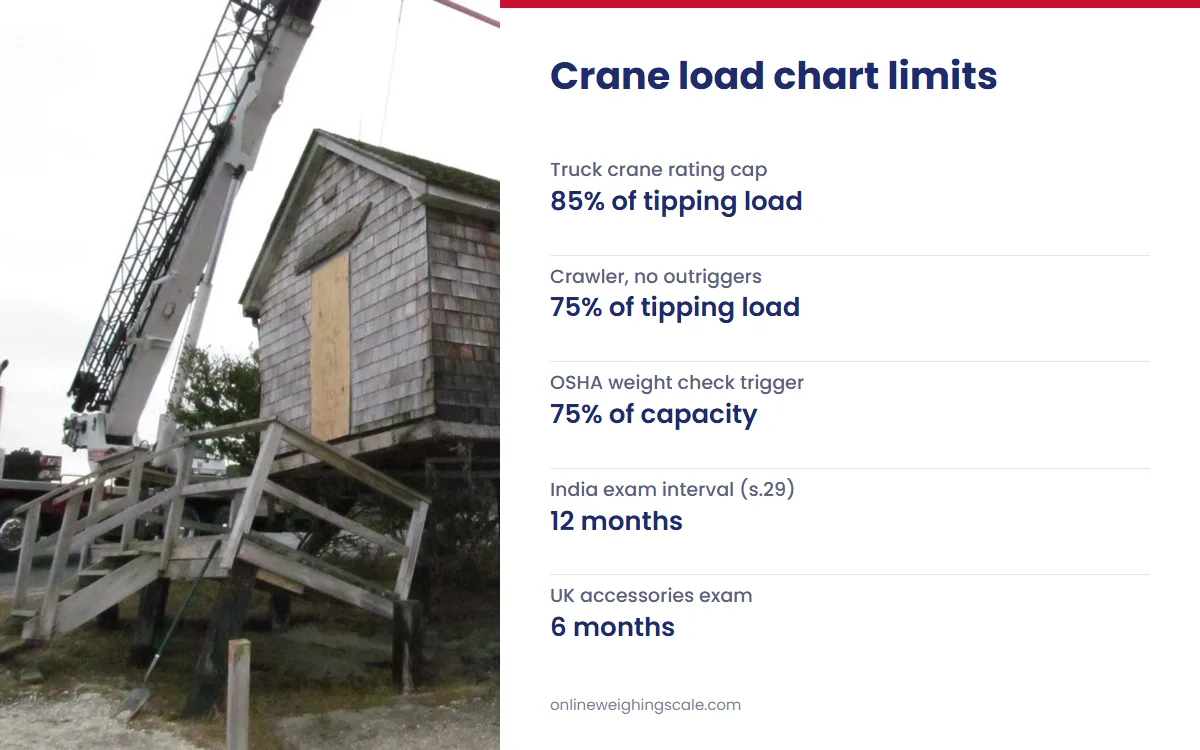
Charts also keep a margin below the tipping point. OSHA's rule for crawler, locomotive and truck cranes limits load ratings to a share of the load that would tip the crane, with the boom in its least stable direction.
| Crane mounting | Highest rating allowed |
|---|---|
| Truck or wheel mounted, no outriggers or outriggers fully extended | 85% of tipping load |
| Crawler, without outriggers | 75% of tipping load |
| Crawler, outriggers fully extended | 85% of tipping load |
| Locomotive, outriggers fully extended | 80% of tipping load |
The tonnage in a crane's name is normally the top figure on its chart, found at short radius with the full setup. A 50 tonne crane lifts far less once the boom reaches out over a trench or a building, which is why a 50 ton crane's chart matters more than its badge. Close to the crane, the strength of the boom and its fittings sets the limit, and further out the risk of tipping takes over.
Safe working load rules in India, the US and the UK
For decades, section 29 of the Factories Act set the basic rules for lifting machines in factories. Every crane, chain, rope and lifting tackle had to be thoroughly examined by a competent person at least once in every 12 months, with a register kept. No lifting machine could be loaded beyond its marked safe working load except for a test. A travelling crane could not come within six metres of a person working on or near its wheel track.
The law has moved since, checked November 2026. The Press Information Bureau announced that the Occupational Safety, Health and Working Conditions Code, 2020 took effect from 21 November 2025. A second release lists both the Factories Act and the Building and Other Construction Workers Act, 1996 among the laws the Code brings together. Rules framed under the old Acts still guide practice on many sites, so ask your state labour or factories department which rules apply to your lift today. The EOT crane guide covers the overhead crane side of the same change.
Construction rules add crane safety duties for the person running the lift. Assam's 2007 rules bar loading any crane, hoist or winch beyond its safe working load except for testing. They require every crane driver to have adequate skill and training on the particular machine, and they keep people from standing or passing under a load being hoisted.
In the US, OSHA's construction standard says equipment must not be operated beyond its rated capacity, and no one may require the operator to do so. The operator must verify that the load is within capacity in one of two ways. The first is to take the weight from a recognised source, such as the load's maker, or from a recognised calculation. The second is to start hoisting with a load weighing device, a load moment indicator or a rated capacity limiter working. If that shows more than 75% of the maximum rated capacity at the longest radius of the lift, the operator must stop until the weight is verified. The same rule makes a competent person adjust for wind, ice and snow, and calls for a tag line where a spinning load would be dangerous.
In the UK, the HSE guide asks the planner a plain question first: how heavy is the load, and is it within the safe limits of the lifting gear? Lifts must be planned by a competent person, supervised and carried out safely. Lifting equipment is thoroughly examined at least once a year, and accessories and equipment for lifting people at least every six months, unless a competent person sets an examination scheme. For an unbalanced load, the guide says to raise it a few inches and pause before going on.
Knowing the weight on the hook
Every step above starts with a weight, and many site loads have none written on them. Castings, scrap bins, wet timber, bales and precast pieces with steel inside rarely weigh what their size suggests. A crane scale hangs between the hook and the load and shows the weight while the load is in the air. That is the load weighing device route in OSHA's rule, used as the load first leaves the ground.
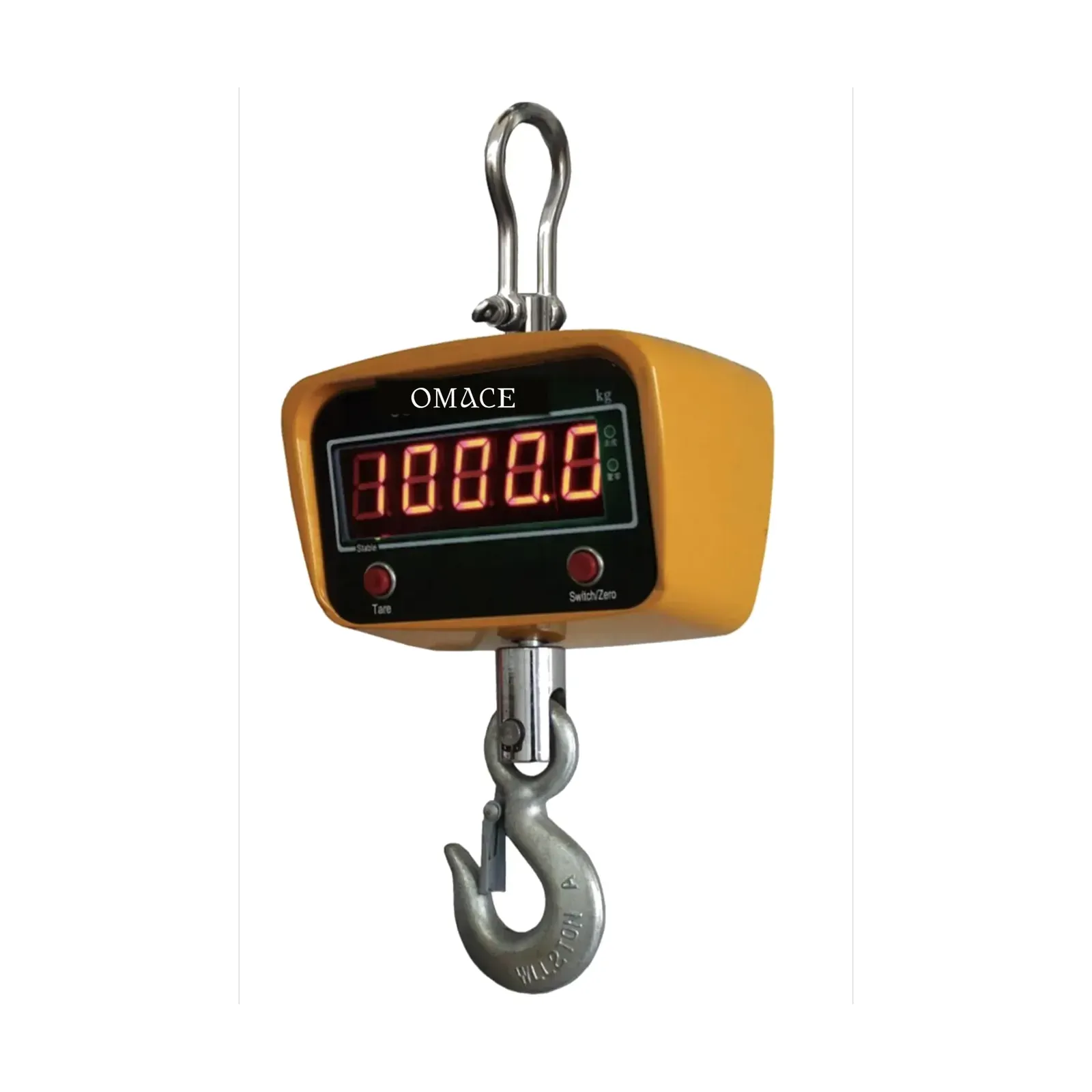
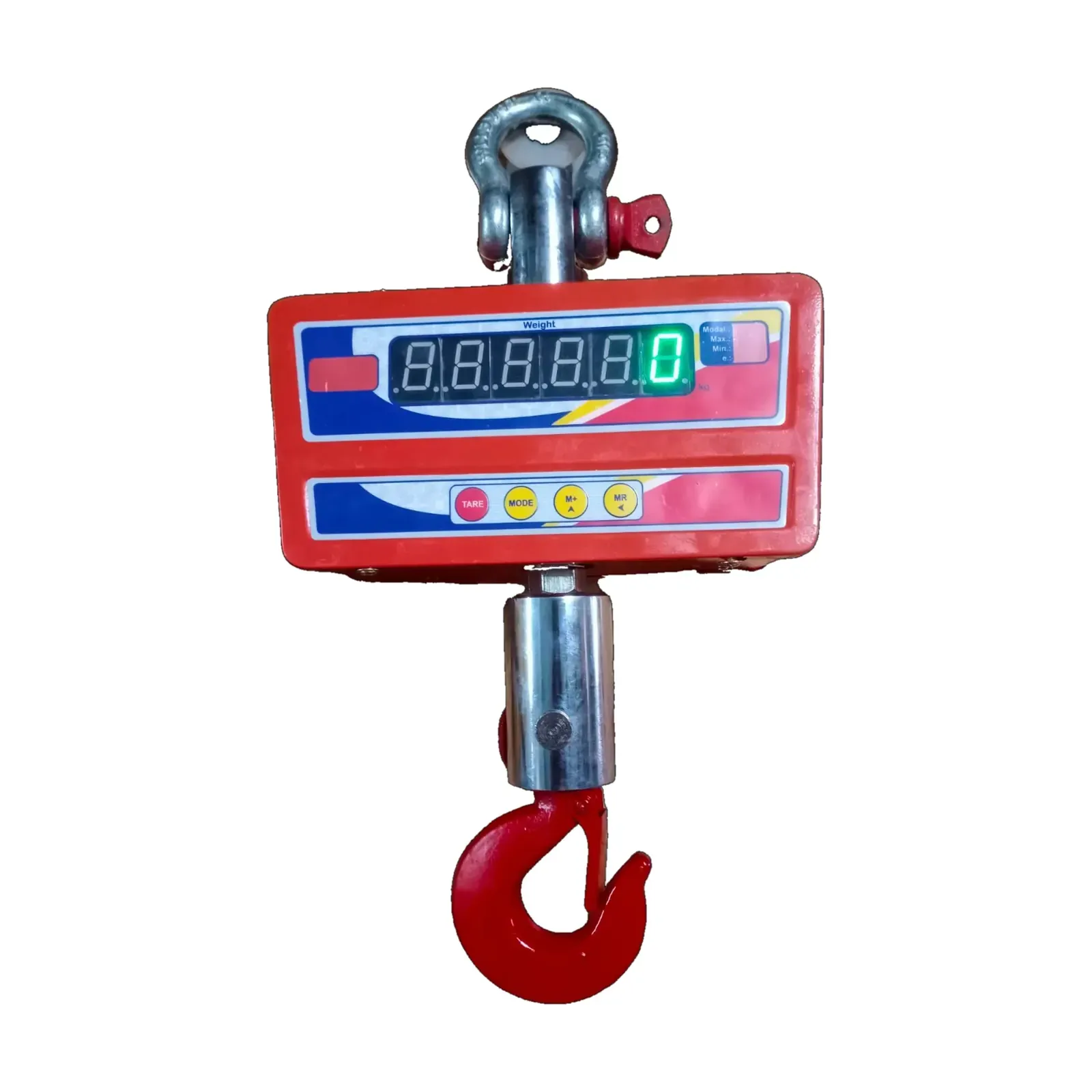
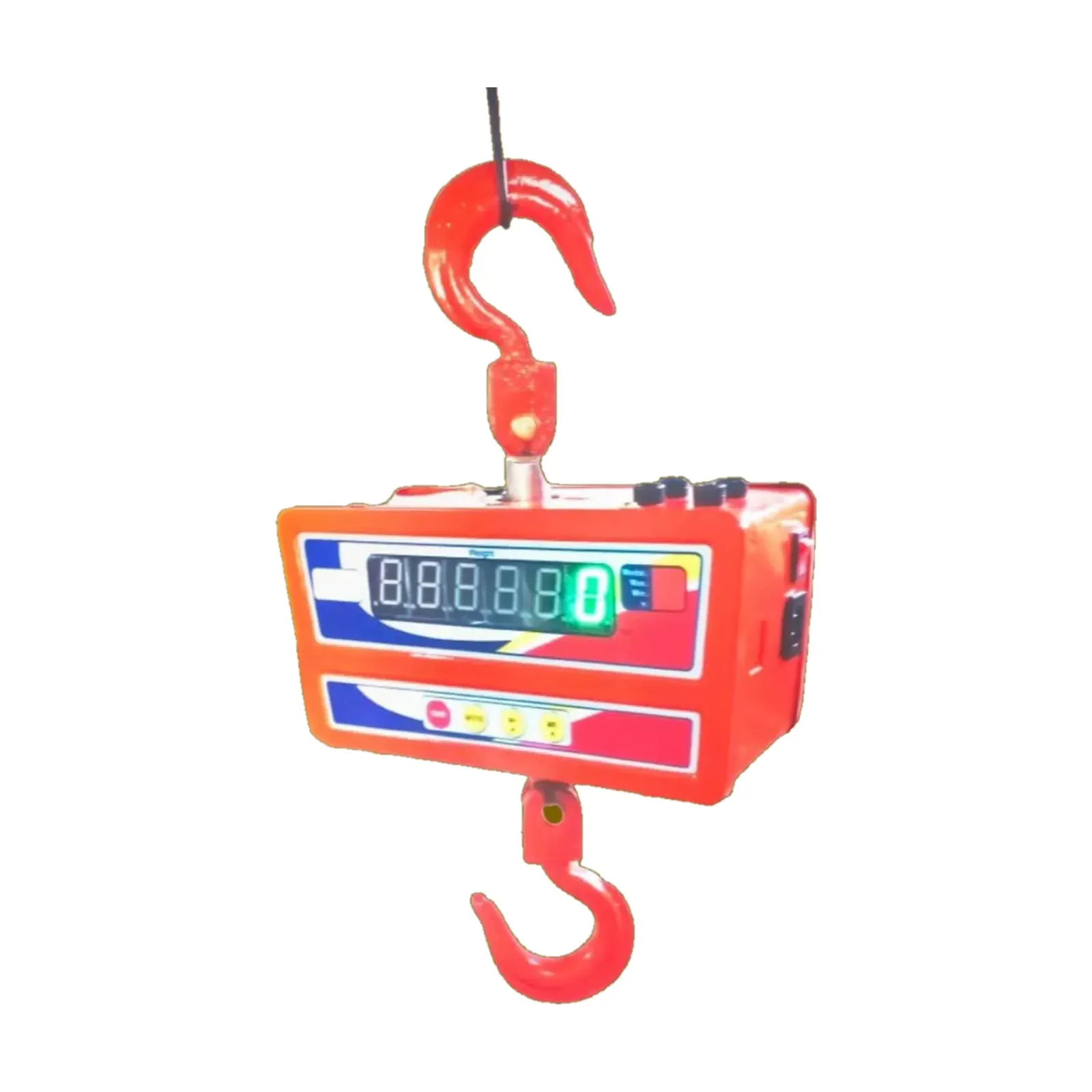
Omace Brands Private Limited makes crane scales and does not make or hire cranes. The Omace OCS crane scale covers 1 to 50 tonnes, with the 40 and 50 t models built on buyer request, and costs ₹11,549–₹2,65,649 depending on capacity. For lighter workshop lifts, the Omace 1 ton crane scale reads in 100 g steps and costs ₹12,999. Omace crane scales leave Bagru verified and stamped by Legal Metrology, and stamping is compulsory on crane scales.
A crane scale is rigging too, so its own weight comes off the chart and its length uses up hook height. Read the display only when the load hangs still, and have the scale checked on schedule. The crane scale calibration guide explains the test weights and the rules.
Hiring a crane: questions for the crane service
A crane hired by the day arrives with its own chart, and the person hiring it still owns the lift plan. Settle these points before the crane rental is booked, because they decide whether mobile crane operation on your site can follow the chart.
- The chart for the exact model and setup. Ask which outrigger spread and counterweight the crane will use on your ground.
- The latest thorough examination report. The old Factories Act interval was 12 months, so ask which rule the examiner followed.
- The operator's training. Construction rules expect skill and training on that particular machine.
- Ground and outrigger support. Drains, soft fill and fresh backfill under an outrigger pad undo what the chart assumes.
- Your own weight and radius figures. Give the crane hire firm the load weight with rigging and the radius at pick and set-down.
Crane scales made and stamped in India
Omace Brands Private Limited has manufactured weighing scales in Bagru, Jaipur since 1994. Omace shop, platform, chicken and crane scales leave the Bagru factory verified and stamped by Legal Metrology, and that stamp is valid across India. Every scale is checked with certified test weights before dispatch. As a manufacturer, the company holds ISO 9001:2015, ISO 13485:2016 and EU MDR quality certificates, and CE and US FDA compliance certificates, all listed on its certificates page. Scales bought from the Omace store carry a 2-year warranty on manufacturing defects, and every Omace scale is made in India.
Before the next lift
Write down the weight with rigging, the largest radius of the lift and the net capacity from the chart that matches the setup. If any of those is a guess, stop and settle it before the hook moves. When the weight is the guess, a crane scale settles it. The crane scale range runs from 50 kg hanging models to 50 tonne units, so a load can be checked in the air before the crane operator commits to the radius.