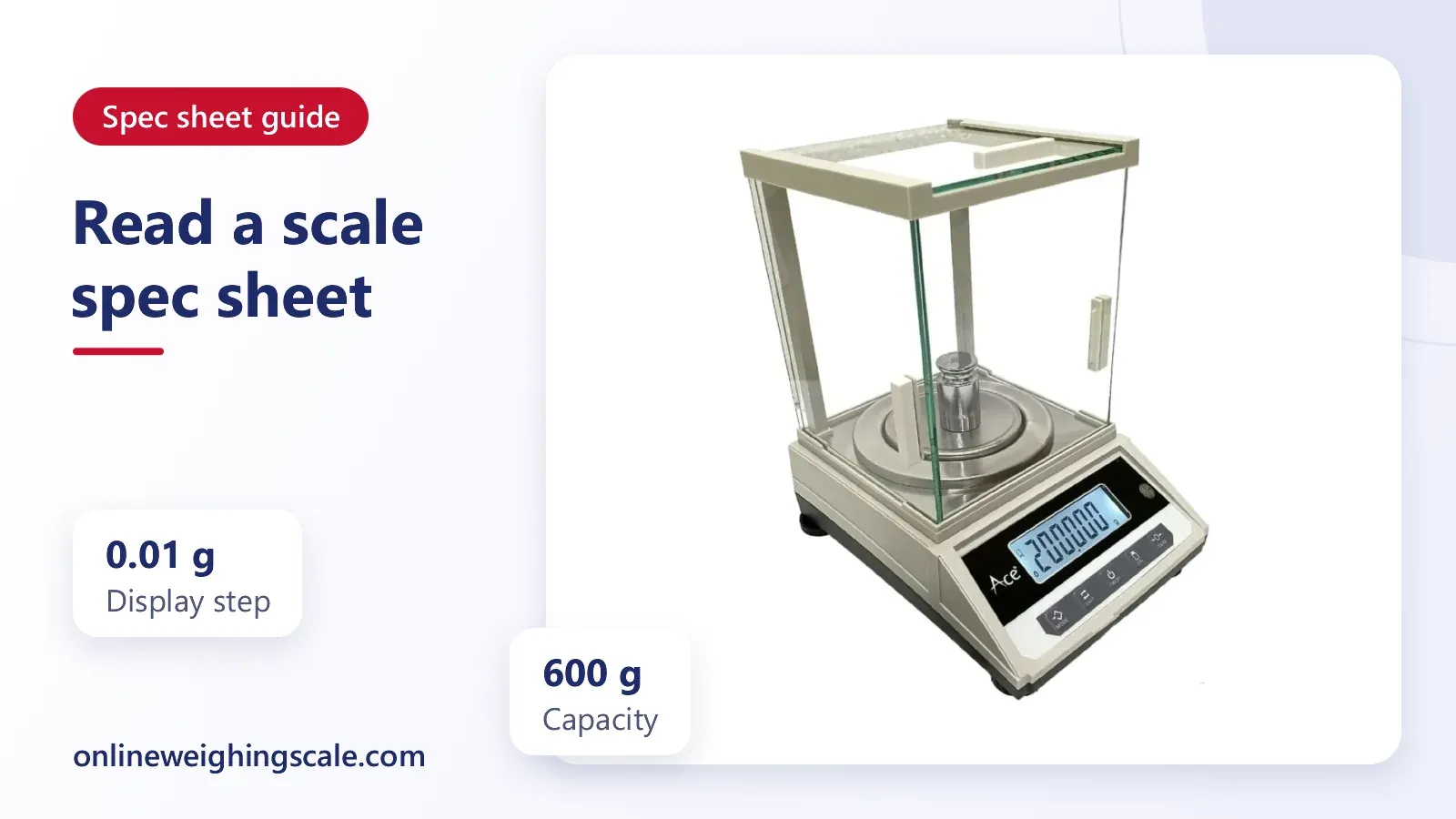
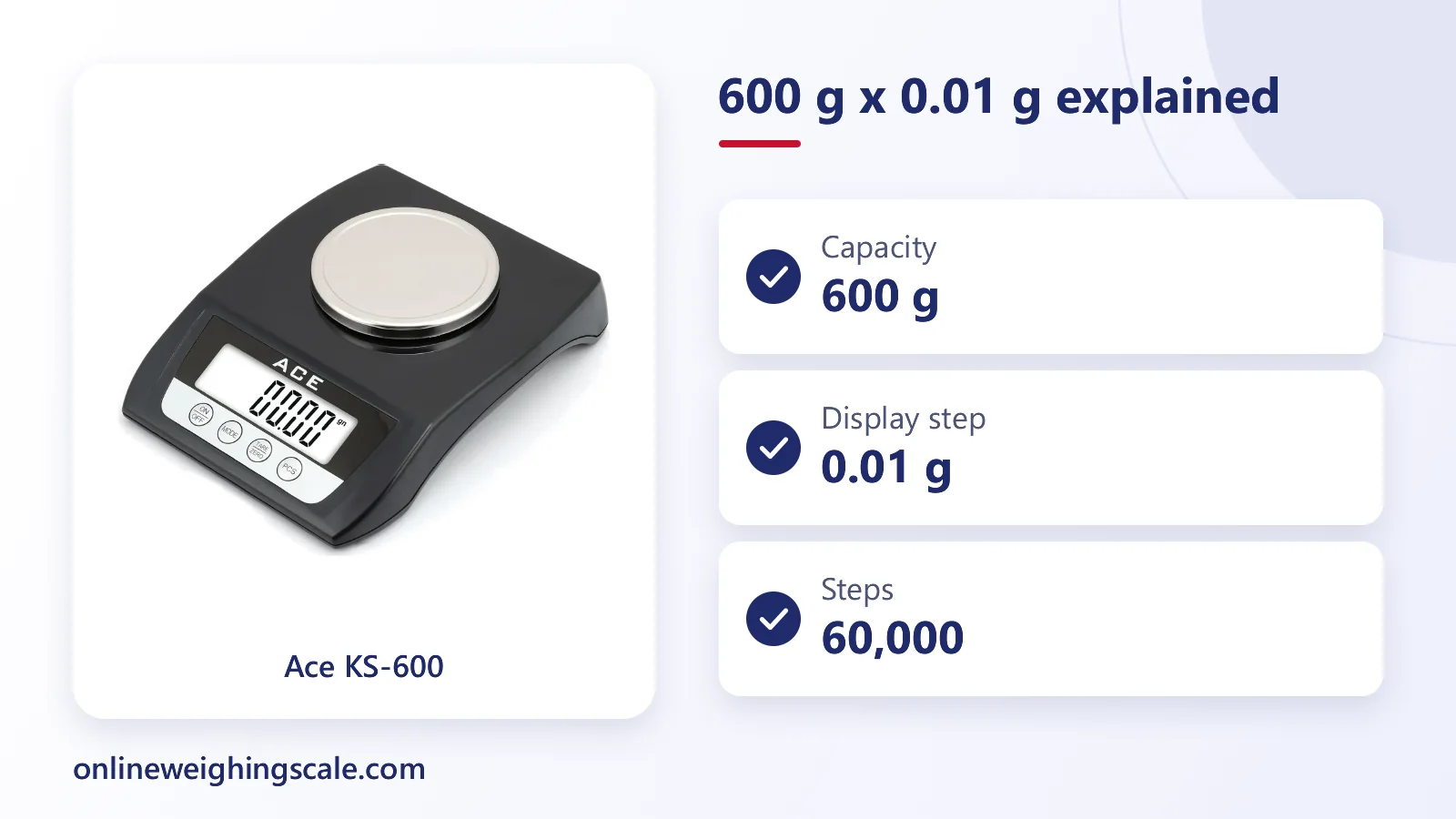
Weighing scale specifications tell you the most a scale can weigh, how finely it shows the result and how far that reading can be trusted. A scale rated 600 g x 0.01 g weighs up to 600 grams and shows the result in steps of 0.01 gram, which gives 60,000 steps across its range.
Every spec sheet is built from a few such terms, and listings often quote only the flattering ones. This guide explains each term in the words a buyer in India needs, using the international recommendation for non-automatic weighing instruments, OIML R 76-1, as the reference for definitions. Models and prices mentioned are Omace's own.
Capacity and readability: the first two numbers
Capacity is the heaviest load the scale is meant to weigh. OIML R 76-1 calls it maximum capacity, written Max, and defines it as the maximum weighing capacity not counting the additive tare. A bowl placed on the pan and zeroed with TARE therefore does not extend Max. Max plus the bowl must stay inside what the scale can carry.
Readability is how small a step the display shows. Shop talk calls it the least count, the smallest difference the screen can show between two readings. In OIML R 76-1 the same idea for a digital display is the actual scale interval, d: the difference between two consecutive indicated values. A display that moves from 12.34 g to 12.35 g has d = 0.01 g.
Readability describes the display. It does not promise that the last digit is correct. That separate question is answered by the accuracy class and the calibration, covered further down.
The terms in one table
| Term | Meaning | Why it matters |
|---|---|---|
| Max (capacity) | Largest load the scale is meant to weigh, not counting tare | Overloading damages the sensor and gives wrong readings |
| Min (minimum capacity) | Load below which the result may carry an excessive relative error | Tiny samples on a big scale are a common source of wrong weights |
| d (readability, least count) | Difference between two consecutive displayed values | Sets how finely you can read the weight |
| e (verification interval) | Value used to classify and verify the instrument | Goes into the accuracy class, and can be larger than d |
| n (number of intervals) | Max divided by e | Together with e, decides the accuracy class |
| Accuracy class | Special, high, medium or ordinary, marked I, II, III and IIII | Tells you how closely the reading is held to the true weight |
| Tare range | Largest container weight the tare device can cancel | Decides whether your bowl or tray can be zeroed |
| Warm-up time | Time from switching on until the scale meets its stated performance | Weighing the moment the screen lights can give a drifting reading |
The definitions of Max, Min, d, e, n, tare effect and warm-up time follow OIML R 76-1 (sections T.3 and T.4). The accuracy class names come from section 3.1 of the same document.
What 600 g x 0.01 g means
The first number is capacity and the second is the display step. So 600 g x 0.01 g means a capacity of 600 g and a readability of 0.01 g. Divide one by the other to count the steps: 600 ÷ 0.01 = 60,000.
The same arithmetic compares scales. The Ace KB-6000 is listed as 6 kg x 0.1 g or 600 g x 0.01 g, and both settings give 60,000 steps. A 30 kg scale reading in 1 g steps has 30,000 steps. The Ace JS-3003, at 300 g x 0.001 g, has 300,000 steps. More steps mean a finer display, and they usually mean a more expensive sensor and electronics.
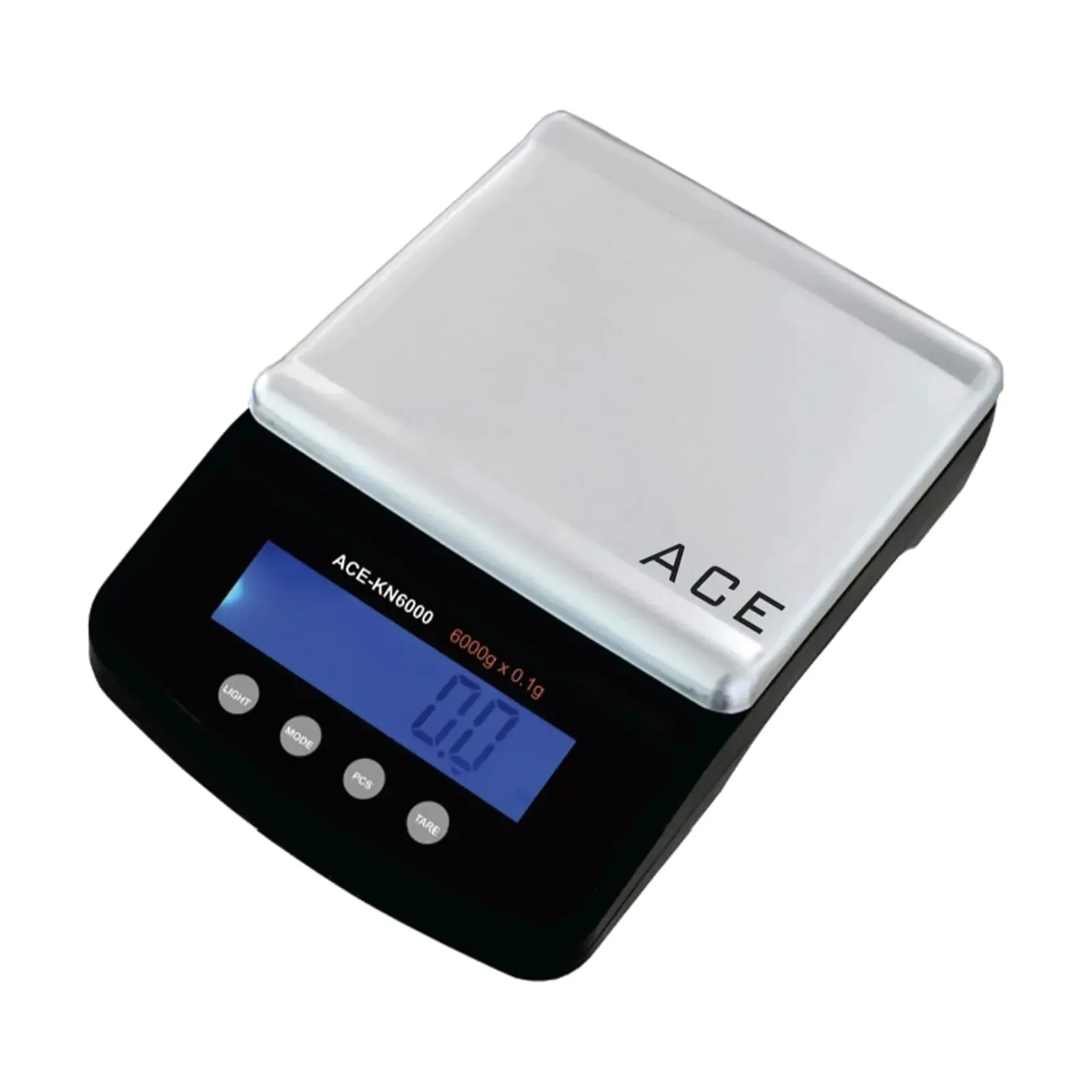
Some scales have two ranges. The Ace KN-10 reads 10 kg x 0.5 g or 6 kg x 0.1 g. OIML R 76-1 calls an instrument with two or more ranges, each running from zero to its own maximum with its own interval, a multiple range instrument. Read each range as if it were a separate scale: the finer step belongs only to the lower capacity.
Least count of a weighing machine
Least count is the term most people in India use for d. A kitchen scale showing whole grams has a least count of 1 g. A jewellery scale showing 0.01 g has a least count of 0.01 g, which is 10 milligrams. A kanta that jumps in steps of 5 g cannot tell 102 g from 104 g, however fine the print on the box looks.
Pick a least count about ten times smaller than the smallest difference that matters to you. A shopkeeper selling by the kilo is served by 1 g or 5 g. A goldsmith checking a ring needs 0.01 g, and a jeweller weighing small stones may need 0.001 g. The guide to jewellery scales goes through that choice.
Why e can differ from d
OIML R 76-1 uses e, the verification scale interval, to classify and verify an instrument. Its Table 2 says that for a graduated instrument without an auxiliary indicating device, e equals d. For other instruments the manufacturer chooses e within the rules of the recommendation. The number of verification intervals is n = Max / e.
Here is a worked example for a table-top scale. A 30 kg scale with e of 5 g has n of 6,000, and Class III allows up to 10,000 intervals in Table 3 of OIML R 76-1, so it is Class III. The same 30 kg scale with e of 2 g has n of 15,000, which is more than Class III allows, so it falls under Class II.
This matters because the accuracy class is fixed by e and n together, not by the number of digits on the screen. The recommendation names four classes: special (I), high (II), medium (III) and ordinary (IIII). NIST Handbook 44, the United States standard, also designates weighing devices by class and by number and value of verification intervals. A display that shows many decimals can still sit in a lower class if its e is large. Details are in the post on weighing scale accuracy class, and the difference between a precise and an accurate reading is in accuracy vs precision.
Minimum load: the number buyers skip
OIML R 76-1 defines Min as the load below which weighing results may be subject to an excessive relative error. A scale is built for its range between Min and Max, not for everything between zero and Max.
Simple arithmetic shows why. On a scale with a 0.01 g step, a 10 g sample can be read to about one part in a thousand. A 0.1 g sample shifts by 10 percent for each step of the last digit. If your smallest sample is tiny, buy a scale whose step and capacity are both small, not a large scale with a long row of decimals. Spec sheets for trade scales often print Min next to Max. Hobby listings rarely do, so ask.
The other lines on the sheet
- Units. Grams, kilograms, carats, ounces, grains and others are selectable on many models. The Ace KB-6000 lists seven units. Check that the one you use daily is included.
- Pan or platform size. A big sample on a small pan overhangs and reads unevenly. Measure your largest item before buying.
- Tare range. The sheet should say how heavy a container can be zeroed. OIML R 76-1 calls this the maximum tare effect.
- Power. Battery, adapter or USB charging. A scale that needs a charger every few days is a poor fit for a counter that runs from morning to night.
- Display. Backlit LCD or LED, front and back or front only. Shops with a customer-facing screen want a second display.
- Operating conditions. Temperature and draught change readings on fine scales. Balances reading 0.001 g are usually sold with a glass windshield for that reason.
Common tricks in listings
Marketplace listings sometimes make a scale look better than it is. Read for these.
- Capacity without division. A listing that says 500 g and nothing else leaves out the display step. Ask for the full form, such as 500 g x 0.01 g.
- Division without capacity. A title that shouts 0.01 g, with 5 kg buried in the description, describes two different things. A 5 kg scale does not read 0.01 g across its range.
- Accuracy confused with readability. A line saying accuracy 0.01 g tells you the display step, not the error. Ask whether a calibration weight is included and what the scale was checked against.
- Dual range blended into one line. Two ranges are two scales, and only the lower capacity has the finer step.
- Missing Min. If small samples are your use, ask what the smallest load is that the scale weighs reliably.
- Trade use with no stamp. A scale used to sell goods by weight in India falls under the Legal Metrology Act; the Department of Consumer Affairs page lists the Act and rules. See legal for trade weighing scale.
Reading a few Omace models
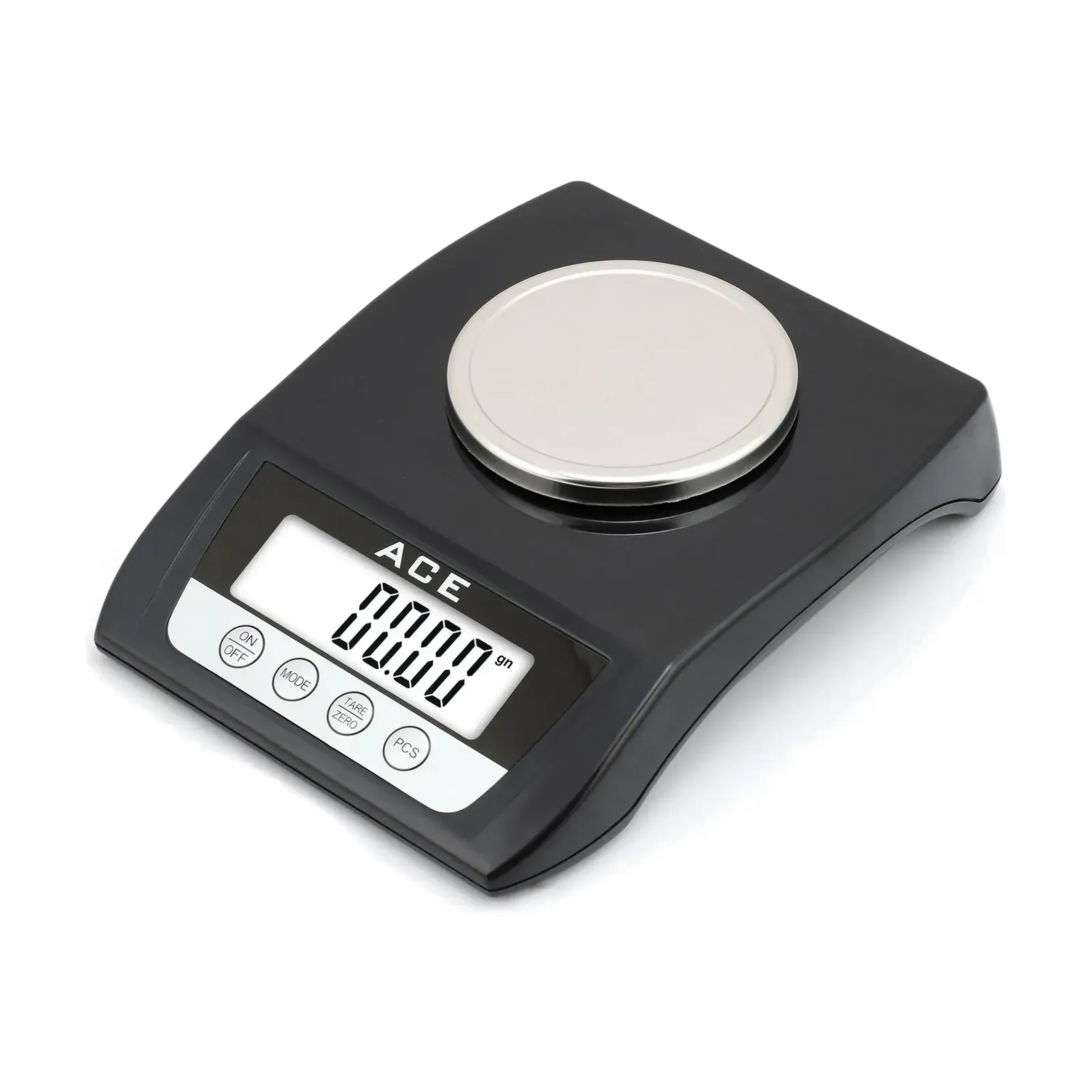
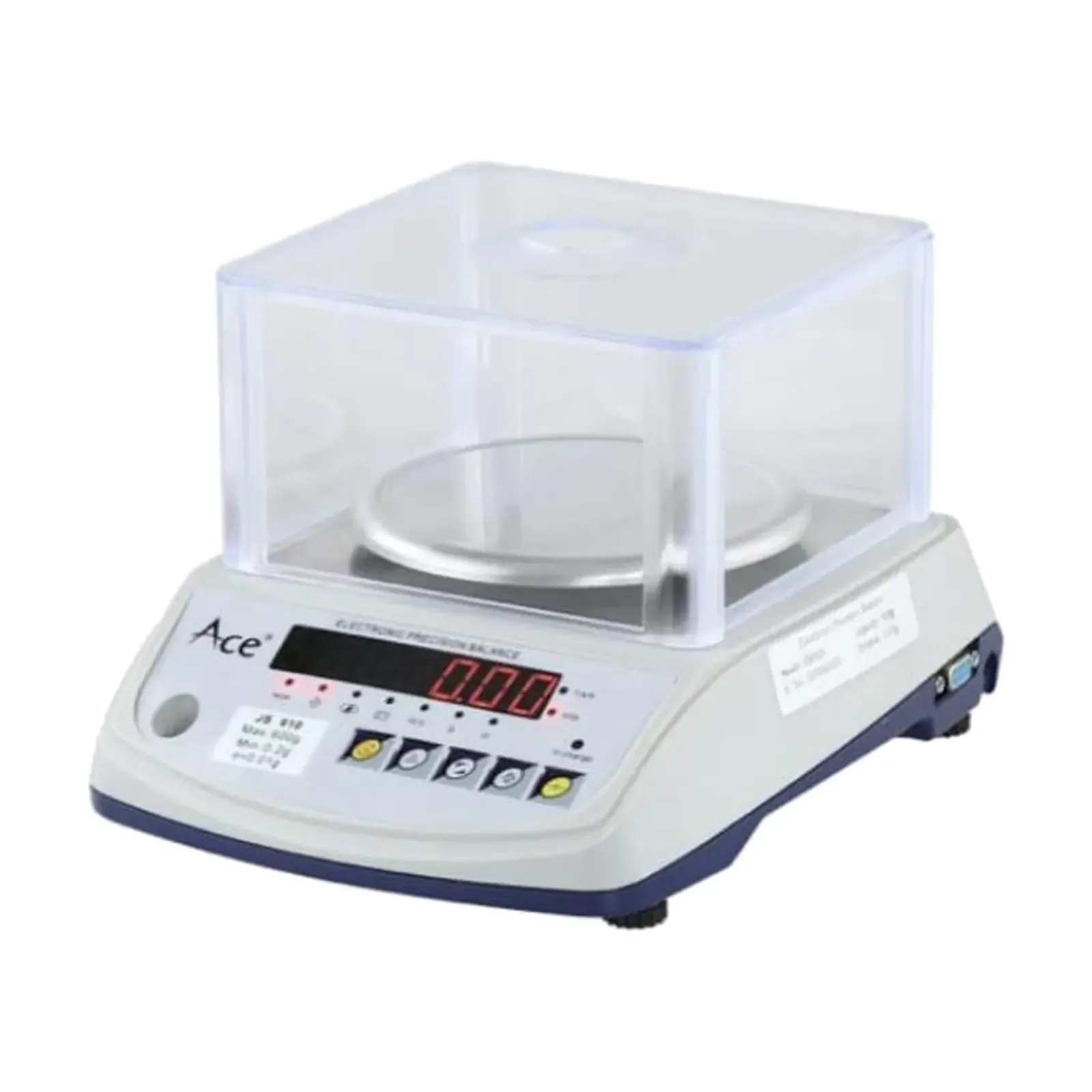
Omace Brands Private Limited prints capacity and display step together on every Ace jewellery model. The Ace KS-600 is 600 g x 0.01 g with a backlit LCD and seven units, priced at ₹3,149. The Ace JS-610 is also 600 g x 0.01 g, with red LED displays front and back, priced at ₹10,499. The two share a rating on paper. The sheet is where you find what differs: the display, the build and the use each was designed for.
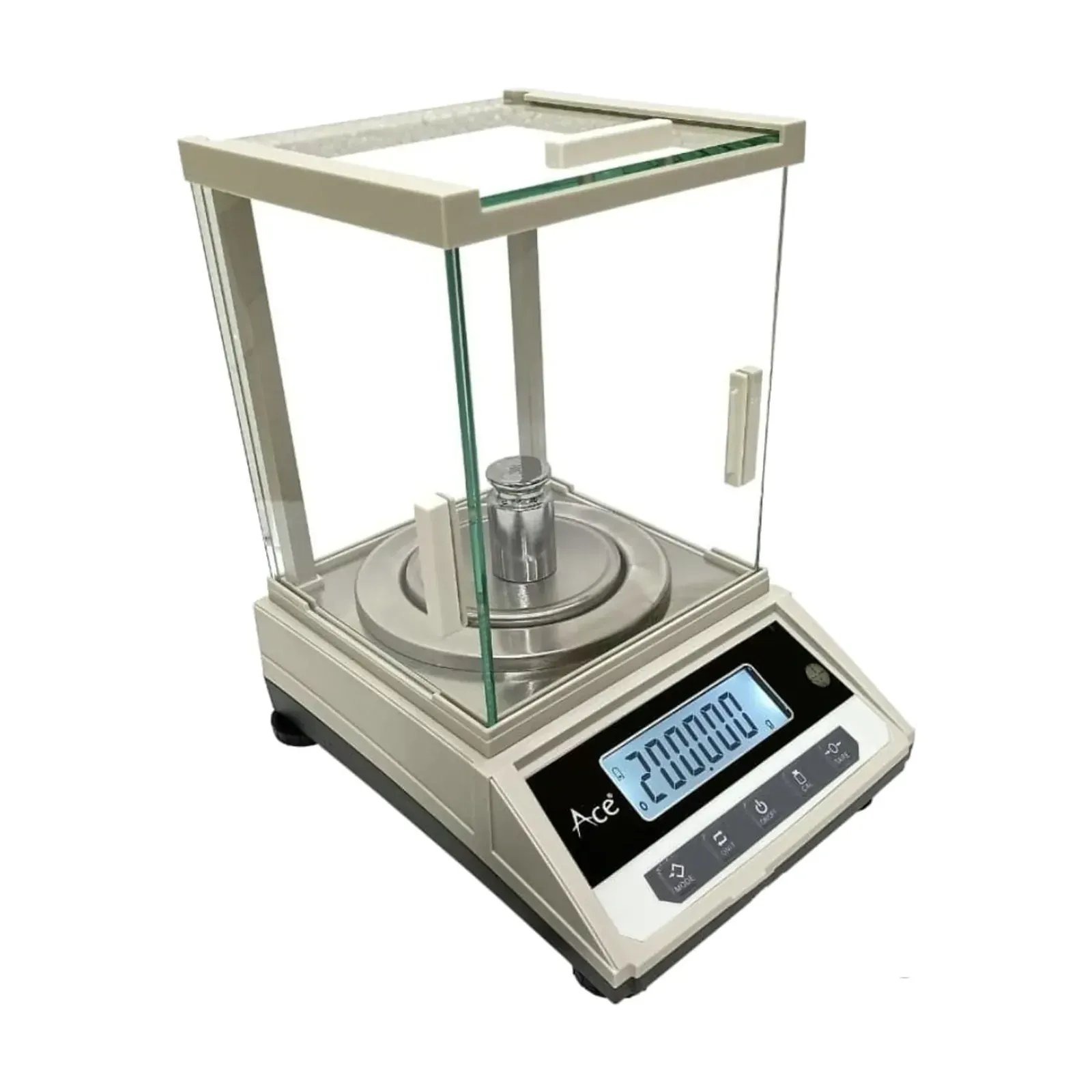
For finer work, the Ace JS-3003 balance, at 300 g x 0.001 g, costs ₹27,258 and carries a glass windshield and a 200 g calibration weight, as its product page states. On Omace digital scales a long press of TARE opens calibration mode on some models and a long press of the M key on others, and the manual for each model shows which, and what calibration is explains why a calibration weight matters. Stamped trade scales are sealed, and a registered repairer recalibrates them.
Questions to ask before you pay
Take the sheet and ask five things. What is the capacity and the display step together? What is the smallest load it weighs well? Does it include a calibration weight, and how do I calibrate it? Is it for home use or for selling by weight, and is it stamped? What happens when it reads wrong? On the last one, Omace Brands Private Limited replaces a scale under warranty if it reads wrong, and the warranty covers manufacturing defects for 2 years. For more on types and uses, see types of weighing scale.