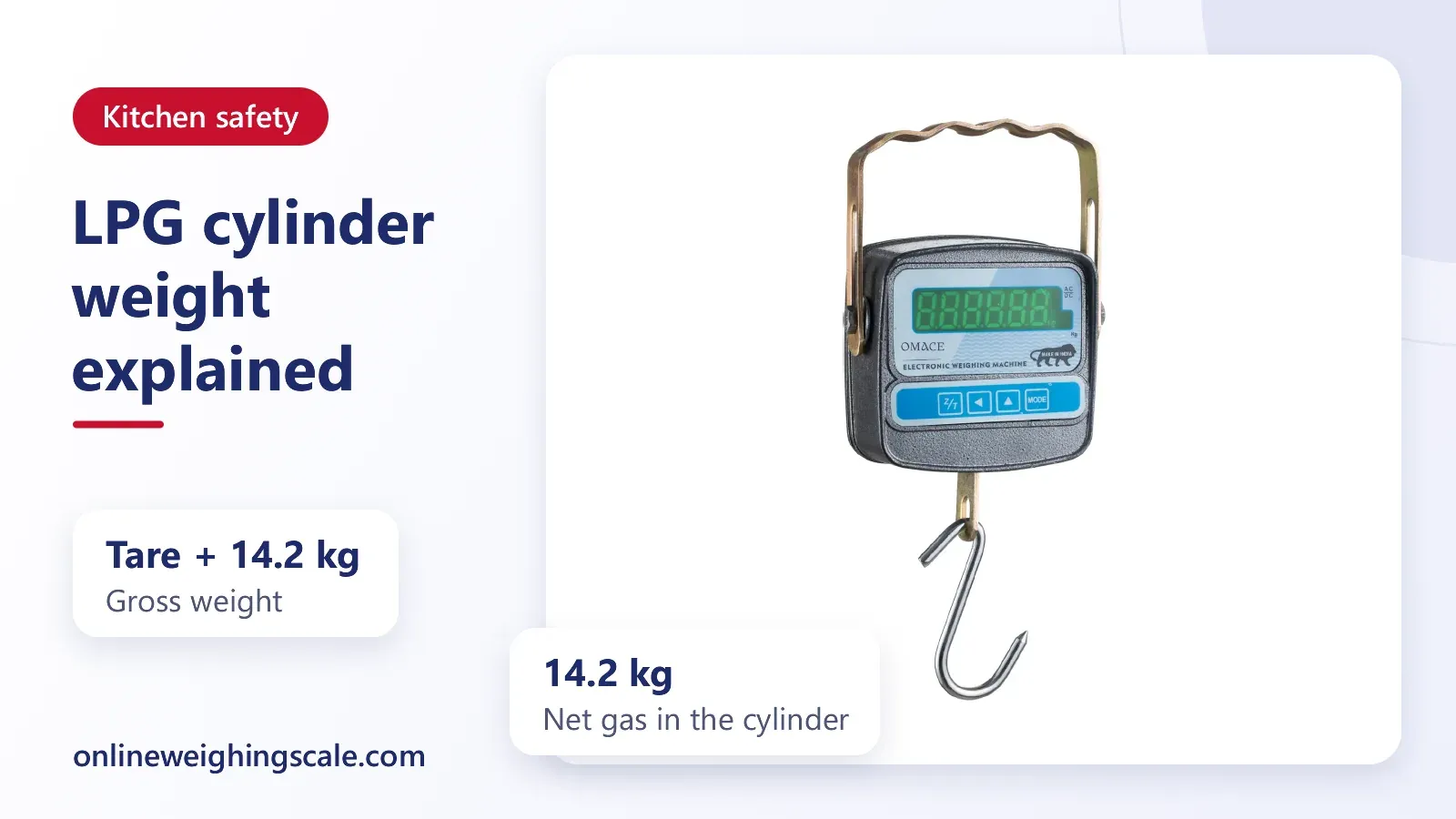
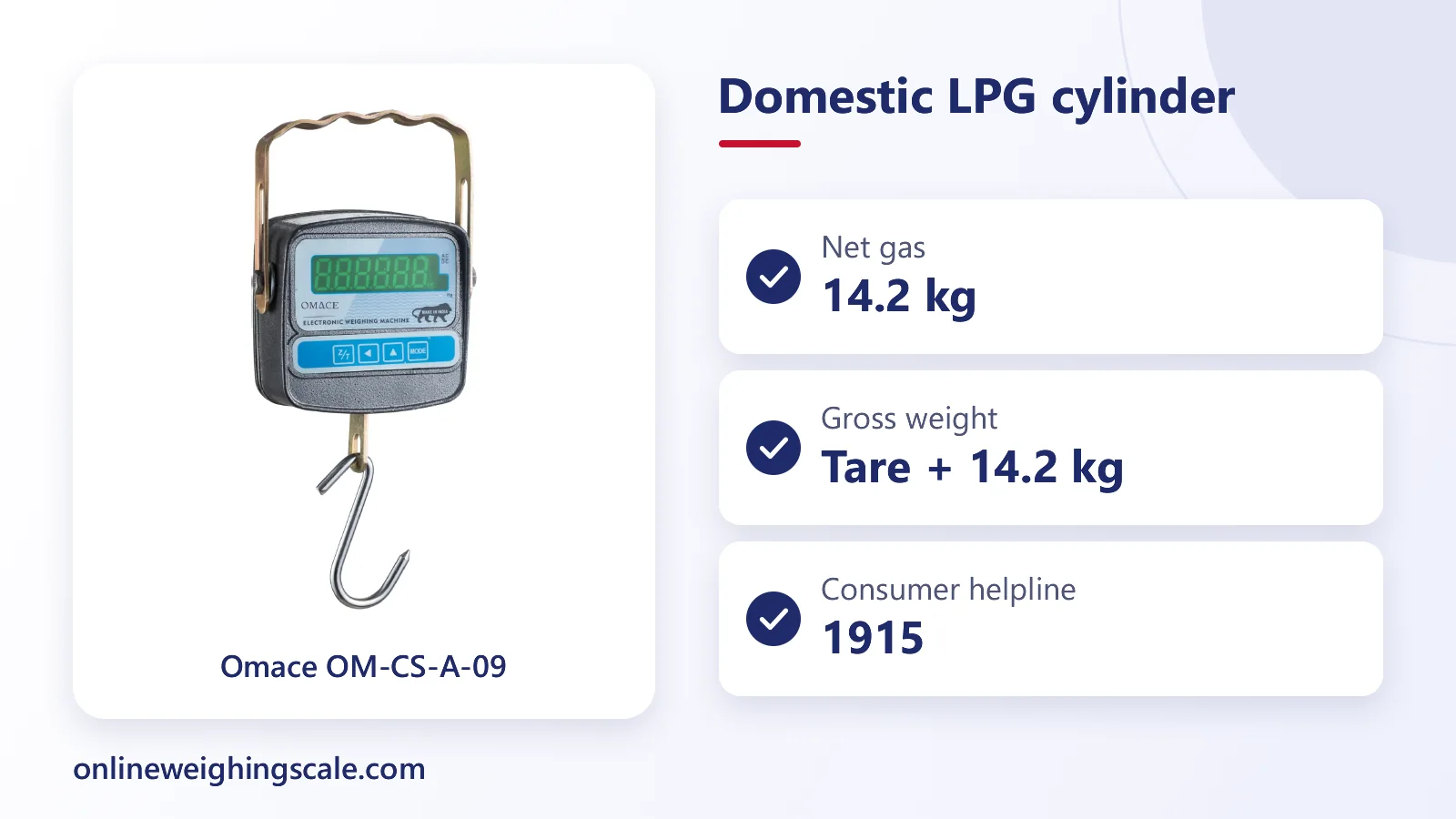
A domestic LPG cylinder in India carries 14.2 kg of gas, and the full cylinder weighs that figure plus the empty weight (tare) marked on the cylinder. Read the tare, add 14.2 kg, and you know what a full cylinder should show on a scale.
This guide explains how to read the markings, how to work out the gross weight, who is expected to weigh the cylinder at your door, and what to do if it comes up short. It also covers how a gas agency or a family can weigh a cylinder with a hanging scale.
Net weight, tare weight and gross weight
Three words come up on every cylinder, and they are easy to mix up. Net weight is the gas inside. Tare weight is the empty steel cylinder with its valve. Gross weight is the two together, and it is the number a scale shows when a full cylinder hangs from it.
| Term | Meaning | Example for a domestic cylinder |
|---|---|---|
| Net weight | LPG inside the cylinder | 14.2 kg |
| Tare weight | Empty cylinder, as stamped on it | Read it from your cylinder |
| Gross weight | Tare plus net | Tare + 14.2 kg |
| Gas left | Reading now minus tare | Scale reading – tare |
The tare differs from one cylinder to another because each steel body is made and tested separately. That is why a general figure found online is not safe to use. Your cylinder's own number is the only one that counts.
Where the tare weight is marked
The public-sector oil companies describe the markings on a cylinder in their consumer literature. Hindustan Petroleum's LPG consumer booklet says the tare and gross weight, the test date and the serial number are embossed or painted on the cylinder. The same booklet says household LPG is sold in cylinders of 14.2 kg and 5 kg capacity.
Look for the line showing the tare in kilograms. The test date tells you when the cylinder was last inspected, and it is worth a glance, because the oil companies' 2018 guidelines say cylinders due for statutory testing must be set aside and returned to the bottling plant.
If the stamping is worn or hard to read, do not guess. Ask the distributor to read the tare from the cylinder record and note it for you.
How to work out what a full cylinder should read
The method is simple arithmetic. Take the tare printed on your cylinder, add 14.2 kg, and compare the total with what the scale shows.
- Note the tare from the markings on the cylinder, in kg.
- Add 14.2 kg to it. This is the expected gross weight of a full cylinder.
- Weigh the cylinder on a scale that is steady and on a flat floor, or hang it from a hanging scale.
- Subtract the tare from the reading. The result is the gas inside.
To estimate how much gas is left in a cylinder that is in use, run the same sum. Weigh it, then subtract the tare. A reading that equals the tare means the cylinder is empty. Many households do this before the last few days of cooking, so that a refill can be booked in time.
The weight of the scale's own hook, strap or chain does not matter on a digital hanging scale if you tare it first. Press TARE with the hook and strap alone, then lift the cylinder. The same idea applies to a platform scale with a mat or a plank under the cylinder. Mass and weight are used loosely in daily talk, and the post on mass vs weight explains why a kanta reads in kilograms even though it senses force.
Who weighs the cylinder at delivery
The oil companies' marketing discipline guidelines set out how a distributor must handle cylinders. The 2018 edition from Hindustan Petroleum says the delivery man of the distributor should carry weighing equipment and deliver the cylinder after demonstrating the weight to the customer or the customer's representative. The same document says cylinders going out for delivery should be checked on a digital platform scale with a least count of 10 g. You can read these clauses in the 2018 guidelines.
So the customer has good grounds to say, politely, "please weigh it here". The delivery person is expected to have the scale on the vehicle. The same clause says the delivery man should also show the seal on the cylinder, so it is reasonable to look at the seal before the cylinder comes inside. The 2022 guidelines add that cash memos should carry the message "Get cylinder checked for weight and leakage at the time of delivery".
The delivery check is a short one. The delivery person lifts the cylinder onto the scale, you read the number together, and you compare it with the tare plus 14.2 kg. If the figures agree within the scale's reading step, sign the slip as usual.
What counts as short weight
A cylinder is filled to the net quantity by the bottling plant, and the quantity is governed by the Legal Metrology (Packaged Commodities) Rules, 2011. The 2022 edition of the oil companies' marketing discipline guidelines says that cylinders whose net weight falls outside the permissible limit under those rules must be returned. It also lists supply of an underweight cylinder beyond that limit as an irregularity by the distributor, and lists free replacement of an underweight cylinder supplied to a customer as compensation.
The guidelines point to the Packaged Commodities Rules for the permitted error and do not state a figure themselves, so this post quotes none. Ask your distributor or the oil company for the current limit in writing, if the amount in dispute is large. For the wider background on how stamping and the department work, see the post on legal metrology in India.
Weighing a cylinder yourself at home
A bathroom scale works for a rough check, but it is built for people. A cylinder is a heavy, narrow-based object, and many bathroom scales read poorly when the load sits in one small spot. Even so, many families put the cylinder on a flat scale and check the reading against the tare plus the net weight. If you do, stand the cylinder in the centre of the platform and let the reading settle.
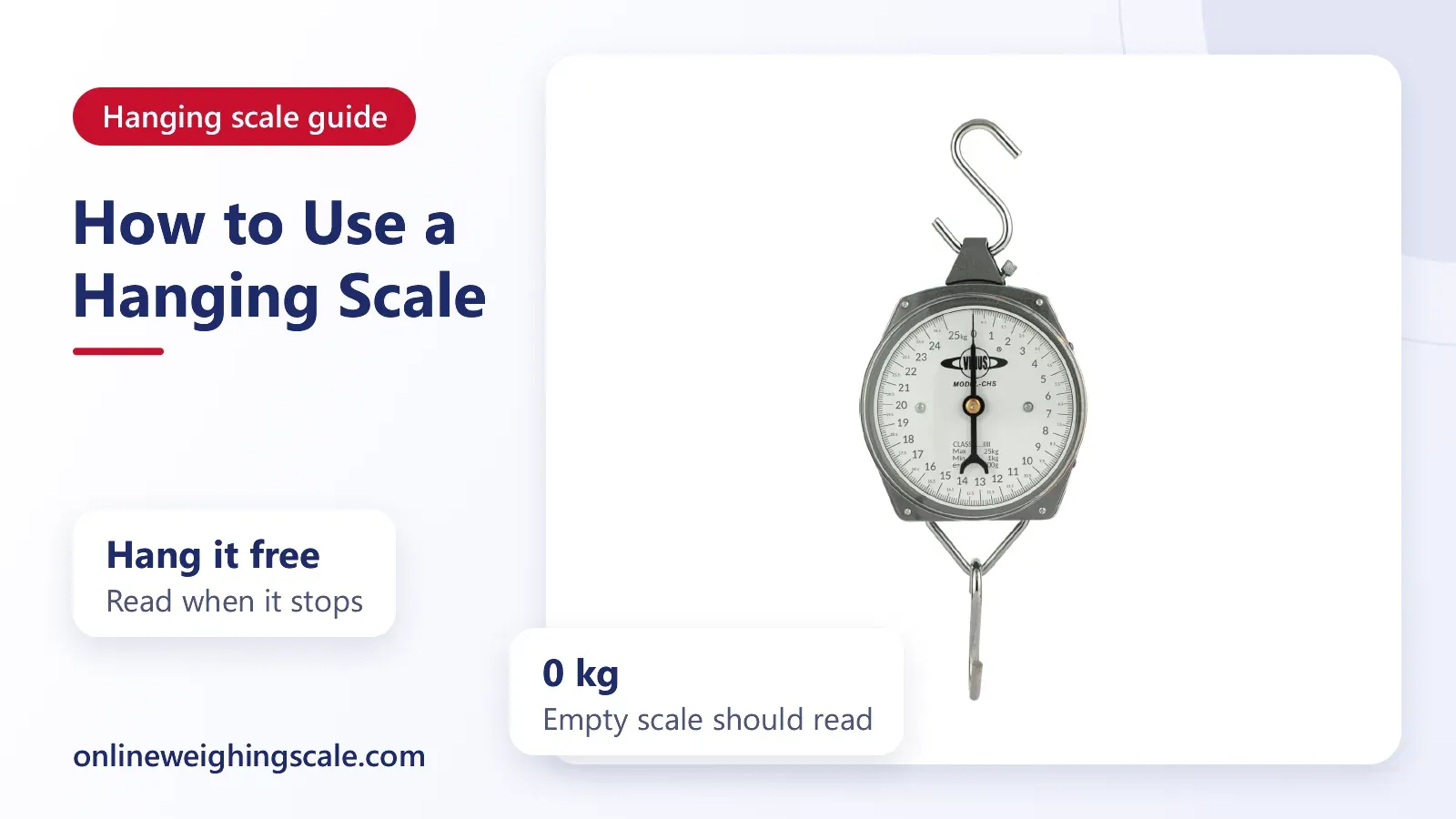
A hanging scale with a hook is the better tool. The cylinder hangs free, the load is central by design, and the reading is steady once it stops swinging. Use a strap that goes through the handle guard, not around the valve, and keep your feet clear in case a strap slips.
Whatever scale you use, test it first. Weigh something of known mass, such as a sealed water can marked in litres, and see whether the reading is close. One litre of water has a mass of about one kilogram. A scale that is clearly off needs calibrating before you trust it for a dispute.
What a gas agency needs from a cylinder scale
An agency weighs many cylinders a day, so the scale has to be quick to read and strong. Capacity comes first. The scale must read the full gross weight of a cylinder with room to spare, so check the tare stamped on the heaviest cylinder you handle, add the net quantity, and compare the total with the scale's capacity.
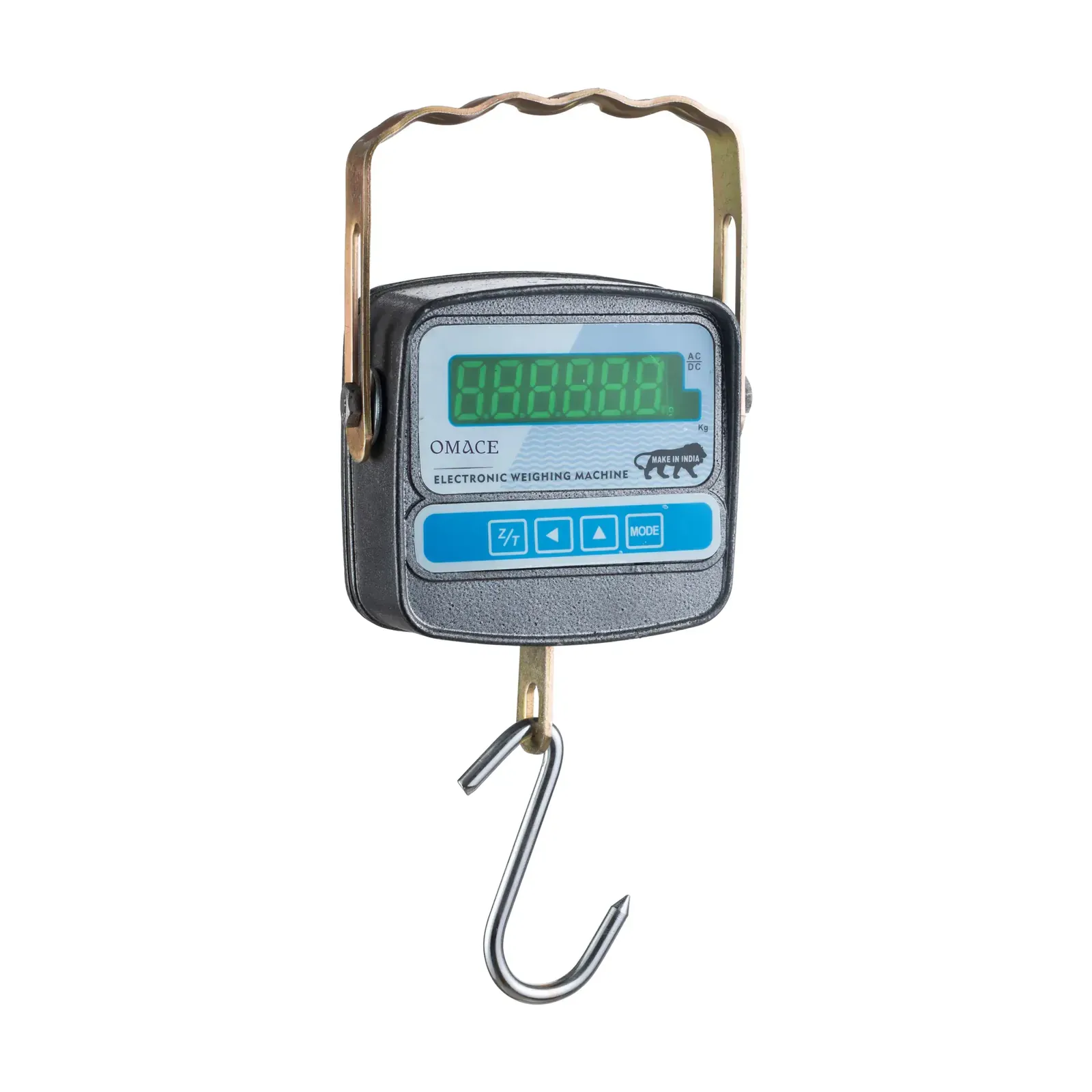
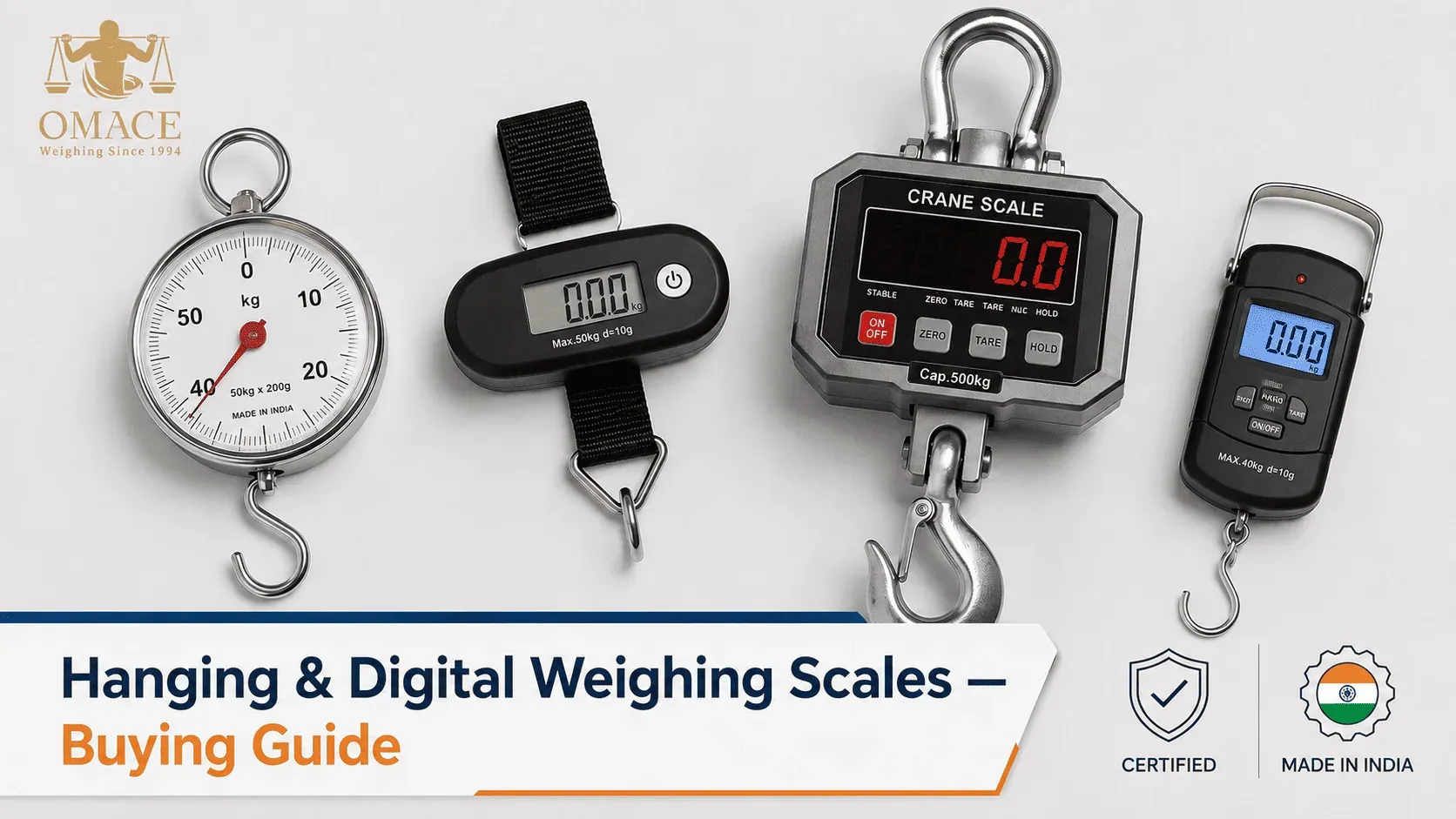
Omace Brands Private Limited makes the OM-CS-A-09 cylinder weight machine, a 50 kg digital hanging scale priced at ₹2099 including GST today. For an agency that also weighs loads beyond a single cylinder, the Omace 120 kg hanging weighing scale reads in 10 g steps, and the Omace digital hanging scale 50 kg is a second 50 kg option. A hook scale of this type lets one person lift the cylinder, read it and put it down without a platform. The other models are in the hanging weighing scale range.
A few habits help any scale of this kind:
- Hang it from a firm beam or a hook rated for the load, never from a loose rope.
- Press TARE with the strap on, so the strap is not counted.
- Let the cylinder stop swinging before reading it.
- Check the zero between loads, and test the scale with a known weight at the start of the day.
On Omace digital scales a long press of TARE opens calibration mode on some models and a long press of the M key on others, and the manual for each model shows which. The steps are in the guide to calibrating a digital weighing scale. Omace Brands Private Limited also repairs its commercial scales when the buyer asks. The buyer pays the shipping both ways and the repair cost, and spare parts depend on availability, so write to the company first through Contact Us.
A scale used for trade weighing has legal rules on top of this. If you charge customers by the weight shown, read the post on the legal-for-trade weighing scale before you buy.
If the cylinder is short: what to do
Keep the cylinder, do not open the valve, and act on the same day. The steps below are general advice, built on the oil companies' guidelines and the Helpline routes described below.
- Weigh the cylinder in front of the delivery person and read the figure aloud.
- Write the reading, the tare, the date and the time on paper, and ask the delivery person to sign it.
- Refuse the cylinder and ask for a free replacement from the same distributor, which the 2022 guidelines list as compensation.
- Call or write to the distributor, then to the oil company's regional office if there is no answer.
- File a complaint with the National Consumer Helpline.
The National Consumer Helpline takes complaints on toll-free 1915 in 17 languages, and online at consumerhelpline.gov.in, where a one-time sign-up with email verification creates a login. It also takes SMS, WhatsApp and the UMANG app. The Department of Consumer Affairs describes these routes in a 2025 document published by the Press Information Bureau. A short-weight complaint with a signed note and photographs of the scale reading is far easier to act on than a verbal one. Your state's Legal Metrology department can also be asked about short weight in packaged goods.
Cylinder sizes and who they are for
The 14.2 kg cylinder is the household size most families know. Oil companies also supply other sizes, smaller ones for light use and larger ones for restaurants and small industry. The net quantity and the tare differ for each, so the method does not change: read the tare on the cylinder, add the net quantity for that size, and compare the total with the scale. Do not assume that a number meant for one size applies to another.
Common mistakes when weighing a cylinder
- Using a general tare figure from a website instead of the one on the cylinder.
- Reading the scale while the cylinder still swings.
- Forgetting to tare the strap or mat.
- Trusting a scale that has never been checked with a known weight.
- Weighing near the valve with the regulator still fitted. Remove the regulator before weighing.
- Complaining without a written reading, date and signature.
The weighing itself is only as good as the scale. If you are unsure how far a scale can be trusted, the difference between accuracy and precision is a useful read. A scale can show steady numbers and still be wrong by a fixed amount.
Handle the cylinder safely while weighing
LPG is flammable, so weigh in an open, ventilated place away from any flame, switch or hot surface. Keep the cylinder upright on a platform scale. Lift with your legs and never drag a cylinder across the floor. If you smell gas at any time, do not touch switches, open the windows and call the emergency number of your distributor or oil company. This is general information. Ask your distributor or fire service about your own cylinder and connection.
Keeping a record of cylinder weights
A short note in a diary is enough. Write the date of delivery, the tare, the weight shown at the door and the person who delivered it. After three or four deliveries you see a pattern. A cylinder that always comes in light from the same distributor is a pattern worth showing to the oil company. An agency can keep the same record per truck. The habit costs nothing and it turns an argument into a conversation about numbers.
Omace Brands Private Limited has made scales in Bagru, Jaipur since 1994, and its hanging, crane and platform scales are used for loads like this. More about the company is on the About us page.