
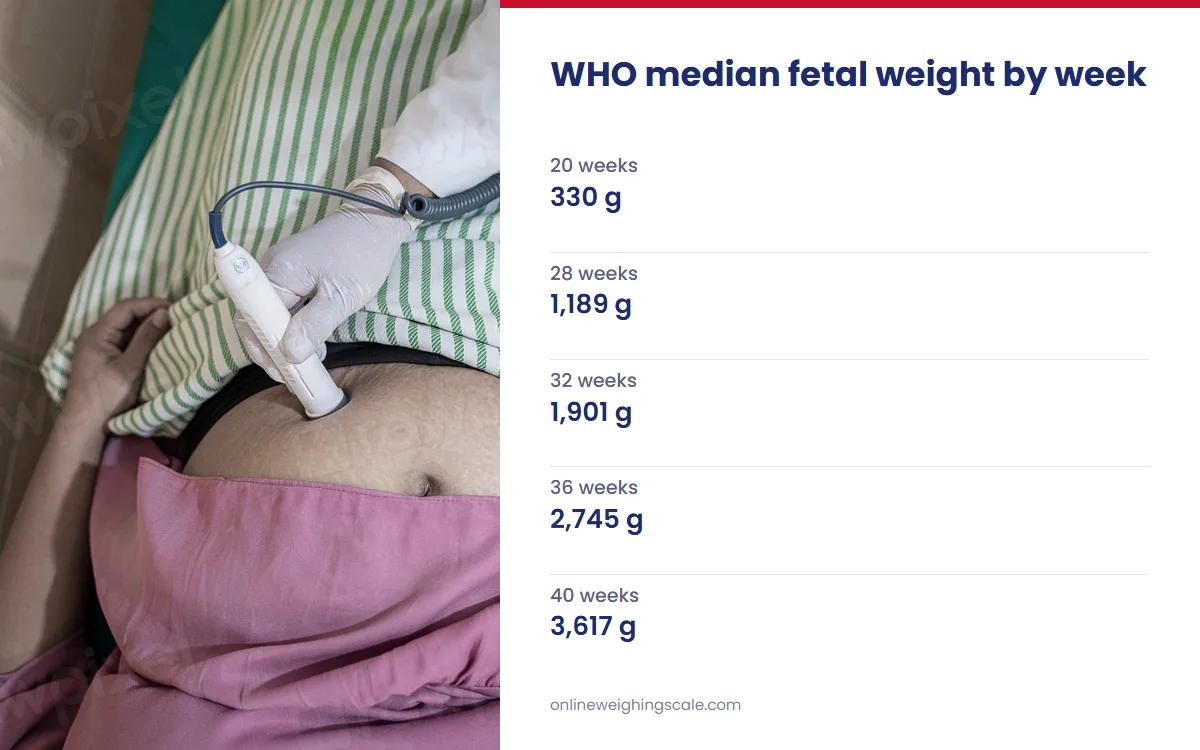
A pregnancy weight chart lists how much a mother usually gains and how much the baby weighs by week. For a normal starting BMI, the Institute of Medicine lists 11.5–16 kg and ICMR-NIN names 10–12 kg. WHO's fetal growth charts put the median baby at 330 g at 20 weeks. These are references, and your doctor decides what fits you.
Weight gain during pregnancy by BMI
The Institute of Medicine (IOM) guideline of 2009 is the chart most pages repeat, and the US CDC publishes the same totals in pounds. It sets ranges by BMI before pregnancy, because starting weight changes the picture. You can work out your BMI with this BMI calculator.
| BMI before pregnancy | Total gain, one baby | Weekly gain, 2nd and 3rd trimester | Total gain, twins |
|---|---|---|---|
| Below 18.5 | 12.5–18 kg | 0.44–0.58 kg | No IOM range |
| 18.5–24.9 | 11.5–16 kg | 0.35–0.50 kg | 17–25 kg |
| 25.0–29.9 | 7–11.5 kg | 0.23–0.33 kg | 14–23 kg |
| 30 or above | 5–9 kg | 0.17–0.27 kg | 11–19 kg |
The IOM assumes a gain of 0.5–2 kg in the first trimester. Its report brief explains why it gives ranges: a single number cannot cover differences between women. It also says the guideline works with clinical judgement and a discussion between a woman and her care provider. For comparison, the NHS says most pregnant women gain between 10 kg and 12.5 kg.
What Indian guidance says
Indian sources use lower BMI cut-offs and give different totals, so you may hear more than one number at the clinic.
| Source | Group | Reference |
|---|---|---|
| ICMR-NIN Dietary Guidelines, 2024 | BMI 18.5–23 | At least 10–12 kg |
| ICMR-NIN Dietary Guidelines, 2024 | BMI below 18.5 | More food, weight gain monitored closely |
| ICMR-NIN Dietary Guidelines, 2024 | BMI 23 or above | Up to 5–9 kg |
| NHM guideline for ANMs | All women | 9–11 kg, around 2 kg a month after the first trimester |
| Mother and Child Protection Card | All women | At least 9–11 kg, at least 1 kg a month in the last 6 months |
The sources do differ. The National Health Mission guideline for ANMs speaks of around 2 kg a month after the first trimester, and the Mother and Child Protection Card gives a floor of 1 kg a month in the last 6 months. ICMR-NIN adds that a woman of normal weight needs an extra 350 calories a day from the second trimester on.
ICMR has said the evidence for Indian women is limited. Its call for data from August 2025 says existing recommendations such as IOM and INTERGROWTH-21st come largely from non-Indian populations or selected subgroups. It is gathering Indian data to build context-specific advice. Until then, your doctor chooses the reference and reads it against your own history.
Pregnancy weight gain by week
The IOM gives weekly rates and does not print a week-by-week table, so the one below is plain arithmetic. It adds the IOM's mean rate (0.51, 0.42, 0.28 and 0.22 kg a week, from left to right) to its first-trimester range. A real pregnancy rarely moves in a straight line, and the NHS notes that most of the gain comes after week 20.
| Week | BMI below 18.5 | BMI 18.5–24.9 | BMI 25.0–29.9 | BMI 30 or above |
|---|---|---|---|---|
| 13 | 0.5–2 kg | 0.5–2 kg | 0.5–2 kg | 0.5–2 kg |
| 20 | 4.1–5.6 kg | 3.4–4.9 kg | 2.5–4.0 kg | 2.0–3.5 kg |
| 28 | 8.2–9.7 kg | 6.8–8.3 kg | 4.7–6.2 kg | 3.8–5.3 kg |
| 36 | 12.2–13.7 kg | 10.2–11.7 kg | 6.9–8.4 kg | 5.6–7.1 kg |
| 40 | 14.3–15.8 kg | 11.8–13.3 kg | 8.1–9.6 kg | 6.4–7.9 kg |
Read the table as a rough picture of pace, with the total range above as the fuller guide. It is not a target for any given week.
Where the weight goes
Much of the gain is the baby's support system and the mother's own body. A published review on maternal weight breaks down a typical gain of about 12.5 kg at term like this:
| Part | Approximate weight |
|---|---|
| Baby | 3.40 kg |
| Placenta | 0.65 kg |
| Amniotic fluid | 0.80 kg |
| Uterus | 0.97 kg |
| Breast tissue | 0.41 kg |
| Blood | 1.45 kg |
| Extra body water | 1.48 kg |
| Fat stores | 3.35 kg |
The fat stores have a purpose. The NHS says the body stores fat to produce breast milk after birth.
Foetal weight chart by week
The WHO fetal growth charts, published in PLOS Medicine in 2017, draw on 1,362 women in 10 countries, including India. Estimated fetal weight comes from head circumference, abdominal circumference and femur length, using Hadlock's third formula. The 50th percentile is the median, and the 10th and 90th mark the lower and upper parts of the range.
| Week | 10th percentile | 50th percentile | 90th percentile | Median in kg |
|---|---|---|---|---|
| 14 | 78 g | 90 g | 104 g | 0.09 |
| 15 | 99 g | 114 g | 132 g | 0.11 |
| 16 | 124 g | 144 g | 166 g | 0.14 |
| 17 | 155 g | 179 g | 207 g | 0.18 |
| 18 | 192 g | 222 g | 255 g | 0.22 |
| 19 | 235 g | 272 g | 313 g | 0.27 |
| 20 | 286 g | 330 g | 380 g | 0.33 |
| 21 | 345 g | 398 g | 458 g | 0.40 |
| 22 | 412 g | 476 g | 548 g | 0.48 |
| 23 | 489 g | 565 g | 650 g | 0.57 |
| 24 | 576 g | 665 g | 765 g | 0.67 |
| 25 | 673 g | 778 g | 894 g | 0.78 |
| 26 | 780 g | 902 g | 1,038 g | 0.90 |
| 27 | 898 g | 1,039 g | 1,196 g | 1.04 |
| 28 | 1,026 g | 1,189 g | 1,368 g | 1.19 |
| 29 | 1,165 g | 1,350 g | 1,554 g | 1.35 |
| 30 | 1,313 g | 1,523 g | 1,753 g | 1.52 |
| 31 | 1,470 g | 1,707 g | 1,964 g | 1.71 |
| 32 | 1,635 g | 1,901 g | 2,187 g | 1.90 |
| 33 | 1,807 g | 2,103 g | 2,419 g | 2.10 |
| 34 | 1,985 g | 2,312 g | 2,659 g | 2.31 |
| 35 | 2,167 g | 2,527 g | 2,904 g | 2.53 |
| 36 | 2,352 g | 2,745 g | 3,153 g | 2.75 |
| 37 | 2,537 g | 2,966 g | 3,403 g | 2.97 |
| 38 | 2,723 g | 3,186 g | 3,652 g | 3.19 |
| 39 | 2,905 g | 3,403 g | 3,897 g | 3.40 |
| 40 | 3,084 g | 3,617 g | 4,135 g | 3.62 |
Why a scan report can differ from the chart
A scan gives an estimate, and many things move it. The WHO paper reports that boys ran larger than girls, by 3.5% at the lower percentiles and 4.5% at the upper ones. At 37 weeks, the median for girls was 84 g lower than for boys. Maternal height and age went with heavier babies, and so did having given birth before.
Country mattered too. Near term, the 10th percentile was about 2,700 g in India, against about 3,100 g globally and 3,400 g in Norway. The paper's own example is a baby of 3,200 g, which sits below the 10th percentile for Norway and well above it for India. The authors say the charts may need adjusting for local clinical use, so a doctor reads one estimate alongside your earlier scans and your history.
Hospitals may also use another chart. The INTERGROWTH-21st estimated fetal weight standard covers 22 to 40 weeks and is built from 4,231 scans. The same baby can sit on a different percentile on each chart, so ask which one your report uses.
Fetal biometry: BPD, HC, AC, FL and CRL
Scan reports use short codes. These are the WHO chart's medians in millimetres at six points in pregnancy.
| Week | BPD | HC | AC | FL |
|---|---|---|---|---|
| 20 | 47 mm | 173 mm | 150 mm | 32 mm |
| 24 | 60 mm | 222 mm | 197 mm | 43 mm |
| 28 | 72 mm | 264 mm | 240 mm | 52 mm |
| 32 | 81 mm | 296 mm | 279 mm | 61 mm |
| 36 | 89 mm | 321 mm | 317 mm | 69 mm |
| 40 | 96 mm | 342 mm | 363 mm | 73 mm |
- BPD: biparietal diameter, the width of the head.
- HC: head circumference.
- AC: abdominal circumference, around the tummy.
- FL: femur length, the thigh bone.
- CRL: crown-rump length, measured from head to bottom in early pregnancy.
CRL is used for dating. The INTERGROWTH-21st early pregnancy standard recruited women from 9+0 to 13+6 weeks for this purpose. WHO recommends one ultrasound scan before 24 weeks to estimate gestational age and to detect fetal anomalies and multiple pregnancies.
Weighing yourself at home during pregnancy
The clinic's weight stays the record. The Mother and Child Protection Card asks for a weight check-up at each visit, and the NHM guideline treats the first-visit weight as the baseline. A home vajan reading between visits can help you answer your doctor's questions. Use the same scale on a flat, hard floor, at about the same time of day and in similar clothes.
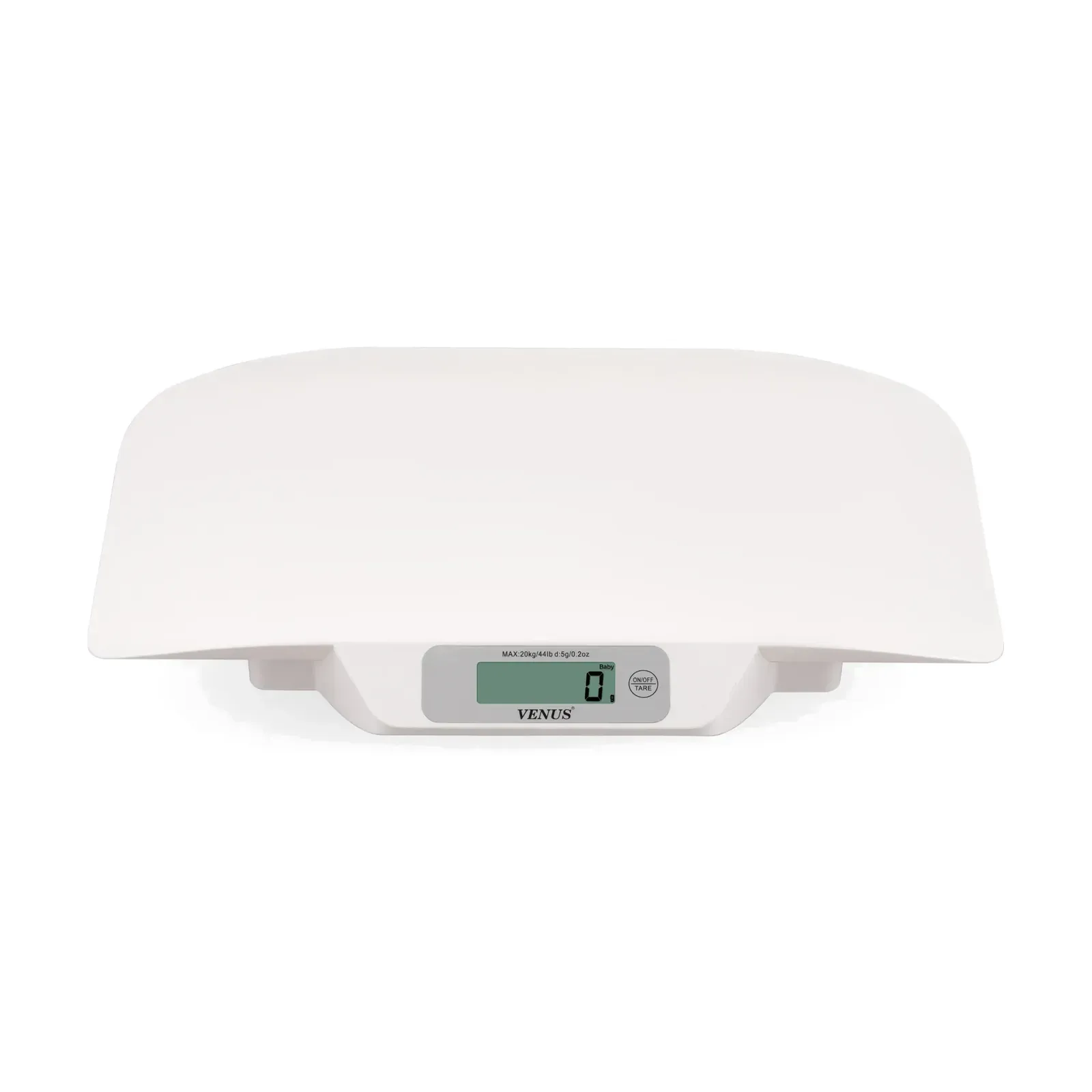
A plain digital scale is enough, because this chart needs only kilograms. The Venus EPS-05 mother and child weighing scale costs ₹729, weighs up to 180 kg and has auto tare for baby weight after birth. The Venus EPS-09 (M) mother and baby weight machine costs ₹1,040 and has a Tuff Steel body. After the birth, the same habit carries on with a newborn weight chart.
A scale only reports kilograms, and it says nothing about how a pregnancy is going. The NHS says pregnancy is not the time to go on a diet, as it may harm the unborn child. Worries about weight belong with your doctor or midwife.
When to talk to your doctor
The NHM guideline for ANMs names two signals for health workers. A gain of more than 3 kg in a month should raise suspicion of pre-eclampsia, twins or diabetes. A gain of less than 2 kg a month after the first trimester can suggest an inadequate diet, and the woman may need food supplementation. A home scale cannot confirm any of these, so tell your doctor and let the clinic check.
Two other checks run alongside weight. The NHM gestational diabetes guideline calls for testing at first antenatal contact and again at 24–28 weeks if the first test is negative, and this guide to the glucometer explains the numbers. The Mother and Child Protection Card covers blood pressure at each visit, and this guide to the BP machine explains those readings. This is general information. Ask your doctor about your own readings.
Who makes Omace mother and baby scales
Omace Brands Private Limited manufactures weighing scales at G-29 RIICO Industrial Area, Bagru, Jaipur. The company has been in the weighing trade since 1994. At Bagru, every scale is checked with certified test weights before dispatch. Every Omace digital scale opens calibration mode when TARE is held for about 5 seconds. Omace scales are made in India.
As a manufacturer, Omace Brands Private Limited holds ISO 13485:2016 and ISO 9001:2015 certificates, an EU MDR quality certificate, a CE certificate of compliance and a US FDA compliance certificate. These are company certificates, listed on the certificates page. Scales bought from the Omace store carry a 2-year warranty on manufacturing defects, and a scale that reads wrong is replaced under warranty. An Omace scale reports weight, and medical decisions stay with your doctor.
Using these charts with your doctor
At your next visit, ask which reference your doctor uses for your weight gain and which fetal chart your hospital's scan report follows. Those two answers make the numbers on this page easier to read. Keep your first-visit weight and each later clinic weight in one place, and carry any home readings with them. If you are also planning for the months after birth, Omace's baby weighing scales are listed by type and capacity. A chart gives you a reference point, and your doctor reads it against your own pregnancy.