Gold is weighed in a jewellery shop on an electronic balance that reads in grams, and the bill for hallmarked jewellery must show the net weight of the precious metal. A piece set with stones therefore weighs more on the pan than the gold in it, and the difference is yours to ask about.
Omace Brands Private Limited, a weighing scale maker in Bagru, Jaipur, wrote this for people buying or selling gold jewellery. It covers the balance on the counter, what the jeweller should do before the weight is read, and what the bill should say, checked November 2026.
The balance on the counter
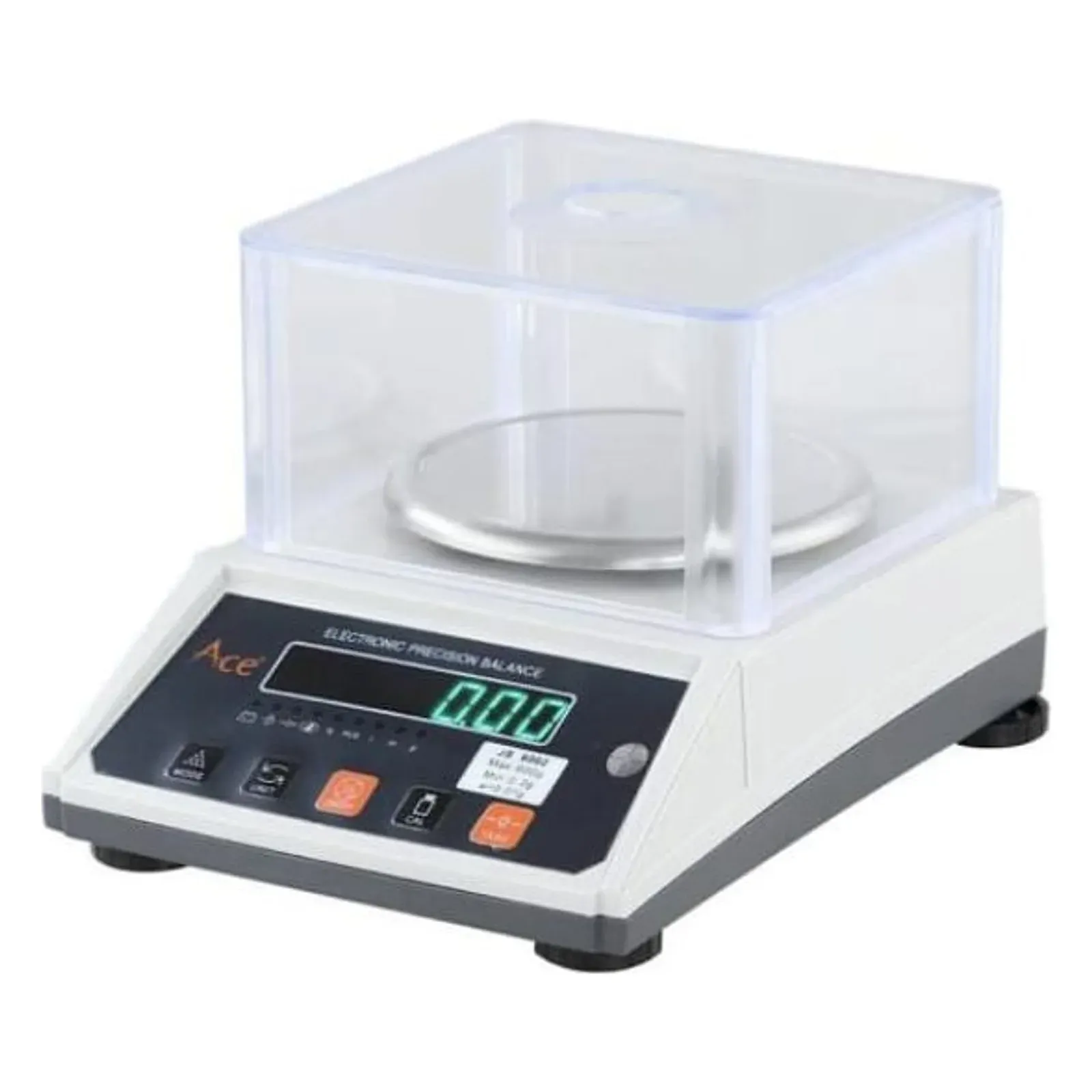
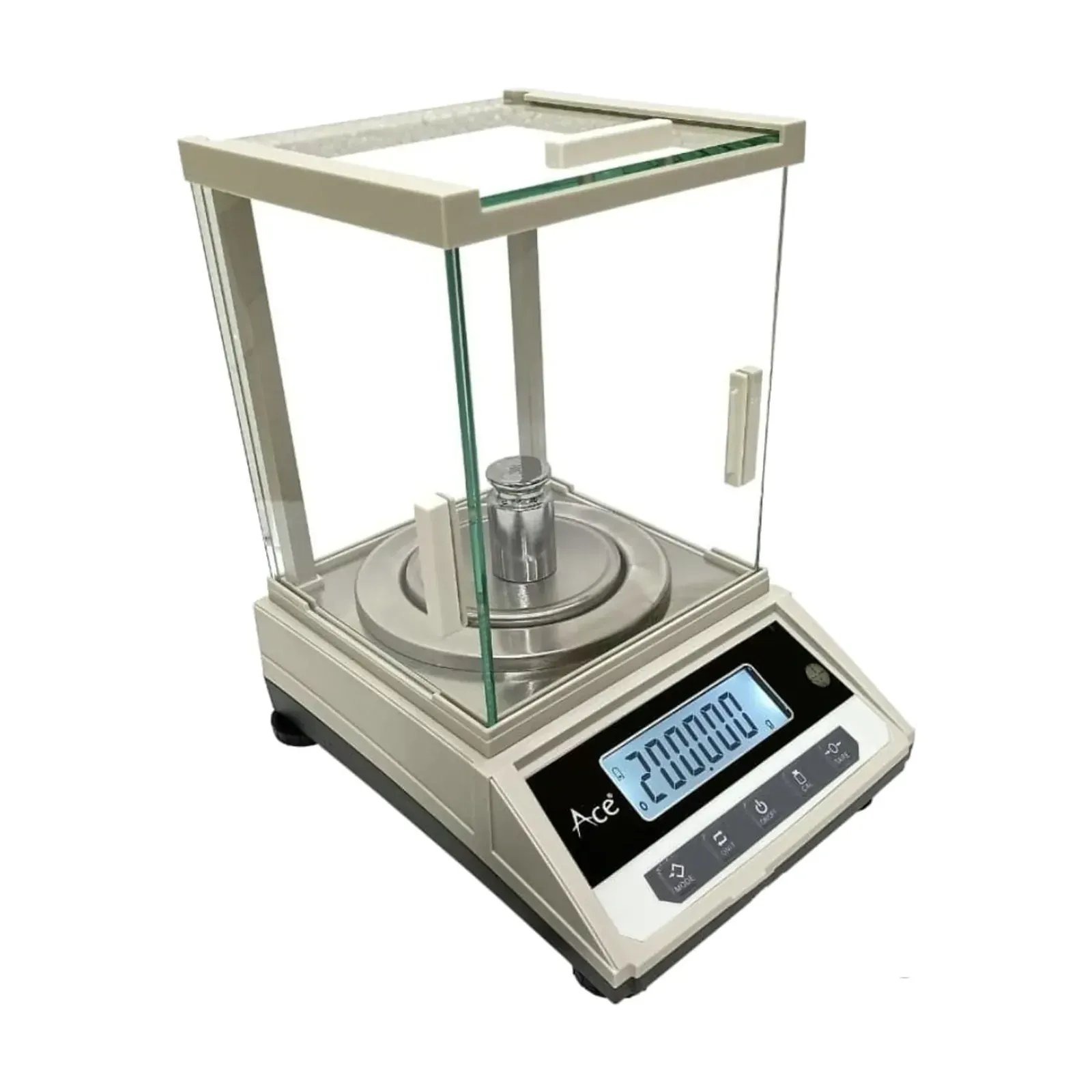
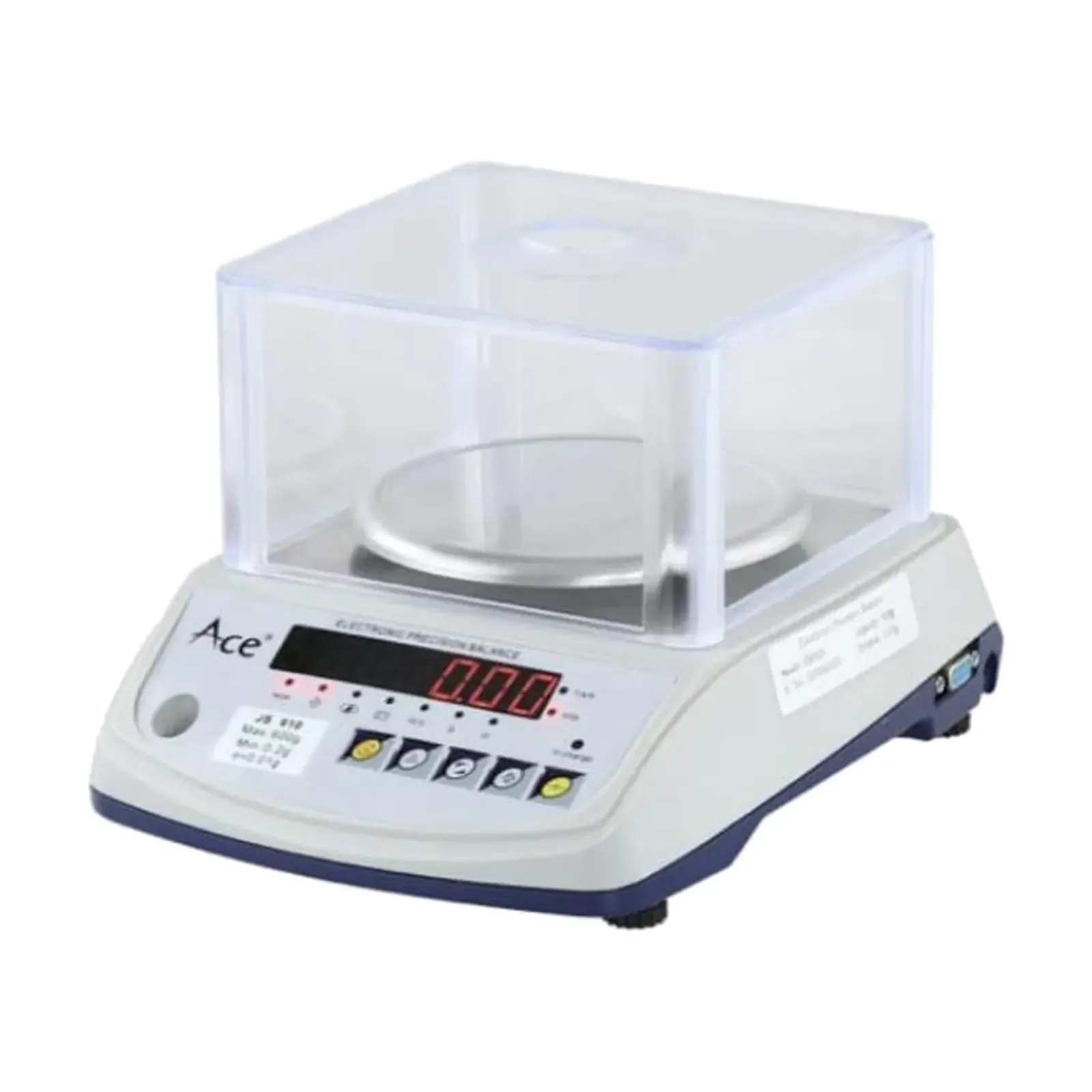
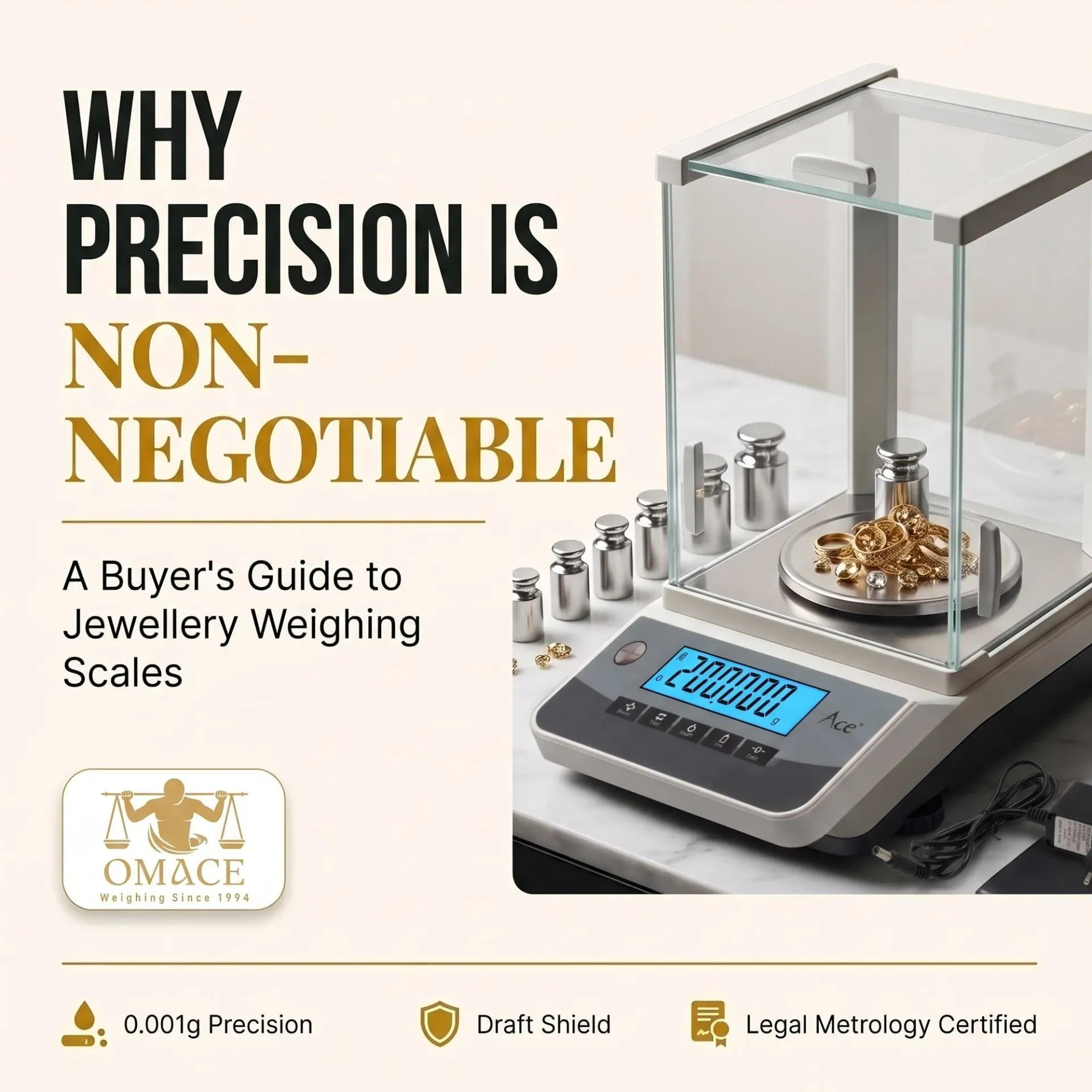
Most jewellers weigh gold on a digital precision balance with a glass cover around the pan. Such balances usually read to 0.01 g, and finer ones read to 0.001 g (one milligram). The pan is small, the display is close to the customer, and the reading appears within a few seconds.
The international standard for non-automatic weighing instruments, OIML R 76-1, sorts scales into four accuracy classes: class I is special, class II is high, class III is medium and class IIII is ordinary. Gold counters use the first two. The same standard says it is not normally feasible to test and verify an instrument with a verification interval below 1 mg, and that class I instruments must carry a levelling device and a level indicator.
Which class and interval an Indian jeweller must use is a matter of state rules that are still changing in 2026. Our separate post on the 1 mg weighing scale rule for jewellers lists what has been reported state by state and what could not be confirmed. This post does not repeat it. For the maths of accuracy classes and calibration, see how to calibrate a gold weighing scale.
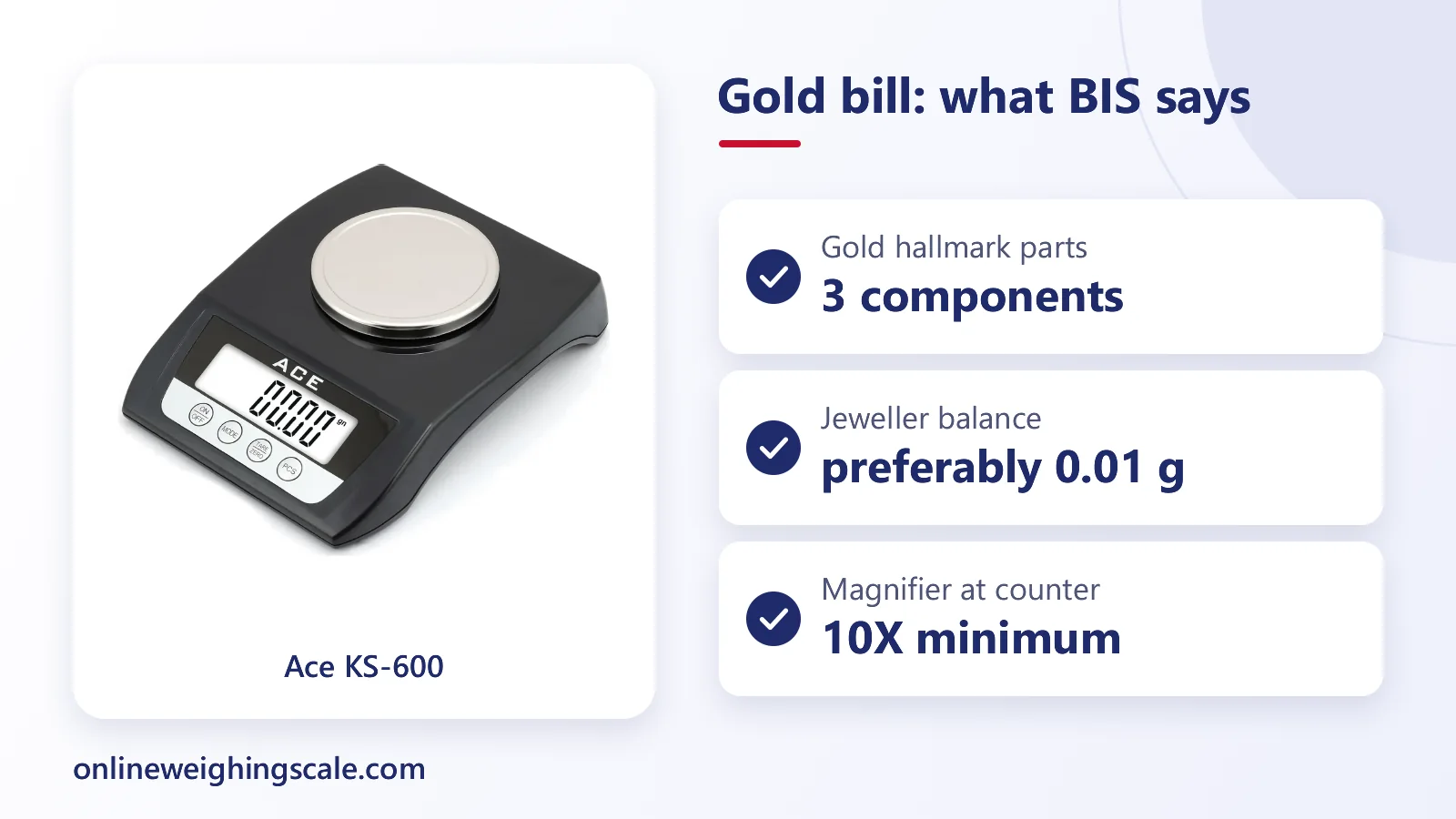
The Bureau of Indian Standards (BIS) also sets a display duty. Its Guidelines for Jewellers of July 2026 say a registered jeweller must keep a suitable weighing balance, preferably of 0.01 g accuracy, so that customers can verify the weight of the jewellery. The same list asks for a magnifying glass of at least 10X, so you can read the hallmark yourself.
What a careful jeweller does before reading the weight
A jeweller who weighs well follows a short routine. None of it is a legal step. It is how any good balance is used, and you can watch for it.
- Levelling. The balance sits on a steady bench and its bubble level sits in the middle. A tilted balance gives a different reading.
- Zero. The display shows 0.00 g before the piece goes on. If a small tray or paper is used, the jeweller presses TARE with the empty tray on the pan.
- Draught shield. The glass cover is closed. A fan, an air-conditioner vent or even breath moves a reading in the last digit.
- Settling. The jeweller waits until the reading stops changing and the stable symbol appears, then reads it.
- A check weight. A shop that cares keeps a small test weight and puts it on the pan now and then. Omace Brands Private Limited checks every bench scale with certified test weights before dispatch for the same reason.
A balance with a worn pan, a damaged cover or a reading that drifts needs recalibration by someone who knows the instrument. Our guide on what calibration is explains the steps and the certificate.
Why the weight is in grams
The balance reads in grams and milligrams, even when the talk at the counter is in tola. Our guide on jewellery weighing units converts tola, masha, ratti and carat to grams and explains which unit the law wants on a bill. If a figure is spoken in tola at the counter, ask to see it in grams on the display.
What the bill must show for hallmarked jewellery
BIS answers this in its consumer FAQ. It says the description of each article, the net weight of precious metal, the purity in carat and fineness, and the hallmarking charges must be mentioned in the bill or invoice of sale of hallmarked precious metal articles. The BIS Guidelines for Jewellers add one more line: the invoice shall also mention that the consumer can get the purity verified at any BIS-recognised Assaying and Hallmarking Centre. The same guidelines say this applies to retail sales and to jeweller-to-jeweller sales.
| Item on the bill | What BIS says |
|---|---|
| Description of each article | Each article is described separately |
| Net weight of precious metal | Required |
| Purity in carat and fineness | Required |
| Hallmarking charges | Required |
| Purity-verification line | Bill states that purity can be verified at a BIS-recognised centre |
BIS names net weight of precious metal in these texts. The pages read for this post do not say how a gross weight or the weight of stones must appear, and this post does not claim a rule about them. Ask the jeweller to write the gross weight, the stone weight and the net gold weight as separate figures. The three numbers should add up.
Net weight, gross weight and stones
When a ring with stones is placed on the pan, the balance shows the gross weight of the whole piece: gold, stones and any small fittings. The gold itself is lighter. If the stones are weighed by the jeweller and subtracted, the result is the net weight of the gold.
For gold you pay for, the net weight is the figure that matters. For stones, the stone weight and the stone charge should be shown on their own, so you can see what you pay for each. Rough stone weights are often written by hand from a smaller balance, so ask which balance was used.
The hallmark on the piece
The BIS brief on the hallmarking scheme, updated 1 October 2026, says gold jewellery carries three hallmark components since 1 July 2021: the BIS Standard Mark, the purity in carat and fineness, and a six-digit alphanumeric HUID. The HUID can be verified through the Verify HUID feature of the BIS Care app. For silver, the same brief says HUID-based hallmarking started on 1 September 2025 on a voluntary basis, and any silver article submitted for hallmarking under the BIS scheme must bear the HUID-based hallmark.
The weight on the bill and the hallmark are separate checks. The first tells you how much metal you are paying for. The second tells you its purity.
How silver is weighed
Silver is weighed the same way, on a balance that reads in grams. Silver ornaments such as anklets and utensils are bulkier than gold ones, so silver counters often use a larger-capacity scale than the small glass-covered balance used for gold. The bill rules above are written for precious metal articles in general, and the BIS brief describes the hallmark and HUID for silver separately.
Weighing old gold you bring to sell or exchange
When you bring old jewellery, the same balance and the same routine apply. A few habits protect you.
- Remove stones, pearls, lac or thread filling where you can, or ask that they are weighed and deducted.
- Watch the display being zeroed, and see the full reading before it is noted.
- Ask for the weight in grams and write it down yourself.
- If the deduction for purity is explained, ask how it was tested. A hallmarked piece carries its purity on it, and an unmarked piece needs a test.
Our post on legal metrology in India covers the law that governs scales used in trade, and the post on weighing scale stamping charges covers verification fees. Whether a particular jeweller's balance carries a current stamp is worth a look. Ask to see it.
Checking a jeweller's scale yourself
- Look for the verification stamp and its date on the balance.
- Put a known weight on the pan, such as a 10 g or 20 g test weight from a reputable supplier, and compare the reading.
- Ask for the same piece to be weighed twice. The two readings should match to the last digit.
- If a shop will not let you see the display clearly, that is information too.
Omace Brands Private Limited makes Ace jewellery scales for shops and workshops in Bagru, and every scale is checked with certified test weights before dispatch. For counters that need a bench balance, the Ace JS-6002 gold weighing scale reads 600 g x 0.01 g and costs ₹16107. For finer work, the Ace JS-3003 precision weighing balance reads 300 g x 0.001 g with a glass windshield and costs ₹27258. Whether either one meets a particular state's rule is something to confirm with your Legal Metrology office before you buy, and the full range is in jewellery weighing scales. Our jewellery scale buying guide helps you choose.
Questions to ask at the counter
Ask the jeweller to show the balance reading before and after the piece goes on, to read out the gross weight, the stone weight and the net weight, and to point to the hallmark with the magnifying glass. If any figure is missing from the bill, ask for it to be written in.