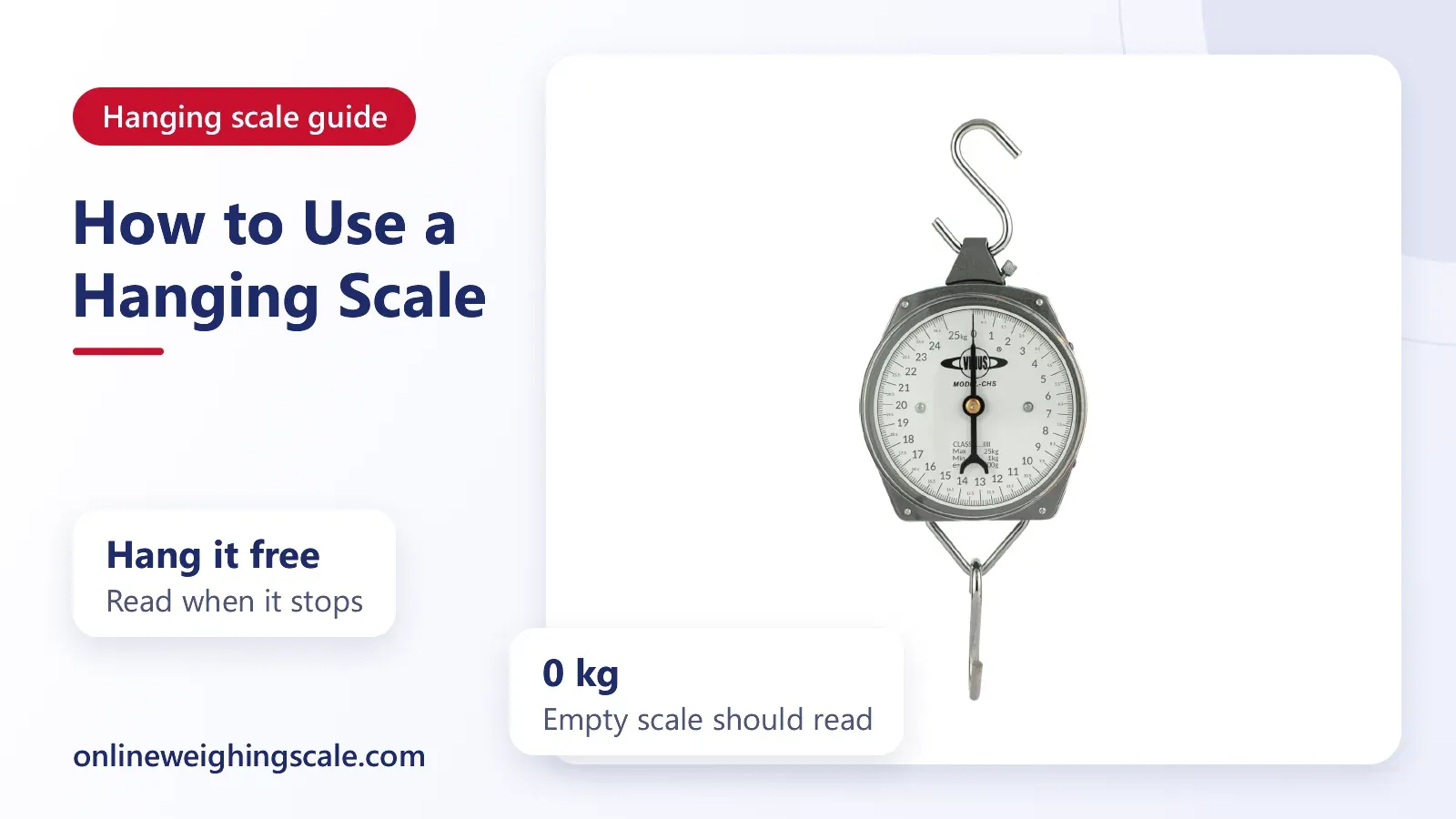
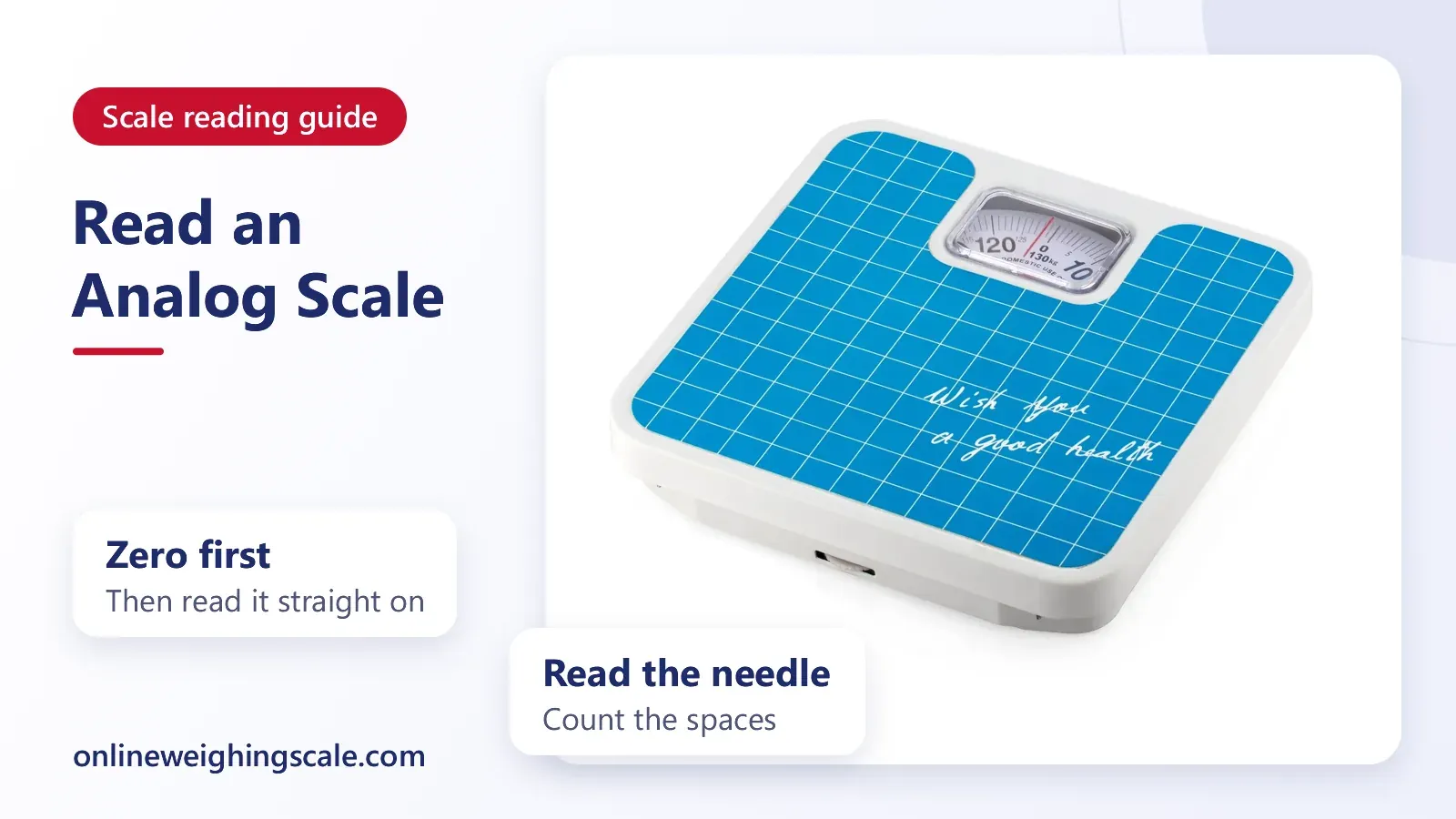
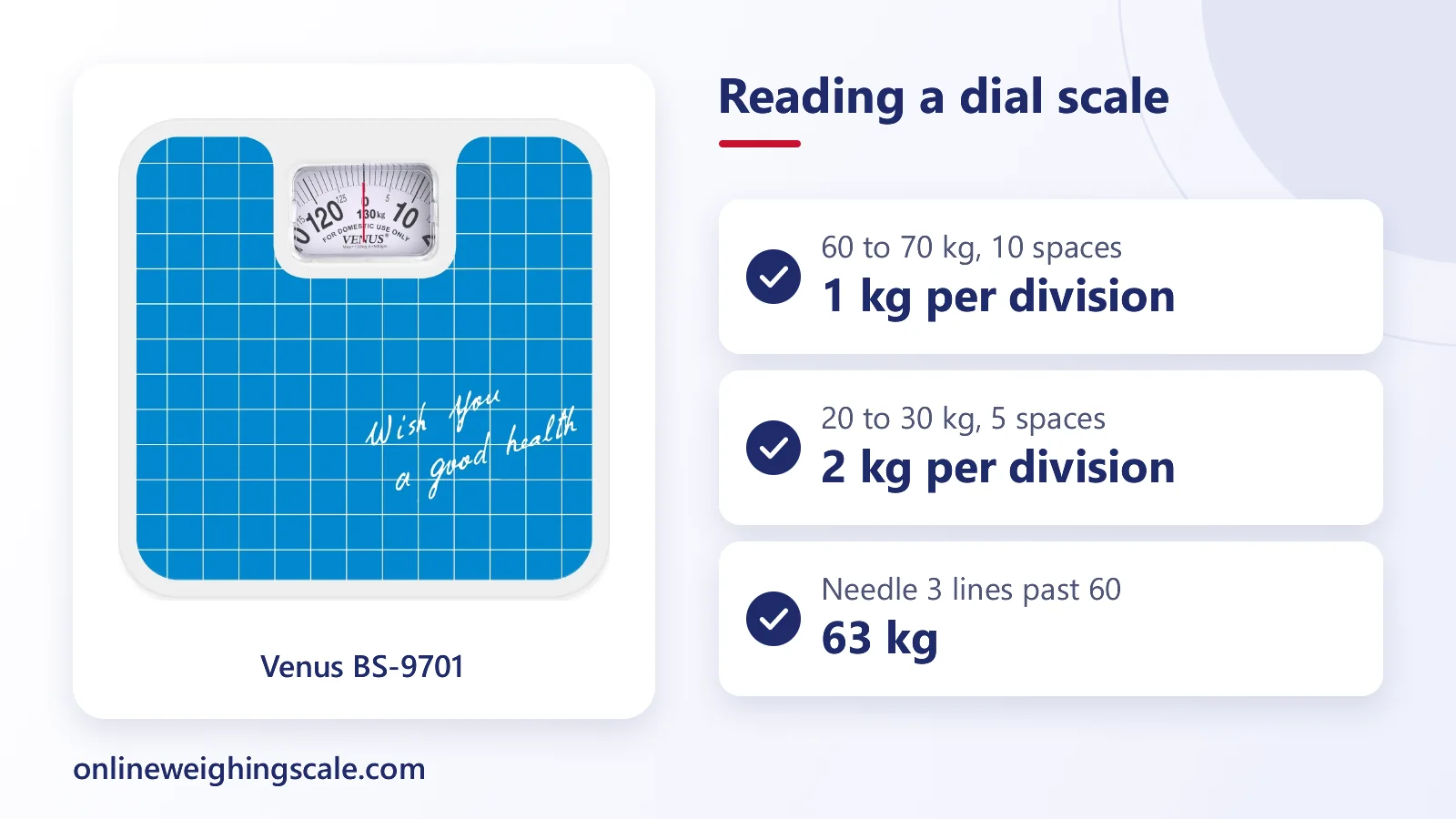
To read an analog weighing scale, first work out what one small division is worth, then look straight at the needle and count the divisions it has passed. A dial with ten divisions between 60 kg and 70 kg reads 1 kg per division, so a needle on the third line past 60 reads 63 kg.
The same method works on a bathroom dial scale, a hanging kanta with a round face and a hand-held spring balance. The printed numbers are only a few of the marks, and most reading mistakes come from guessing what the unnumbered lines mean. This guide goes through the dial, the value of one division, the angle you read from, setting the needle to zero and what to do when the needle sits between two lines.
What is on the face of a dial scale
A dial scale has a needle (also called a pointer or indicator) that turns over a printed face. A spring inside stretches or compresses under the load, and a gear or lever turns that small movement into a needle swing. Nothing needs a battery.
The face usually has three kinds of marks:
- Long lines with a printed number, such as 10, 20, 30 kg. These are the major graduations.
- Shorter lines between the numbered ones. These are the minor graduations, and they carry the real precision.
- One or two rings of numbers. A dial may carry kilograms on one ring and pounds on another, or newtons and grams on a science spring scale. On a dual-ring dial, the unit you want is the ring you must follow with your eye, so check which ring matches your unit before you note a value.
Also look for the maximum capacity, which is the largest printed number. Staying under it matters for the life of the spring, as the section on drift below explains.
Step 1: work out the value of one small division
This is the step people skip. The value of one division is the difference between two neighbouring numbered marks, divided by the number of spaces between them.
Count the spaces, not the lines. If you count the lines, you will be off by one every time.
- Pick two neighbouring numbered marks, for example 60 and 70 kg.
- Subtract: 70 minus 60 is 10 kg.
- Count the spaces between them, say 10.
- Divide: 10 kg over 10 spaces is 1 kg per space.
The table shows how the same sum works on three dials.
| Numbered marks | Spaces between | One division | Needle on the third line past the lower mark |
|---|---|---|---|
| 60 and 70 kg | 10 | 1 kg | 63 kg |
| 20 and 30 kg | 5 | 2 kg | 26 kg |
| 2 and 3 N | 5 | 0.2 N | 2.6 N |
A different dial may have five spaces between 20 and 30 kg. Then each space is 2 kg, and a needle on the second line past 20 reads 24 kg.
Do this once for every new dial. The value of a division is also called the least count, the smallest step the face can show, a term used in the De Anza College physics lab skills manual. The same idea is used to read a vernier caliper, and our post on the vernier caliper and its least count shows it on a metal gauge. Reading a tape works the same way, as the post on how to read a measuring tape explains.
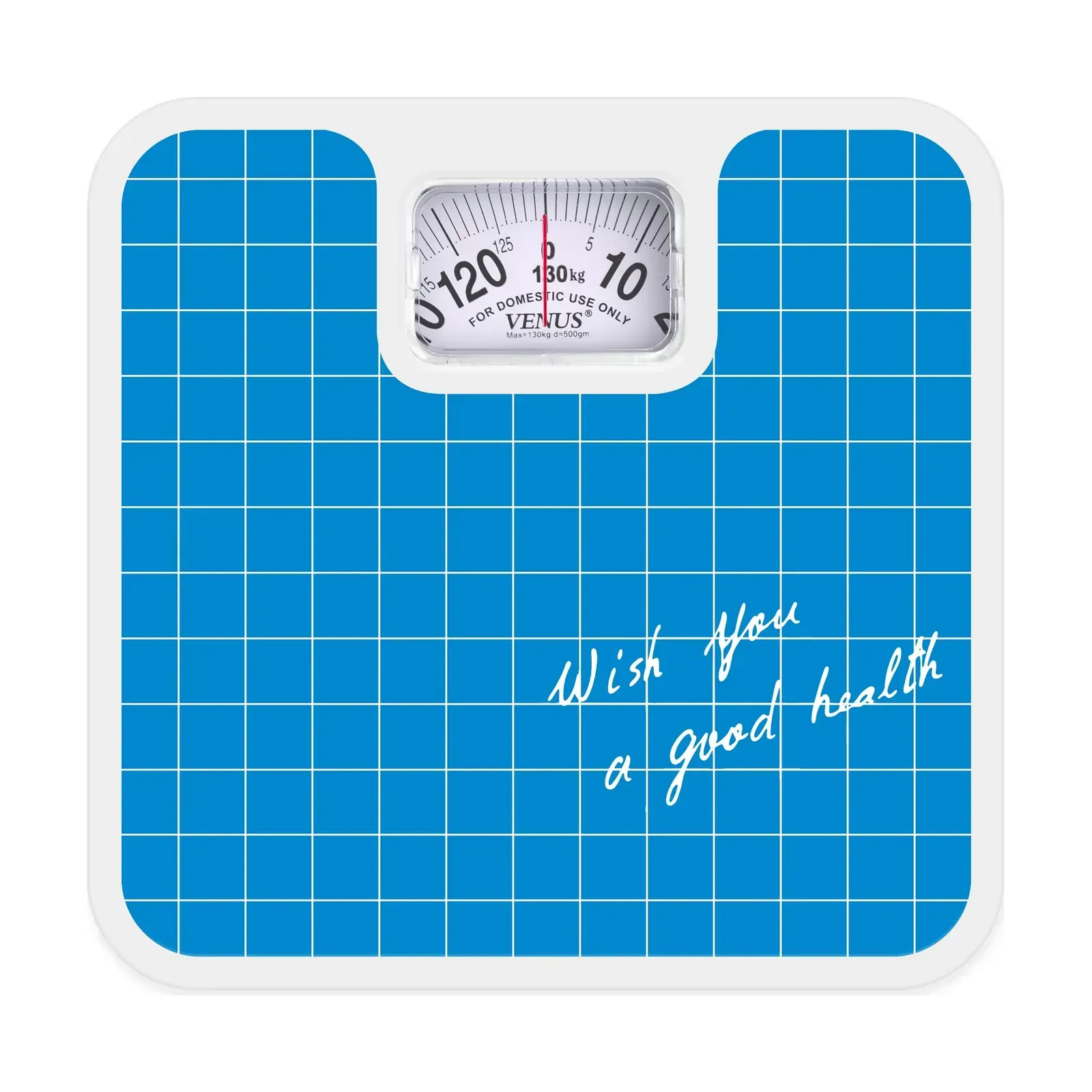
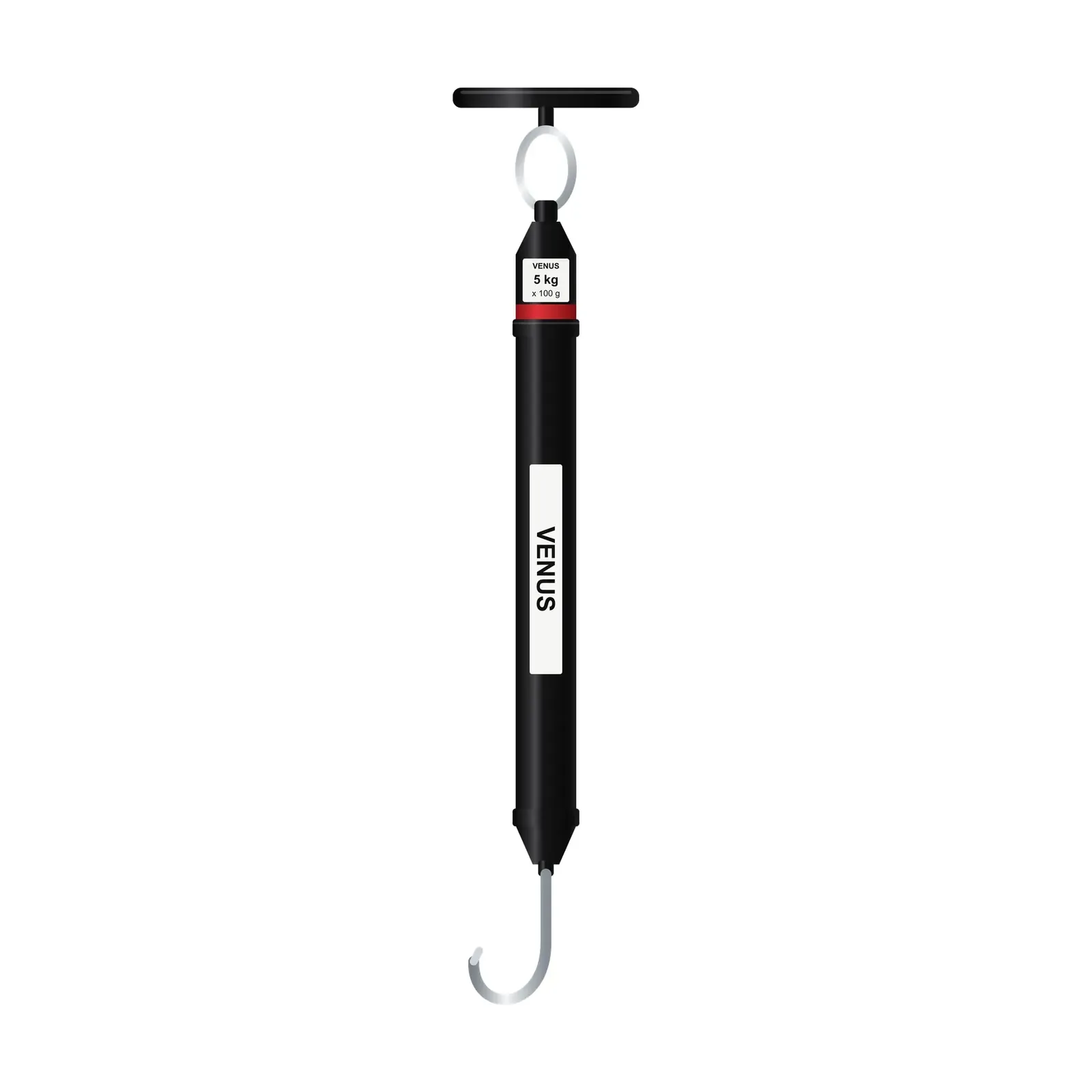
A big-capacity dial usually has coarser steps than a small one, because the same dial face has to cover a longer range. That is normal. The Omace Venus BS-9701 reads 130 kg in 500 g steps, and the Venus tubular spring balance reads in 100 g steps.
Step 2: read straight on to avoid parallax
The needle floats a little above the printed face. If your eye is to the left or right of the needle, the needle appears to sit over a different line from the one it is truly on. This apparent shift is parallax error. The University of North Carolina physics lab guide says it can occur whenever there is some distance between the measuring scale and the indicator, and that if the eye is not squarely aligned with the pointer and scale, the reading may be too high or low.
The fix is simple. Put your eye in front of the needle and look straight at the face, not from above or below. The same goes for any dial: look straight at the face, and on a tube-type spring balance bring the pointer to eye height.
On a bathroom dial scale on the floor, you read from standing height, and that angle is the worst case. Bend your head directly over the dial, or ask someone else to read it while you stand still.
Parallax is a known problem even in regulated weighing. The US National Institute of Standards and Technology states in Handbook 44, section 2.20 that parallax effects in scale indicating elements must be reduced to the practicable minimum. A maker can only reduce it, so the reader still has to look straight on.
Step 3: set the needle to zero before you weigh
An analog scale must show zero with nothing on it. If the needle rests a little to one side, every reading carries that error.
Handbook 44 section 2.20 expects a scale to have a means of adjusting the zero-load balance, and a maintenance rule says the scale should indicate zero balance with no load. On a small dial scale the practical steps are these:
- Place the scale on a hard, flat floor. A carpet or uneven tile tilts the mechanism.
- For a hanging dial scale, hang it by its hook and let it settle with nothing on it.
- Find the adjusting wheel or screw. On many bathroom dial scales it is a small wheel at the edge of the face or on the base, and it turns the dial so the zero mark moves under the needle. On a hand-held spring balance it is usually a screw or nut at the top.
- Turn it until the needle sits exactly on 0, looking straight on as in step 2.
- Step on and off once, or lift and lower the load, and check that the needle returns to 0.
If your scale has no adjusting wheel, note the offset and subtract it from the final reading. A needle that rests on 1 kg with nothing on it means every reading must lose 1 kg. A needle that sits below zero means you add the amount.
Let the needle stop moving before you read, because a bouncing or swinging needle gives an unreliable reading. On a bathroom scale, stand still, keep your weight even on both feet and wait a second or two.
Step 4: read when the needle falls between marks
The needle will often land between two small lines. In that case, estimate, and estimate honestly.
- Note the last line the needle has passed, which is the lower reading.
- Judge how far it has travelled towards the next line: a quarter, a half or three quarters.
- Add that fraction of one division to the lower reading.
With 1 kg divisions, a needle halfway between 63 and 64 kg reads about 63.5 kg. The De Anza lab manual puts the uncertainty of a reading on an analog scale at about one half of the least count, so on a 1 kg dial a half kilo is a fair estimate and 63.37 kg is invented precision.
A short worked example
A dial scale has numbers every 10 kg and nine short lines between them. Ten spaces between 60 and 70 give 1 kg per division. The needle has passed 60 and three short lines, and sits slightly short of the fourth.
- Value of one division: 10 kg divided by 10 spaces is 1 kg.
- Lines passed after 60: three, so 60 plus 3 is 63 kg.
- Needle is a little before the fourth line, perhaps a quarter of a division short, so the reading is about 63.7 kg.
- Zero check: if the needle rested 0.5 kg above zero before weighing, the true weight is about 63.2 kg.
That last line is why zeroing comes first. A half kilo of zero error is as large as the estimate itself.
Reading the kg and lb rings
Some dials show kilograms and pounds on separate rings. Each ring has its own divisions, and the two sets of lines do not line up. Read only one ring from start to finish.
Find the value of one division on that ring, using step 1, and ignore the other ring. If you need the other unit, read the second ring separately instead of converting by memory. Rounding a conversion in your head adds an error the dial never had.
Why a mechanical scale drifts with age
A dial scale depends on a spring, and a spring can change with overstretching, long storage under load, rust or corrosion. If the pointer does not return to zero after unloading, re-zeroing will not fix a spring that has been permanently stretched, and the scale should be replaced.
Overloading past the maximum capacity is the commonest cause, so every later reading is then wrong.
Habits that protect the spring:
- Never load beyond the printed maximum.
- Store the scale unloaded and dry.
- Zero it before each session.
- Check it now and then with a known mass.
For a bathroom dial, a bag of rice or sugar of known weight from a shop gives a rough test. For the full method on floor scales, see how to calibrate a bathroom scale and check its accuracy.
Dial or digital: when to choose which
A dial needs no battery and has no display to fail. Its limit is the human eye, because two people can read the same needle a little differently. A digital scale prints the number for you. Our post on analog vs digital weighing machines compares the two in detail, and weighing scale not working covers faults.
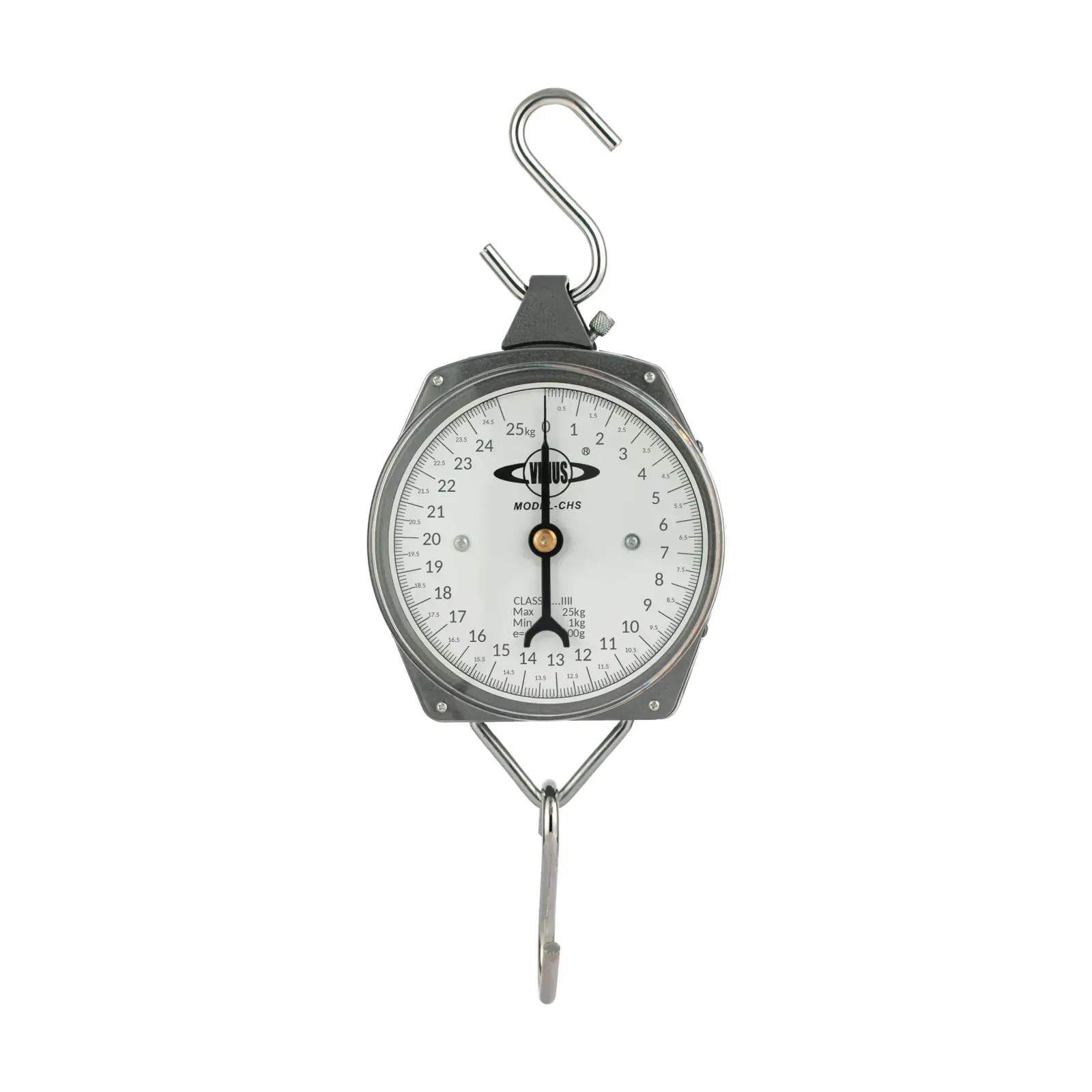
Omace Brands Private Limited lists a few mechanical models in Bagru, Jaipur, for buyers who want no battery. The Venus BS-9701 Analog Weighing Scale is a 130 kg mechanical dial scale with a metal body at ₹839. The Venus CHS Mechanical Hanging Scale has a round analog dial under an unbreakable polycarbonate cover, accuracy class IIII, and covers 25 to 200 kg at ₹939. The Venus Tubular Spring Balance is a hand-held 5 kg and 25 kg spring balance at ₹259. Dial and digital body scales are listed together under personal weighing scale.
Whichever dial you own, the four steps are the same: value of one division, straight-on view, zero, then an honest estimate between lines.