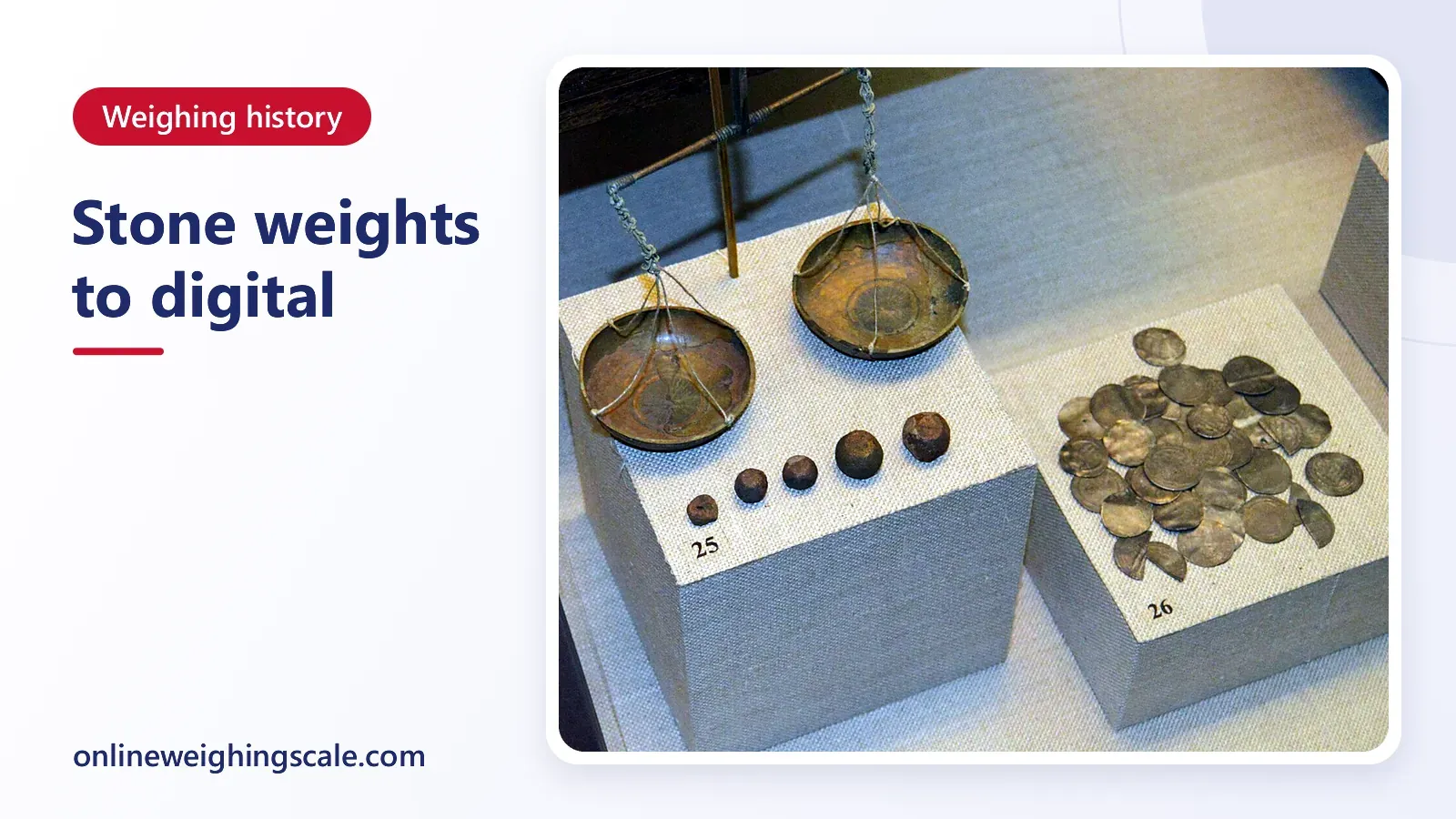
The history of the weighing scale runs from the stone weights of Indus cities, which flourished around 2600 to 1900 BC, to the digital scales of today. Weighing began as a way to make trade fair, and the same idea still drives every kanta in a Jaipur market.
This page follows that line in order: the earliest weights, the equal-arm balance we call taraju, the steelyard and the spring balance, the metric system, the load cell and the 2019 change to the kilogram. Dates appear only where an official or university source states them. Where the record is vague, the text says so.
Who invented the weighing scale?
No single person invented the weighing scale. The balance appeared in several early trading societies, and nobody can name its first maker with confidence.
What the record does show is that weighing and trade grew together. Anything sold by quantity needs a shared idea of how much one unit is. A balance without agreed weights is only a toy, so the first real step was the weight, and the scale followed it.
Indus Valley weights: the oldest measures from India
Indus cities, dated to about 2600 to 1900 BC, had weights and measures among their early technologies, alongside writing, metalworking and seals. A University of Cambridge repository paper on the Indus civilisation lists them in that group and describes standardised systems of weights and measures that were recovered even where there was little sign of great wealth.
The same paper notes that debris from making beads, bangles, weights and seals has been found throughout the civilisation. That tells us weights were made in quantity, not as one-off curiosities. A buyer in one town could expect a seller in another to use a matching stone.
The exact ratios between these stones, and the mass of the base unit, are discussed in specialist archaeology. Omace Brands Private Limited does not quote a single figure here, because published accounts differ.
The equal-arm balance and the taraju
The oldest weighing instrument in the common mind is the equal-arm balance. A beam rests on a central pivot. An object goes in one pan, known weights go in the other, and the beam sits level when the two masses match.
Indian shops know this instrument as taraju or tarazu, the pair of pans hanging from a beam. A shopkeeper in Bagru or Jodhpur will still call a modern digital counter scale a taraju or a kanta, because the old word outlived the old tool. Our post on taraju in English covers the names and their regional forms. The working of the beam itself, with its parts and uses, is in the post on the beam balance.
One property makes the equal-arm balance special. It compares masses, not forces, so it gives the same answer on a hill and on a plain. That idea matters again when we reach the kilogram.
The steelyard and the spring balance
The steelyard is a lever with unequal arms. A single hanging weight slides along a marked beam until the lever balances. It needs one weight instead of a whole box of stones, which made it handy for markets and for heavy loads.
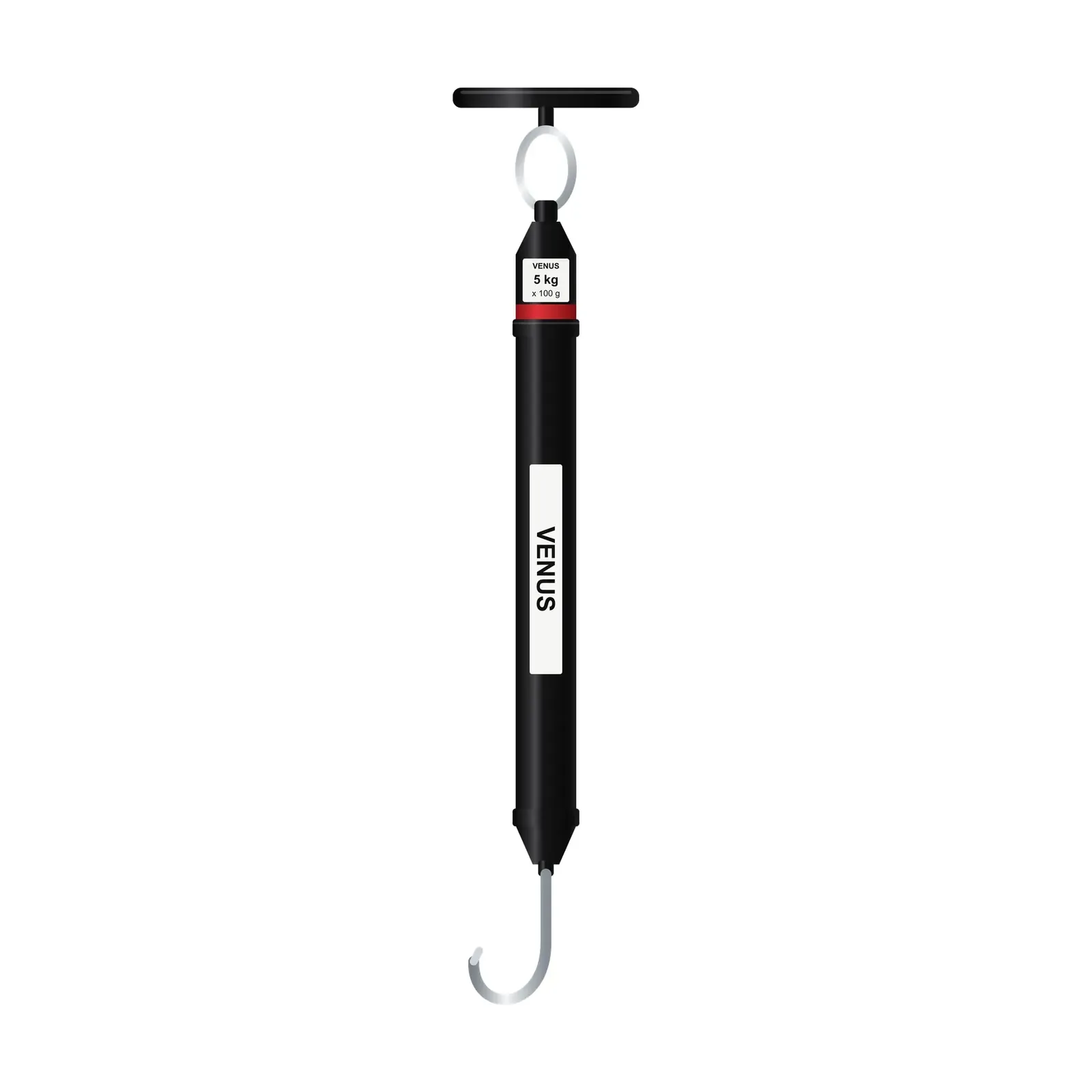
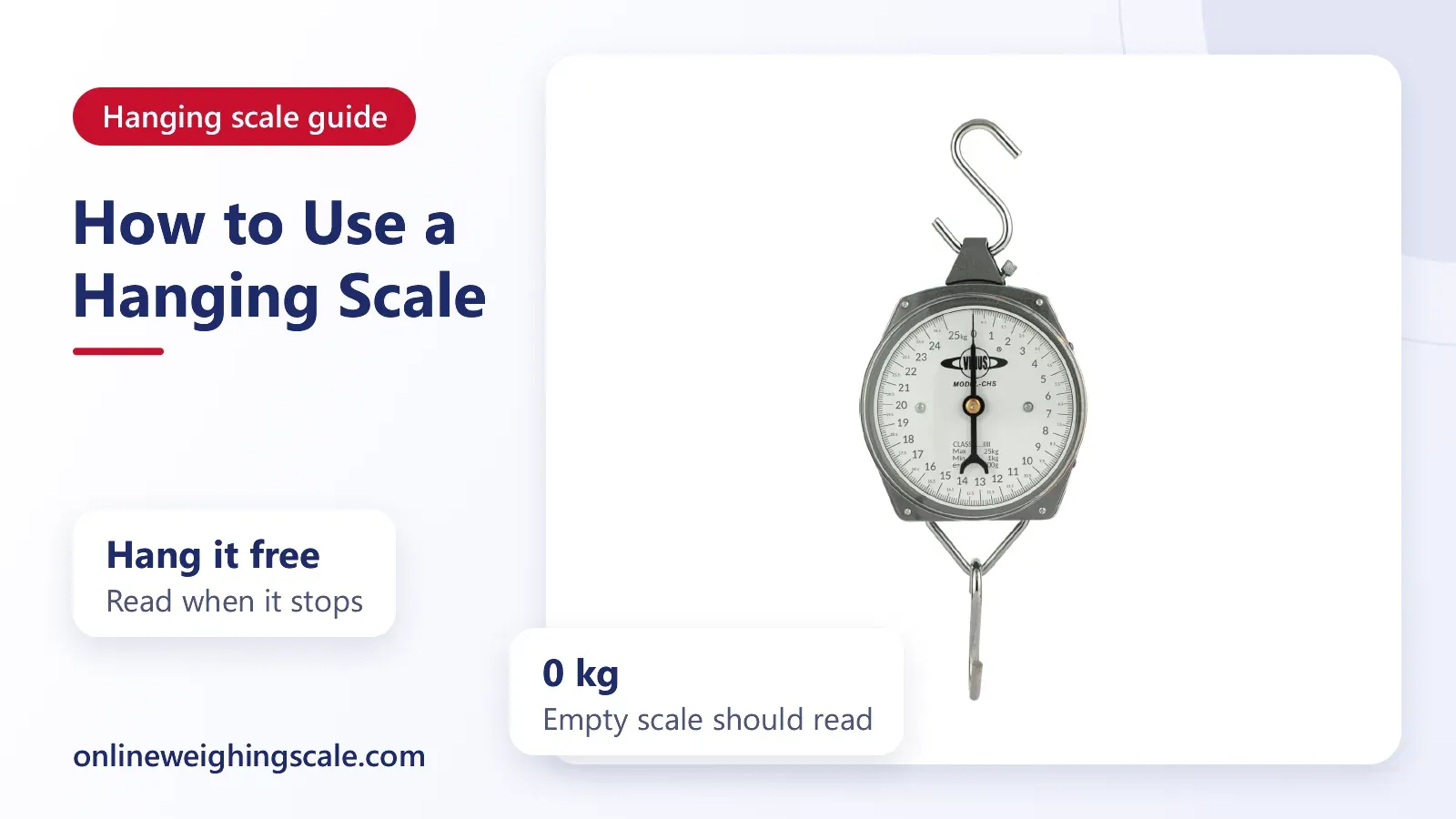
The spring balance works differently. A spring stretches under a load, and a pointer on a scale shows how far. It measures the pull of gravity on the object, so it is a force instrument marked in mass units. The difference is explained in mass vs weight.
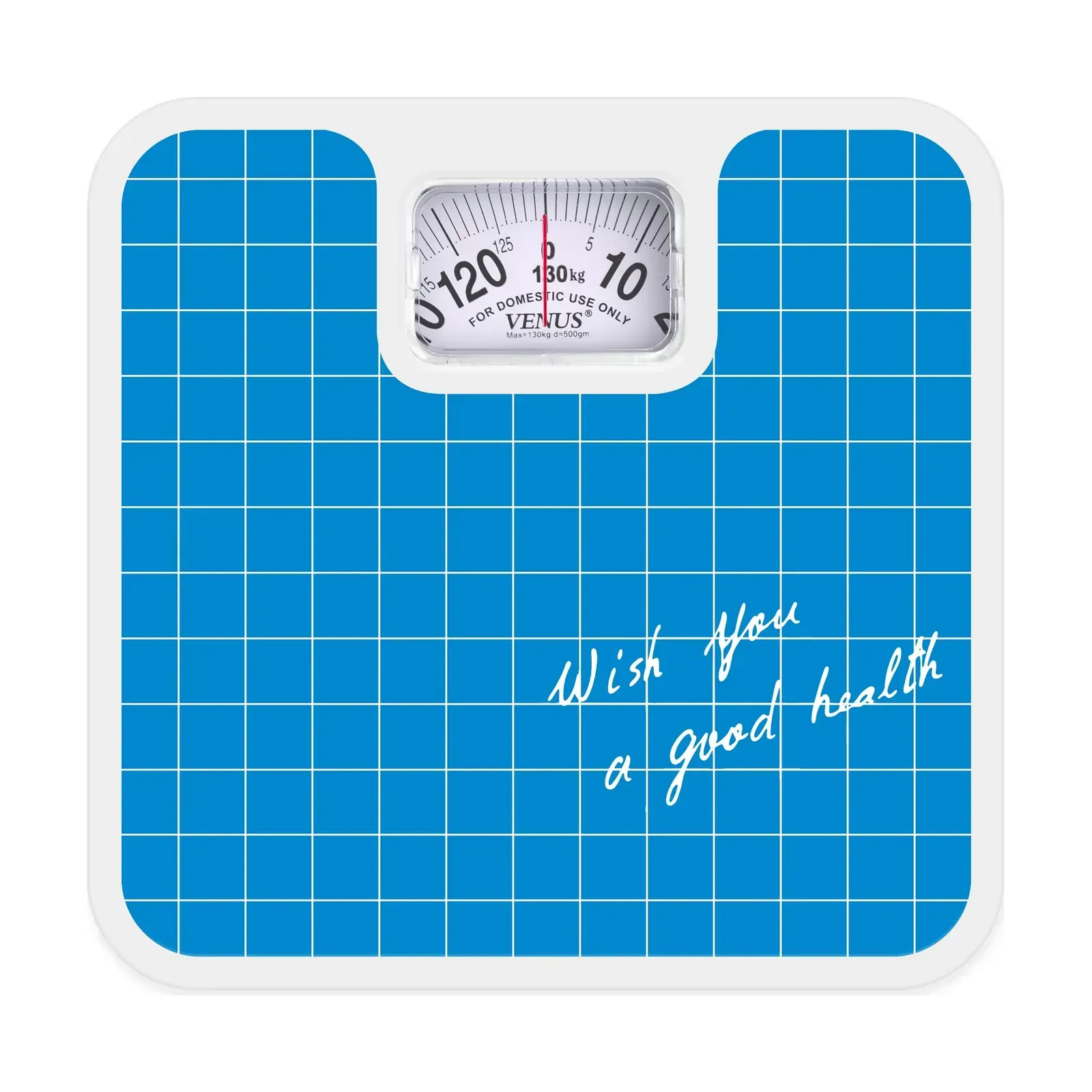
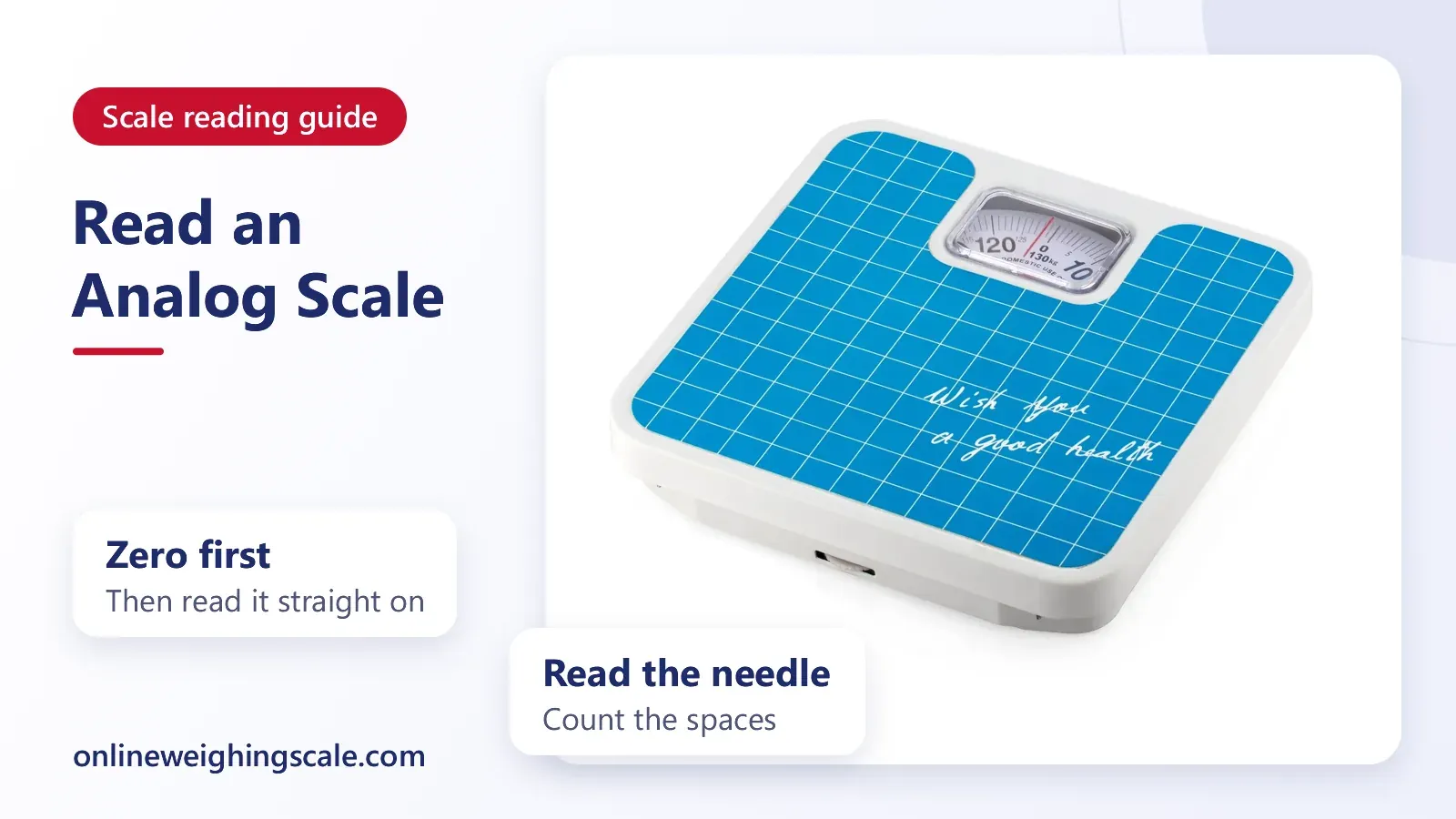
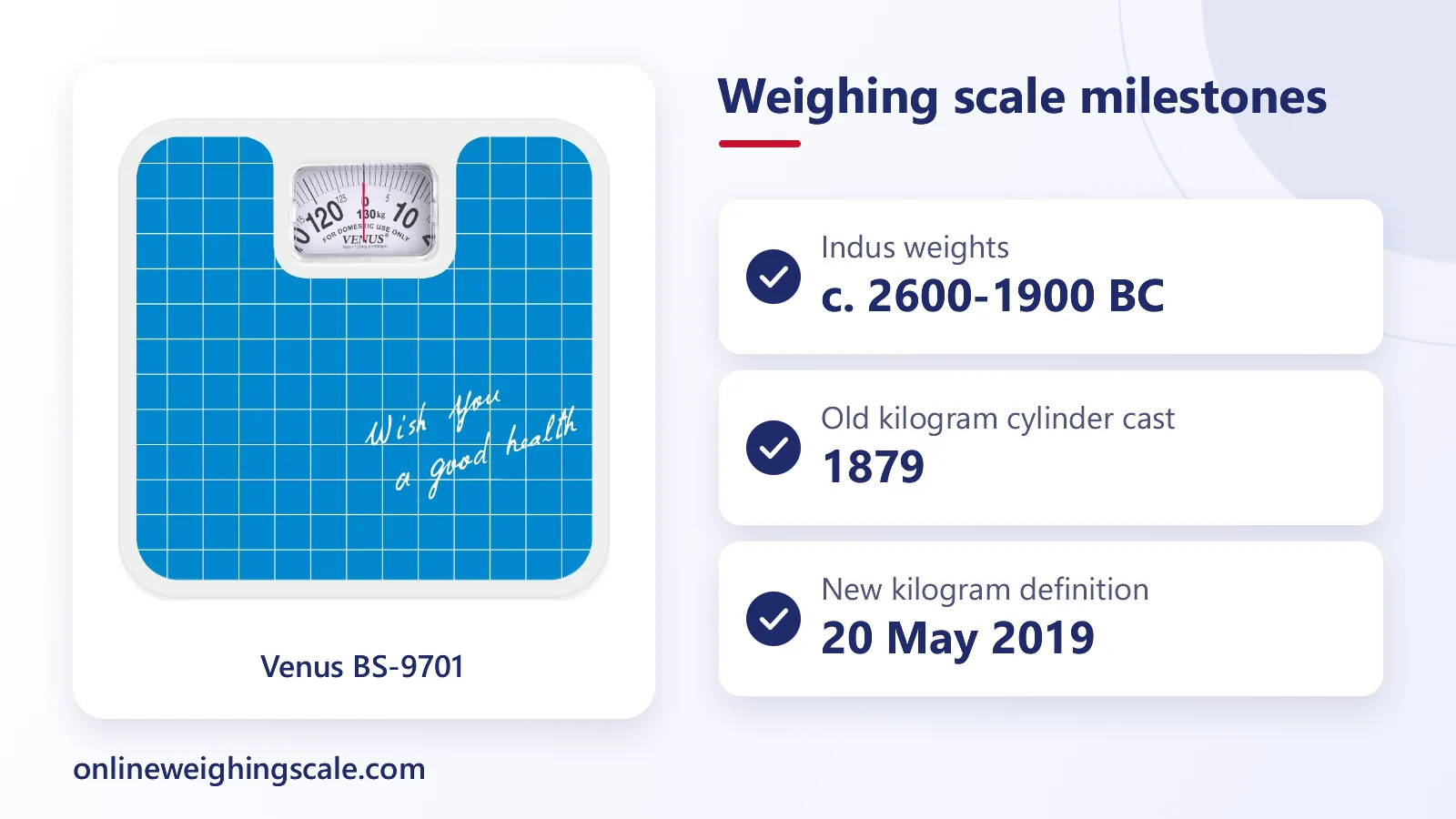
Spring balances are still sold today and still useful, because they need no battery and fit in a pocket. The Venus Tubular Spring Balance in 5 kg and 25 kg sizes costs ₹259 on the spring balance page, and the mechanical dial bathroom scale, the Venus BS-9701 analog weighing scale, costs ₹839 and runs without a cell.
Metric units in India
Before metric units, Indian trade used seer, maund, tola and many local variants, and the same word could mean different amounts in different towns. Our guide to units of measurement lists the old Indian units next to the SI ones.
Today the law is plain. Section 4 of the Legal Metrology Act, 2009 states that every unit of weight or measure shall be in accordance with the metric system based on the international system of units, in a copy of the Act hosted by PRS Legislative Research. The kilogram and the gram are therefore the legal language of every shop scale in India.
Enforcement sits with the Legal Metrology department of each state. Stamping, verification and the rules a shopkeeper must follow are explained in Legal Metrology in India.
From springs to strain gauges: the digital scale
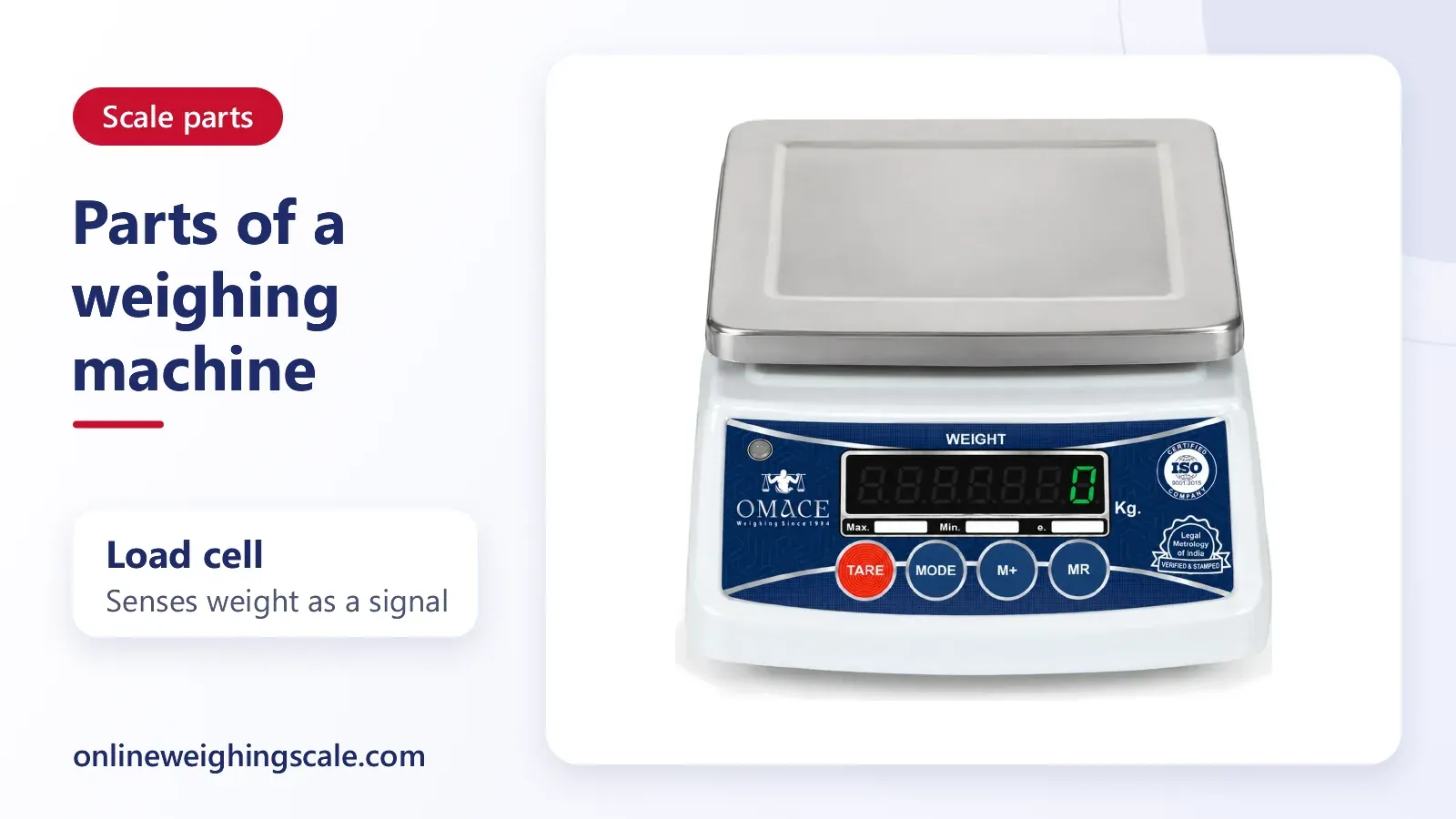
A digital scale replaces the moving spring or lever with a load cell. Under load, a small metal body bends by a tiny amount, and strain gauges bonded to it change their electrical resistance. Circuits turn that change into a number on the display.
Strain-gauge load cells are now the standard sensor in electronic weighing. Everything from a 600 g pocket scale to a crane scale that lifts tonnes uses the same principle, scaled to the job. A fuller account is in the post on the load cell.
Digital scales brought a clear number instead of a pointer position, and a tare key that cancels the weight of a bowl or pan. They also brought a new habit to check, because a number on a screen looks more certain than a pointer ever did. How to check a scale is covered in what is calibration, and the trade-offs between the two display styles are in analog vs digital weighing machine.
The kilogram changes in 2019
For many decades the kilogram was a physical object. The International Prototype of the Kilogram was a platinum-iridium cylinder, cast in 1879 and kept in a vault near Paris, as the National Institute of Standards and Technology (NIST) describes. Every national standard traced back to it.
The weakness of a single object is that nobody can be sure it stays the same. The metrology community therefore moved the kilogram onto a constant of nature. NIST states that May 20, 2019 was the official launch date of the revised SI, and that the new system redefines the kilogram using a fixed value for the Planck constant.
For a shopkeeper or a home cook nothing changes. NIST says consumers will not immediately notice the change, and a kilogram of rice weighs what it did the day before. The change matters for the top of the calibration chain, where national laboratories now realise the kilogram without any physical cylinder.
Timeline of the weighing scale
| Period | What changed |
|---|---|
| About 2600 to 1900 BC | Indus cities use standardised weights and measures in trade |
| Ancient and medieval trade | Equal-arm balance (taraju) and steelyard serve markets |
| Centuries of mechanical design | Spring balances and dial scales put a pointer on a dial |
| 1879 | The platinum-iridium prototype of the kilogram is cast |
| 1994 | Omace Brands Private Limited enters the weighing trade |
| 2009 | Legal Metrology Act, 2009 sets the metric system as India's legal basis |
| 20 May 2019 | The kilogram is defined through the Planck constant |
Where Omace fits in this story
Omace Brands Private Limited has been in the weighing trade since 1994 and makes scales at Bagru, Jaipur. The company's own story is on the About Omace page. The long history above is the reason the work matters: a kanta is a promise of fairness between two people, and that promise is the same one the Indus traders made with their stones.
What the old tools still teach
Two habits survive from the stone-weight era: compare against a known reference, and never trust a scale you have not checked. A digital kanta that is tared on a flat surface and tested with a known weight is as honest as a balance with good stones.
If you want to see these ideas in a working scale, start with the simplest one. A spring balance shows force acting on a spring, and a pan balance shows mass comparison. Digital scales hide both behind a screen, yet they follow the same logic.
Frequently confused points
People often mix up weight and mass. A scale reads in kilograms, but strictly a spring or load cell responds to force, and the display converts it. This is why a scale calibrated in one city can read slightly differently in another unless it is adjusted. The post on mass vs weight explains this without formulas.
Another mix-up is age. Old does not mean accurate. A balance is only as good as its weights, and a worn or rusted weight quietly spoils every reading. Modern scales carry the same risk in a different form, such as a damaged load cell or a flat battery.