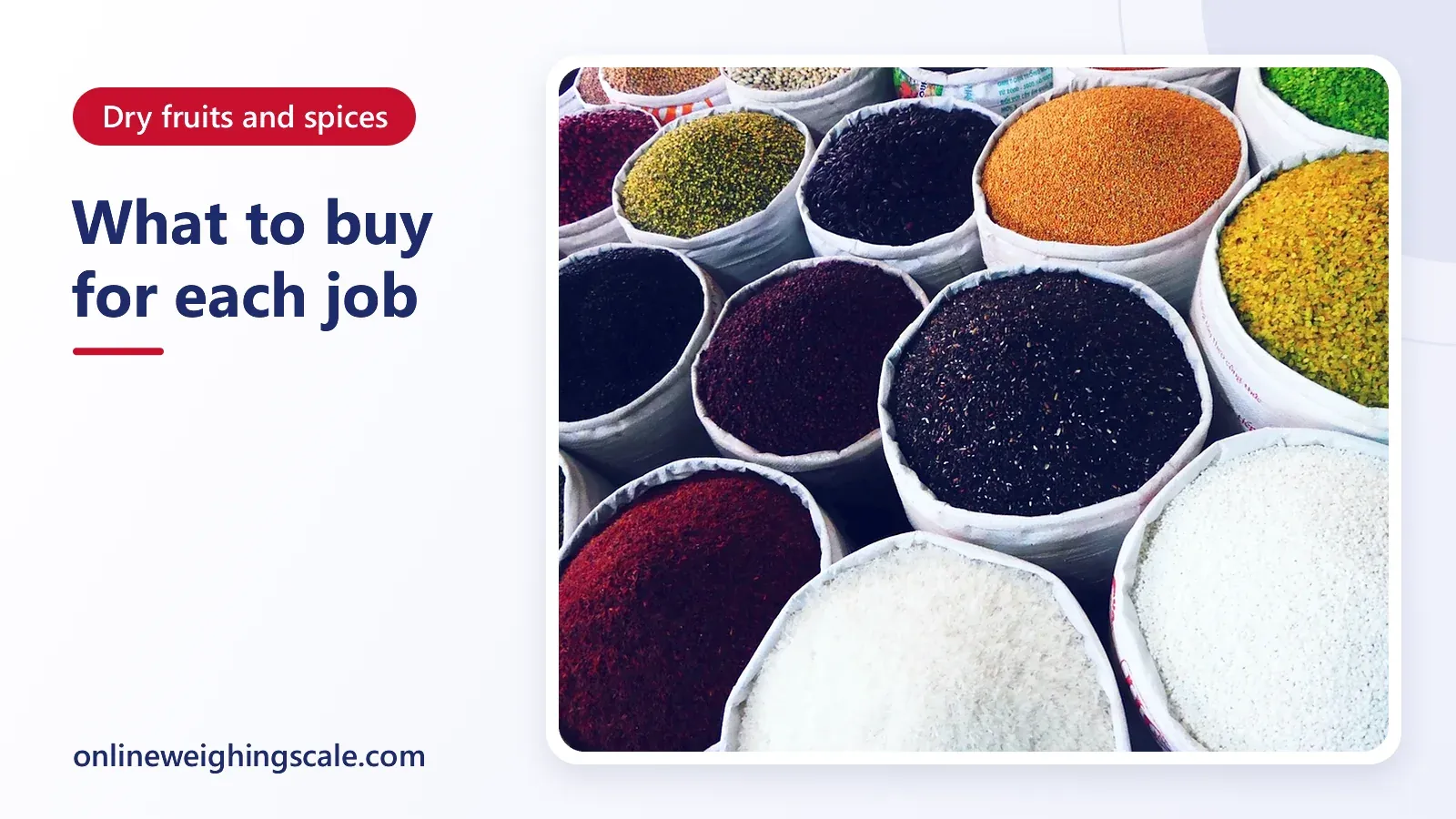
A weighing scale for dry fruits needs a division of 1 g or finer, because a shop that sells almonds, cashews or pista at a high rate per kg loses real money on every rounded gram. A reading that moves in steps of 10 g can hide 5 g in either direction on each sale. A shop scale also has to be stamped by Legal Metrology, kept clear of draught, and checked with a test weight now and then.
Why a fine division matters when the rate per kg is high
The smallest step a digital scale shows is its division. OIML R 76-1, the international recommendation for non-automatic scales, calls the value used to classify and verify a scale the verification scale interval, written e, and defines the number of divisions, n, as the maximum capacity divided by e.
Money is where this shows up. The figures below use a made-up rate of ₹2,000 per kg, chosen only to keep the sums simple. They are an example, not a market price.
| Division | Value of one step at the example rate | Largest rounding gap on one sale (half a step) |
|---|---|---|
| 10 g | ₹20 | ₹10 |
| 5 g | ₹10 | ₹5 |
| 1 g | ₹2 | ₹1 |
| 0.1 g | ₹0.20 | ₹0.10 |
One rupee per sale looks small. A counter that makes 150 weighings a day can see up to ₹150 of rounding gap a day at 1 g, and up to ₹1,500 at 10 g, still using the example rate. The gap runs in both directions, so it often evens out. The customer who is short-changed remembers it, and the shop that gives extra pays for it.
Saffron is a different case. Suppose a made-up rate of ₹300 per gram. A scale that steps in 1 g cannot sell a 2.5 g pack honestly. One that steps in 0.01 g shows 2.50 g, and one step is worth ₹3 in this example.
Pick the division by what you sell
| Goods | Usual pack or sale | Division that suits |
|---|---|---|
| Almonds, cashews, raisins, walnuts | 100 g to a few kg | 1 g |
| Pista, cardamom (elaichi), cloves | 25 g to 500 g | 1 g, or 0.1 g for the small packs |
| Saffron (kesar), vanilla | 0.5 g to 10 g | 0.01 g |
| Tea, whole masala, dried herbs | 50 g to 1 kg | 1 g |
This table is Omace Brands Private Limited's guidance for choosing a division. It is not a legal limit. Which division and class the law accepts for a particular trade is a question for your local Legal Metrology office, and the General Rules text could not be read in machine form for this post, so no class limit is quoted here.
Capacity: do not buy more than you need
A dry-fruit counter rarely weighs more than 2 kg at a time, yet many shops buy a 30 kg scale because it is on offer. OIML R 76-1 defines a minimum capacity, Min, as the load below which the weighing result may carry an excessive relative error. A 30 kg scale used for 5 g pinches sits close to that lower limit, while a smaller scale suits small loads better.
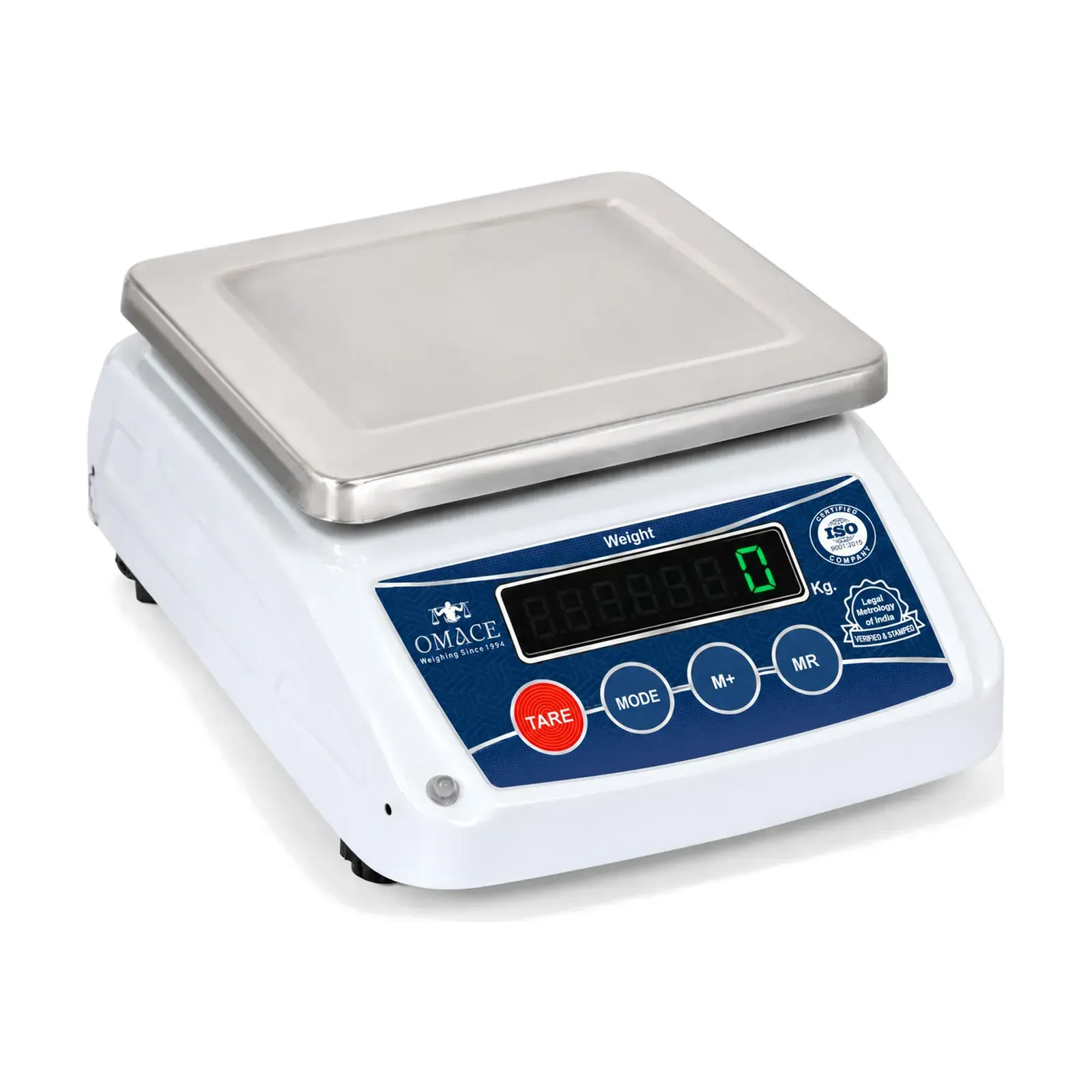
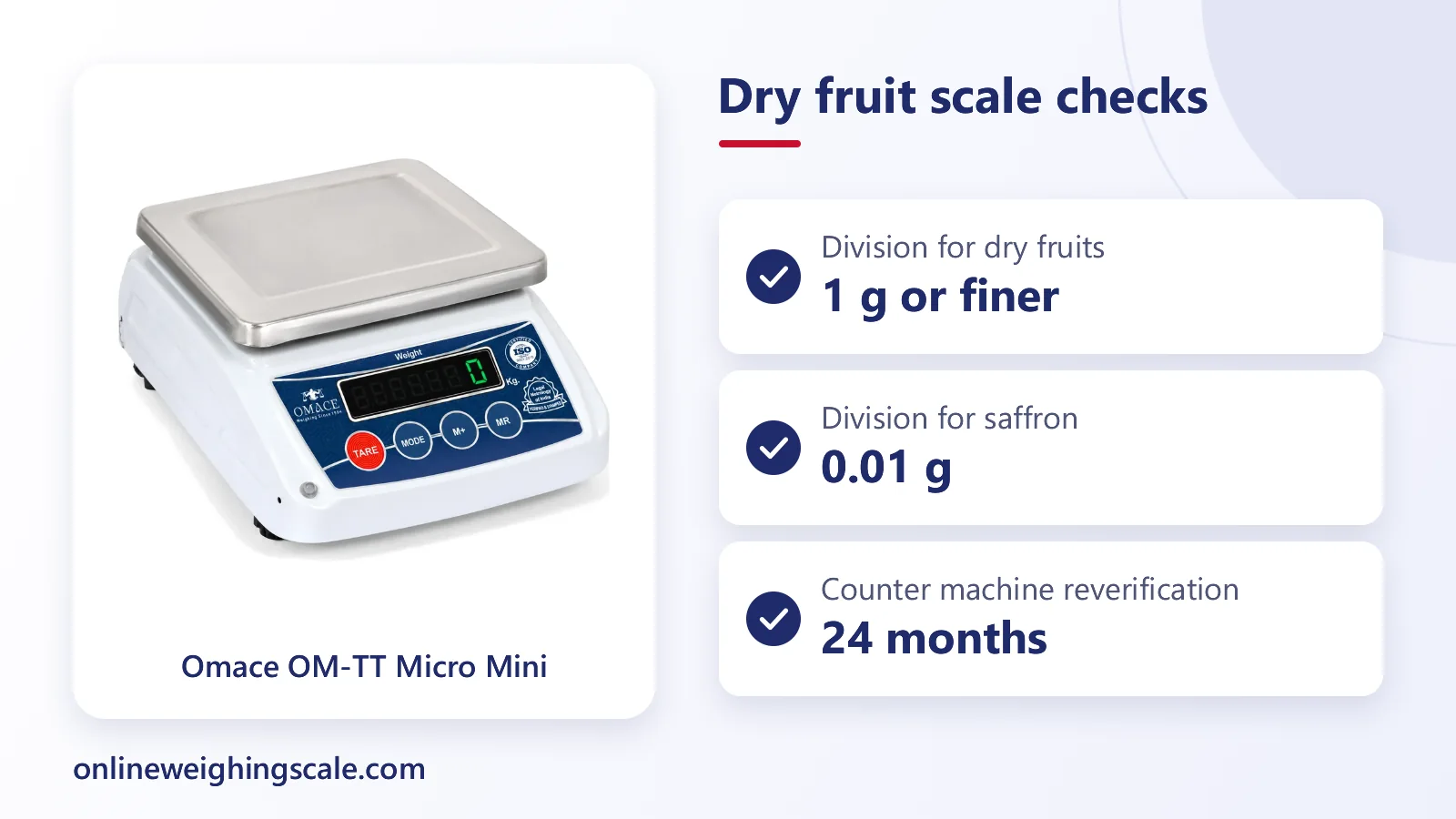
For a shop that sells in packs up to a few kg, a 10 kg scale at 1 g is a good match. Omace Brands Private Limited lists the Omace Om-TT-Micro Mini weighing machine at 10 kg x 1 g for ₹1995, on a 130 x 160 mm pan with a double-side green LED display and a built-in battery backup of about 2 days. It belongs to the Om-TT shop scale range. The Om-TT scales are accuracy class III and weigh only: they do not compute price. At 10 kg x 1 g the Micro Mini has 10,000 intervals, which is the most OIML R 76-1 Table 3 allows for class III. For comparison, 30 kg at a 5 g division is 6,000 intervals and sits in class III, while 30 kg at a 2 g division is 15,000 and falls under class II. Omace shop scales leave Bagru, Jaipur verified and stamped by Legal Metrology, and the stamp is valid across India.
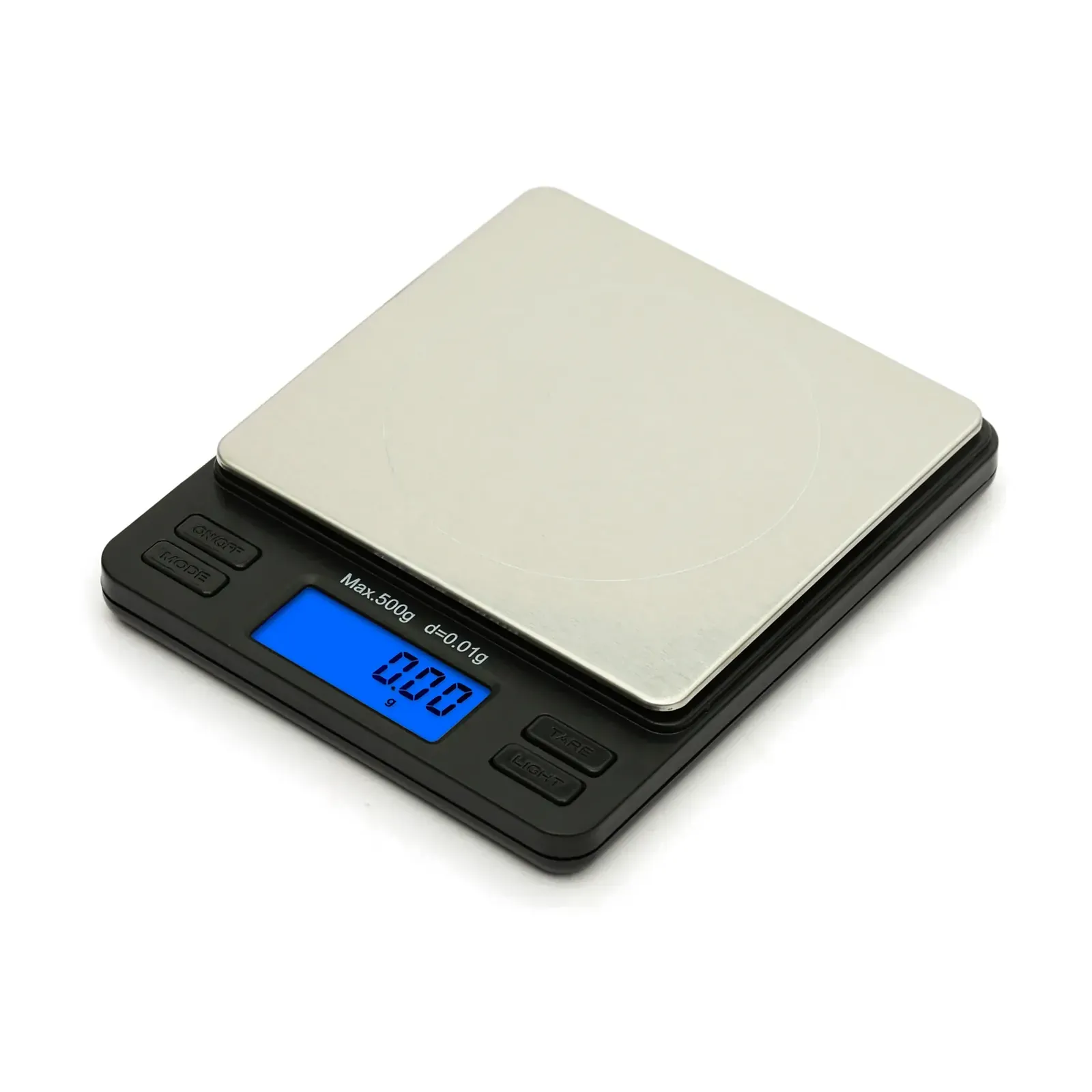
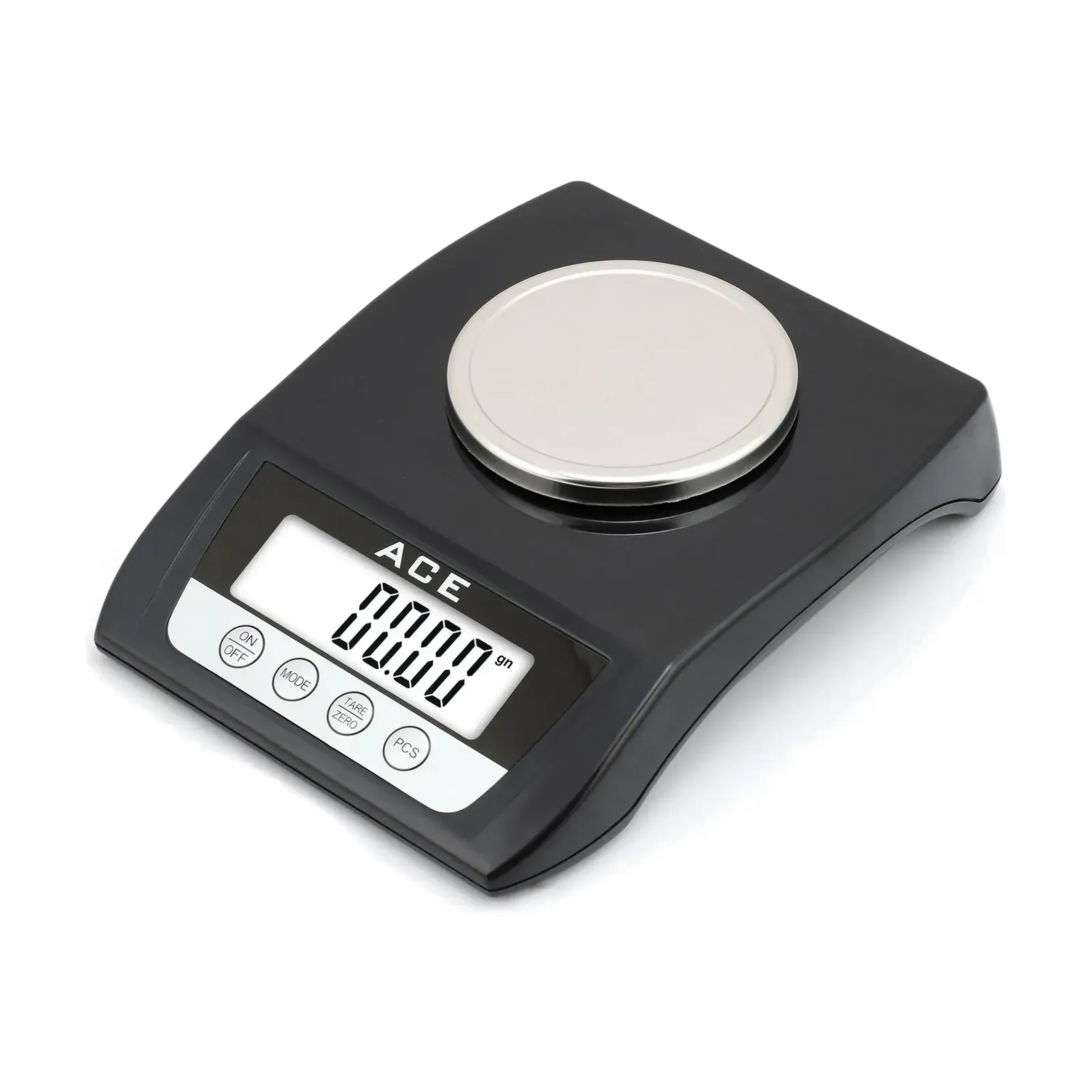
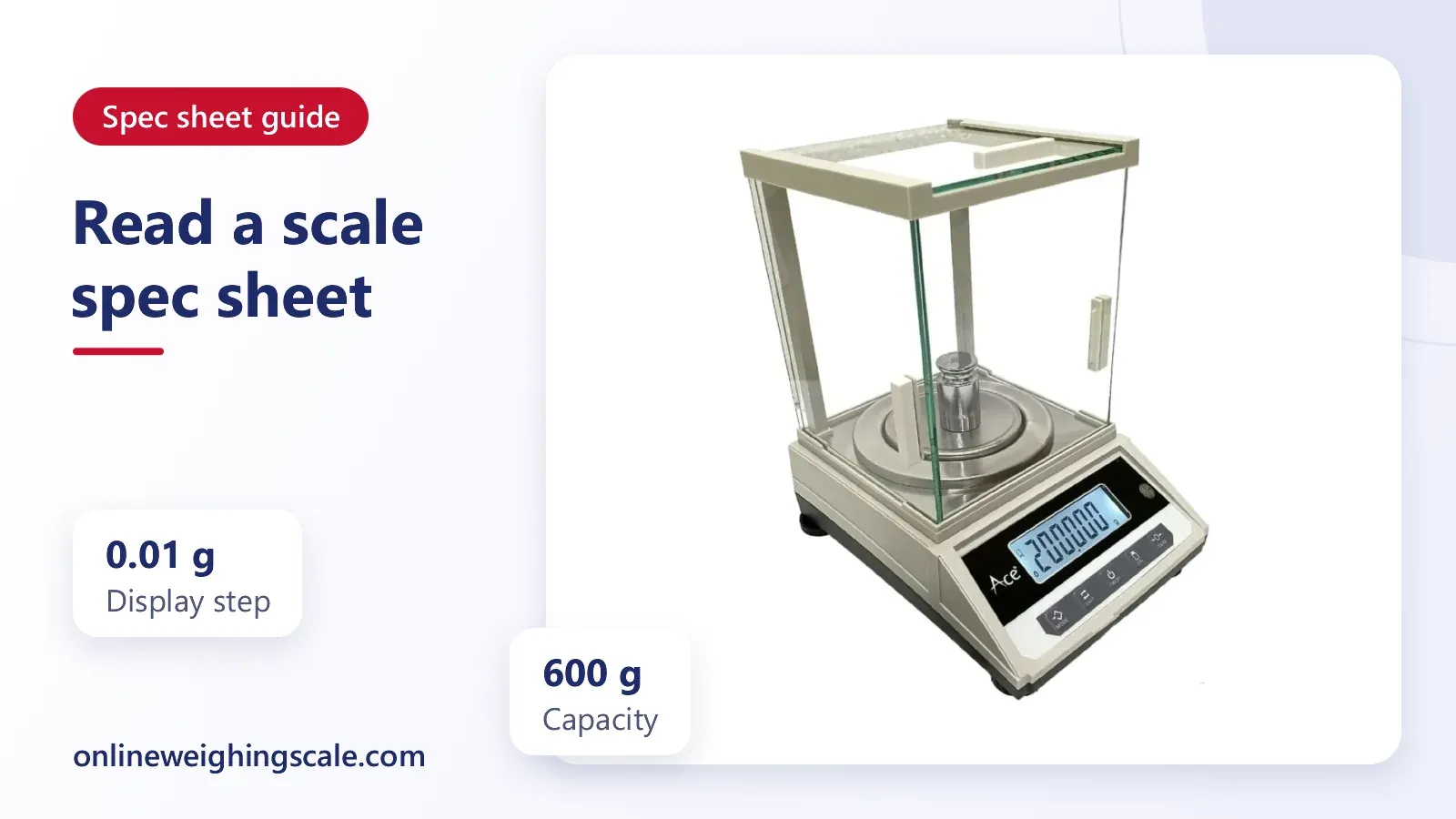
For saffron and other goods sold by the gram, the Ace TP-500 gram weighing machine reads 500 g x 0.01 g with a 90 mm pan and two clear trays, priced at ₹2099. It is in the pocket scale range, so ask Omace whether a model is sold stamped before you use it for sales to customers. For 600 g x 0.01 g with a backlit display, the Ace KS-600 digital jewellery scale costs ₹3149. Omace balances read 0.001 g at best, which no spice counter needs.
A stamped scale for selling
A scale used to sell by weight is a trade instrument, and in India that means verification and a stamp from the Legal Metrology department. Legal Metrology in India explains the Act and the department. The legal for trade post explains what the stamp covers, and weighing scale stamping charges covers the fees.
The stamp does not last for ever. The Department of Consumer Affairs notified the General Rules Seventh Amendment 2025, G.S.R. 905(E) of 18 December 2025, which sets the reverification period at twenty-four months for weights, capacity measures, length measures, tape, beam scale, counter machine and fuel dispensers (checked November 2026). Counter machine is the rule's term for a scale that sits on a shop counter. If your scale is a different type, ask the local office which period applies to it. The Jan Vishwas (Amendment of Provisions) Act, 2026 also revised the penalty amounts under the Legal Metrology Act and added improvement notices from 1 May 2026, so ask the office for the current figure.
A kitchen scale or a pocket scale is built for home use and is a poor choice for a counter, whatever its division. The small business scale guide covers the choice across shop types, and the kirana shop post covers general provision stores.
Accuracy class in plain words
OIML R 76-1 names four accuracy classes. Class I is special accuracy, class II is high accuracy, class III is medium accuracy and class IIII is ordinary accuracy. The class, with Max, Min and e, is marked on the scale's data plate. Read those numbers before you pay. The accuracy class post goes through them, and how to read weighing scale specifications covers the rest of the label.
Pan, scoop and the way you weigh
Dry fruits are light and bulky, so most of the accuracy comes from the shop's habits.
- Use a pan with a lip or a tray, so loose pieces do not roll off and a spice does not blow away.
- Press tare (the key that sets the display to zero with a container on the pan) after placing the empty scoop or bowl. The tare and zero post explains the difference.
- Keep the scale on a firm, level counter. A wobbling table makes the last digit jump.
- Add the goods slowly. Dropping a scoop of walnuts from a height makes the reading overshoot for a moment.
- Wipe saffron threads and spice dust from the pan every day, and clear any powder from under it.
Draught, vibration, humidity and heat
A scale that reads in 0.01 g feels air movement. A ceiling fan, a door that keeps opening or a shelf that shakes will make the number drift. The cure is physical: move the scale away from the fan, place it on a solid counter and, for saffron, work inside a small box or use a scale with a clear cover or glass windshield.
Heat and damp deserve a thought in Jaipur summers and the monsoon. Keep the scale out of direct sun and away from steam. Dry fruits take up moisture from the air, and a scale weighs that moisture too, so an airtight jar helps the sale as well as the product.
Packed goods and the label
Many shops pre-pack 250 g and 500 g bags at quiet hours. Pre-packed goods fall under the Legal Metrology (Packaged Commodities) Rules, 2011, which the Department of Consumer Affairs lists among the rules under the Legal Metrology Act. The official text of those rules could not be read for this post, so the label requirements and permitted errors in pack contents are not set out here. Ask your local Legal Metrology office what a bag must carry before you start packing, and use a scale with a division fine enough that every bag clears the quantity printed on it.
Checking and repair
Put a test weight on the scale each morning and note the reading. A 100 g weight that reads 99 g or 101 g on a 1 g scale needs a closer look. On Omace digital scales a long press of TARE opens calibration mode on some models and a long press of the M key on others, and the manual for each model shows which, but a stamped trade scale is sealed, so a registered repairer recalibrates it. What is calibration gives the steps. Omace scales are factory calibrated, and one that reads wrong is replaced under warranty.
Omace Brands Private Limited repairs its commercial scales when the buyer asks. The buyer pays the shipping both ways and the repair cost. Spare parts depend on availability, so ask first through the Contact Us page. If the display is blank or the reading is stuck, read weighing scale not working first.
What to ask before you buy
- What is the division, and is it 1 g or finer?
- What are Max and Min on the data plate?
- Is the scale stamped, and where does the stamp sit?
- Does it run on a battery as well as an adaptor, in case the power goes?
- Is the pan easy to wipe, with a lip or tray?
- Who repairs it, and what do you pay?
Omace Brands Private Limited has made scales in Bagru, Jaipur since 1994, and every scale is checked with certified test weights before dispatch. See the About us page for the company. A shop that sells in grams needs a scale that shows grams, and the sums above show why.