To choose a coffee scale, look first at readability: a scale that reads to 0.1 g is the usual minimum, because the Specialty Coffee Association asks for a scale with 0.1 g or higher accuracy when it weighs coffee for cupping.
After readability come capacity, a built-in timer, platform size, how quickly the display settles, the units, the power source and how the scale copes with heat and splashes. This guide takes those in order, then matches them to pour-over, espresso, French press, South Indian filter and cold brew, and ends with a table of the kinds of scale you will see in a shop.
Start with readability: why 0.1 g is the usual floor
Readability, also called division, is the smallest step the display shows. A kitchen scale that moves in 1 g steps cannot tell 15 g of coffee from 15.9 g, and in a 250 g pour-over that gap changes the strength of the cup.
The Specialty Coffee Association sample-preparation standard SCA-102 says each cup's beans shall be weighed on a scale with 0.1 g or higher accuracy, and it allows a tolerance of 0.2 g in the final mass of coffee per cup. That is a standard for professional cupping, but it is a fair benchmark for a home scale too. A 0.1 g display lets you stay inside that tolerance without effort.
Finer is not automatically better for a kitchen counter. A scale that reads to 0.01 g is built for small loads such as jewellery and has a low capacity, so a dripper, a server and water would overload it. For coffee, 0.1 g with a capacity of a few kilograms is the sensible pairing. The post on how to read weighing scale specifications explains the capacity and division lines if the spec sheet is new to you.
Capacity: the weight of everything on the platform
Capacity is the heaviest load the scale will show. It counts the cup, the dripper, the filter, the coffee and the water together, not only the coffee. A heavy ceramic server and a full kettle of water can pass a kilogram, so a 500 g scale is too small for pour-over.
The two Omace coffee scales both have a capacity of 3 kg, which leaves room for a dripper, a carafe and the water at once. If you only pull espresso into a small cup, you will never come near that figure, but spare capacity does no harm.
Timer: what it adds and when you can skip it
A built-in timer shows brew time and weight together on one display. For pour-over and espresso that matters, because the pour is judged against the clock: the first pour to wet the grounds, the total brew time, the 25 to 30 seconds many baristas aim for on a shot. A Specialty Coffee Association survey of baristas found 51% of shots were pulled in 25 to 30 seconds, and 82% of the baristas weighed the yield.
If you only use a French press or make cold brew, a phone timer is enough, since the steep runs for minutes or hours and the second hand does not matter. Check the product page for how a scale's timer starts, because that varies between models.
Platform size and response speed
The platform must be large enough to hold the base of your server or cup without the edge hanging off. Weight on a corner can change the reading. A platform of about 12 to 15 cm across takes most drippers, servers and espresso cups, and a small cup placed in the middle of a wide platform is no problem at all.
Response speed is how fast the display settles when you pour. A slow scale lags behind a steady pour, so you overshoot the target. You cannot judge this from a number on a box. Watch a review video, or try the scale in a shop by placing a coin on it and noticing how quickly the figure steadies.
Heat, splashes and the places a coffee scale gets used
A coffee scale lives next to a kettle. Steam, drips and spilt grounds are part of the job, so look for a smooth, wipeable surface and a keypad that is not recessed where water collects. A stainless steel platform wipes clean, and an anti-slip rubber mat keeps a cup from sliding on a wet counter.
Omace Brands Private Limited does not claim any water-resistance rating for its coffee scales, so wipe spills straight away and keep the kettle spout away from the keys. The same habit is described in how to clean a weighing scale.
Units, auto-off and power
Choose a scale that has a gram mode, because recipes are written in grams and a scale that wakes up in ounces ruins a brew. Millilitre mode is a convenience for water: one gram of water is about one millilitre, which is the approximation the SCA standard itself uses. Coffee grounds are a different matter, so always weigh them rather than counting spoons.
Auto-off saves batteries, but check how long it waits. A scale that shuts off in the middle of a slow bloom is annoying. A low-battery indicator is worth having, since a weak battery makes the display drift or flicker, and an overload indicator warns you before you press the platform past its limit.
Power is either replaceable batteries or a built-in rechargeable cell charged over USB. Batteries are simple and a spare set is cheap. A USB scale needs a charger within reach. Both Omace coffee scales run on three AAA batteries, which are included.
Which scale suits which brew method
The brew method decides how much of the above you need. Exact ratios and recipes for each method are in the post on the coffee to water ratio. The notes below only say what the scale must be able to do.
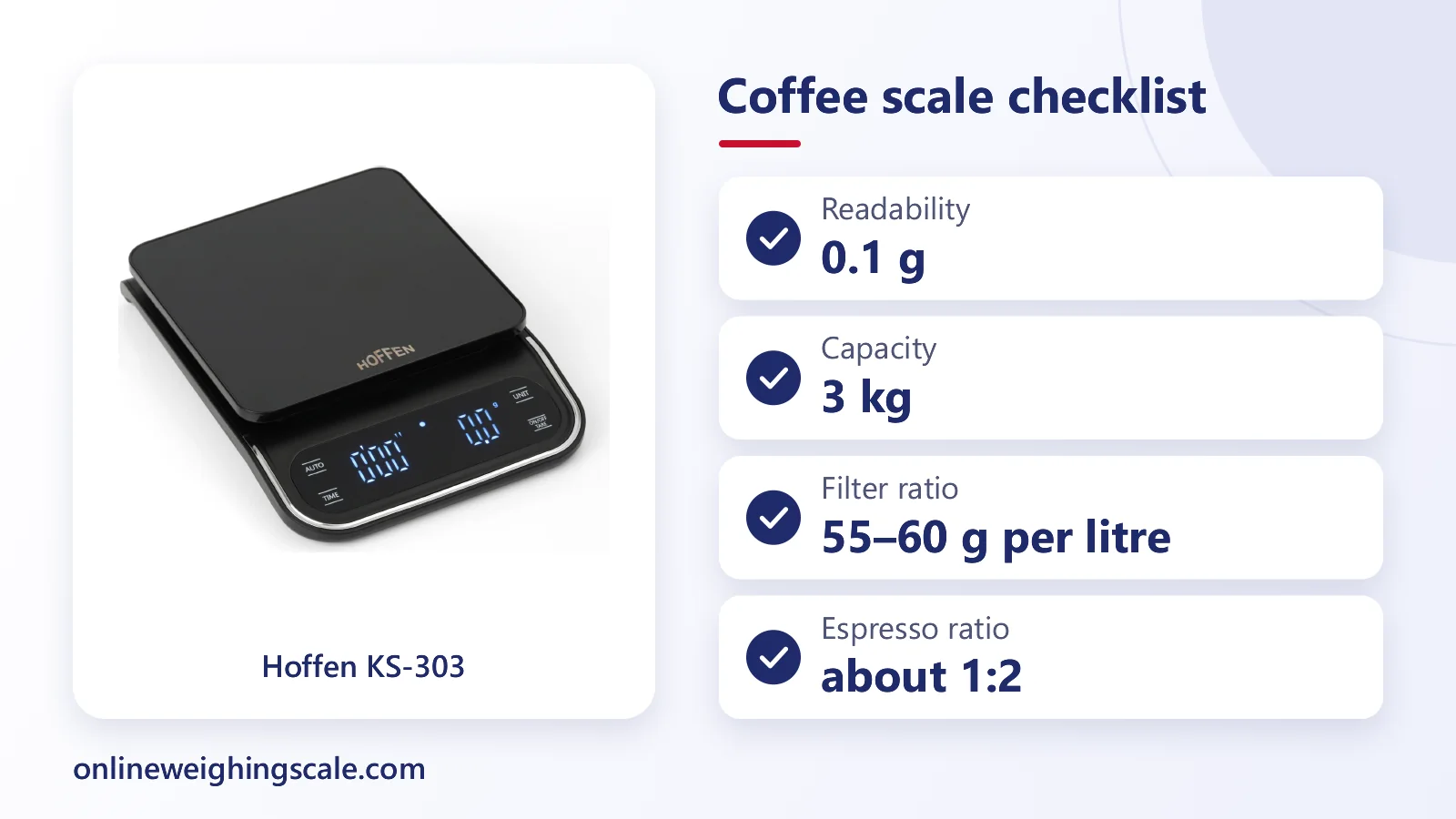
- Pour-over: a timer, 0.1 g readability and generous capacity. The SCA-102 standard gives 55 to 60 g of coffee per litre of water for filter brewing, which works out to about 14 to 15 g for 250 g of water.
- Espresso: 0.1 g readability matters most, plus a platform small enough that the cup fits under the portafilter. The SCA survey above found an average ratio of 1:2, so 18 g of coffee gives about 36 g in the cup.
- French press: the same 55 to 60 g per litre range applies. The timer is optional and capacity matters, because the pot is heavy when full.
- South Indian filter: a stronger decoction uses a smaller volume of water. The South Indian filter coffee guide covers the method, and a 0.1 g scale helps you repeat a decoction you liked.
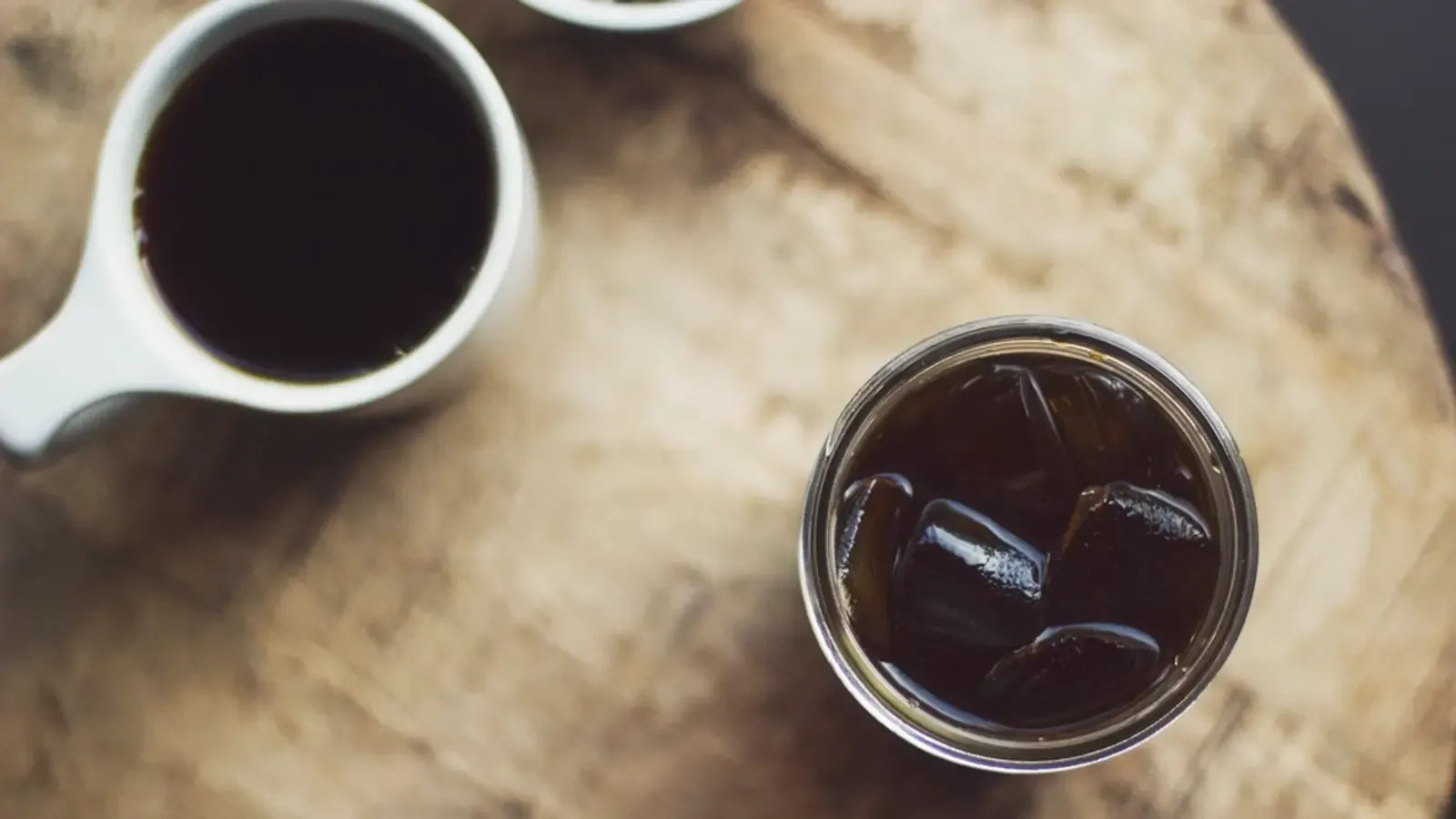
- Cold brew: the steep takes many hours, so a timer on the scale is not needed, but a large capacity is, because you weigh a litre or more of water. See the cold brew coffee guide for the ratio and steep time.
Comparison of the kinds of scale
| Kind of scale | Typical readability | Timer | Good for | Watch out for |
|---|---|---|---|---|
| Coffee scale with timer | 0.1 g | Built in | Pour-over, espresso, French press | Check platform size and how the timer starts |
| Basic kitchen scale | 1 g | Usually none | Baking, cold brew in bulk | Coarse steps hide small dose changes |
| Kitchen scale with 0.1 g display | 0.1 g | Sometimes | Pour-over with a phone timer | Capacity may be small |
| Pocket or jewellery scale | 0.01 g | None | Tiny test doses | Capacity too low for a dripper and water |
| Hanging, platform or shop scale | Much coarser | None | Selling beans by weight, bulk lots | Too coarse for a brew dose |
If you are weighing up the second row against the first, coffee scale vs kitchen scale sets out the differences in more detail. The readability column is a general guide, not a promise about any one product.
Who needs which
A home brewer who makes one pour-over or French press a day gets most of the benefit from a 0.1 g scale with a timer. A person who pulls espresso daily needs the same, plus a platform that fits under the portafilter. Someone who only makes kaapi in a steel filter can manage with a plain kitchen scale, though a 0.1 g one makes the decoction easier to repeat.
A small cafe or a roaster has an extra job: weighing green beans and roasted bags in bigger lots. The guide to coffee roasting explains why weight is tracked through a roast. A coffee scale handles small test batches, while a bench or platform scale handles sacks. If you sell beans by weight over the counter, you are using a scale for trade, which falls under Legal Metrology rules in India, and a home coffee scale is not the instrument for that. Omace shop, platform, chicken and crane scales leave Bagru verified and stamped by Legal Metrology, with a stamp valid across India.
The beans matter as much as the scale. Arabica and Robusta behave differently, and the types of coffee beans guide explains how Indian-grown coffee fits in. If you are still choosing between an espresso machine, a moka pot and a filter setup, read about coffee machine types and then pick a scale that fits it.
Two Omace coffee scales, side by side
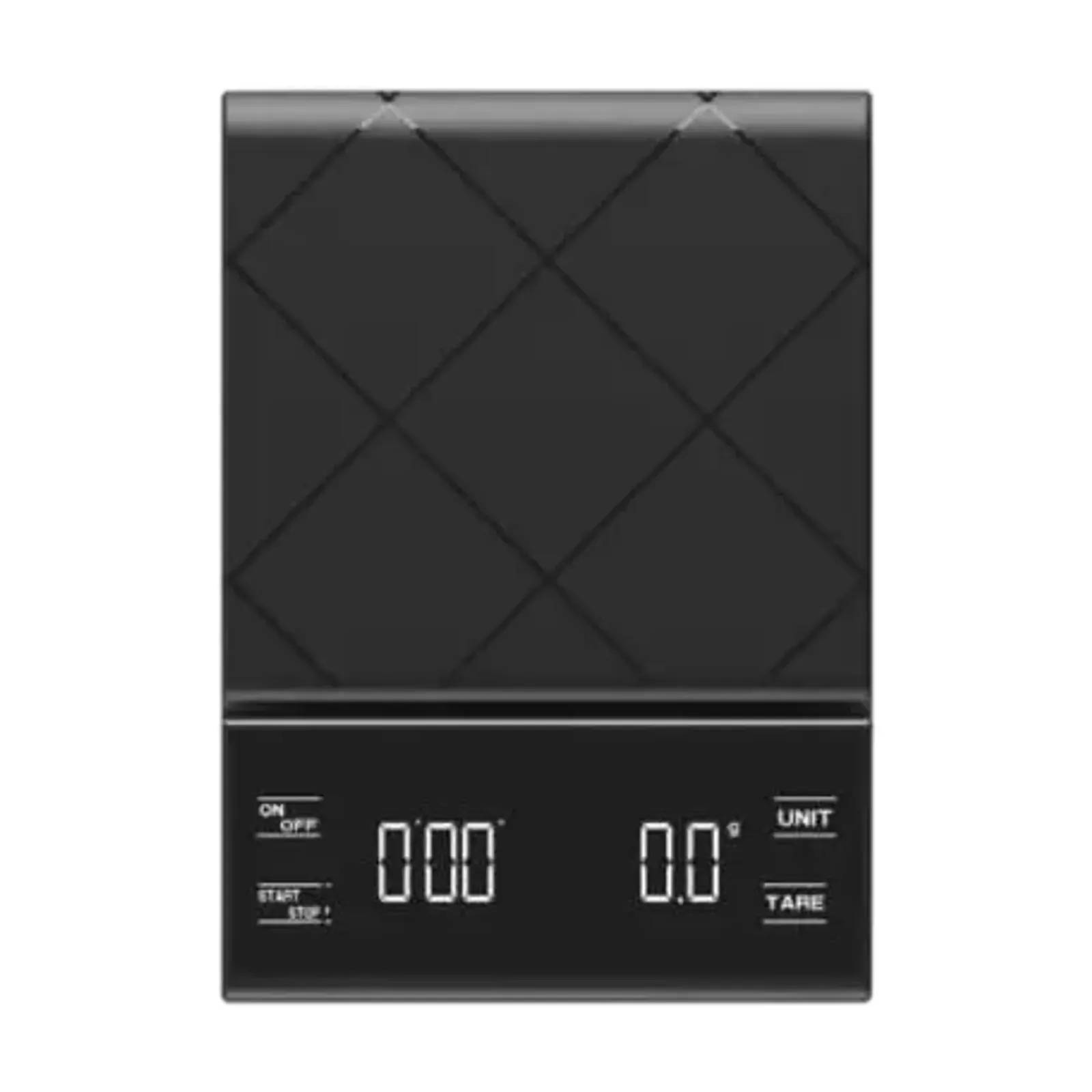
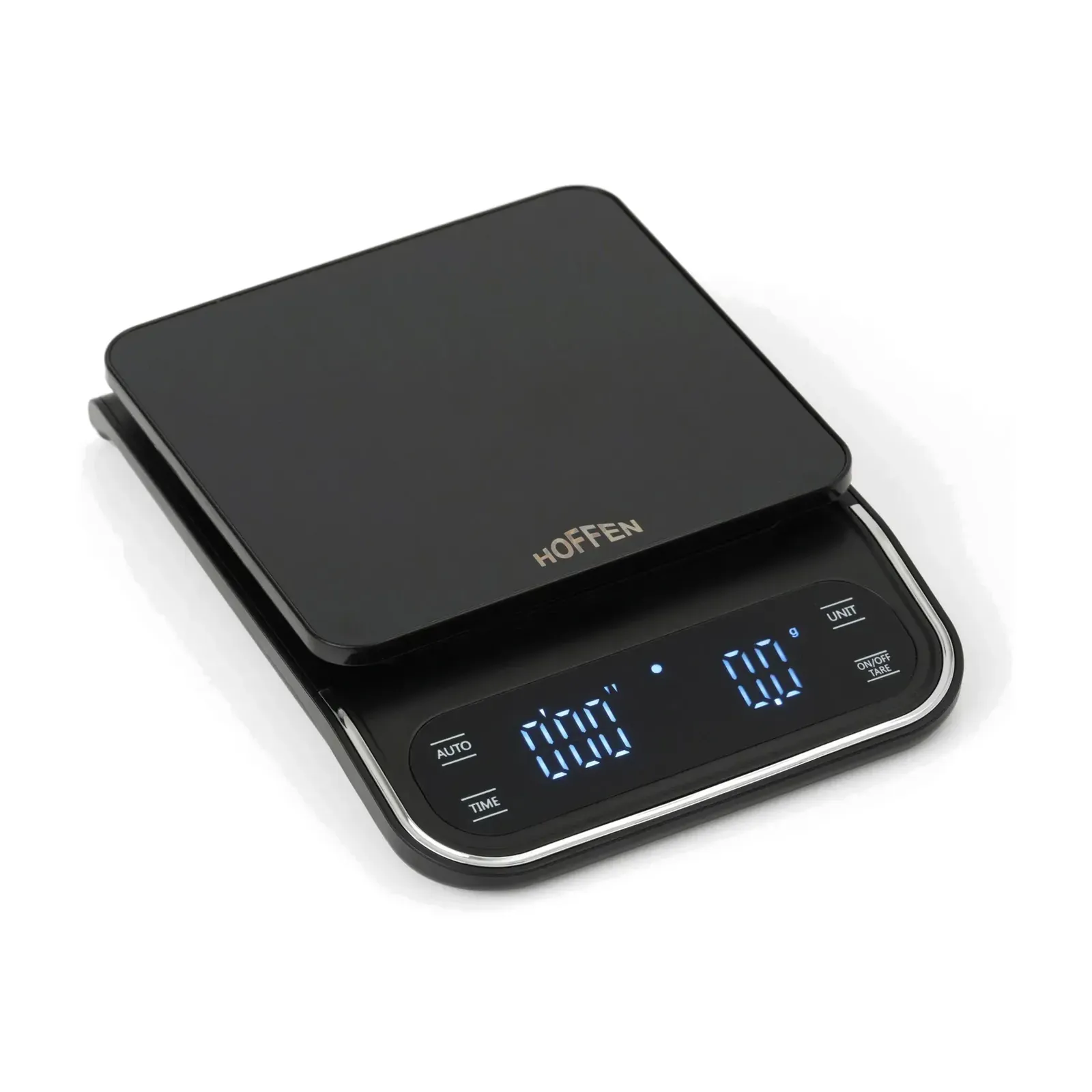
Omace Brands Private Limited sells two coffee scales under its Hoffen brand. Both read to 0.1 g, carry a 3 kg capacity, show weight and brew time together, and take three AAA batteries that come in the box. The full range is on the coffee scale page.
- The Hoffen KS-301 has an ABS body, a 125 × 120 mm platform with an anti-slip rubber mat, and shows g, oz and ml. Its timer counts up to 99 minutes 59 seconds. It weighs 340 g and costs ₹1575.
- The Hoffen KS-303 has touch-sensor keys and a 145 × 145 mm stainless steel platform that wipes clean. It adds lb to the units and costs ₹1785.
Both have tare, an overload indicator, a low-battery indicator and auto-off. The wider KS-303 platform suits a larger server, and the KS-301 mat suits a wet counter. Every Omace product carries a 2-year warranty on manufacturing defects.
Care and checks after you buy
Check a new scale with something you know the weight of. A sealed packet or a coin of known mass is fine for a home check, and the guide to checking weighing scale accuracy at home shows how. Repeat the same check every few weeks, and again after a drop.
If the figure is off, the way to correct it is described in the post on coffee scale calibration and the SCA Golden Cup standard. Every Omace digital scale opens calibration mode when TARE is held for about five seconds, and the scale is factory calibrated and replaced under warranty if it reads wrong.
Once the scale is in your kitchen, how to use a coffee scale walks through a pour-over, a French press and an espresso shot in order. Keep it on a flat counter, tare before each weighing, take the batteries out if you will not use it for months, and wipe it dry after each brew.
What to buy: a short checklist
Pick a scale with 0.1 g readability, at least 1 kg of capacity and preferably 3 kg, a timer if you brew pour-over or espresso, a platform that fits your server, a gram mode, auto-off and a low-battery indicator, and a wipeable surface. Skip any claim you cannot check on the product page, especially water resistance.