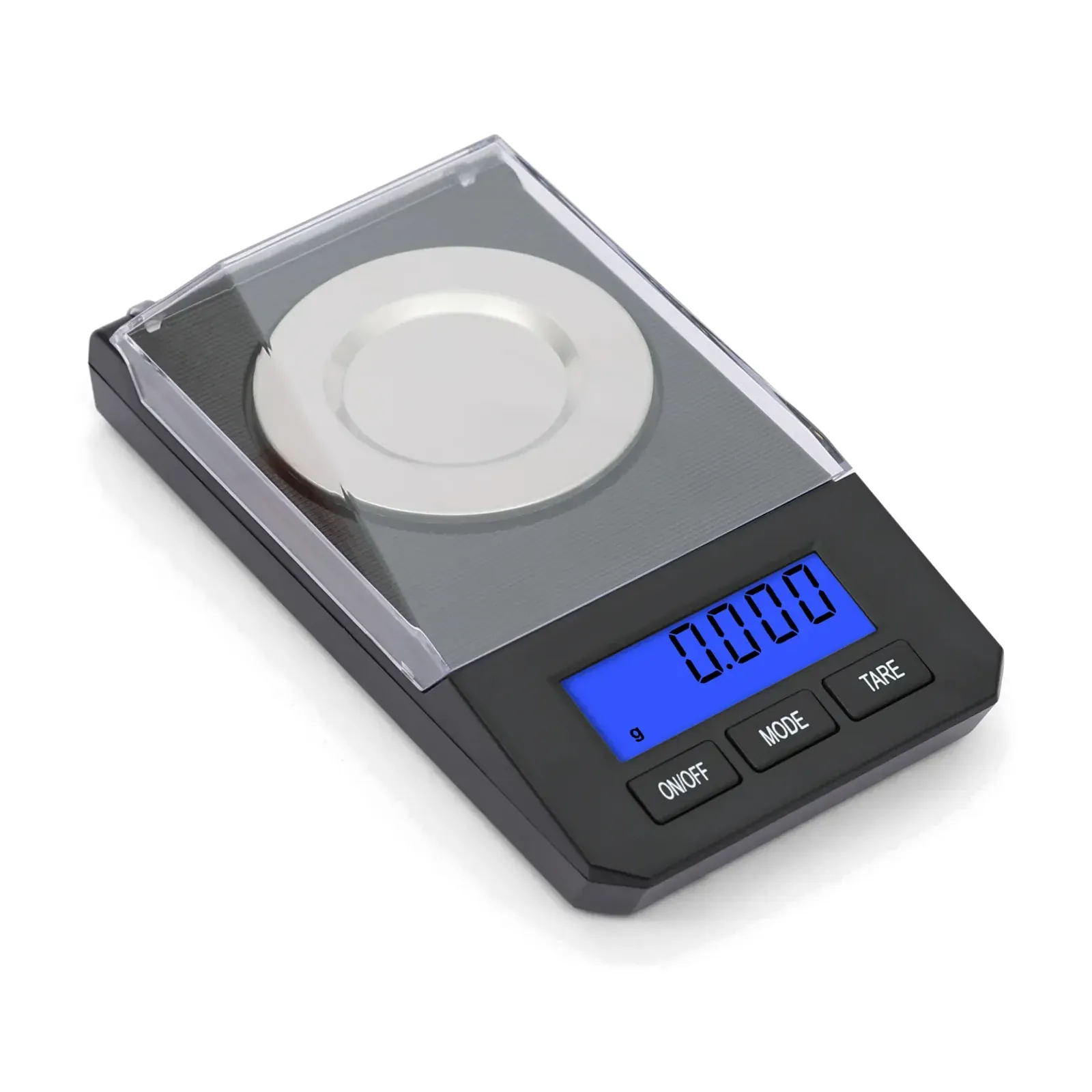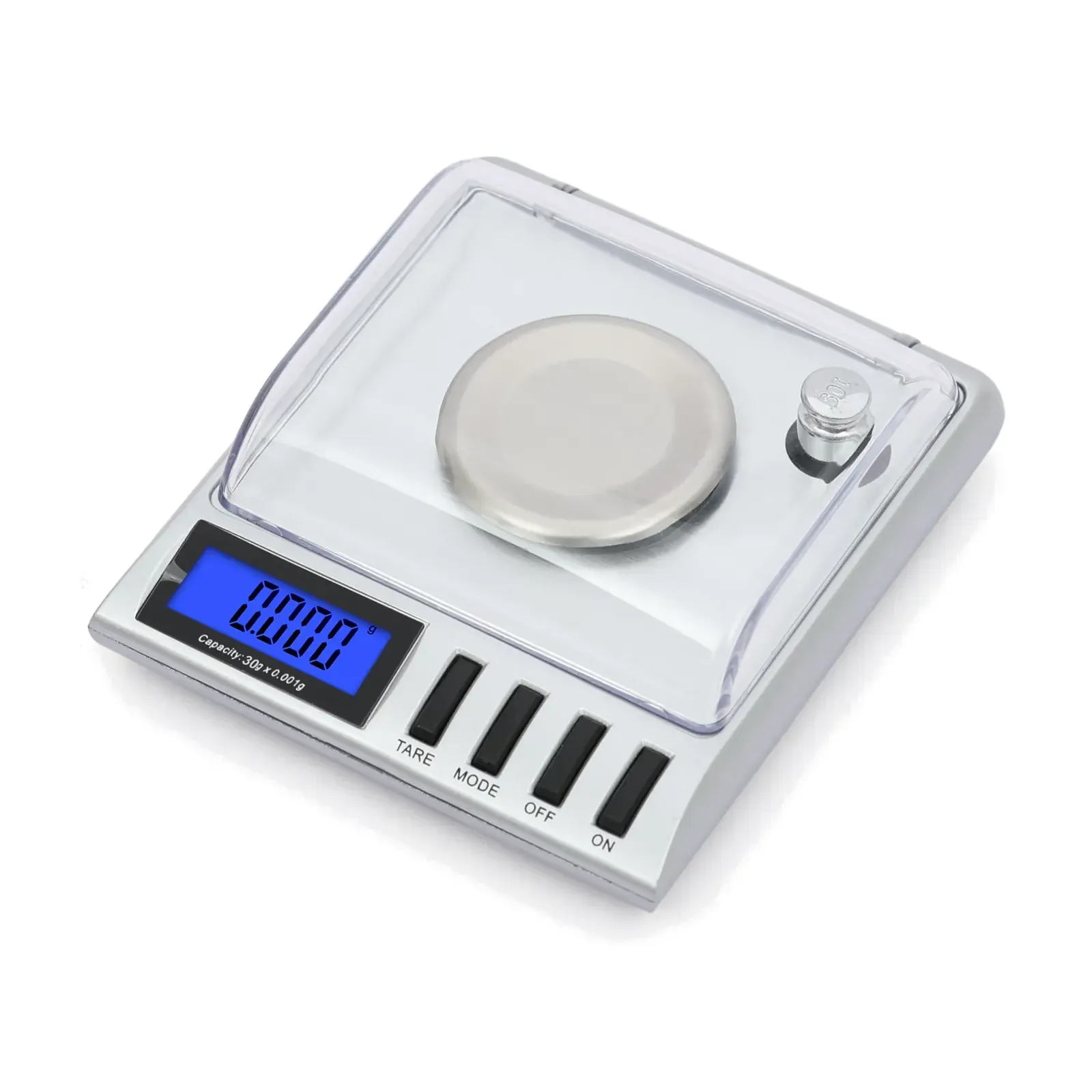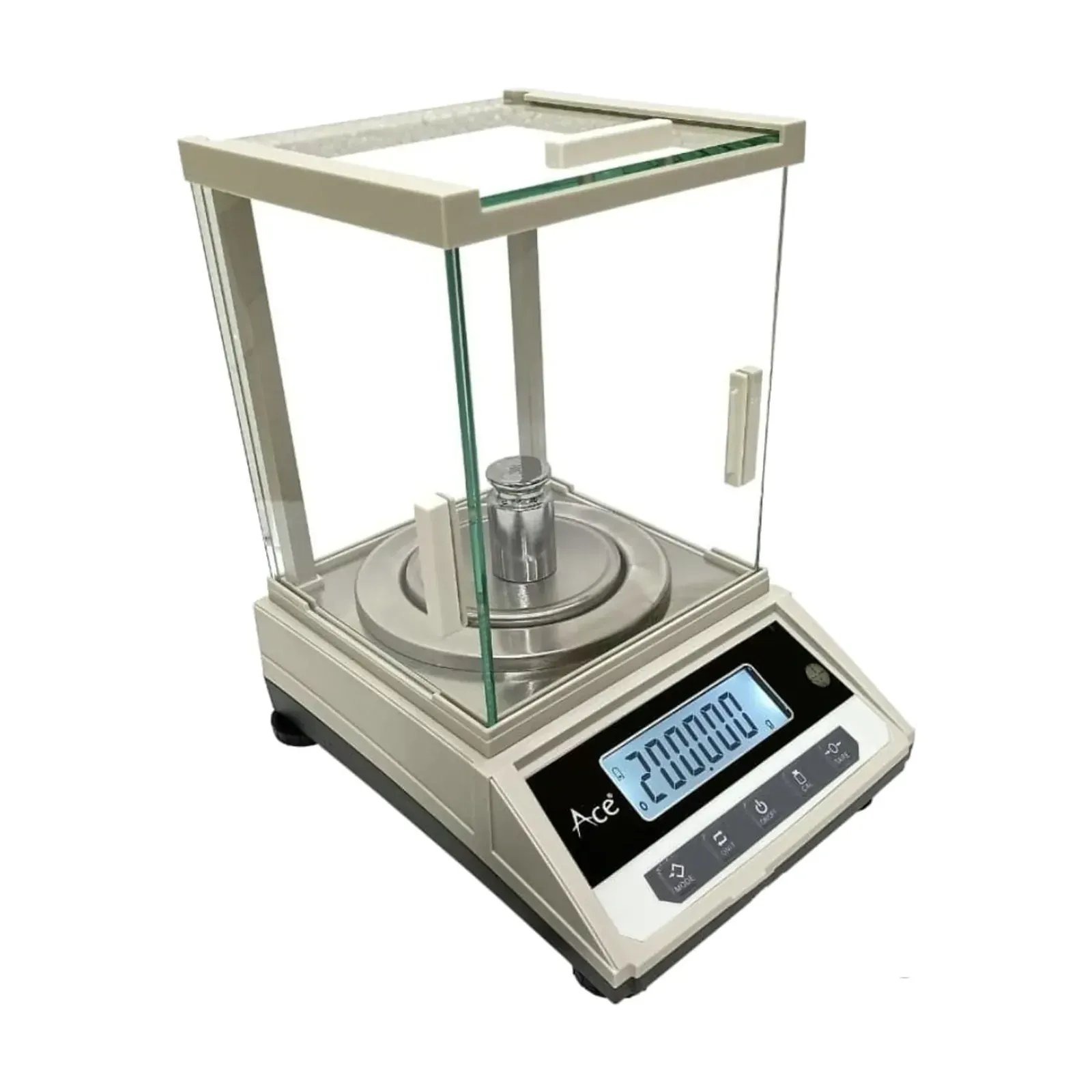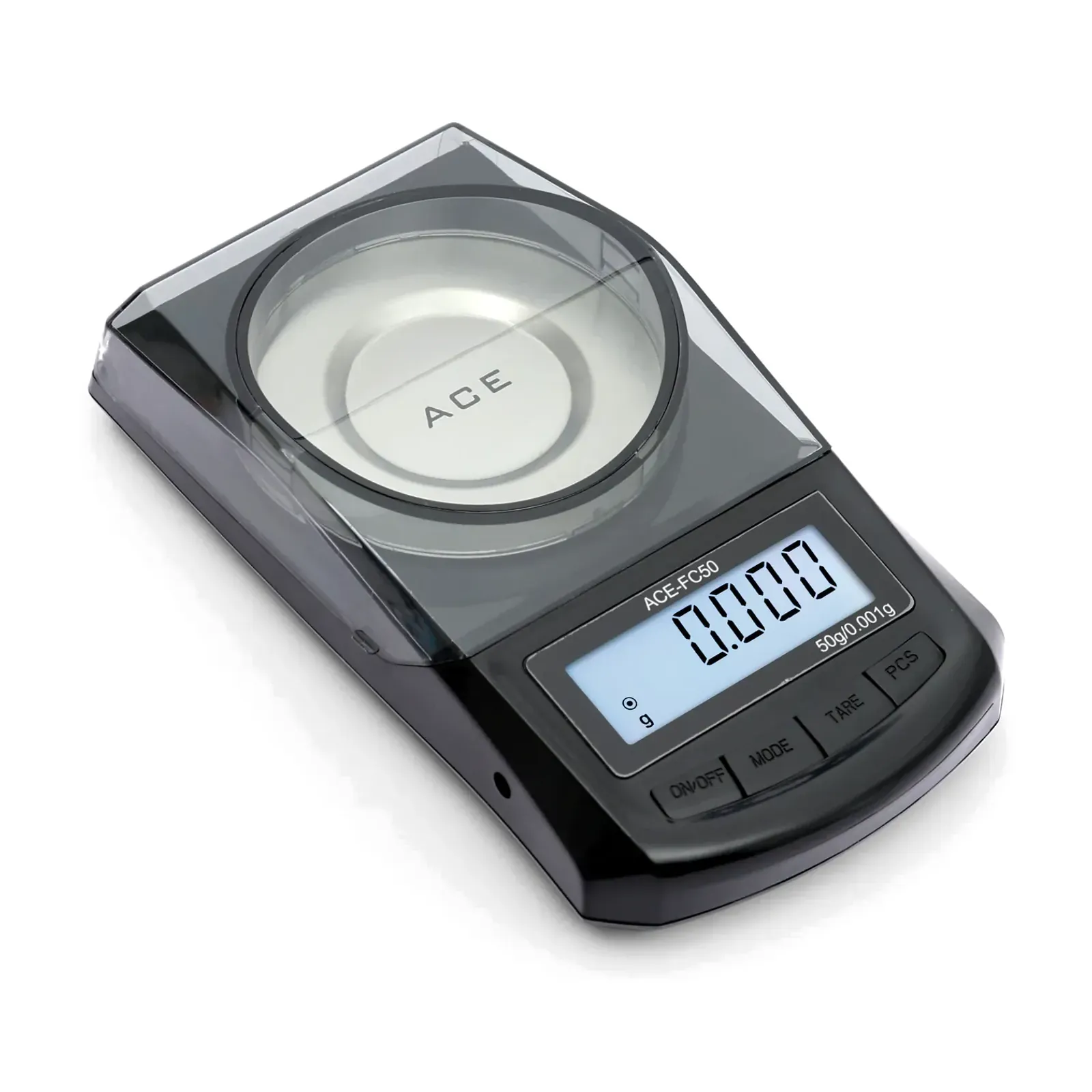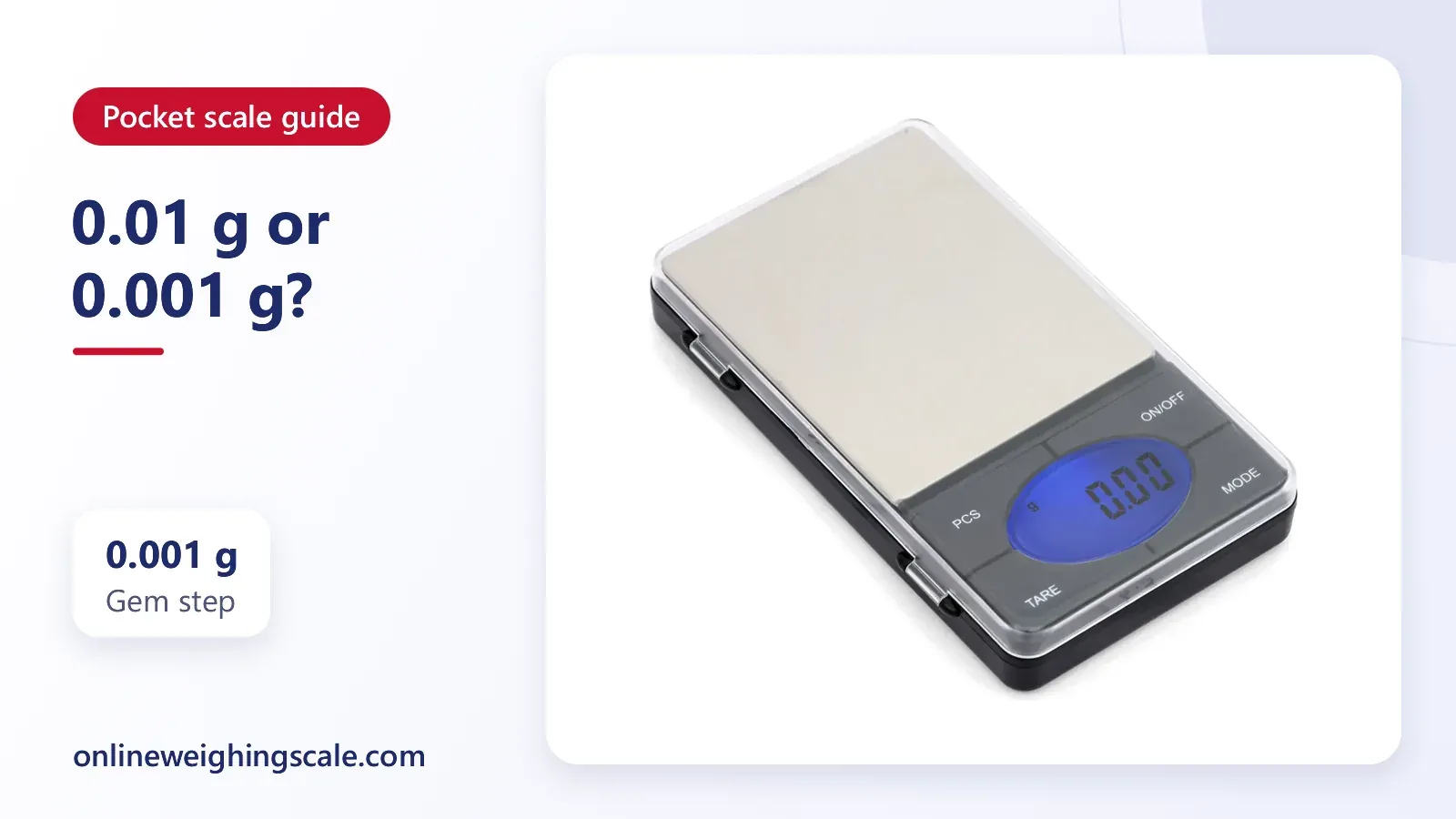
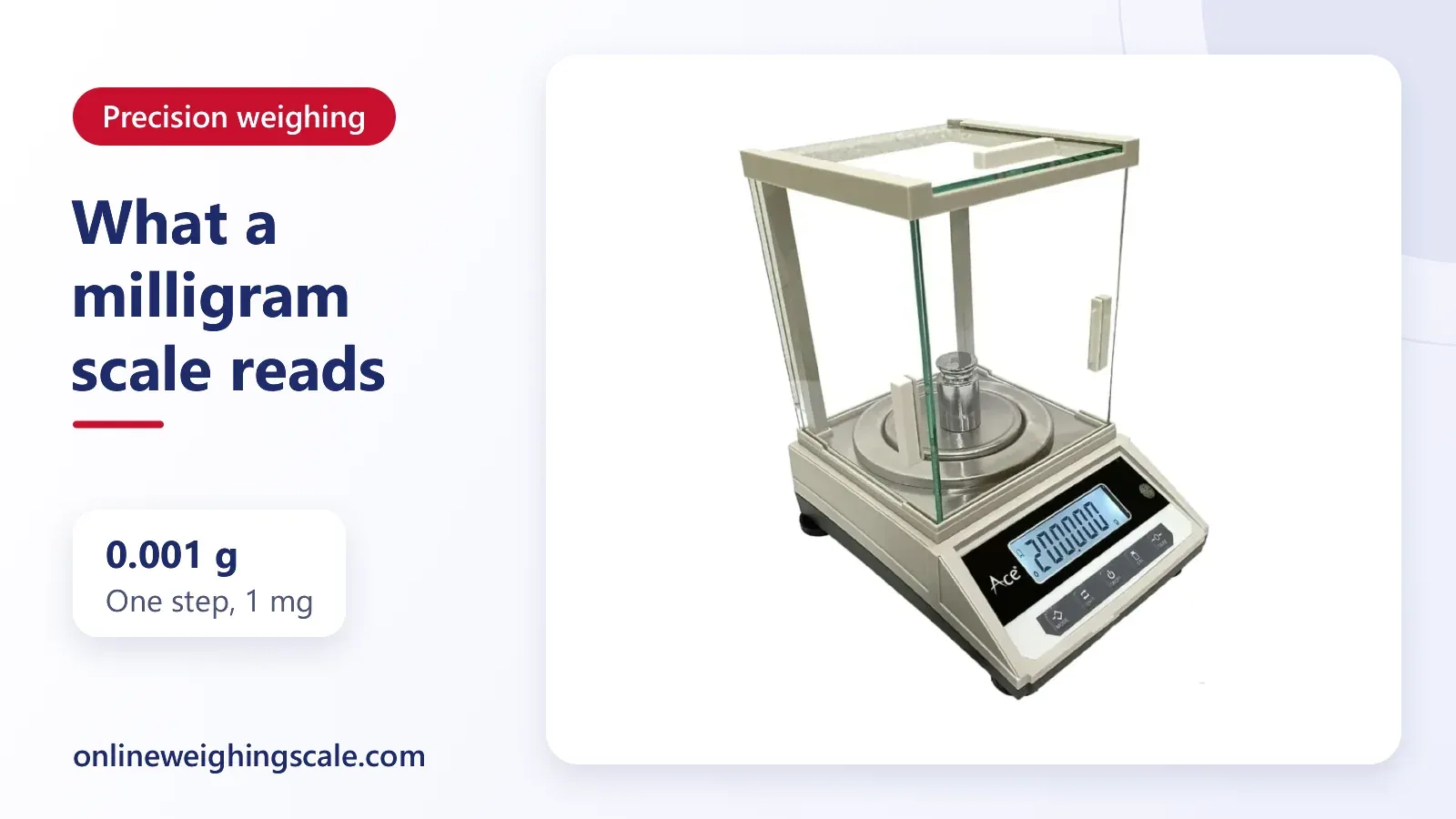
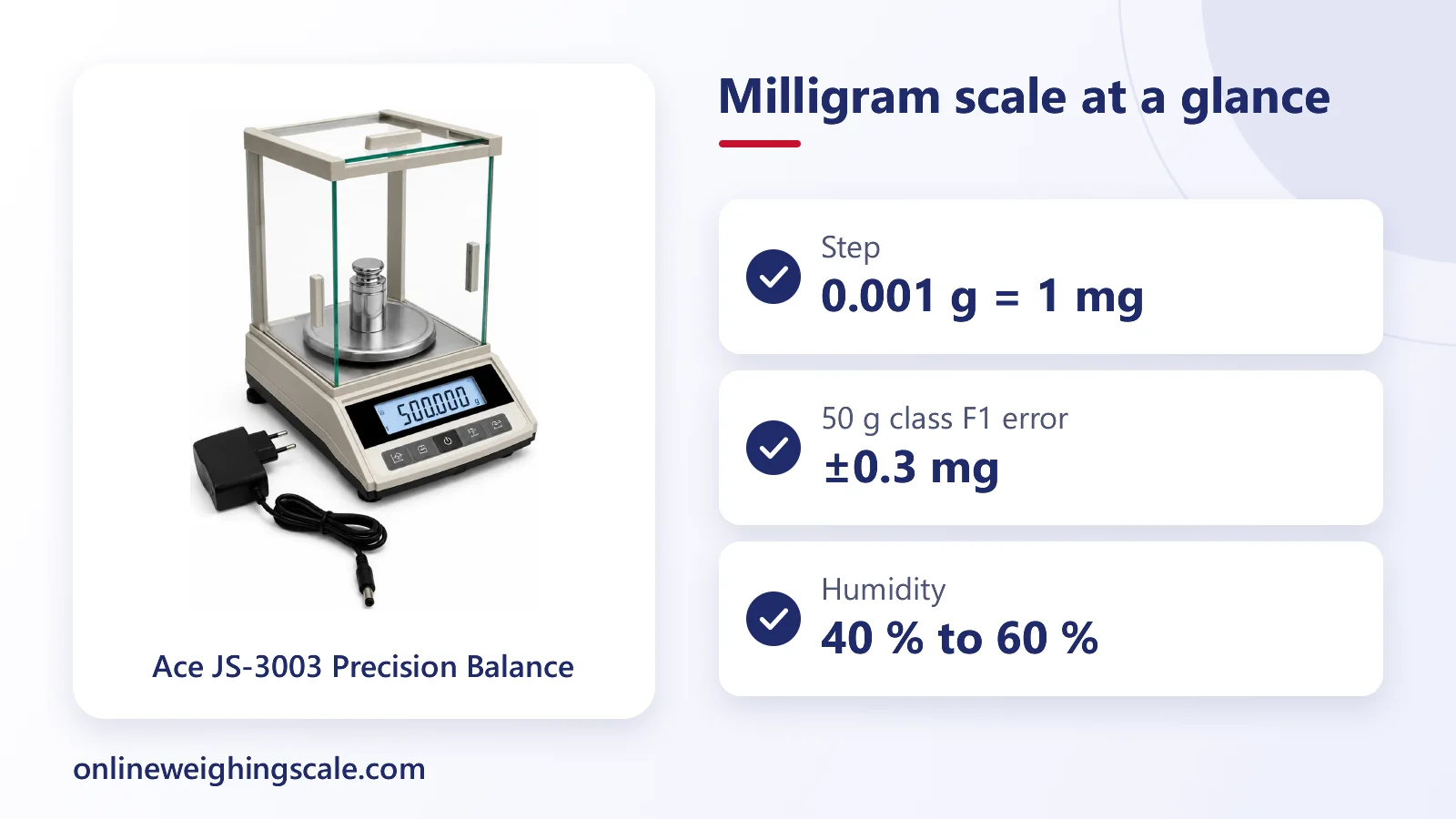
A milligram scale is a digital scale that shows weight to 0.001 g, which is one milligram, so 1,000 steps make one gram. That fine step is useful for gemstones, small jewellery parts, powders and lab samples, and it makes the scale fussy, because a draught or a tilted table can move the last digit.
What a milligram scale reads and what it does not
The number on the display is the readability, the smallest step the scale can show. A scale that reads 0.001 g can tell 10.000 g from 10.001 g. Readability does not promise that the figure is right. How close the reading is to the true mass depends on calibration, the room and how the scale is used. Accuracy vs precision explains the difference with scale examples.
The finer the step, the lower the capacity, because the same sensor has to resolve a smaller fraction of its range. The Omace models listed further down run from 50 g to 500 g. Omace Brands Private Limited sells the smaller ones in the pocket scale category and the larger ones with glass windshields among its jewellery weighing scale models.
Where a 0.001 g scale is used
Gemstone and diamond dealers use it for stones and loose parts. Goldsmiths weigh solder, small stones and findings on it. Laboratories and school science departments use it for reagents. Cosmetic makers and small compounding workshops weigh actives that go in at tiny doses, and hobbyists use it for tea samples, seeds, model parts and similar small lots.
A scale that is used to sell goods by weight falls under the Legal Metrology Act (see the Department of Consumer Affairs page), and a lab-style scale is a different thing from a verified trade scale. The post on Legal Metrology in India covers who verifies what.
Milligram scale vs pocket scale vs analytical balance
The three instruments differ in step size, enclosure and the room they need. This table compares them.
| Instrument | Reads to | Draft protection | Where it fits |
|---|---|---|---|
| Pocket scale | 0.01 g (10 mg) | Usually a lid only | Counter, spice and herb portions, rough gold and silver checks |
| Milligram scale | 0.001 g (1 mg) | Clear windshield on the Omace models below | Gemstones, small samples, workshop and teaching lab |
| Analytical balance | 0.0001 g (0.1 mg) | Enclosed glass chamber | Quality labs, formulation and research |
A milligram scale sits one decimal place finer than a 0.01 g pocket scale, and the pocket scale vs bench scale post helps with that choice. One decimal place finer again sits the analytical balance, covered in Analytical Balance: Meaning, Principle, Parts and Use. If a task needs 0.0001 g, a milligram scale will not do it, whatever the display shows.
Why a draft shield, a level and a warm-up matter
At 1 mg, moving air shows up on the display. The US National Institute of Standards and Technology lists balance drift, air currents, lack of thermal equilibrium, and electrostatic and magnetic fields as sources of error in its good measurement practice for weighing operations. Each has a cheap remedy at a bench.
- Windshield. Keep the clear cover closed while reading. NIST says the balance must stand in an area free from air currents and away from heating and cooling vents, so a fan or air conditioner blowing at the pan will spoil the last digit.
- Level. Set the feet until the bubble sits in the circle, if the scale has a level indicator. A tilted pan can read differently from a level one.
- Warm-up. NIST says repeatability improves once a balance has been warmed up and exercised with a load before readings are taken, and that the maker's own warm-up period matters too. Switch on and let it settle before you start.
- Temperature. For high-precision work NIST asks for no more than ±1 °C change in 24 hours. A sunny window or a torch nearby works against that.
- Humidity and static. NIST recommends relative humidity of 40 % to 60 %, the limits most balance makers give, and says that below 40 % electrostatic discharge can cause erratic readings. Plastic containers can hold a charge, so a plastic weighing boat may read oddly on a dry day.
- Handling. Place the sample gently at the centre of the pan and use tweezers or a spoon instead of fingers.
A steady table helps too. Concrete or a heavy slab beats a wobbly shop counter, and nobody should lean on it while you read.
How to check a milligram scale with a small test weight
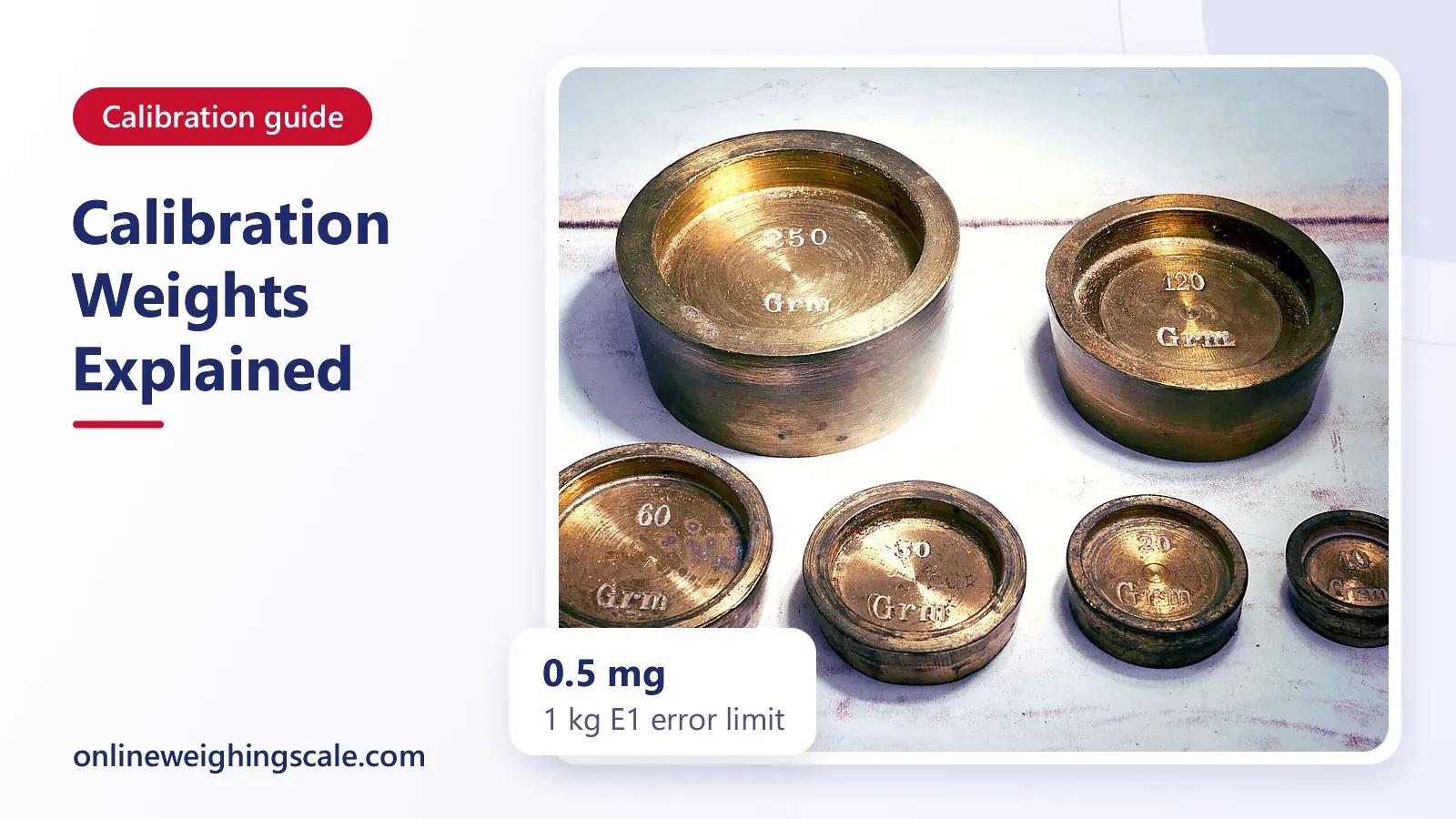
Checking is quick when you have a certified weight. The standard that classifies weights for this job is OIML R 111-1, the recommendation of the International Organization of Legal Metrology. It names classes from E1 (finest) through E2, F1 and F2 to M1 and coarser, and gives a maximum permissible error for each nominal value.
The class you buy should have an error well below one step of your scale. Table 1 of R 111-1 gives these limits, in milligrams, for 50 g, 20 g and 1 g weights.
| Nominal weight | Class E2 | Class F1 | Class F2 |
|---|---|---|---|
| 50 g | ±0.10 mg | ±0.3 mg | ±1.0 mg |
| 20 g | ±0.08 mg | ±0.25 mg | ±0.8 mg |
| 1 g | ±0.03 mg | ±0.10 mg | ±0.3 mg |
A 50 g class F2 weight may itself be out by 1.0 mg, which is one full step on a 0.001 g scale. That weight cannot tell you whether the scale is right to the last digit. A class F1 or E2 weight keeps the error inside a fraction of a step, so choose F1 or finer for a scale with 0.001 g steps. Keep the weight in its box and lift it with tweezers.
The steps follow the general method in How to Calibrate a Pocket Scale and Check It With Coins, with the milligram precautions above.
- Place the scale on a steady table, away from vents, and level it.
- Switch on and allow it to warm up. Close the windshield.
- Press the zero or tare key with the pan empty and wait for 0.000 g.
- Place the test weight in the centre. Wait until the display stops changing and note the figure.
- Remove the weight, confirm the display returns to zero, and repeat three to five times.
- Compare. If the readings agree with each other but sit away from the weight's marked value by more than a step or two, the scale needs calibration. If the readings wander, look for draughts, static or an unlevel table first.
On Omace digital scales a long press of TARE opens calibration mode on some models and a long press of the M key on others, and the manual for each model shows which. Use the calibration weight named on the product page of your model. What Is Calibration? covers when a scale needs a certificate rather than a home check.
Omace models that read 0.001 g
The product pages carry the exact capacity, windshield and included accessories. These are the models whose names show a 0.001 g step.
- Ace FN-50 Milligram Scale: 50 g × 0.001 g, clear windshield, 65 mm pan, 6 units, ₹2099.
- Ace FC-50 0.001g Scale: 50 g capacity, round windshield, counting key, ₹4719.
- Ace GM-50 Carat Scale: 50 g × 0.001 g, windshield, tweezer, dish and calibration weights, ₹2729.
- Ace CT-50 Diamond Weighing Scale: 50 g × 0.001 g, windshield, calibration weights, ₹4719.
- Ace JS-3003 Precision Weighing Balance: 300 g × 0.001 g, glass windshield, ₹27258.
- Ace CY-2003 Lab Weighing Balance: 200 g × 0.001 g, glass windshield, ₹27299.
- Ace JS-5003 Electronic Balance: 500 g × 0.001 g, glass windshield, ₹33453.
Prices include GST and were checked on 20 November 2026. Every scale is checked with certified test weights before dispatch, as the tested before dispatch page explains. Omace Brands Private Limited has made scales in Bagru, Jaipur since 1994 (about Omace), and its balances read 0.001 g at best. Buyers who need 0.0001 g should look at an analytical balance from a laboratory supplier.
Choosing the capacity and caring for the scale
Pick a capacity that covers the heaviest item you expect, without going far above it. A 50 g scale suits a 0.5 g stone and a 20 g sample alike. Check that the pan is wide enough for the container you use. Look for a tare key for weighing boats, a counting key for beads or tablets, and a unit list that includes carats if you work with stones.
Wipe the pan with a dry, lint-free cloth. Keep liquids and magnets away, since NIST also lists magnetic fields among error sources. Do not drop objects on the pan or load it above its capacity. Store the weights and the scale in their cases, and recheck the scale after a move, after a fall and at fixed intervals if you use it daily.