A weighing scale for a warehouse is picked by the heaviest single unit you handle, often a sack or drum of 100 to 500 kg. A godown usually ends up with three scales, each doing one job: a platform kanta at the receiving bay, a table-top scale for cartons and loose items, and a hanging scale for loads that arrive on a hook.
This guide explains how to match a scale to what comes through your doors, how big the platform should be, how to count stock by weight, and what to ask about battery, ramps and records. Omace Brands Private Limited makes platform, table-top and crane scales in Bagru, Jaipur, so the models named here come from its own range.
Start with the heaviest unit, not the stock total
A warehouse holds tonnes of goods, but a scale never weighs the tonnes. It weighs one sack, one carton, one drum or one pallet-load at a time. List the heaviest single unit that crosses your dock on a normal day, then add a margin for the odd heavy one. That number sets the capacity you need.
Capacity is only half the choice. The smallest step the display shows (the scale interval) decides how finely you can tell two sacks apart. A platform with a 100 g step is fine for 50 kg bags of grain. The same step is useless for 2 kg cartons of spices. The sensible answer for a busy godown is two scales, one big and coarse, one small and fine.
Weight in a warehouse is read by a load cell, a force transducer that turns the force of the load into an electrical signal (peer-reviewed paper in the journal Sensors, 2022). If you want to know what sits under your platform, the post on what a load cell is explains it.
Which scale for which load
| What you weigh | Scale type | Omace model |
|---|---|---|
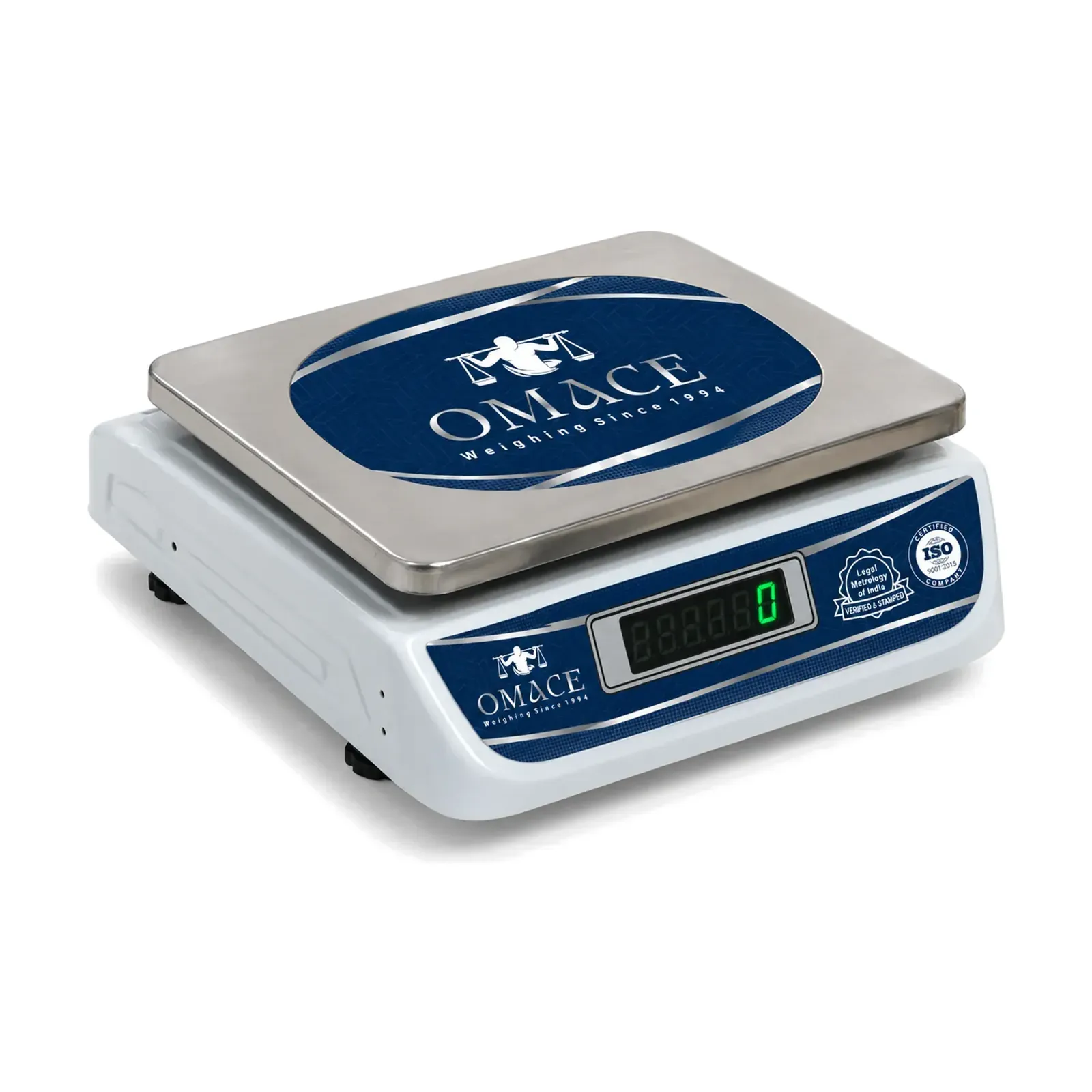
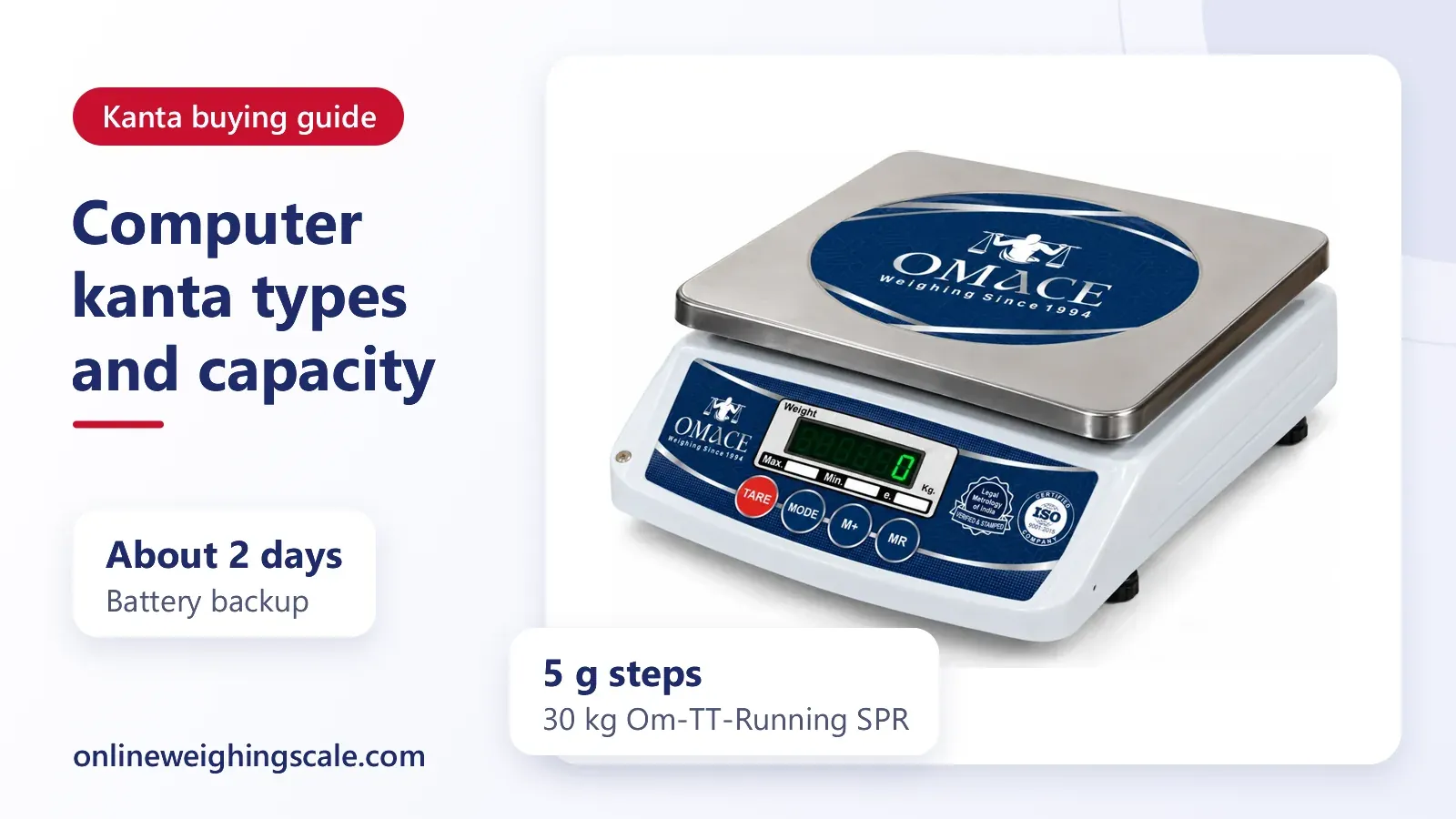
| Small cartons, parts, bags up to about 30 kg | Table-top digital scale | Om-TT-Running SPR 30 kg, Ace KN 10 kg with piece counting |
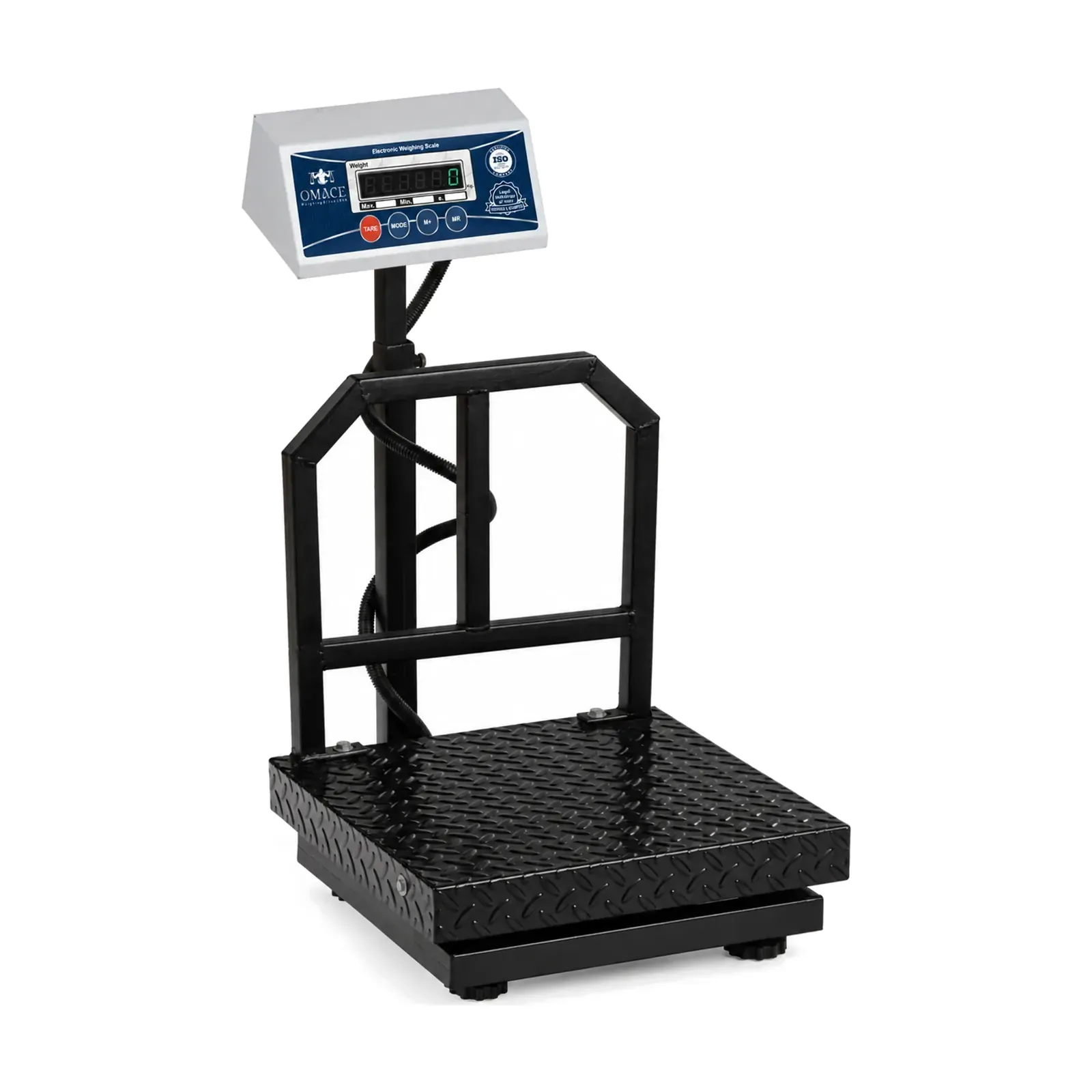
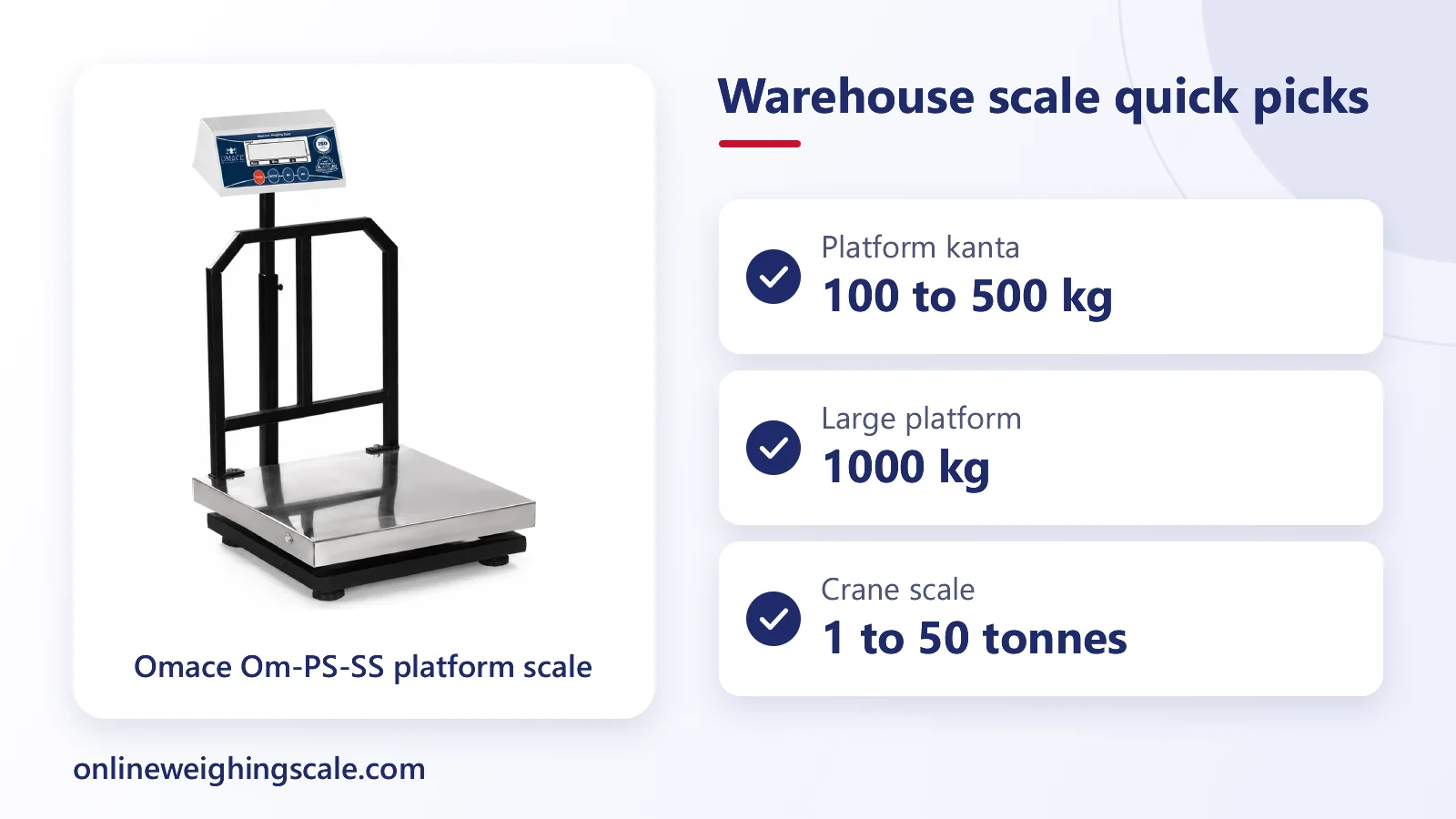
| Sacks, drums, cartons from 50 kg to 500 kg | Platform kanta | Om-PS-MS platform kanta, 100 to 500 kg |
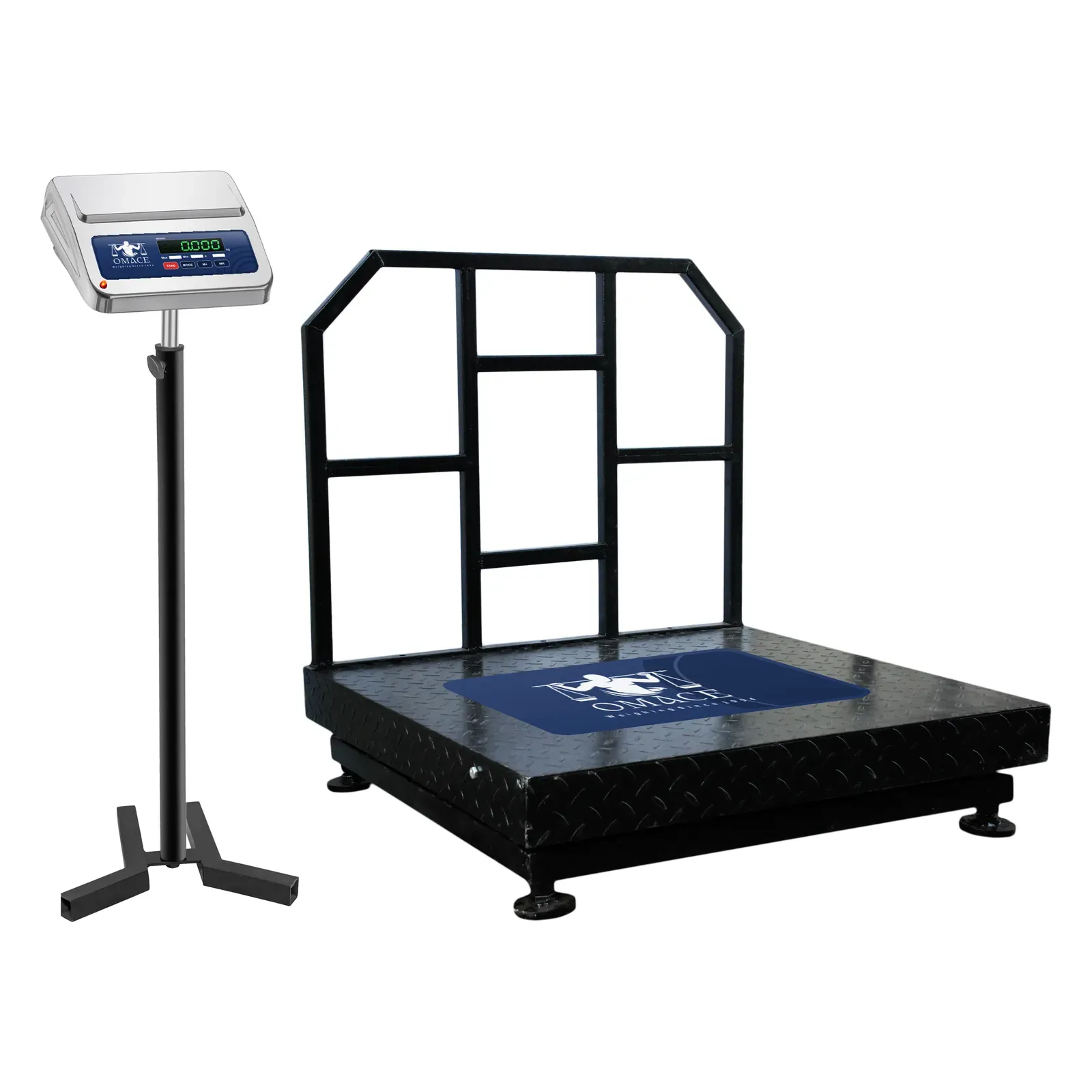
| Stacked goods or a loaded pallet around 1 tonne | Large platform scale | Om-PS-MS 1000 kg platform scale |
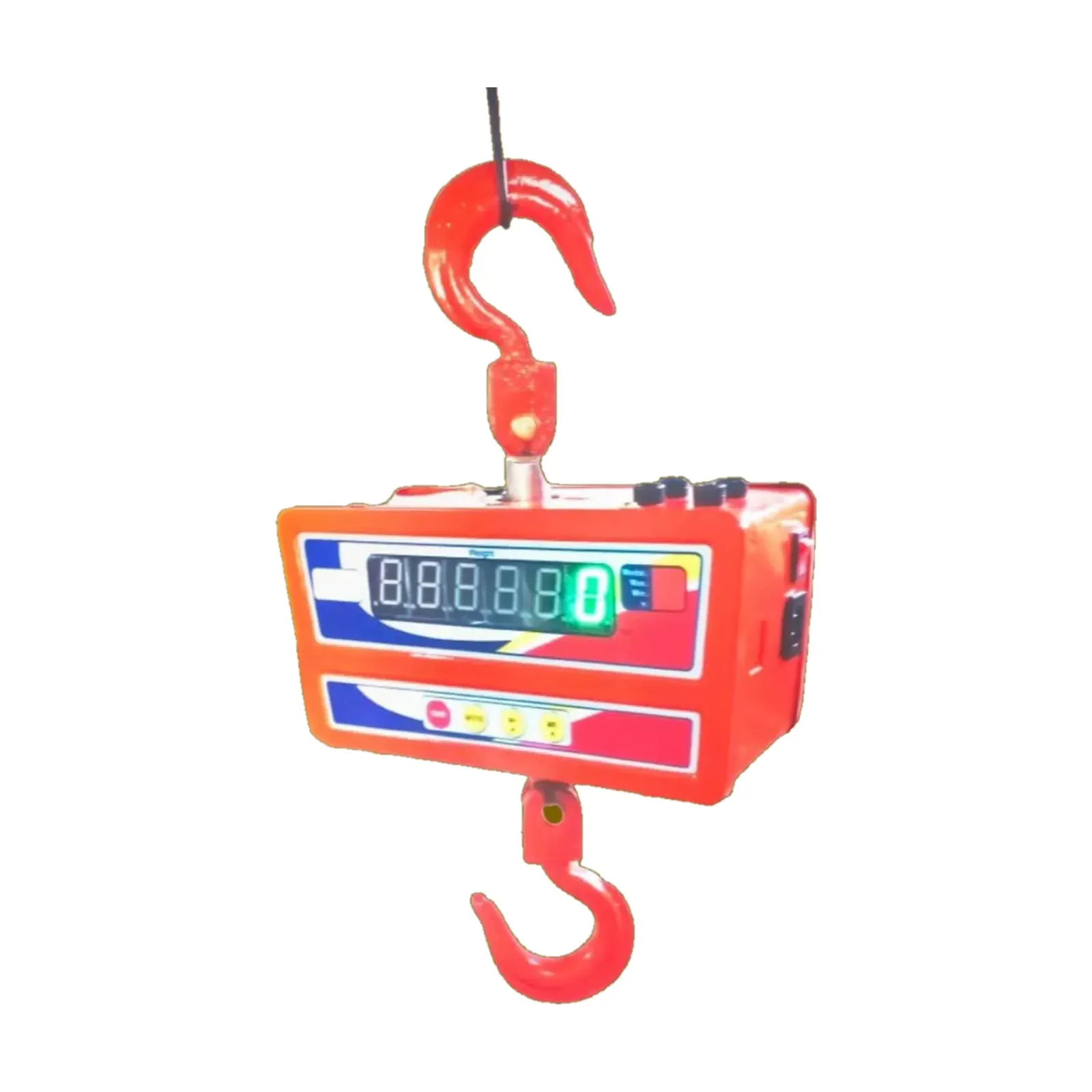
| Loads lifted by hoist, chain block or crane | Crane scale | Omace 500 kg crane scale, OCS crane scale 1 to 50 tonnes |
| Bundles and coils on a hook, up to 50 kg | Hanging scale | Omace 50 kg digital hanging scale |
Table-top scales for cartons and loose stock
Most e-commerce and spare-parts godowns weigh many small items. A table-top scale on a packing bench is faster than lifting each carton onto the floor platform. The Omace Om-TT-Running SPR 30 kg weight machine reads in 5 g steps and costs ₹3,150 today. The Ace KN 10 kg weighing scale has a piece-counting function and is listed at ₹4,199. For the choice between a bench and a pocket-size scale, see pocket scale vs bench scale.
Platform kanta for sacks, drums and big cartons
A platform scale lets you roll or lift a load onto a flat steel deck and read the weight from a separate indicator. The Omace Om-PS-MS platform kanta comes in 100 to 500 kg and starts at ₹6,300. The category page for platform weighing scales lists the stainless steel version too, which suits damp or food-grade stores. For loads near a tonne, the Omace 1000 kg platform scale is listed at ₹28,349.
Crane and hanging scales for lifted loads
If goods already move on a hoist or chain pulley, weigh them in the air and skip the floor scale. The Omace 500 kg crane scale is listed at ₹9,999, and the OCS crane scale covers 1 to 50 tonnes from ₹11,549. Omace Brands Private Limited builds OCS units from 1 to 50 tonnes, with the 40 and 50 tonne sizes made on the buyer's request. For lighter hanging loads, the 50 kg digital hanging scale costs ₹3,459.
Platform size against carton size
A platform that is too small makes the load overhang, and overhang is where wrong readings start. Sit the load fully inside the deck, with the weight centred rather than pushed to one edge. Measure your biggest carton or sack footprint, then pick a platform clearly larger than it, with a hand's width spare on each side. The Om-PS-MS platform kanta has a 400 × 400 mm deck at 100 kg and 500 × 500 mm at 200 kg, and the 300 kg and 500 kg models have a 600 × 600 mm deck. The 1000 kg platform scale comes with a 750 × 750 mm or 900 × 900 mm deck. Check these against your largest unit before you order.
Sacks are soft and spread out, so a 50 kg bag takes more floor than its weight suggests. Drums are the opposite: small footprint, heavy, and they can rock if the deck has a lip. Bring one real drum or bag to compare against the listed deck size when you are unsure.
Ask where the indicator will stand. A display fixed on a column at eye level saves bending and cuts wrong readings from the loader. A display on a long cable lets the clerk stand away from forklift traffic.
Counting by weight for stock-taking
Counting thousands of small items by hand is slow, and mistakes creep in. Counting by weight is quicker: weigh a known number of pieces, let the scale work out the weight of one piece, then weigh the whole tray or bin and read the piece count. A sample of 10 pieces weighing 250 g gives 25 g a piece. A bin that weighs 12.5 kg then holds about 500 pieces.
The method works well when the pieces are alike. It struggles when the pieces vary in weight, when the scale step is large compared with one piece, or when the bin and liners differ each time. Use a bigger sample for more even counts, and always tare the empty container first. The full method, with sample sizes and checks, is in the post on counting scales.
Battery or mains power
Many godown scales run on a rechargeable battery with a mains charger, which is useful when the scale moves between bays or when a socket is far away. The Om-PS-MS platform kanta plugs into a 220 V socket and has a built-in battery backup of about 2 days, so it keeps weighing through a power cut. Mains-only scales stay at one fixed spot, such as a weighing counter. Before you buy, ask how long the battery lasts on one charge and whether you can run the scale while charging. Keep the charger in a fixed place and plug it in at the end of every shift, because a flat battery stops dispatch at the worst time.
Trolleys, ramps and floors
A platform scale is only as good as the floor beneath it. Put it on firm, level concrete away from the dock edge. A scale rocking on an uneven floor reads differently each time, so level it with its feet before each use, and check for loose debris under the platform.
A low ramp helps when you roll drums or trolleys onto the deck. Keep the approach straight and the deck clear, and avoid driving a loaded trolley fast onto the platform, because shock loads can disturb the load cells. Weigh the trolley empty once, tare it, and note its weight so staff do not forget to deduct it.
Omace lists table-top, platform and crane scales. It does not list a forklift scale or a weighbridge, so do not drive a forklift onto a platform kanta. For pallets and loads up to 1 ton, use the 1000 kg platform scale. A weighbridge for truck loads is a different, fixed installation, explained in the post on the weighbridge.
Legal stamping when you buy or sell by weight
If the weight on your scale decides what a customer, supplier or transporter pays, the scale is used in trade. Section 24 of the Legal Metrology Act, 2009 requires anyone who holds a weight or measure that is, or is likely to be, used in a transaction to have it verified before using it, and section 33 fines the use of an unverified one. Omace shop, platform and crane scales leave Bagru verified and stamped by Legal Metrology, and the stamp is valid across India. Stamping is compulsory on platform and crane scales.
Whether a scale used only for internal stock-taking needs the stamp is a question for your state's Legal Metrology office. The posts on legal metrology in India and stamping charges cover the detail. A stamped trade scale is sealed, so a registered repairer recalibrates it, not the user.
Records and day-to-day checks
A scale in a warehouse is a money tool, so treat its readings as records. Write the date, item, gross weight, tare, net weight and the clerk's initials in a register or a sheet. For goods that cross the dock both ways, keep inward and outward entries in separate columns so the stock sheet balances against the scale.
Run a quick check at the start of each shift with a known weight, such as a certified test weight or a sealed bag you have weighed once and keep for this purpose. If the reading drifts, stop and look at the floor, the battery and the platform before blaming the scale. The post on a weighing scale not working lists the common causes. On Omace digital scales a long press of TARE opens calibration mode on some models and a long press of the M key on others, and the manual for each model shows which, except stamped trade scales, which are sealed. Omace Brands Private Limited checks every scale with certified test weights before dispatch. The calibration guide explains how to check one.
Repair and spare parts
Omace Brands Private Limited repairs its commercial scales when the buyer asks. The buyer pays the shipping both ways and the repair cost. Spare parts depend on availability, so ask first through the contact page before you send anything.
What to ask before you buy for a godown
- What is the heaviest single unit, and does the capacity cover it with margin?
- How large is your biggest carton or sack footprint against the deck size?
- Does it need a stamp because weight sets a price?
- Do you need a battery, and how long should it last on one charge?
- Will counting by weight save time on small parts?
For a broader checklist across industries, read how to choose an industrial weighing scale. For bulk orders for several godowns, the dealer and bulk order page is the place to start.